By Nose
The perfume of pasta and the memory of wheat
Apr 27, 2026
By Nose
The perfume of pasta and the memory of wheat
Apr 27, 2026
By Nose
The perfume of pasta and the memory of wheat
Apr 27, 2026
There are gifts that are not perceived at first glance. They do not reside upon the surface, nor do they commend themselves to the eye with the vibration of color, nor to the fingertips with the roughness of the die. Certain virtues demand silence, proximity, and devotion. They come to pass 'by the nose', through the most archaic and mysterious of senses: olfaction.
Opening a package of pasta should be, even before a domestic gesture, a small ritual of verification. Fine pasta does not intrude; it does not perfume itself like a creation crafted solely to seduce. It has no need for ostentatious fragrances. Yet, if the semolina is pristine, if the grain has been chosen with reverence, if the milling has not impoverished its substance and the drying has not scorched its memory, something arrives: a faint, dry, clean scent. Wheat. Cereal. Nuances of bread crust. At times a sweeter note, almost noisette, as if within that static form there still survived the olfactory seal of the field from whence it came.
Scent, in pasta, is a discreet sense. It seeks not the immediate astonishment of a brazen and artificial note, but a subtle reassurance. It speaks of whether the matter is alive or already spent, whether time has safeguarded or weakened it, whether the artisanal process has respected the semolina or reduced it, through haste, to mere sustenance. A fine pasta carries with it a faint yet recognizable scent: it must not smell of confinement, of dust, of cardboard, of fatigue. It must not be mute of accents.
When pasta breathes no scent at all, perhaps something has been severed. This is not always a grave defect, but it is often the sign of a loss: grains devoid of aromas, excessive preservation, accelerated processing, dryings that have stolen more than they have preserved. The pasta then remains technically correct, perhaps even functional, but devoid of that native pulse which distinguishes true nourishment from a mere commodity.
To breathe in the dry pasta is to interrogate the entire lineage before cooking. For dry pasta, in its apparent simplicity, is an archive: it preserves all that it has journeyed through. The variety of the wheat, the quality of the semolina, the manner in which it was kneaded, extruded, and dried. Everything leaves a trace, however minuscule, and the nose — far more than hasty judgment — knows how to capture it.
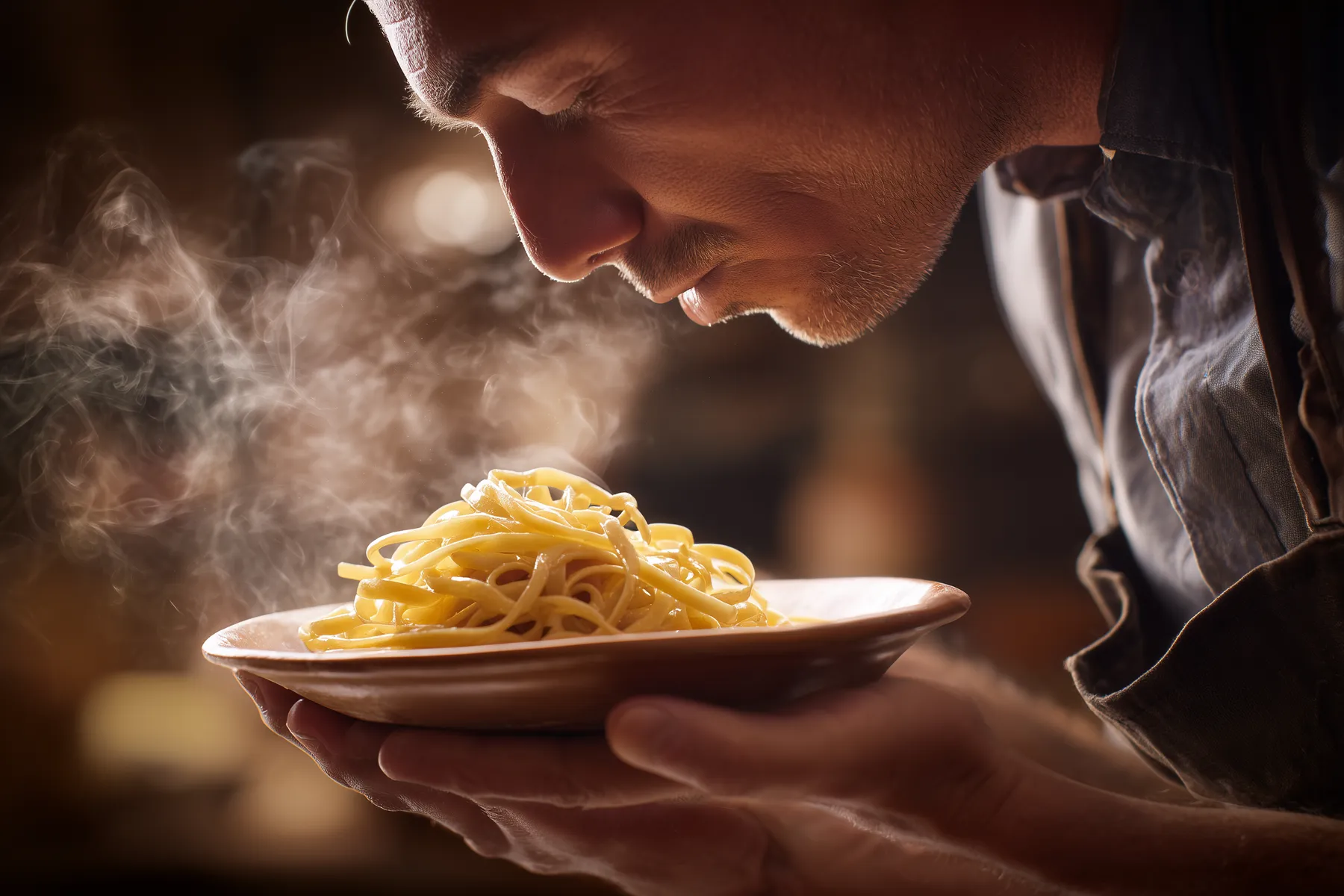
Then comes the pot, and the perfume transforms. The scalding water awakens that which was held captive in the raw pasta. The cereal blossoms, the starch begins to surrender, the semolina once more becomes a discreet presence. Here too, the distinction is felt: a well-crafted pasta does not release heavy, acidic, or lifeless aromas. It maintains a fundamental purity, a sober aromatic profile that prepares the path for the sauce without being eclipsed by it.
In truth, the aroma of pasta is modest. It does not seek to dominate the dish, but to accompany it. It is the mysteriously quiet prelude to taste: to recognize it, one need only draw near, breathe in, and grant the grain the time to bloom.


There are gifts that are not perceived at first glance. They do not reside upon the surface, nor do they commend themselves to the eye with the vibration of color, nor to the fingertips with the roughness of the die. Certain virtues demand silence, proximity, and devotion. They come to pass 'by the nose', through the most archaic and mysterious of senses: olfaction.
Opening a package of pasta should be, even before a domestic gesture, a small ritual of verification. Fine pasta does not intrude; it does not perfume itself like a creation crafted solely to seduce. It has no need for ostentatious fragrances. Yet, if the semolina is pristine, if the grain has been chosen with reverence, if the milling has not impoverished its substance and the drying has not scorched its memory, something arrives: a faint, dry, clean scent. Wheat. Cereal. Nuances of bread crust. At times a sweeter note, almost noisette, as if within that static form there still survived the olfactory seal of the field from whence it came.
Scent, in pasta, is a discreet sense. It seeks not the immediate astonishment of a brazen and artificial note, but a subtle reassurance. It speaks of whether the matter is alive or already spent, whether time has safeguarded or weakened it, whether the artisanal process has respected the semolina or reduced it, through haste, to mere sustenance. A fine pasta carries with it a faint yet recognizable scent: it must not smell of confinement, of dust, of cardboard, of fatigue. It must not be mute of accents.
When pasta breathes no scent at all, perhaps something has been severed. This is not always a grave defect, but it is often the sign of a loss: grains devoid of aromas, excessive preservation, accelerated processing, dryings that have stolen more than they have preserved. The pasta then remains technically correct, perhaps even functional, but devoid of that native pulse which distinguishes true nourishment from a mere commodity.
To breathe in the dry pasta is to interrogate the entire lineage before cooking. For dry pasta, in its apparent simplicity, is an archive: it preserves all that it has journeyed through. The variety of the wheat, the quality of the semolina, the manner in which it was kneaded, extruded, and dried. Everything leaves a trace, however minuscule, and the nose — far more than hasty judgment — knows how to capture it.
Then comes the pot, and the perfume transforms. The scalding water awakens that which was held captive in the raw pasta. The cereal blossoms, the starch begins to surrender, the semolina once more becomes a discreet presence. Here too, the distinction is felt: a well-crafted pasta does not release heavy, acidic, or lifeless aromas. It maintains a fundamental purity, a sober aromatic profile that prepares the path for the sauce without being eclipsed by it.
In truth, the aroma of pasta is modest. It does not seek to dominate the dish, but to accompany it. It is the mysteriously quiet prelude to taste: to recognize it, one need only draw near, breathe in, and grant the grain the time to bloom.
There are gifts that are not perceived at first glance. They do not reside upon the surface, nor do they commend themselves to the eye with the vibration of color, nor to the fingertips with the roughness of the die. Certain virtues demand silence, proximity, and devotion. They come to pass 'by the nose', through the most archaic and mysterious of senses: olfaction.
Opening a package of pasta should be, even before a domestic gesture, a small ritual of verification. Fine pasta does not intrude; it does not perfume itself like a creation crafted solely to seduce. It has no need for ostentatious fragrances. Yet, if the semolina is pristine, if the grain has been chosen with reverence, if the milling has not impoverished its substance and the drying has not scorched its memory, something arrives: a faint, dry, clean scent. Wheat. Cereal. Nuances of bread crust. At times a sweeter note, almost noisette, as if within that static form there still survived the olfactory seal of the field from whence it came.
Scent, in pasta, is a discreet sense. It seeks not the immediate astonishment of a brazen and artificial note, but a subtle reassurance. It speaks of whether the matter is alive or already spent, whether time has safeguarded or weakened it, whether the artisanal process has respected the semolina or reduced it, through haste, to mere sustenance. A fine pasta carries with it a faint yet recognizable scent: it must not smell of confinement, of dust, of cardboard, of fatigue. It must not be mute of accents.
When pasta breathes no scent at all, perhaps something has been severed. This is not always a grave defect, but it is often the sign of a loss: grains devoid of aromas, excessive preservation, accelerated processing, dryings that have stolen more than they have preserved. The pasta then remains technically correct, perhaps even functional, but devoid of that native pulse which distinguishes true nourishment from a mere commodity.
To breathe in the dry pasta is to interrogate the entire lineage before cooking. For dry pasta, in its apparent simplicity, is an archive: it preserves all that it has journeyed through. The variety of the wheat, the quality of the semolina, the manner in which it was kneaded, extruded, and dried. Everything leaves a trace, however minuscule, and the nose — far more than hasty judgment — knows how to capture it.
Then comes the pot, and the perfume transforms. The scalding water awakens that which was held captive in the raw pasta. The cereal blossoms, the starch begins to surrender, the semolina once more becomes a discreet presence. Here too, the distinction is felt: a well-crafted pasta does not release heavy, acidic, or lifeless aromas. It maintains a fundamental purity, a sober aromatic profile that prepares the path for the sauce without being eclipsed by it.
In truth, the aroma of pasta is modest. It does not seek to dominate the dish, but to accompany it. It is the mysteriously quiet prelude to taste: to recognize it, one need only draw near, breathe in, and grant the grain the time to bloom.