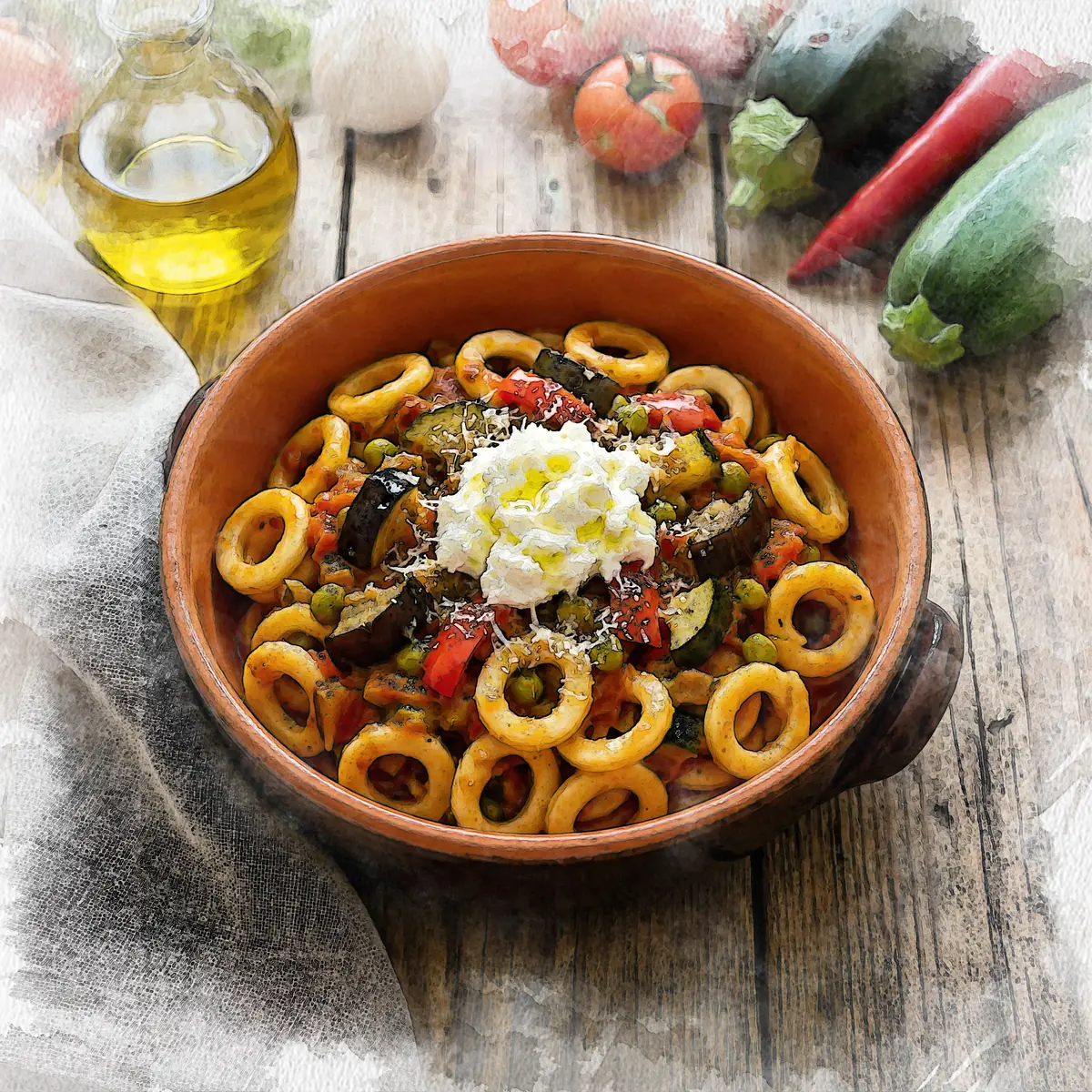
Anellini alla Pecorara
Flour, Eggs, Tomatoes, Aubergines, Sweet Peppers, Courgettes, Peas, Sheep's Milk Ricotta, Pecorino
Moderate
Abruzzo
A journey of ninety minutes
580 Kilocalories
Anellini alla Pecorara
Flour, Eggs, Tomatoes, Aubergines, Sweet Peppers, Courgettes, Peas, Sheep's Milk Ricotta, Pecorino
Moderate
Abruzzo
A journey of ninety minutes
580 Kilocalories
Anellini alla Pecorara
Flour, Eggs, Tomatoes, Aubergines, Sweet Peppers, Courgettes, Peas, Sheep's Milk Ricotta, Pecorino
Moderate
Abruzzo
A journey of ninety minutes
580 Kilocalories
GENESIS
The anellini alla pecorara stand as one of the most defining and captivating treasures of Abruzzo's gastronomic heritage, with deep roots anchored specifically within the terroir of Elice, a historic hamlet in the province of Pescara. This preparation is intimately bound to the ancient rites of transhumance and the pastoral realm, as unequivocally evoked by the adjective "pecorara"—a lyrical homage to the shepherd's life and the fruits of ovine husbandry, the historic pillar of the region's livelihood. The defining artistry of the dish lies in the morphology of the pasta: delicate rings of egg dough, meticulously crafted by hand, one by one, with devotion and profound mastery.
Several evocative theories illuminate the origin of this singular form. One school of thought, tied to the rhythms of rural life and toil in the fields, perceives in the pasta's silhouette a reflection of the iron rings adorned upon mule harnesses or pack saddles to secure provisions during the epic migrations of the flocks. Another interpretation, more poetic and woven into local custom, likens the anellini to the hoop earrings worn by Abruzzese women on feast days and during bridal ceremonies. The sauce that graces this pasta is a sumptuous vegetable ragout, a triumphant tapestry of summer garden hues and flavors, crowned by the indispensable sheep's milk ricotta. Rather than a mere accompaniment, this pristine ingredient imparts an enveloping creaminess and a distinctive, rustic soul that balances the sweet nectar of the vegetables. This culinary masterpiece is celebrated annually in local festivals, vibrant testimonies to the preservation of manual craft and the authentic, ancestral flavors of the Vestini hills and the rolling Pescara landscape.
PORTIONS (FOR 4 PERSONS)
FOR THE FRESHLY KNEADED PASTA
Durum wheat semolina flour
Medium eggs
Water
Fine salt
400 g
4
To taste
A pinch
FOR THE EMBELLISHMENT
San Marzano Tomatoes
Aubergine
Red bell pepper
Zucchini
Fresh spring peas
Medium golden onion
Sheep's milk ricotta
Pecorino from Abruzzo
Extra virgin olive oil
Fine sea salt
300 g
1
1
2
100 g
1
200 g
80 g
To taste
To taste
CURATION
For the fresh pasta:
Arrange the durum wheat semolina flour in a fountain shape upon a wooden pastry board, fashioning a wide well at its heart. Crack the eggs into the center and add a pinch of fine salt. Begin to whisk the eggs with a fork, gradually drawing the flour from the inner borders to prevent the eggs from escaping. Once the dough begins to coalesce, knead it vigorously by hand for at least ten minutes, coaxing it into a smooth, supple, and elastic sphere; should it prove too unyielding, soothe it with a mere droplet of tepid water. Wrap the dough in cling film and allow it to rest at room temperature for some thirty minutes, letting the gluten find its repose.
This interval elapsed, take small portions of the dough and roll them beneath your palms into slender cords (biscette) about half a centimeter thick. Cut these cords into segments of some 4 to 5 centimeters in length. To fashion the small ring, loop each piece of pasta around your index finger and press the two ends firmly together to seal them. Ensure the ring remains open in the center and the seam is secure. Arrange the anellini upon a floured tray, spaced apart, and let them dry gently while you prepare the sauce.For the condiment:
Prepare the vegetables by washing them meticulously under running water. Dice the aubergine into small cubes, and place them in a colander sprinkled with salt for about twenty minutes to purge them of their bitter waters; then rinse and dry them thoroughly. Dice the red bell pepper and courgettes to the same dimensions, maintaining a harmony of size for uniform cooking. Shell the fresh peas. Take the fresh tomatoes, score a cross at their base, and blanch them for a few seconds in boiling water to easily shed their skins; then chop them, discarding the excess seeds.
In a wide, deep pan, warm a generous swirl of extra virgin olive oil and gently sauté the finely chopped onion until it turns translucent and golden. Introduce the vegetables in order of their firmness: first the peppers and peas, followed five minutes later by the aubergine, and lastly the courgettes. Sauté the ensemble over a lively flame for a few minutes to seal their essences. Add the chopped tomatoes, season with salt, and cover. Lower the flame and cook for about twenty minutes, adding a ladle of hot water should the sauce reduce excessively. The vegetables must emerge tender and richly seasoned, yet retain their form.To complete the dish:
Bring a generous pot of salted water to a rolling boil. Plunge the anellini into the water and cook for 4 to 5 minutes; taste them to ensure they remain delightfully resilient to the bite. Meanwhile, in a large bowl, whisk the sheep's milk Ricotta with a ladle of the pasta's cooking water until it transforms into a velvety cream.
Drain the anellini al dente and toss them directly into the pan with the warm vegetable condiment. Fold everything together off the heat for a minute, integrating half of the Ricotta cream and the grated Pecorino Abruzzese to bind the components in harmony. Plate immediately, crowning each portion with a final spoonful of fresh ricotta and a drizzle of raw extra virgin olive oil to elevate the aromas.
aspiration
For a sublime creation, employ golden-yolk eggs, which shall bestow an intense and enticingly warm hue upon the delicate veil of pasta.
Should you wish to honor the most decadent tradition of festive feasts, fry the aubergines, courgettes, and bell peppers individually in a generous bath of extra virgin olive oil before uniting them with the tomato base; thus, the flavor shall emerge far more robust and profound.
Sheep's milk Ricotta is the crowning jewel of this dish: seek it out of the utmost freshness, harvested, if you can, from an artisanal dairy where time-honored crafts endure.
You may elevate the pasta dough with a mere whisper of saffron dissolved in water or egg, a poetic tribute to the prized gold of the Navelli Plateau.


GENESIS
The anellini alla pecorara stand as one of the most defining and captivating treasures of Abruzzo's gastronomic heritage, with deep roots anchored specifically within the terroir of Elice, a historic hamlet in the province of Pescara. This preparation is intimately bound to the ancient rites of transhumance and the pastoral realm, as unequivocally evoked by the adjective "pecorara"—a lyrical homage to the shepherd's life and the fruits of ovine husbandry, the historic pillar of the region's livelihood. The defining artistry of the dish lies in the morphology of the pasta: delicate rings of egg dough, meticulously crafted by hand, one by one, with devotion and profound mastery.
Several evocative theories illuminate the origin of this singular form. One school of thought, tied to the rhythms of rural life and toil in the fields, perceives in the pasta's silhouette a reflection of the iron rings adorned upon mule harnesses or pack saddles to secure provisions during the epic migrations of the flocks. Another interpretation, more poetic and woven into local custom, likens the anellini to the hoop earrings worn by Abruzzese women on feast days and during bridal ceremonies. The sauce that graces this pasta is a sumptuous vegetable ragout, a triumphant tapestry of summer garden hues and flavors, crowned by the indispensable sheep's milk ricotta. Rather than a mere accompaniment, this pristine ingredient imparts an enveloping creaminess and a distinctive, rustic soul that balances the sweet nectar of the vegetables. This culinary masterpiece is celebrated annually in local festivals, vibrant testimonies to the preservation of manual craft and the authentic, ancestral flavors of the Vestini hills and the rolling Pescara landscape.
PORTIONS (FOR 4 PERSONS)
FOR THE FRESHLY KNEADED PASTA
Durum wheat semolina flour
Medium eggs
Water
Fine salt
400 g
4
To taste
A pinch
FOR THE EMBELLISHMENT
San Marzano Tomatoes
Aubergine
Red bell pepper
Zucchini
Fresh spring peas
Medium golden onion
Sheep's milk ricotta
Pecorino from Abruzzo
Extra virgin olive oil
Fine sea salt
300 g
1
1
2
100 g
1
200 g
80 g
To taste
To taste
CURATION
For the fresh pasta:
Arrange the durum wheat semolina flour in a fountain shape upon a wooden pastry board, fashioning a wide well at its heart. Crack the eggs into the center and add a pinch of fine salt. Begin to whisk the eggs with a fork, gradually drawing the flour from the inner borders to prevent the eggs from escaping. Once the dough begins to coalesce, knead it vigorously by hand for at least ten minutes, coaxing it into a smooth, supple, and elastic sphere; should it prove too unyielding, soothe it with a mere droplet of tepid water. Wrap the dough in cling film and allow it to rest at room temperature for some thirty minutes, letting the gluten find its repose.
This interval elapsed, take small portions of the dough and roll them beneath your palms into slender cords (biscette) about half a centimeter thick. Cut these cords into segments of some 4 to 5 centimeters in length. To fashion the small ring, loop each piece of pasta around your index finger and press the two ends firmly together to seal them. Ensure the ring remains open in the center and the seam is secure. Arrange the anellini upon a floured tray, spaced apart, and let them dry gently while you prepare the sauce.For the condiment:
Prepare the vegetables by washing them meticulously under running water. Dice the aubergine into small cubes, and place them in a colander sprinkled with salt for about twenty minutes to purge them of their bitter waters; then rinse and dry them thoroughly. Dice the red bell pepper and courgettes to the same dimensions, maintaining a harmony of size for uniform cooking. Shell the fresh peas. Take the fresh tomatoes, score a cross at their base, and blanch them for a few seconds in boiling water to easily shed their skins; then chop them, discarding the excess seeds.
In a wide, deep pan, warm a generous swirl of extra virgin olive oil and gently sauté the finely chopped onion until it turns translucent and golden. Introduce the vegetables in order of their firmness: first the peppers and peas, followed five minutes later by the aubergine, and lastly the courgettes. Sauté the ensemble over a lively flame for a few minutes to seal their essences. Add the chopped tomatoes, season with salt, and cover. Lower the flame and cook for about twenty minutes, adding a ladle of hot water should the sauce reduce excessively. The vegetables must emerge tender and richly seasoned, yet retain their form.To complete the dish:
Bring a generous pot of salted water to a rolling boil. Plunge the anellini into the water and cook for 4 to 5 minutes; taste them to ensure they remain delightfully resilient to the bite. Meanwhile, in a large bowl, whisk the sheep's milk Ricotta with a ladle of the pasta's cooking water until it transforms into a velvety cream.
Drain the anellini al dente and toss them directly into the pan with the warm vegetable condiment. Fold everything together off the heat for a minute, integrating half of the Ricotta cream and the grated Pecorino Abruzzese to bind the components in harmony. Plate immediately, crowning each portion with a final spoonful of fresh ricotta and a drizzle of raw extra virgin olive oil to elevate the aromas.
aspiration
For a sublime creation, employ golden-yolk eggs, which shall bestow an intense and enticingly warm hue upon the delicate veil of pasta.
Should you wish to honor the most decadent tradition of festive feasts, fry the aubergines, courgettes, and bell peppers individually in a generous bath of extra virgin olive oil before uniting them with the tomato base; thus, the flavor shall emerge far more robust and profound.
Sheep's milk Ricotta is the crowning jewel of this dish: seek it out of the utmost freshness, harvested, if you can, from an artisanal dairy where time-honored crafts endure.
You may elevate the pasta dough with a mere whisper of saffron dissolved in water or egg, a poetic tribute to the prized gold of the Navelli Plateau.
latest culinary creations
GENESIS
The anellini alla pecorara stand as one of the most defining and captivating treasures of Abruzzo's gastronomic heritage, with deep roots anchored specifically within the terroir of Elice, a historic hamlet in the province of Pescara. This preparation is intimately bound to the ancient rites of transhumance and the pastoral realm, as unequivocally evoked by the adjective "pecorara"—a lyrical homage to the shepherd's life and the fruits of ovine husbandry, the historic pillar of the region's livelihood. The defining artistry of the dish lies in the morphology of the pasta: delicate rings of egg dough, meticulously crafted by hand, one by one, with devotion and profound mastery.
Several evocative theories illuminate the origin of this singular form. One school of thought, tied to the rhythms of rural life and toil in the fields, perceives in the pasta's silhouette a reflection of the iron rings adorned upon mule harnesses or pack saddles to secure provisions during the epic migrations of the flocks. Another interpretation, more poetic and woven into local custom, likens the anellini to the hoop earrings worn by Abruzzese women on feast days and during bridal ceremonies. The sauce that graces this pasta is a sumptuous vegetable ragout, a triumphant tapestry of summer garden hues and flavors, crowned by the indispensable sheep's milk ricotta. Rather than a mere accompaniment, this pristine ingredient imparts an enveloping creaminess and a distinctive, rustic soul that balances the sweet nectar of the vegetables. This culinary masterpiece is celebrated annually in local festivals, vibrant testimonies to the preservation of manual craft and the authentic, ancestral flavors of the Vestini hills and the rolling Pescara landscape.
PORTIONS (FOR 4 PERSONS)
FOR THE FRESHLY KNEADED PASTA
Durum wheat semolina flour
Medium eggs
Water
Fine salt
400 g
4
To taste
A pinch
FOR THE EMBELLISHMENT
San Marzano Tomatoes
Aubergine
Red bell pepper
Zucchini
Fresh spring peas
Medium golden onion
Sheep's milk ricotta
Pecorino from Abruzzo
Extra virgin olive oil
Fine sea salt
300 g
1
1
2
100 g
1
200 g
80 g
To taste
To taste
CURATION
For the fresh pasta:
Arrange the durum wheat semolina flour in a fountain shape upon a wooden pastry board, fashioning a wide well at its heart. Crack the eggs into the center and add a pinch of fine salt. Begin to whisk the eggs with a fork, gradually drawing the flour from the inner borders to prevent the eggs from escaping. Once the dough begins to coalesce, knead it vigorously by hand for at least ten minutes, coaxing it into a smooth, supple, and elastic sphere; should it prove too unyielding, soothe it with a mere droplet of tepid water. Wrap the dough in cling film and allow it to rest at room temperature for some thirty minutes, letting the gluten find its repose.
This interval elapsed, take small portions of the dough and roll them beneath your palms into slender cords (biscette) about half a centimeter thick. Cut these cords into segments of some 4 to 5 centimeters in length. To fashion the small ring, loop each piece of pasta around your index finger and press the two ends firmly together to seal them. Ensure the ring remains open in the center and the seam is secure. Arrange the anellini upon a floured tray, spaced apart, and let them dry gently while you prepare the sauce.For the condiment:
Prepare the vegetables by washing them meticulously under running water. Dice the aubergine into small cubes, and place them in a colander sprinkled with salt for about twenty minutes to purge them of their bitter waters; then rinse and dry them thoroughly. Dice the red bell pepper and courgettes to the same dimensions, maintaining a harmony of size for uniform cooking. Shell the fresh peas. Take the fresh tomatoes, score a cross at their base, and blanch them for a few seconds in boiling water to easily shed their skins; then chop them, discarding the excess seeds.
In a wide, deep pan, warm a generous swirl of extra virgin olive oil and gently sauté the finely chopped onion until it turns translucent and golden. Introduce the vegetables in order of their firmness: first the peppers and peas, followed five minutes later by the aubergine, and lastly the courgettes. Sauté the ensemble over a lively flame for a few minutes to seal their essences. Add the chopped tomatoes, season with salt, and cover. Lower the flame and cook for about twenty minutes, adding a ladle of hot water should the sauce reduce excessively. The vegetables must emerge tender and richly seasoned, yet retain their form.To complete the dish:
Bring a generous pot of salted water to a rolling boil. Plunge the anellini into the water and cook for 4 to 5 minutes; taste them to ensure they remain delightfully resilient to the bite. Meanwhile, in a large bowl, whisk the sheep's milk Ricotta with a ladle of the pasta's cooking water until it transforms into a velvety cream.
Drain the anellini al dente and toss them directly into the pan with the warm vegetable condiment. Fold everything together off the heat for a minute, integrating half of the Ricotta cream and the grated Pecorino Abruzzese to bind the components in harmony. Plate immediately, crowning each portion with a final spoonful of fresh ricotta and a drizzle of raw extra virgin olive oil to elevate the aromas.
aspiration
For a sublime creation, employ golden-yolk eggs, which shall bestow an intense and enticingly warm hue upon the delicate veil of pasta.
Should you wish to honor the most decadent tradition of festive feasts, fry the aubergines, courgettes, and bell peppers individually in a generous bath of extra virgin olive oil before uniting them with the tomato base; thus, the flavor shall emerge far more robust and profound.
Sheep's milk Ricotta is the crowning jewel of this dish: seek it out of the utmost freshness, harvested, if you can, from an artisanal dairy where time-honored crafts endure.
You may elevate the pasta dough with a mere whisper of saffron dissolved in water or egg, a poetic tribute to the prized gold of the Navelli Plateau.