genesis
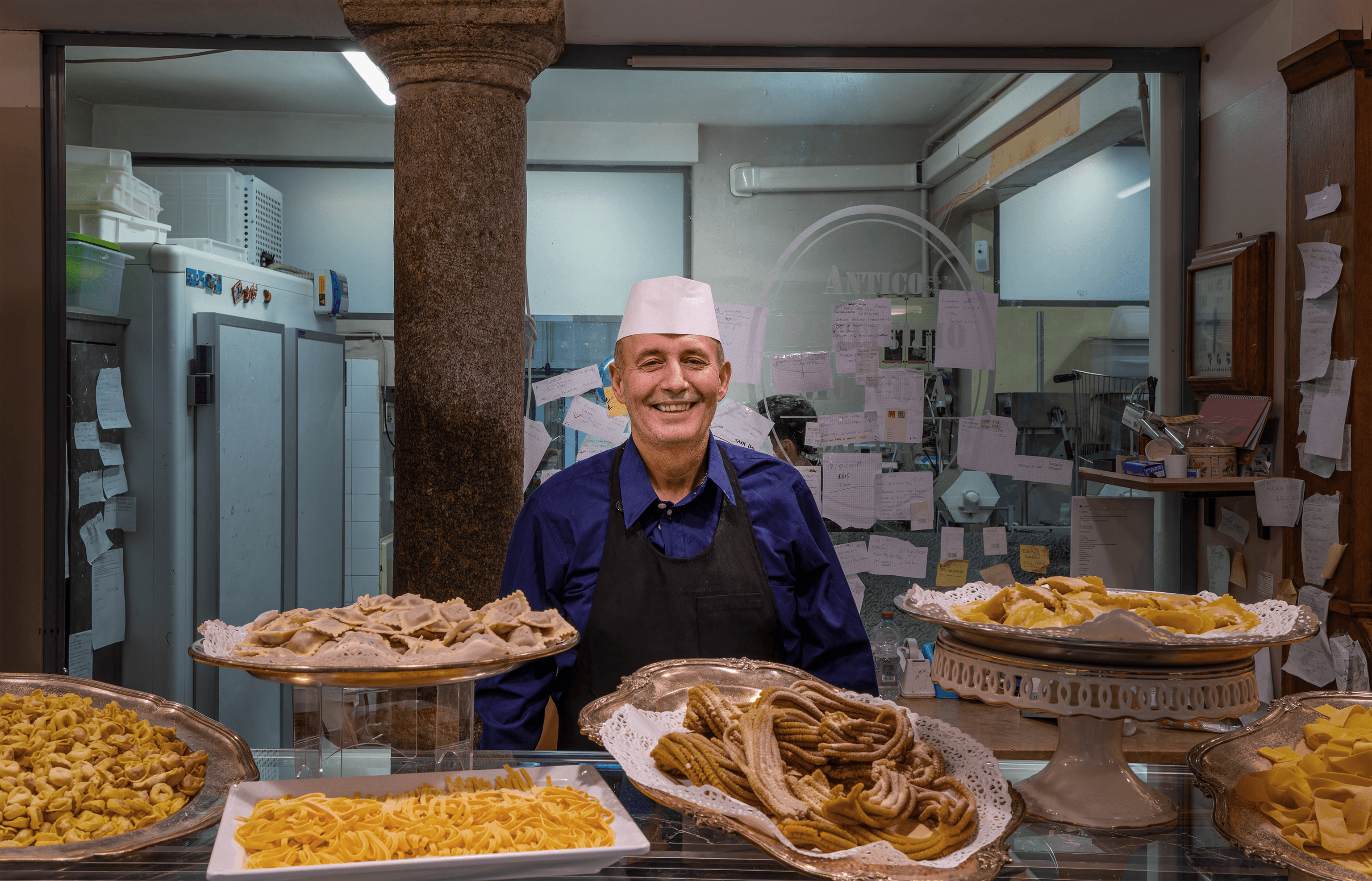
In the heart of Milan, between Brera and San Marco, there exists a rare continuity: a boutique atelier born in 1924 that has remained recognizable to itself, earning the esteemed title of Historical Place of Commerce (Bottega Storica). It is a sanctuary that does not merely "resist" time; it traverses it, absorbs it, and refines it into substance.
And when, some thirty years ago, the inheritance changed hands, the decisive transition occurred. L’Antico Pastificio Moscova ceased to be solely an address for ravioli and was reborn as a living organism of daily gastronomy: authentic labor, a culinary repertoire that breathes in harmony with the seasons, and a discipline that refuses to surrender to haste.
On one hand stands Giambattista Zecchi: classically trained in the culinary arts, guided by rigorous "scholastic" tenets, and possessing a rustic memory that is not mere nostalgia, but a moral compass of taste. His childhood on a farmhouse in Camisano, near Crema — of warm, freshly planed milk, livestock, and slow, deliberate rhythms — remains as an indelible imprint: quality anchored to time, and time bound to responsibility. Then came the Hotel School of San Pellegrino, boarding life, and strict discipline. Finally, a high-volume kitchen (in a school cafeteria: three hundred children a day in Arese) served as his organizational crucible before his arrival in via Moscova.
On the other hand stands Bruno Fabiano, a devotee of the Beautiful, who arrived from a business world intertwined with art. He fell in love first with the vessel rather than its contents — the antique furniture, the atmosphere, the patina — and he defends the boutique’s identity as one would safeguard a fragile masterpiece: to be restored, yet never betrayed.
alchemy
The u201cenchantmentsu201d of Moscova are no mere special effects: they are choices renewed with each dawning day. Meticulously selected flours. u201cTrue meatsu201d for the fillings. Vegetables that follow the rhythm of the seasons, and purveyors from the finest culinary niches. The signature creationu2014that which resonates in the palate like an absolute truthu2014is the brasato ravioli: here they seek no fleeting applause, but enduring devotion. Alongside them, maritime variations (sea bass, prawns) and technical gestures that speak of an evolved artisanal ideal: the cappelletti ring (infused with butter and Parmesan, shaped in the mold, baked, and finished with Parmesan cream and a white ragu00f9); the gnocchi alla parigina, born from a pate choux that shifts form, poached and then gratinu00e9ed to perfection. And, in the cityu2019s emotional calendar, the capon ravioli that arrive at Christmas like a sacred rite: not a seasonal product, but a ancestral calling.
Then there lies a more subtle, narrative magic, almost superstitious in nature: during restaurations, the health ledger of the founder comes to light, born on January 26th, 1900u2014the very same birthday as Zecchiu2014hailing from the same Crema heritage. As if time here were not merely a linear path, but a series of poetic correspondences.
Completing this portrait is the photograph of the former proprietoru2014which Giambattista treasures above his bedu2014seated, with a finger raised: not in pose, but in gentle admonition. u201cI entrust my shop to your care.u201d In that gesture, entrepreneurial history touches upon magical realism and becomes a sacred mission: a fidelity that is no dusty relic, but living devotion.
Lastly, the social magic: an atelier that enters the warmth of the home. Twenty- and thirty-somethings return to this Bottega because their grandparents once walked these floors; the classic Milanese u201csciureu201d mingle with professionals and famed faces, yet the soul of the counter remains untouchedu2014the same hand-rolled pasta, the same attentive ear, the same neighborhood sincerity. And perhaps this is the true luxury of Moscova: not the fleeting exception, but the beautiful continuity. The rare grace of making Milan feel, day after day, intimately like home.
provenance
final heritages


genesis
In the heart of Milan, between Brera and San Marco, there exists a rare continuity: a boutique atelier born in 1924 that has remained recognizable to itself, earning the esteemed title of Historical Place of Commerce (Bottega Storica). It is a sanctuary that does not merely "resist" time; it traverses it, absorbs it, and refines it into substance.
And when, some thirty years ago, the inheritance changed hands, the decisive transition occurred. L’Antico Pastificio Moscova ceased to be solely an address for ravioli and was reborn as a living organism of daily gastronomy: authentic labor, a culinary repertoire that breathes in harmony with the seasons, and a discipline that refuses to surrender to haste.
On one hand stands Giambattista Zecchi: classically trained in the culinary arts, guided by rigorous "scholastic" tenets, and possessing a rustic memory that is not mere nostalgia, but a moral compass of taste. His childhood on a farmhouse in Camisano, near Crema — of warm, freshly planed milk, livestock, and slow, deliberate rhythms — remains as an indelible imprint: quality anchored to time, and time bound to responsibility. Then came the Hotel School of San Pellegrino, boarding life, and strict discipline. Finally, a high-volume kitchen (in a school cafeteria: three hundred children a day in Arese) served as his organizational crucible before his arrival in via Moscova.
On the other hand stands Bruno Fabiano, a devotee of the Beautiful, who arrived from a business world intertwined with art. He fell in love first with the vessel rather than its contents — the antique furniture, the atmosphere, the patina — and he defends the boutique’s identity as one would safeguard a fragile masterpiece: to be restored, yet never betrayed.
alchemy
The u201cenchantmentsu201d of Moscova are no mere special effects: they are choices renewed with each dawning day. Meticulously selected flours. u201cTrue meatsu201d for the fillings. Vegetables that follow the rhythm of the seasons, and purveyors from the finest culinary niches. The signature creationu2014that which resonates in the palate like an absolute truthu2014is the brasato ravioli: here they seek no fleeting applause, but enduring devotion. Alongside them, maritime variations (sea bass, prawns) and technical gestures that speak of an evolved artisanal ideal: the cappelletti ring (infused with butter and Parmesan, shaped in the mold, baked, and finished with Parmesan cream and a white ragu00f9); the gnocchi alla parigina, born from a pate choux that shifts form, poached and then gratinu00e9ed to perfection. And, in the cityu2019s emotional calendar, the capon ravioli that arrive at Christmas like a sacred rite: not a seasonal product, but a ancestral calling.
Then there lies a more subtle, narrative magic, almost superstitious in nature: during restaurations, the health ledger of the founder comes to light, born on January 26th, 1900u2014the very same birthday as Zecchiu2014hailing from the same Crema heritage. As if time here were not merely a linear path, but a series of poetic correspondences.
Completing this portrait is the photograph of the former proprietoru2014which Giambattista treasures above his bedu2014seated, with a finger raised: not in pose, but in gentle admonition. u201cI entrust my shop to your care.u201d In that gesture, entrepreneurial history touches upon magical realism and becomes a sacred mission: a fidelity that is no dusty relic, but living devotion.
Lastly, the social magic: an atelier that enters the warmth of the home. Twenty- and thirty-somethings return to this Bottega because their grandparents once walked these floors; the classic Milanese u201csciureu201d mingle with professionals and famed faces, yet the soul of the counter remains untouchedu2014the same hand-rolled pasta, the same attentive ear, the same neighborhood sincerity. And perhaps this is the true luxury of Moscova: not the fleeting exception, but the beautiful continuity. The rare grace of making Milan feel, day after day, intimately like home.
provenance
final heritages
genesis
In the heart of Milan, between Brera and San Marco, there exists a rare continuity: a boutique atelier born in 1924 that has remained recognizable to itself, earning the esteemed title of Historical Place of Commerce (Bottega Storica). It is a sanctuary that does not merely "resist" time; it traverses it, absorbs it, and refines it into substance.
And when, some thirty years ago, the inheritance changed hands, the decisive transition occurred. L’Antico Pastificio Moscova ceased to be solely an address for ravioli and was reborn as a living organism of daily gastronomy: authentic labor, a culinary repertoire that breathes in harmony with the seasons, and a discipline that refuses to surrender to haste.
On one hand stands Giambattista Zecchi: classically trained in the culinary arts, guided by rigorous "scholastic" tenets, and possessing a rustic memory that is not mere nostalgia, but a moral compass of taste. His childhood on a farmhouse in Camisano, near Crema — of warm, freshly planed milk, livestock, and slow, deliberate rhythms — remains as an indelible imprint: quality anchored to time, and time bound to responsibility. Then came the Hotel School of San Pellegrino, boarding life, and strict discipline. Finally, a high-volume kitchen (in a school cafeteria: three hundred children a day in Arese) served as his organizational crucible before his arrival in via Moscova.
On the other hand stands Bruno Fabiano, a devotee of the Beautiful, who arrived from a business world intertwined with art. He fell in love first with the vessel rather than its contents — the antique furniture, the atmosphere, the patina — and he defends the boutique’s identity as one would safeguard a fragile masterpiece: to be restored, yet never betrayed.
alchemy
The u201cenchantmentsu201d of Moscova are no mere special effects: they are choices renewed with each dawning day. Meticulously selected flours. u201cTrue meatsu201d for the fillings. Vegetables that follow the rhythm of the seasons, and purveyors from the finest culinary niches. The signature creationu2014that which resonates in the palate like an absolute truthu2014is the brasato ravioli: here they seek no fleeting applause, but enduring devotion. Alongside them, maritime variations (sea bass, prawns) and technical gestures that speak of an evolved artisanal ideal: the cappelletti ring (infused with butter and Parmesan, shaped in the mold, baked, and finished with Parmesan cream and a white ragu00f9); the gnocchi alla parigina, born from a pate choux that shifts form, poached and then gratinu00e9ed to perfection. And, in the cityu2019s emotional calendar, the capon ravioli that arrive at Christmas like a sacred rite: not a seasonal product, but a ancestral calling.
Then there lies a more subtle, narrative magic, almost superstitious in nature: during restaurations, the health ledger of the founder comes to light, born on January 26th, 1900u2014the very same birthday as Zecchiu2014hailing from the same Crema heritage. As if time here were not merely a linear path, but a series of poetic correspondences.
Completing this portrait is the photograph of the former proprietoru2014which Giambattista treasures above his bedu2014seated, with a finger raised: not in pose, but in gentle admonition. u201cI entrust my shop to your care.u201d In that gesture, entrepreneurial history touches upon magical realism and becomes a sacred mission: a fidelity that is no dusty relic, but living devotion.
Lastly, the social magic: an atelier that enters the warmth of the home. Twenty- and thirty-somethings return to this Bottega because their grandparents once walked these floors; the classic Milanese u201csciureu201d mingle with professionals and famed faces, yet the soul of the counter remains untouchedu2014the same hand-rolled pasta, the same attentive ear, the same neighborhood sincerity. And perhaps this is the true luxury of Moscova: not the fleeting exception, but the beautiful continuity. The rare grace of making Milan feel, day after day, intimately like home.