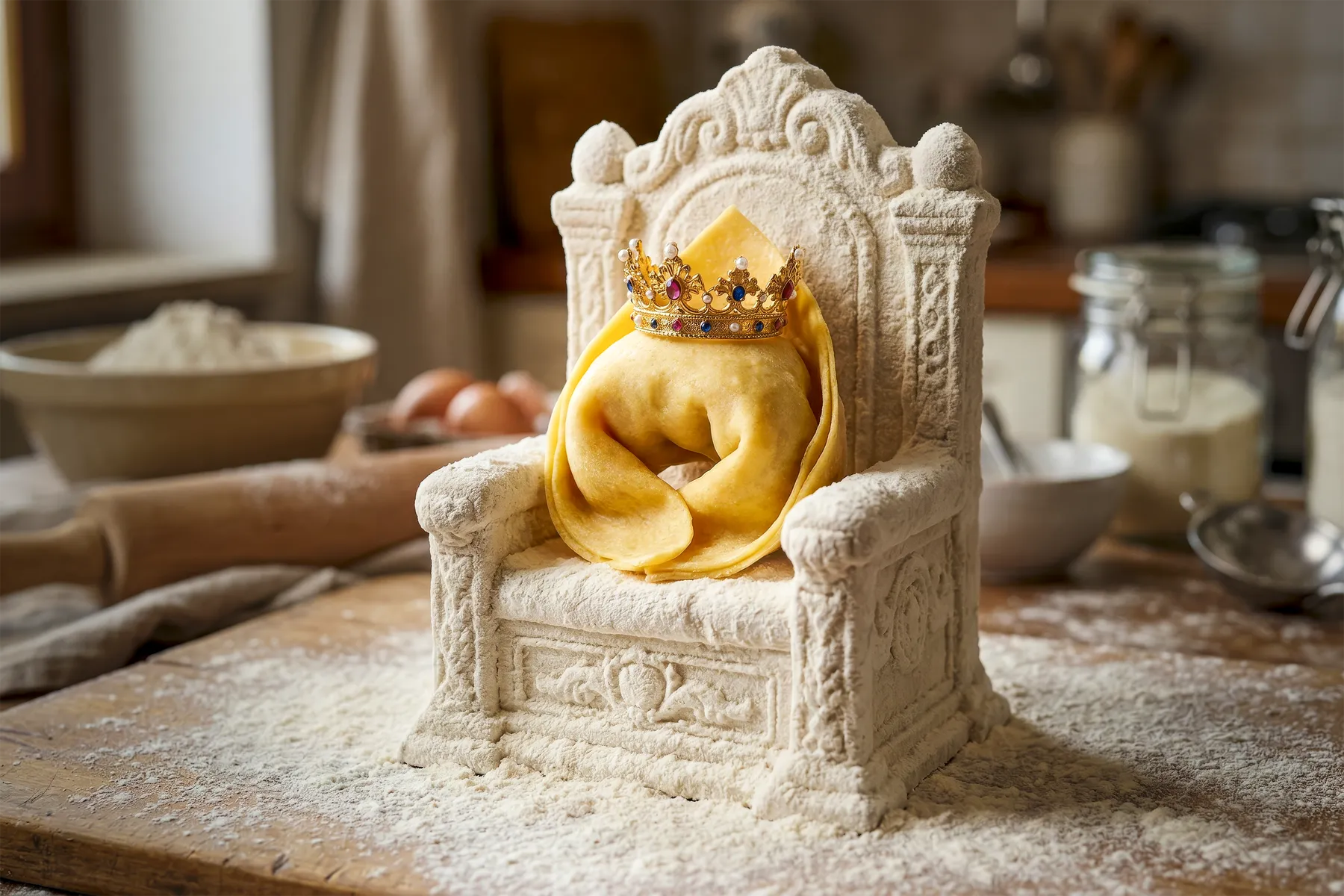
BENIAMINO BALEOTTI AND THE MASTERY OF THE GESTURE
Why the hand-rolled sfoglia transcends the soulless precision of the machine
Mar 23, 2026
BENIAMINO BALEOTTI AND THE MASTERY OF THE GESTURE
Why the hand-rolled sfoglia transcends the soulless precision of the machine
Mar 23, 2026
BENIAMINO BALEOTTI AND THE MASTERY OF THE GESTURE
Why the hand-rolled sfoglia transcends the soulless precision of the machine
Mar 23, 2026
There are callings that do not merely yield sustenance, but safeguard a civilization of care. The ‘sfoglino’ belongs to this lineage, both minute and solemn: he is no mere executor, but an interpreter of matter, an expert reader of flour, of eggs, of humidity, of the dough's resistance. In his hand, something beyond mere technique is at work: it is a form of corporeal intelligence, an ancient knowledge deposited in the wrists, the phalanges, the spine, and in the very rhythm of his breath. For this reason, when Beniamino Baleotti — the King of Sfoglia — defends the primacy of handwork, he is not spinning a nostalgic artifice. He is naming a fundamental, almost ontological difference between two ways of crafting pasta and, more deeply, between two ways of conceiving of human labor.
Baleotti speaks with the clarity of one who knows toil and has no need to mythologize it: the machine serves us, it accelerates, it assists, it abbreviates, and it spares the weariness of the flesh. Yet it does not yield the same destiny. The pasta sheets, passing beneath rollers, are compressed and stressed; but when they encounter the rolling pin, they are guided, chaperoned. It is a distinction seemingly minute, yet utterly decisive. For between crushing and embracing lies the entire chasm separating a routine process from a gesture of wisdom. The wood does not merely impose force: it listens, it coaxes, it corrects. The palms of the sfoglino exert not blind power, but measure. And measure, in gastronomy as in the arts, is ever the threshold where technique ascends to form.
In Emilia-Romagna, most of all within the Bolognese lands, the ‘sfoglino’ and ‘sfoglina’ are no decorative figments to be exhibited behind a windowpane, reassuring tourists hungry for a picturesque authenticity. They are, or ought to be, the guardians of a sacred discipline. Rolling the sfoglia by hand is not merely a matter of stretching dough thin: it is to feel the proper tension of the pasture, to divine how much moisture has been absorbed, to understand if the flour will hold, and whether the egg will demand more vigor or greater delicacy. It is a craft garnered over the vast horizons of repetition, allowing no ruses or shortcuts. Baleotti insists upon this point with an almost ethical clarity: anyone might think that two ingredients, eggs and flour, suffice to obtain a grand sfoglia; yet precisely because the ingredients are so few, error becomes unforgivable. In the apparent poverty of the recipe, the nobility of its execution is laid bare.
The distinction, then, is not merely ideological; it is sensory. Baleotti speaks of porosity, of roughness, of silkiness: words that seem to describe a fine textile or an epidermis, defining instead the structure of a beautifully realized sfoglia. With the rolling pin, the gluten is not coerced in the violent manner of the machine; the dough retains a more vivid, elastic, and translucent weave. In the mouth, everything is transfigured: the resistance changes, the embrace of the sauce differs, and so does the very way the pasta yields to the tooth and, as it were, speaks to the senses. It is not merely "better." It is more complex, more legible, more human.
Yet, how simple it would be to place a veto upon the machine! Baleotti, precisely because he is a creature of the pantry-atélier and not of postcards, does not indulge in this simplification. He knows well that the machine answers concrete necessities: time, cost, volume, and the scarcity of hands. He knows that a professional sfoglina can produce perhaps a single kilogram of tortellini per hour, while a machine can increase that yield threefold with dizzying speed. He knows, too, that the body is not infinite, and that physical toil exacts a tangible price. His posture, for this very reason, is all the more credible: he does not deny the utility of the machine, but asserts that its productive advantage does not equate to a qualitative grace. The machine resolves an economic equation; the hand continues to resolve a question of meaning.
The sfoglino, in this light, is no folkloric relic: he stands as the witness to an uncompromised relationship with raw matter. He reminds us that not all that is swift is fulfilled, that not all that is uniform is perfect, and that not all that functions is akin to that which speaks to the soul.
And perhaps herein lies the deepest truth of Beniamino Baleotti’s discourse. The supremacy of hand-rolled sfoglia does not reside in some vague romantic aura, but in the truth that it preserves, upon its surface, the imprint of the body that sculpted it; for the true sfoglia carries within itself a memory of pressure, of time, and of patient experience; it bears the indelible signature of a profound human presence.


There are callings that do not merely yield sustenance, but safeguard a civilization of care. The ‘sfoglino’ belongs to this lineage, both minute and solemn: he is no mere executor, but an interpreter of matter, an expert reader of flour, of eggs, of humidity, of the dough's resistance. In his hand, something beyond mere technique is at work: it is a form of corporeal intelligence, an ancient knowledge deposited in the wrists, the phalanges, the spine, and in the very rhythm of his breath. For this reason, when Beniamino Baleotti — the King of Sfoglia — defends the primacy of handwork, he is not spinning a nostalgic artifice. He is naming a fundamental, almost ontological difference between two ways of crafting pasta and, more deeply, between two ways of conceiving of human labor.
Baleotti speaks with the clarity of one who knows toil and has no need to mythologize it: the machine serves us, it accelerates, it assists, it abbreviates, and it spares the weariness of the flesh. Yet it does not yield the same destiny. The pasta sheets, passing beneath rollers, are compressed and stressed; but when they encounter the rolling pin, they are guided, chaperoned. It is a distinction seemingly minute, yet utterly decisive. For between crushing and embracing lies the entire chasm separating a routine process from a gesture of wisdom. The wood does not merely impose force: it listens, it coaxes, it corrects. The palms of the sfoglino exert not blind power, but measure. And measure, in gastronomy as in the arts, is ever the threshold where technique ascends to form.
In Emilia-Romagna, most of all within the Bolognese lands, the ‘sfoglino’ and ‘sfoglina’ are no decorative figments to be exhibited behind a windowpane, reassuring tourists hungry for a picturesque authenticity. They are, or ought to be, the guardians of a sacred discipline. Rolling the sfoglia by hand is not merely a matter of stretching dough thin: it is to feel the proper tension of the pasture, to divine how much moisture has been absorbed, to understand if the flour will hold, and whether the egg will demand more vigor or greater delicacy. It is a craft garnered over the vast horizons of repetition, allowing no ruses or shortcuts. Baleotti insists upon this point with an almost ethical clarity: anyone might think that two ingredients, eggs and flour, suffice to obtain a grand sfoglia; yet precisely because the ingredients are so few, error becomes unforgivable. In the apparent poverty of the recipe, the nobility of its execution is laid bare.
The distinction, then, is not merely ideological; it is sensory. Baleotti speaks of porosity, of roughness, of silkiness: words that seem to describe a fine textile or an epidermis, defining instead the structure of a beautifully realized sfoglia. With the rolling pin, the gluten is not coerced in the violent manner of the machine; the dough retains a more vivid, elastic, and translucent weave. In the mouth, everything is transfigured: the resistance changes, the embrace of the sauce differs, and so does the very way the pasta yields to the tooth and, as it were, speaks to the senses. It is not merely "better." It is more complex, more legible, more human.
Yet, how simple it would be to place a veto upon the machine! Baleotti, precisely because he is a creature of the pantry-atélier and not of postcards, does not indulge in this simplification. He knows well that the machine answers concrete necessities: time, cost, volume, and the scarcity of hands. He knows that a professional sfoglina can produce perhaps a single kilogram of tortellini per hour, while a machine can increase that yield threefold with dizzying speed. He knows, too, that the body is not infinite, and that physical toil exacts a tangible price. His posture, for this very reason, is all the more credible: he does not deny the utility of the machine, but asserts that its productive advantage does not equate to a qualitative grace. The machine resolves an economic equation; the hand continues to resolve a question of meaning.
The sfoglino, in this light, is no folkloric relic: he stands as the witness to an uncompromised relationship with raw matter. He reminds us that not all that is swift is fulfilled, that not all that is uniform is perfect, and that not all that functions is akin to that which speaks to the soul.
And perhaps herein lies the deepest truth of Beniamino Baleotti’s discourse. The supremacy of hand-rolled sfoglia does not reside in some vague romantic aura, but in the truth that it preserves, upon its surface, the imprint of the body that sculpted it; for the true sfoglia carries within itself a memory of pressure, of time, and of patient experience; it bears the indelible signature of a profound human presence.
There are callings that do not merely yield sustenance, but safeguard a civilization of care. The ‘sfoglino’ belongs to this lineage, both minute and solemn: he is no mere executor, but an interpreter of matter, an expert reader of flour, of eggs, of humidity, of the dough's resistance. In his hand, something beyond mere technique is at work: it is a form of corporeal intelligence, an ancient knowledge deposited in the wrists, the phalanges, the spine, and in the very rhythm of his breath. For this reason, when Beniamino Baleotti — the King of Sfoglia — defends the primacy of handwork, he is not spinning a nostalgic artifice. He is naming a fundamental, almost ontological difference between two ways of crafting pasta and, more deeply, between two ways of conceiving of human labor.
Baleotti speaks with the clarity of one who knows toil and has no need to mythologize it: the machine serves us, it accelerates, it assists, it abbreviates, and it spares the weariness of the flesh. Yet it does not yield the same destiny. The pasta sheets, passing beneath rollers, are compressed and stressed; but when they encounter the rolling pin, they are guided, chaperoned. It is a distinction seemingly minute, yet utterly decisive. For between crushing and embracing lies the entire chasm separating a routine process from a gesture of wisdom. The wood does not merely impose force: it listens, it coaxes, it corrects. The palms of the sfoglino exert not blind power, but measure. And measure, in gastronomy as in the arts, is ever the threshold where technique ascends to form.
In Emilia-Romagna, most of all within the Bolognese lands, the ‘sfoglino’ and ‘sfoglina’ are no decorative figments to be exhibited behind a windowpane, reassuring tourists hungry for a picturesque authenticity. They are, or ought to be, the guardians of a sacred discipline. Rolling the sfoglia by hand is not merely a matter of stretching dough thin: it is to feel the proper tension of the pasture, to divine how much moisture has been absorbed, to understand if the flour will hold, and whether the egg will demand more vigor or greater delicacy. It is a craft garnered over the vast horizons of repetition, allowing no ruses or shortcuts. Baleotti insists upon this point with an almost ethical clarity: anyone might think that two ingredients, eggs and flour, suffice to obtain a grand sfoglia; yet precisely because the ingredients are so few, error becomes unforgivable. In the apparent poverty of the recipe, the nobility of its execution is laid bare.
The distinction, then, is not merely ideological; it is sensory. Baleotti speaks of porosity, of roughness, of silkiness: words that seem to describe a fine textile or an epidermis, defining instead the structure of a beautifully realized sfoglia. With the rolling pin, the gluten is not coerced in the violent manner of the machine; the dough retains a more vivid, elastic, and translucent weave. In the mouth, everything is transfigured: the resistance changes, the embrace of the sauce differs, and so does the very way the pasta yields to the tooth and, as it were, speaks to the senses. It is not merely "better." It is more complex, more legible, more human.
Yet, how simple it would be to place a veto upon the machine! Baleotti, precisely because he is a creature of the pantry-atélier and not of postcards, does not indulge in this simplification. He knows well that the machine answers concrete necessities: time, cost, volume, and the scarcity of hands. He knows that a professional sfoglina can produce perhaps a single kilogram of tortellini per hour, while a machine can increase that yield threefold with dizzying speed. He knows, too, that the body is not infinite, and that physical toil exacts a tangible price. His posture, for this very reason, is all the more credible: he does not deny the utility of the machine, but asserts that its productive advantage does not equate to a qualitative grace. The machine resolves an economic equation; the hand continues to resolve a question of meaning.
The sfoglino, in this light, is no folkloric relic: he stands as the witness to an uncompromised relationship with raw matter. He reminds us that not all that is swift is fulfilled, that not all that is uniform is perfect, and that not all that functions is akin to that which speaks to the soul.
And perhaps herein lies the deepest truth of Beniamino Baleotti’s discourse. The supremacy of hand-rolled sfoglia does not reside in some vague romantic aura, but in the truth that it preserves, upon its surface, the imprint of the body that sculpted it; for the true sfoglia carries within itself a memory of pressure, of time, and of patient experience; it bears the indelible signature of a profound human presence.