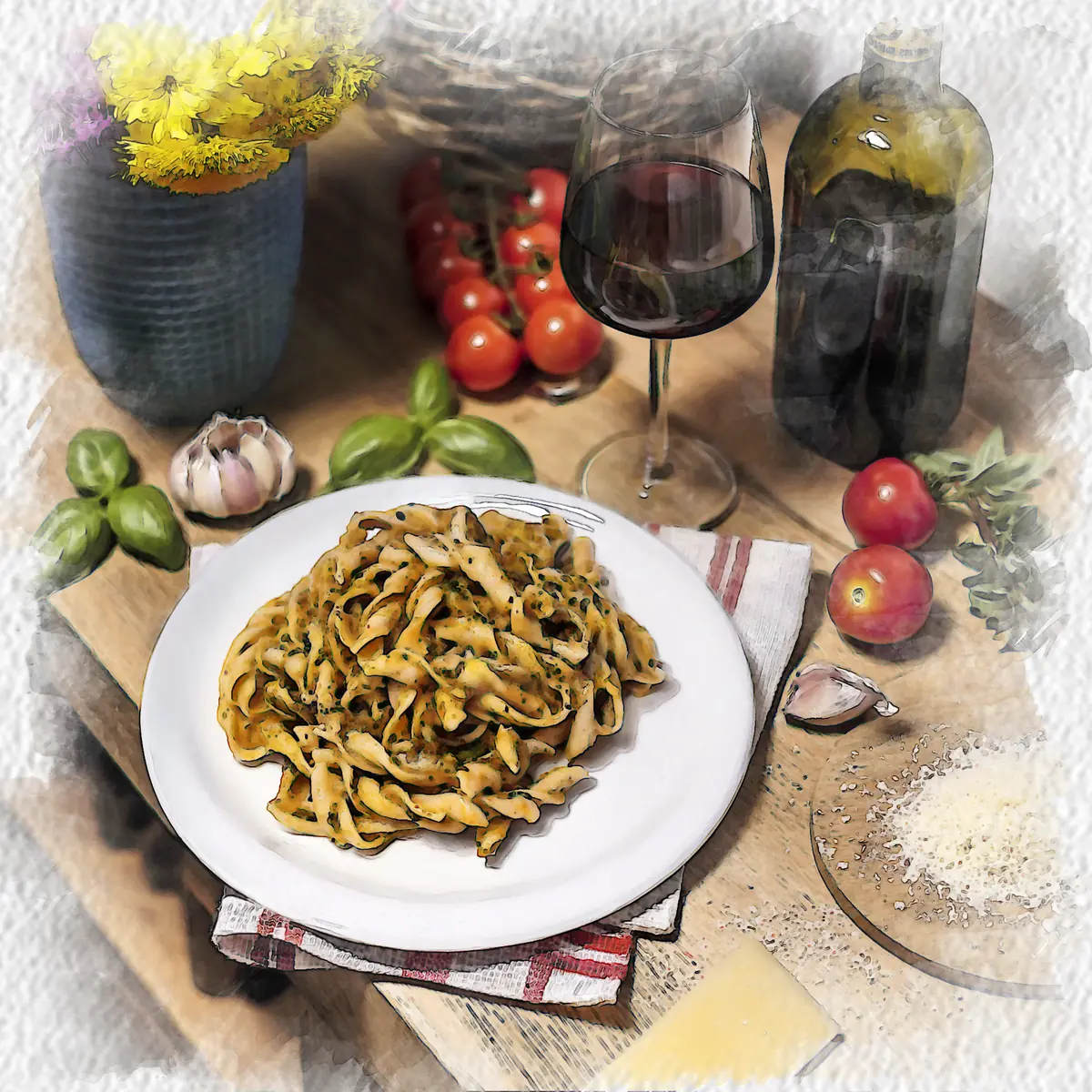
Busiate with Trapanese Pesto: A Lyrical Tribute to Sicilian Harvest
Semolina, Tomatoes, Almonds, Garlic, Basil, Pecorino.
Effortless
Sicily
A journey of ninety minutes
600 kcal
Busiate with Trapanese Pesto: A Lyrical Tribute to Sicilian Harvest
Semolina, Tomatoes, Almonds, Garlic, Basil, Pecorino.
Effortless
Sicily
A journey of ninety minutes
600 kcal
Busiate with Trapanese Pesto: A Lyrical Tribute to Sicilian Harvest
Semolina, Tomatoes, Almonds, Garlic, Basil, Pecorino.
Effortless
Sicily
A journey of ninety minutes
600 kcal
GENESIS
The Busiate with Pesto Trapanese are a true and proper hymn to the flavors and aromas of western Sicily, a dish that encapsulates within itself both agrarian and maritime history and tradition.
The origin of this condiment, known in dialect as "pasta cull'àgghia" (pasta with garlic), traces its roots back to the ancient port of Trapani, a crossroads of cultures and commerce. Legend has it that Genoese sailors, docking in the city, brought with them their celebrated pesto of basil and garlic.
Yet, the clever housewives of Trapani did not merely replicate the Ligurian recipe; instead, they reinvented it using the generous bounty of their own soil. They substituted local almonds, more readily found, for the pine nuts, and added an ingredient that would become fundamental: fresh tomato, the very sun of Sicily. Thus was born the pesto alla trapanese, a raw and fragrant emulsion that pairs exquisitely with fresh pasta, particularly with busiate.
The busiate themselves are a prototypical pasta shape of Trapani, whose spiral form is achieved by winding the dough around a "buso", a knitting needle or a twig of ampelodesmos (a local plant). This artisanal craftsmanship imparts a unique porosity to the pasta, capable of "capturing" and retaining every drop of flavor from the rich pesto. A dish simple in its conception, yet extraordinarily complex and gratifying to the palate, standing as a testament to the Sicilian capacity to elevate humble ingredients into gastronomic masterpieces.
PORTIONS (FOR 4 PERSONS)
FOR THE PASTA
Re-milled durum wheat semolina
Tepefied water
Salt
400 g
200-220 ml
a pinch
FOR THE EMBELLISHMENT
Ripe tomatoes (vine-ripened or San Marzano)
Blanched almonds
Garlic
Fresh basil (approximately 30-40 g of leaves)
Grated Sicilian Pecorino
Extra virgin olive oil
Coarse sea salt
Black pepper
250 g
50 g
1 clove
30-40 g of leaves
50 g
To taste
To taste
To taste
CURATION
For the Handcrafted Pasta:
Upon a wooden board, cascade the semolina into a gentle mound and hollow the center to form a well.
Infuse the warm water with a whisper of salt and pour it gradually into the quick, beginning to incorporate the flour with a fork's gentle touch.
Once the moisture is fully embraced, begin to knead with your hands, working with vigor for some 10 to 15 minutes, until you fashion a smooth, elastic, and harmonious dough.
Envelope the dough in film and allow it to rest at room temperature, undisturbed, for at least 30 minutes.
When its rest is complete, take small portions of the dough and roll them into slender cords, about half a centimeter thick.
Divide these cords into yielding pieces, some 5 to 7 cm in length.
Take one such piece and, utilizing a balance-thin busiate-rod (or a slender skewer), rest it upon the board. Apply a delicate pressure and, with the palm of your hand, sweep the dough over the iron, coaxing it into its classic, spiraling dance. Gently release the busiata from the rod.
Arrange the busiate on a tray dusted lightly with semolina, keeping them apart to preserve their singular beauty.For the Condiment (Pesto Trapanese):
Within a mortar (the ancestral preparation calls for this vessel, though a modern mill may suffice), place the peeled garlic and a pinch of coarse salt. Gratin with the pestle until a smooth paste is born.
Introduce the blanched almonds and continue to crush until they yield a textured, rustic paste.
Wash and thoroughly dry the basil leaves. Entrust them to the mortar, pressing them gently with a rhythmic touch (or blend on low speed to preserve their vibrant green soul without heat) until they are unified with the other elements.
Bathe the tomatoes, scoring a cross upon their base, and blanch them for a few fleeting seconds in boiling water. Plunge them into an icy bath, peel away the skin, discard the seeds and excess moisture, and section them into rustic pieces.
Add the tomatoes to the mortar, crushing them to achieve a textured, artisanal consistency, rich and varied, never too fine.
Transfer this vibrant emulsion to a bowl. Fold in the grated pecorino, stirring with grace.
Slowly drizzle the extra virgin olive oil, whisking continuous, until the pesto attains a creamy majesty, yet retains its body.
Season with salt and pepper to satisfy your palate. Let the pesto rest for at least 15 to 20 minutes, allowing the flavors to converse and harmonize.To Complete the Masterpiece:
Bring a generous pot of salted water to a rolling boil.
Gently immerse the fresh busiate. They will reach perfection in a few fleeting moments (the cooking time depends upon their thickness; taste to ensure they are cooked to perfection).
As the pasta cooks, place the pesto into a large bowl or directly into the pan where the marriage will take place. If desired, whisper a spoonful or two of the pasta's cooking water into the pesto to heighten its velvety texture.
Drain the busiate al dente, retaining a portion of the starchy cooking water.
Toss the busiate into the waiting bowl with the pesto, stirring gently to enlace them in a uniform embrace. If utilizing a pan, toss the pasta over a gentle flame for a mere moment.
If the harmony requires, add another splash of the cooking water to yield a perfectly integrated creation.
aspiration
For a pesto of even greater fragrance, crush the ingredients within a mortar: manual alchemy best preserves the delicate, fleeting aromas.
You may gently toast the almonds in a non-stick pan before their union, coaxing forth a more profound, roasted essence.
Should you wish to enrich the composition, adorn the dish with cubed fried aubergines or potatoes, in faithful reverence to sacred tradition.
For a more ethereal manifestation, you may diminish the portion of cheese, or omit it entirely to compose a vegan offering.


GENESIS
The Busiate with Pesto Trapanese are a true and proper hymn to the flavors and aromas of western Sicily, a dish that encapsulates within itself both agrarian and maritime history and tradition.
The origin of this condiment, known in dialect as "pasta cull'àgghia" (pasta with garlic), traces its roots back to the ancient port of Trapani, a crossroads of cultures and commerce. Legend has it that Genoese sailors, docking in the city, brought with them their celebrated pesto of basil and garlic.
Yet, the clever housewives of Trapani did not merely replicate the Ligurian recipe; instead, they reinvented it using the generous bounty of their own soil. They substituted local almonds, more readily found, for the pine nuts, and added an ingredient that would become fundamental: fresh tomato, the very sun of Sicily. Thus was born the pesto alla trapanese, a raw and fragrant emulsion that pairs exquisitely with fresh pasta, particularly with busiate.
The busiate themselves are a prototypical pasta shape of Trapani, whose spiral form is achieved by winding the dough around a "buso", a knitting needle or a twig of ampelodesmos (a local plant). This artisanal craftsmanship imparts a unique porosity to the pasta, capable of "capturing" and retaining every drop of flavor from the rich pesto. A dish simple in its conception, yet extraordinarily complex and gratifying to the palate, standing as a testament to the Sicilian capacity to elevate humble ingredients into gastronomic masterpieces.
PORTIONS (FOR 4 PERSONS)
FOR THE PASTA
Re-milled durum wheat semolina
Tepefied water
Salt
400 g
200-220 ml
a pinch
FOR THE EMBELLISHMENT
Ripe tomatoes (vine-ripened or San Marzano)
Blanched almonds
Garlic
Fresh basil (approximately 30-40 g of leaves)
Grated Sicilian Pecorino
Extra virgin olive oil
Coarse sea salt
Black pepper
250 g
50 g
1 clove
30-40 g of leaves
50 g
To taste
To taste
To taste
CURATION
For the Handcrafted Pasta:
Upon a wooden board, cascade the semolina into a gentle mound and hollow the center to form a well.
Infuse the warm water with a whisper of salt and pour it gradually into the quick, beginning to incorporate the flour with a fork's gentle touch.
Once the moisture is fully embraced, begin to knead with your hands, working with vigor for some 10 to 15 minutes, until you fashion a smooth, elastic, and harmonious dough.
Envelope the dough in film and allow it to rest at room temperature, undisturbed, for at least 30 minutes.
When its rest is complete, take small portions of the dough and roll them into slender cords, about half a centimeter thick.
Divide these cords into yielding pieces, some 5 to 7 cm in length.
Take one such piece and, utilizing a balance-thin busiate-rod (or a slender skewer), rest it upon the board. Apply a delicate pressure and, with the palm of your hand, sweep the dough over the iron, coaxing it into its classic, spiraling dance. Gently release the busiata from the rod.
Arrange the busiate on a tray dusted lightly with semolina, keeping them apart to preserve their singular beauty.For the Condiment (Pesto Trapanese):
Within a mortar (the ancestral preparation calls for this vessel, though a modern mill may suffice), place the peeled garlic and a pinch of coarse salt. Gratin with the pestle until a smooth paste is born.
Introduce the blanched almonds and continue to crush until they yield a textured, rustic paste.
Wash and thoroughly dry the basil leaves. Entrust them to the mortar, pressing them gently with a rhythmic touch (or blend on low speed to preserve their vibrant green soul without heat) until they are unified with the other elements.
Bathe the tomatoes, scoring a cross upon their base, and blanch them for a few fleeting seconds in boiling water. Plunge them into an icy bath, peel away the skin, discard the seeds and excess moisture, and section them into rustic pieces.
Add the tomatoes to the mortar, crushing them to achieve a textured, artisanal consistency, rich and varied, never too fine.
Transfer this vibrant emulsion to a bowl. Fold in the grated pecorino, stirring with grace.
Slowly drizzle the extra virgin olive oil, whisking continuous, until the pesto attains a creamy majesty, yet retains its body.
Season with salt and pepper to satisfy your palate. Let the pesto rest for at least 15 to 20 minutes, allowing the flavors to converse and harmonize.To Complete the Masterpiece:
Bring a generous pot of salted water to a rolling boil.
Gently immerse the fresh busiate. They will reach perfection in a few fleeting moments (the cooking time depends upon their thickness; taste to ensure they are cooked to perfection).
As the pasta cooks, place the pesto into a large bowl or directly into the pan where the marriage will take place. If desired, whisper a spoonful or two of the pasta's cooking water into the pesto to heighten its velvety texture.
Drain the busiate al dente, retaining a portion of the starchy cooking water.
Toss the busiate into the waiting bowl with the pesto, stirring gently to enlace them in a uniform embrace. If utilizing a pan, toss the pasta over a gentle flame for a mere moment.
If the harmony requires, add another splash of the cooking water to yield a perfectly integrated creation.
aspiration
For a pesto of even greater fragrance, crush the ingredients within a mortar: manual alchemy best preserves the delicate, fleeting aromas.
You may gently toast the almonds in a non-stick pan before their union, coaxing forth a more profound, roasted essence.
Should you wish to enrich the composition, adorn the dish with cubed fried aubergines or potatoes, in faithful reverence to sacred tradition.
For a more ethereal manifestation, you may diminish the portion of cheese, or omit it entirely to compose a vegan offering.
latest culinary creations
GENESIS
The Busiate with Pesto Trapanese are a true and proper hymn to the flavors and aromas of western Sicily, a dish that encapsulates within itself both agrarian and maritime history and tradition.
The origin of this condiment, known in dialect as "pasta cull'àgghia" (pasta with garlic), traces its roots back to the ancient port of Trapani, a crossroads of cultures and commerce. Legend has it that Genoese sailors, docking in the city, brought with them their celebrated pesto of basil and garlic.
Yet, the clever housewives of Trapani did not merely replicate the Ligurian recipe; instead, they reinvented it using the generous bounty of their own soil. They substituted local almonds, more readily found, for the pine nuts, and added an ingredient that would become fundamental: fresh tomato, the very sun of Sicily. Thus was born the pesto alla trapanese, a raw and fragrant emulsion that pairs exquisitely with fresh pasta, particularly with busiate.
The busiate themselves are a prototypical pasta shape of Trapani, whose spiral form is achieved by winding the dough around a "buso", a knitting needle or a twig of ampelodesmos (a local plant). This artisanal craftsmanship imparts a unique porosity to the pasta, capable of "capturing" and retaining every drop of flavor from the rich pesto. A dish simple in its conception, yet extraordinarily complex and gratifying to the palate, standing as a testament to the Sicilian capacity to elevate humble ingredients into gastronomic masterpieces.
PORTIONS (FOR 4 PERSONS)
FOR THE PASTA
Re-milled durum wheat semolina
Tepefied water
Salt
400 g
200-220 ml
a pinch
FOR THE EMBELLISHMENT
Ripe tomatoes (vine-ripened or San Marzano)
Blanched almonds
Garlic
Fresh basil (approximately 30-40 g of leaves)
Grated Sicilian Pecorino
Extra virgin olive oil
Coarse sea salt
Black pepper
250 g
50 g
1 clove
30-40 g of leaves
50 g
To taste
To taste
To taste
CURATION
For the Handcrafted Pasta:
Upon a wooden board, cascade the semolina into a gentle mound and hollow the center to form a well.
Infuse the warm water with a whisper of salt and pour it gradually into the quick, beginning to incorporate the flour with a fork's gentle touch.
Once the moisture is fully embraced, begin to knead with your hands, working with vigor for some 10 to 15 minutes, until you fashion a smooth, elastic, and harmonious dough.
Envelope the dough in film and allow it to rest at room temperature, undisturbed, for at least 30 minutes.
When its rest is complete, take small portions of the dough and roll them into slender cords, about half a centimeter thick.
Divide these cords into yielding pieces, some 5 to 7 cm in length.
Take one such piece and, utilizing a balance-thin busiate-rod (or a slender skewer), rest it upon the board. Apply a delicate pressure and, with the palm of your hand, sweep the dough over the iron, coaxing it into its classic, spiraling dance. Gently release the busiata from the rod.
Arrange the busiate on a tray dusted lightly with semolina, keeping them apart to preserve their singular beauty.For the Condiment (Pesto Trapanese):
Within a mortar (the ancestral preparation calls for this vessel, though a modern mill may suffice), place the peeled garlic and a pinch of coarse salt. Gratin with the pestle until a smooth paste is born.
Introduce the blanched almonds and continue to crush until they yield a textured, rustic paste.
Wash and thoroughly dry the basil leaves. Entrust them to the mortar, pressing them gently with a rhythmic touch (or blend on low speed to preserve their vibrant green soul without heat) until they are unified with the other elements.
Bathe the tomatoes, scoring a cross upon their base, and blanch them for a few fleeting seconds in boiling water. Plunge them into an icy bath, peel away the skin, discard the seeds and excess moisture, and section them into rustic pieces.
Add the tomatoes to the mortar, crushing them to achieve a textured, artisanal consistency, rich and varied, never too fine.
Transfer this vibrant emulsion to a bowl. Fold in the grated pecorino, stirring with grace.
Slowly drizzle the extra virgin olive oil, whisking continuous, until the pesto attains a creamy majesty, yet retains its body.
Season with salt and pepper to satisfy your palate. Let the pesto rest for at least 15 to 20 minutes, allowing the flavors to converse and harmonize.To Complete the Masterpiece:
Bring a generous pot of salted water to a rolling boil.
Gently immerse the fresh busiate. They will reach perfection in a few fleeting moments (the cooking time depends upon their thickness; taste to ensure they are cooked to perfection).
As the pasta cooks, place the pesto into a large bowl or directly into the pan where the marriage will take place. If desired, whisper a spoonful or two of the pasta's cooking water into the pesto to heighten its velvety texture.
Drain the busiate al dente, retaining a portion of the starchy cooking water.
Toss the busiate into the waiting bowl with the pesto, stirring gently to enlace them in a uniform embrace. If utilizing a pan, toss the pasta over a gentle flame for a mere moment.
If the harmony requires, add another splash of the cooking water to yield a perfectly integrated creation.
aspiration
For a pesto of even greater fragrance, crush the ingredients within a mortar: manual alchemy best preserves the delicate, fleeting aromas.
You may gently toast the almonds in a non-stick pan before their union, coaxing forth a more profound, roasted essence.
Should you wish to enrich the composition, adorn the dish with cubed fried aubergines or potatoes, in faithful reverence to sacred tradition.
For a more ethereal manifestation, you may diminish the portion of cheese, or omit it entirely to compose a vegan offering.