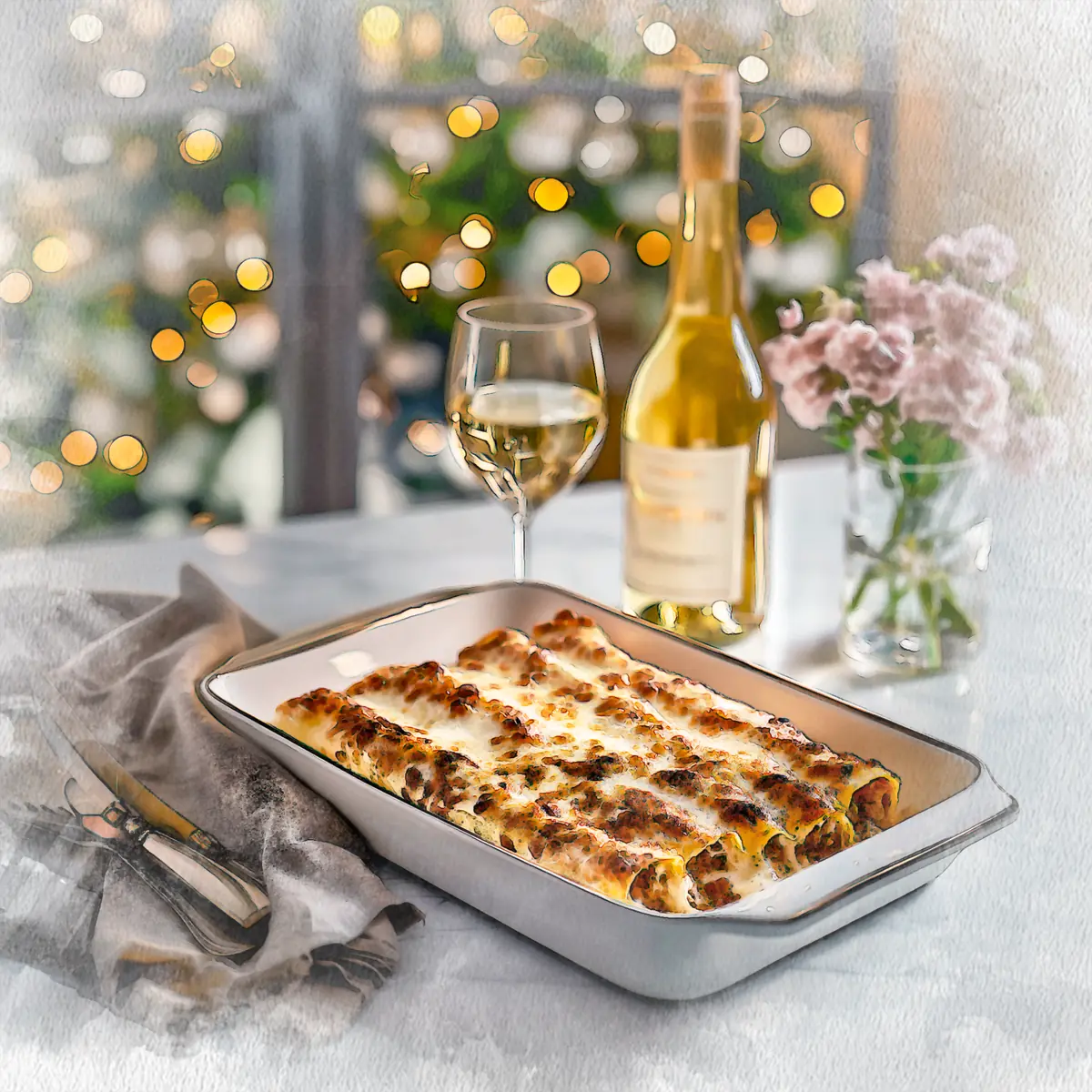
MEAT-STUFFED CANNELLONI
Minced meats, purée of sun-ripened tomatoes, aged Parmigiano Reggiano, farm eggs, whole milk, sweet butter, refined flour.
Moderate
Emilia-Romagna
120 minutes
Approximately 700 calories of culinary art
MEAT-STUFFED CANNELLONI
Minced meats, purée of sun-ripened tomatoes, aged Parmigiano Reggiano, farm eggs, whole milk, sweet butter, refined flour.
Moderate
Emilia-Romagna
120 minutes
Approximately 700 calories of culinary art
MEAT-STUFFED CANNELLONI
Minced meats, purée of sun-ripened tomatoes, aged Parmigiano Reggiano, farm eggs, whole milk, sweet butter, refined flour.
Moderate
Emilia-Romagna
120 minutes
Approximately 700 calories of culinary art
GENESIS
Meat-stuffed cannelloni stand as a noble pillar of Italian gastronomy, a rich and sumptuous first course that often reigns supreme over Sunday feasts and festive gatherings. Their history traces its lineage to antiquity, though their exact origins remain draped in a veil of mystery. It is murmured that a primordial guise of stuffed pasta, akin to the cannelloni of today, was already known in ancient Rome. Yet, the creation bequeathed to us—with its savory, seasoned filling and oven-baked finish—boasts a more recent heredity, having evolved over the centuries across Italy’s diverse regions.
The earliest documented whispers of preparations evoking modern cannelloni emerge in seventeenth-century culinary manuscripts, though sweet variations filled with cream or ricotta and dusted with sugar were more prevalent at the time. In the eighteenth century, the Neapolitan chef Vincenzo Corrado, within his celebrated treatise "Il Cuoco Galante," portrays a recipe of boiled "grossi paccheri," piped with meats and truffles and baked in a rich meat reduction—a close ancestor to the savory cannellone we revere today. The nineteenth century witnessed the triumphal rise of the cannellone in various regional dialects. Most notably, in Emilia-Romagna, where fresh egg pasta is a sacred art, the recipe flourished with a rich meat stuffing and velvety béchamel, ascending to a glorious emblem of Emilian culinary heritage.
Lore and legends abound regarding the genesis of cannelloni, such as the tale attributing their invention to an Amalfi chef in 1924, or the culinary rivalries between the Amalfi and Sorrentine coasts claiming paternity of the dish. Beyond these romantic myths, cannelloni have evolved into the quintessential dish of conviviality, possessing the power to unite families and kin around the festive table. Their versatility has inspired countless variations, from delicate vegetarian fillings of ricotta and spinach to coastal seafood renditions, yet it is this meat-filled masterpiece, enveloping and profound, that remains the most beloved and enduring.
PORTIONS (FOR 4 PERSONS)
FOR THE PASTA
Flour "00"
Medium eggs
300 gr
3
FOR THE CREATION'S HEART
Finely minced beef
Finely minced pork
Artisanal cured prosciutto
Mortadella
Farm-fresh egg
Parmigiano Reggiano
A whisper of nutmeg
Salt
Black pepper
Extra virgin olive oil
300 gr
100 gr
50 gr
50 gr
1
50 gr
q.s.
q.s.
q.s.
q.s.
FOR THE EMBELLISHMENT
Vellutata of sun-ripened tomatoes
Sweet garden carrot
Crisp stalk of celery
Delicate baby onion
Luscious whole milk
Rich churned butter
Fine "00" flour
Aged Parmigiano Reggiano
Pristine salt
Freshly cracked black pepper
Sublime Extra Virgin Olive Oil
700 gr
1
1
1
500 ml
50 gr
50 gr
to taste
to taste
to taste
to taste
CURATION
For the Handcrafted Pasta:
Upon your work surface, shape the flour into a gentle mound, fashioning a deep well at its heart. Gently release the eggs into this central cradle. With a fork, begin to whisper the eggs into motion, gradually coaxing the flour inward from the edges. As the dough gathers strength, abandon the utensil and knead by hand until you achieve a smooth, harmonious silken sphere. Swathe the dough in plastic wrap and allow it to rest in peaceful contemplation at room temperature for at least 30 minutes. Once rested, roll the dough thin with a pasta machine or a classic rolling pin, creating delicate sheets of about 1 mm in thickness. Shape these sheets into elegant rectangles of approximately 10x12 cm.For the Meat Ragù:
In a spacious, heavy-bottomed pan, let the finely minced carrot, celery, and onion gently sizzle in a generous thread of extra virgin olive oil. Once these aromatics have softened, introduce the ground beef and pork, searing over a lively flame and crumbling the meat with a wooden spoon. Fold in the finely chopped prosciutto and mortadella, letting their rich flavors marry for a few moments. Splash with a touch of white wine (optional) and let it vaporize entirely. Introduce the tomato passata, season with salt and pepper, and stir with devotion. Cover the pan and let the ragù simmer lazily over a low flame for at least 1 hour and 30 minutes, stirring occasionally and adding, if needed, a splash of warm water or vegetable broth to preserve its luscious texture.For the Béchamel:
In a small saucepan, gently melt the butter over a low flame. Rain in the flour all at once and whisk with vigor to avert any lumps. Cook this golden paste (the roux) for a brief couple of minutes, keeping its color pale. Draw away from the heat and pour in the cold milk in a thin stream, whisking without pause. Return to the flame and continue to stir until the béchamel thickens into a velvety cream. Season with salt, pepper, and a fragrant grating of fresh nutmeg.For the Stuffing of the Cannelloni:
Once the ragù is ready, set aside a portion of it (about a third) and let it cool slightly. In a generous bowl, combine this warm ragù, the egg, the grated Parmigiano Reggiano, a whisper of nutmeg, salt, and pepper. Merge all these elements until a perfectly balanced filling is born.For the Assembly:
Bring a generous pot of salted water to a rolling boil. Immerse the pasta rectangles a few at a time, parboiling them for just 1 to 2 minutes, simply to render them pliable. Tenderly lift them out with a skimmer and lay them upon a clean, damp cloth to rest. Spoon a generous portion of the meat filling onto the center of each pasta sheet. Roll the pasta upon itself, cloaking the filling to form the classic cannelloni. Across the bottom of a baking dish, spread a ladle of ragù and a sweep of béchamel. Arrange the cannelloni side by side, creating a harmonious, singular layer. Blanket the cannelloni with the remaining ragù and a lavish layer of béchamel. SShower the dish with an abundant snowfall of grated Parmigiano Reggiano. Bake in a preheated static oven at 180°C for approximately 25-30 minutes, until the top is beautifully gilded and crisp. Let the cannelloni rest for a few minutes away from the heat before presenting this masterpiece at the table.
aspiration
For a more profound depth of flavor, you may grace the ragù with a small glass of red wine as the meat gently browns, inviting a richer complexity.
To achieve an even more exquisite and golden crust, dot the surface with delicate whispers of butter just before committing it to the oven.
These culinary creations may be composed in advance, resting in the cool sanctuary of the refrigerator for a single day, or preserved in the frost—either raw or fully baked—to be gently warmed when the moment arises.


GENESIS
Meat-stuffed cannelloni stand as a noble pillar of Italian gastronomy, a rich and sumptuous first course that often reigns supreme over Sunday feasts and festive gatherings. Their history traces its lineage to antiquity, though their exact origins remain draped in a veil of mystery. It is murmured that a primordial guise of stuffed pasta, akin to the cannelloni of today, was already known in ancient Rome. Yet, the creation bequeathed to us—with its savory, seasoned filling and oven-baked finish—boasts a more recent heredity, having evolved over the centuries across Italy’s diverse regions.
The earliest documented whispers of preparations evoking modern cannelloni emerge in seventeenth-century culinary manuscripts, though sweet variations filled with cream or ricotta and dusted with sugar were more prevalent at the time. In the eighteenth century, the Neapolitan chef Vincenzo Corrado, within his celebrated treatise "Il Cuoco Galante," portrays a recipe of boiled "grossi paccheri," piped with meats and truffles and baked in a rich meat reduction—a close ancestor to the savory cannellone we revere today. The nineteenth century witnessed the triumphal rise of the cannellone in various regional dialects. Most notably, in Emilia-Romagna, where fresh egg pasta is a sacred art, the recipe flourished with a rich meat stuffing and velvety béchamel, ascending to a glorious emblem of Emilian culinary heritage.
Lore and legends abound regarding the genesis of cannelloni, such as the tale attributing their invention to an Amalfi chef in 1924, or the culinary rivalries between the Amalfi and Sorrentine coasts claiming paternity of the dish. Beyond these romantic myths, cannelloni have evolved into the quintessential dish of conviviality, possessing the power to unite families and kin around the festive table. Their versatility has inspired countless variations, from delicate vegetarian fillings of ricotta and spinach to coastal seafood renditions, yet it is this meat-filled masterpiece, enveloping and profound, that remains the most beloved and enduring.
PORTIONS (FOR 4 PERSONS)
FOR THE PASTA
Flour "00"
Medium eggs
300 gr
3
FOR THE CREATION'S HEART
Finely minced beef
Finely minced pork
Artisanal cured prosciutto
Mortadella
Farm-fresh egg
Parmigiano Reggiano
A whisper of nutmeg
Salt
Black pepper
Extra virgin olive oil
300 gr
100 gr
50 gr
50 gr
1
50 gr
q.s.
q.s.
q.s.
q.s.
FOR THE EMBELLISHMENT
Vellutata of sun-ripened tomatoes
Sweet garden carrot
Crisp stalk of celery
Delicate baby onion
Luscious whole milk
Rich churned butter
Fine "00" flour
Aged Parmigiano Reggiano
Pristine salt
Freshly cracked black pepper
Sublime Extra Virgin Olive Oil
700 gr
1
1
1
500 ml
50 gr
50 gr
to taste
to taste
to taste
to taste
CURATION
For the Handcrafted Pasta:
Upon your work surface, shape the flour into a gentle mound, fashioning a deep well at its heart. Gently release the eggs into this central cradle. With a fork, begin to whisper the eggs into motion, gradually coaxing the flour inward from the edges. As the dough gathers strength, abandon the utensil and knead by hand until you achieve a smooth, harmonious silken sphere. Swathe the dough in plastic wrap and allow it to rest in peaceful contemplation at room temperature for at least 30 minutes. Once rested, roll the dough thin with a pasta machine or a classic rolling pin, creating delicate sheets of about 1 mm in thickness. Shape these sheets into elegant rectangles of approximately 10x12 cm.For the Meat Ragù:
In a spacious, heavy-bottomed pan, let the finely minced carrot, celery, and onion gently sizzle in a generous thread of extra virgin olive oil. Once these aromatics have softened, introduce the ground beef and pork, searing over a lively flame and crumbling the meat with a wooden spoon. Fold in the finely chopped prosciutto and mortadella, letting their rich flavors marry for a few moments. Splash with a touch of white wine (optional) and let it vaporize entirely. Introduce the tomato passata, season with salt and pepper, and stir with devotion. Cover the pan and let the ragù simmer lazily over a low flame for at least 1 hour and 30 minutes, stirring occasionally and adding, if needed, a splash of warm water or vegetable broth to preserve its luscious texture.For the Béchamel:
In a small saucepan, gently melt the butter over a low flame. Rain in the flour all at once and whisk with vigor to avert any lumps. Cook this golden paste (the roux) for a brief couple of minutes, keeping its color pale. Draw away from the heat and pour in the cold milk in a thin stream, whisking without pause. Return to the flame and continue to stir until the béchamel thickens into a velvety cream. Season with salt, pepper, and a fragrant grating of fresh nutmeg.For the Stuffing of the Cannelloni:
Once the ragù is ready, set aside a portion of it (about a third) and let it cool slightly. In a generous bowl, combine this warm ragù, the egg, the grated Parmigiano Reggiano, a whisper of nutmeg, salt, and pepper. Merge all these elements until a perfectly balanced filling is born.For the Assembly:
Bring a generous pot of salted water to a rolling boil. Immerse the pasta rectangles a few at a time, parboiling them for just 1 to 2 minutes, simply to render them pliable. Tenderly lift them out with a skimmer and lay them upon a clean, damp cloth to rest. Spoon a generous portion of the meat filling onto the center of each pasta sheet. Roll the pasta upon itself, cloaking the filling to form the classic cannelloni. Across the bottom of a baking dish, spread a ladle of ragù and a sweep of béchamel. Arrange the cannelloni side by side, creating a harmonious, singular layer. Blanket the cannelloni with the remaining ragù and a lavish layer of béchamel. SShower the dish with an abundant snowfall of grated Parmigiano Reggiano. Bake in a preheated static oven at 180°C for approximately 25-30 minutes, until the top is beautifully gilded and crisp. Let the cannelloni rest for a few minutes away from the heat before presenting this masterpiece at the table.
aspiration
For a more profound depth of flavor, you may grace the ragù with a small glass of red wine as the meat gently browns, inviting a richer complexity.
To achieve an even more exquisite and golden crust, dot the surface with delicate whispers of butter just before committing it to the oven.
These culinary creations may be composed in advance, resting in the cool sanctuary of the refrigerator for a single day, or preserved in the frost—either raw or fully baked—to be gently warmed when the moment arises.
latest culinary creations
GENESIS
Meat-stuffed cannelloni stand as a noble pillar of Italian gastronomy, a rich and sumptuous first course that often reigns supreme over Sunday feasts and festive gatherings. Their history traces its lineage to antiquity, though their exact origins remain draped in a veil of mystery. It is murmured that a primordial guise of stuffed pasta, akin to the cannelloni of today, was already known in ancient Rome. Yet, the creation bequeathed to us—with its savory, seasoned filling and oven-baked finish—boasts a more recent heredity, having evolved over the centuries across Italy’s diverse regions.
The earliest documented whispers of preparations evoking modern cannelloni emerge in seventeenth-century culinary manuscripts, though sweet variations filled with cream or ricotta and dusted with sugar were more prevalent at the time. In the eighteenth century, the Neapolitan chef Vincenzo Corrado, within his celebrated treatise "Il Cuoco Galante," portrays a recipe of boiled "grossi paccheri," piped with meats and truffles and baked in a rich meat reduction—a close ancestor to the savory cannellone we revere today. The nineteenth century witnessed the triumphal rise of the cannellone in various regional dialects. Most notably, in Emilia-Romagna, where fresh egg pasta is a sacred art, the recipe flourished with a rich meat stuffing and velvety béchamel, ascending to a glorious emblem of Emilian culinary heritage.
Lore and legends abound regarding the genesis of cannelloni, such as the tale attributing their invention to an Amalfi chef in 1924, or the culinary rivalries between the Amalfi and Sorrentine coasts claiming paternity of the dish. Beyond these romantic myths, cannelloni have evolved into the quintessential dish of conviviality, possessing the power to unite families and kin around the festive table. Their versatility has inspired countless variations, from delicate vegetarian fillings of ricotta and spinach to coastal seafood renditions, yet it is this meat-filled masterpiece, enveloping and profound, that remains the most beloved and enduring.
PORTIONS (FOR 4 PERSONS)
FOR THE PASTA
Flour "00"
Medium eggs
300 gr
3
FOR THE CREATION'S HEART
Finely minced beef
Finely minced pork
Artisanal cured prosciutto
Mortadella
Farm-fresh egg
Parmigiano Reggiano
A whisper of nutmeg
Salt
Black pepper
Extra virgin olive oil
300 gr
100 gr
50 gr
50 gr
1
50 gr
q.s.
q.s.
q.s.
q.s.
FOR THE EMBELLISHMENT
Vellutata of sun-ripened tomatoes
Sweet garden carrot
Crisp stalk of celery
Delicate baby onion
Luscious whole milk
Rich churned butter
Fine "00" flour
Aged Parmigiano Reggiano
Pristine salt
Freshly cracked black pepper
Sublime Extra Virgin Olive Oil
700 gr
1
1
1
500 ml
50 gr
50 gr
to taste
to taste
to taste
to taste
CURATION
For the Handcrafted Pasta:
Upon your work surface, shape the flour into a gentle mound, fashioning a deep well at its heart. Gently release the eggs into this central cradle. With a fork, begin to whisper the eggs into motion, gradually coaxing the flour inward from the edges. As the dough gathers strength, abandon the utensil and knead by hand until you achieve a smooth, harmonious silken sphere. Swathe the dough in plastic wrap and allow it to rest in peaceful contemplation at room temperature for at least 30 minutes. Once rested, roll the dough thin with a pasta machine or a classic rolling pin, creating delicate sheets of about 1 mm in thickness. Shape these sheets into elegant rectangles of approximately 10x12 cm.For the Meat Ragù:
In a spacious, heavy-bottomed pan, let the finely minced carrot, celery, and onion gently sizzle in a generous thread of extra virgin olive oil. Once these aromatics have softened, introduce the ground beef and pork, searing over a lively flame and crumbling the meat with a wooden spoon. Fold in the finely chopped prosciutto and mortadella, letting their rich flavors marry for a few moments. Splash with a touch of white wine (optional) and let it vaporize entirely. Introduce the tomato passata, season with salt and pepper, and stir with devotion. Cover the pan and let the ragù simmer lazily over a low flame for at least 1 hour and 30 minutes, stirring occasionally and adding, if needed, a splash of warm water or vegetable broth to preserve its luscious texture.For the Béchamel:
In a small saucepan, gently melt the butter over a low flame. Rain in the flour all at once and whisk with vigor to avert any lumps. Cook this golden paste (the roux) for a brief couple of minutes, keeping its color pale. Draw away from the heat and pour in the cold milk in a thin stream, whisking without pause. Return to the flame and continue to stir until the béchamel thickens into a velvety cream. Season with salt, pepper, and a fragrant grating of fresh nutmeg.For the Stuffing of the Cannelloni:
Once the ragù is ready, set aside a portion of it (about a third) and let it cool slightly. In a generous bowl, combine this warm ragù, the egg, the grated Parmigiano Reggiano, a whisper of nutmeg, salt, and pepper. Merge all these elements until a perfectly balanced filling is born.For the Assembly:
Bring a generous pot of salted water to a rolling boil. Immerse the pasta rectangles a few at a time, parboiling them for just 1 to 2 minutes, simply to render them pliable. Tenderly lift them out with a skimmer and lay them upon a clean, damp cloth to rest. Spoon a generous portion of the meat filling onto the center of each pasta sheet. Roll the pasta upon itself, cloaking the filling to form the classic cannelloni. Across the bottom of a baking dish, spread a ladle of ragù and a sweep of béchamel. Arrange the cannelloni side by side, creating a harmonious, singular layer. Blanket the cannelloni with the remaining ragù and a lavish layer of béchamel. SShower the dish with an abundant snowfall of grated Parmigiano Reggiano. Bake in a preheated static oven at 180°C for approximately 25-30 minutes, until the top is beautifully gilded and crisp. Let the cannelloni rest for a few minutes away from the heat before presenting this masterpiece at the table.
aspiration
For a more profound depth of flavor, you may grace the ragù with a small glass of red wine as the meat gently browns, inviting a richer complexity.
To achieve an even more exquisite and golden crust, dot the surface with delicate whispers of butter just before committing it to the oven.
These culinary creations may be composed in advance, resting in the cool sanctuary of the refrigerator for a single day, or preserved in the frost—either raw or fully baked—to be gently warmed when the moment arises.