CASANOVA, THE PRINCE OF MACCHERONI
Sex, hunger, and literature in the pasta of the libertine
May 13, 2026
CASANOVA, THE PRINCE OF MACCHERONI
Sex, hunger, and literature in the pasta of the libertine
May 13, 2026
CASANOVA, THE PRINCE OF MACCHERONI
Sex, hunger, and literature in the pasta of the libertine
May 13, 2026
There are men who do not merely traverse the world: they devour it. Giacomo Casanova belongs to this restless breed, composed of wanderers, actors of their own selves, avid collectors of encounters, alcoves, banquets, and promises. His life, long before becoming a voluptuous legend, was a continuous exercise of appetite: a hunger for bodies, for fortune, for recognition, for adventure. And also, in the most concrete sense, a yearning for sustenance.
Within his Histoire de ma vie, that unstable and magnificent monument where memory, vanity, and confession intertwine without ever completely separating, the table is no decorative detail. It is a stage. A minor yet essential theater, where man reveals himself no less than in the bedchambers or the salons. Casanova dines to know, to possess, to celebrate the ephemeral transit of existence. Each dish becomes a small trial of the world, an occasion in which pleasure translates into eloquence.
In this 'theater of appetite', macaroni occupies a singular place. It is at once a comic and noble medium, popular and ceremonial, capable of transforming a banquet into a sacred rite and a jubilant glutton into a nigh-chivalric title.
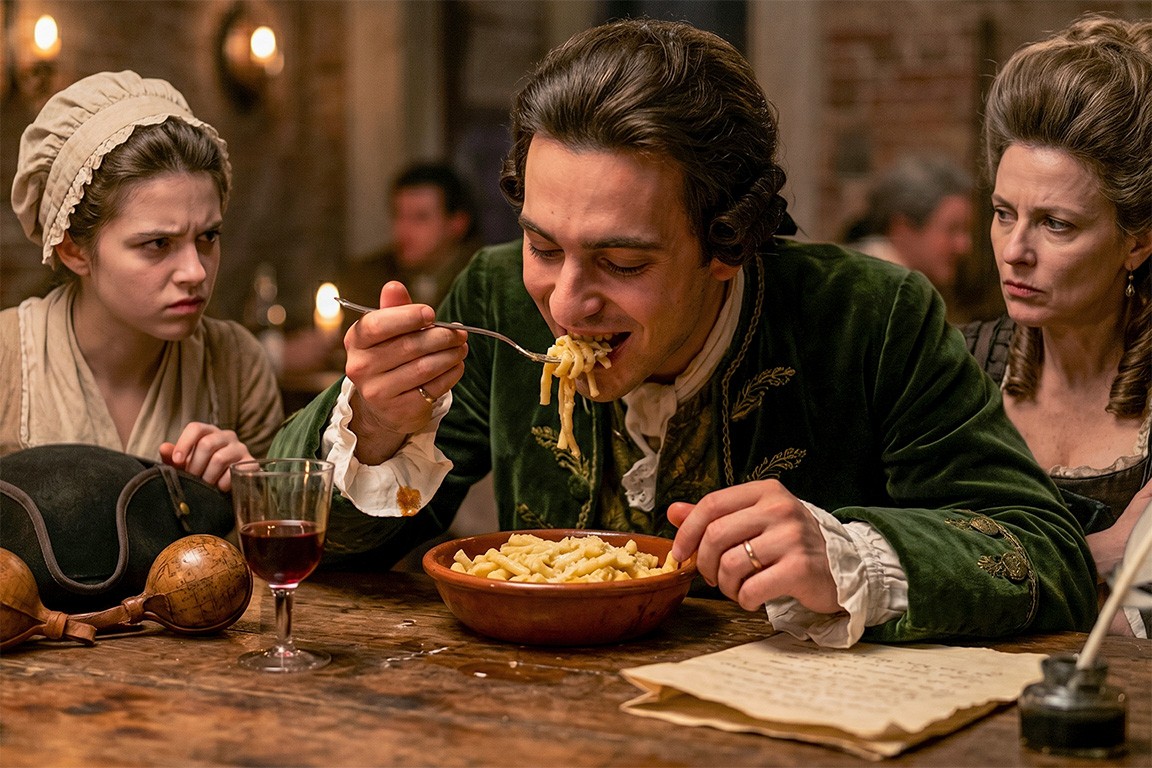
The most celebrated episode unfolds in Chioggia, an amphibious city suspended between water, salt, taverns, and passages. There, Casanova encounters a company of epicureans and verse-makers, a sort of convivial brotherhood dedicated to macaroni and playful wordplay. Here, the pasta is not merely served: it is celebrated, sung, elevated to an emblem of belonging. Within that scene, amidst irony, appetite, and performance, Casanova is proclaimed the Prince of Macaroni.
The title, naturally, carries the tone of a jest. Yet, as so often occurs in eighteenth-century mockery, it suggests far more than it seems. To be the Prince of Macaroni is to be recognized as sovereign not of a kingdom, but of a gesture: to dine with pleasing cupidity, with presence, with that innate theatricality which in Casanova becomes destiny. Macaroni, a food of substance and merriment, assumes the paradox of a culinary royalty—democratic and carnal.
The pasta, in this scene, demands no genealogies: it demands jaws, hands, appetite, and company. It is a rustic heraldry, forged of semolina, water, boiling fire, condiment, and that immediate joy which no courtly etiquette can ever truly confine.
Elsewhere in his memoirs, Casanova returns to pasta with the same naturalness with which he returns to gambling, to travel, to seduction. Renowned too is his Parmesan recollection of an opulent dish, wherein macaroni is entwined with butter, eggs, prosciutto, and cheese: not a delicate recipe, but a grand architecture of abundance. A rich, generous, almost baroque pasta, that seems to belong far more to desire than to temperance.
And perhaps it is precisely here that the bond between Casanova and macaroni grows most poignant. The pasta serves him not merely as nourishment. It is theatrical staging. It is a narrative of the self. Every table becomes a brief self-portrait, every hunger a declaration of existence.
Thus the libertine Venetian, whom history has consigned primarily to the chambers of desire, reveals himself for an instant in a different light: no less sensual, but more terrestrial. A man seated before a plate, once again poised to transfigure experience into prose. The pasta becomes his most unexpected mirror: not the refined, perfumed elegance of the salon, but the warm, raw, unyielding, and atavistic truth of hunger.
And in that playful title, Prince of Macaroni, the myth no longer speaks "ex cathedra" but acquires physical substance; it transforms a dish into a tale, a longing into destiny, a libertine into an ephemeral, smiling sovereign of a realm made of semolina, butter, banter, and delight.


There are men who do not merely traverse the world: they devour it. Giacomo Casanova belongs to this restless breed, composed of wanderers, actors of their own selves, avid collectors of encounters, alcoves, banquets, and promises. His life, long before becoming a voluptuous legend, was a continuous exercise of appetite: a hunger for bodies, for fortune, for recognition, for adventure. And also, in the most concrete sense, a yearning for sustenance.
Within his Histoire de ma vie, that unstable and magnificent monument where memory, vanity, and confession intertwine without ever completely separating, the table is no decorative detail. It is a stage. A minor yet essential theater, where man reveals himself no less than in the bedchambers or the salons. Casanova dines to know, to possess, to celebrate the ephemeral transit of existence. Each dish becomes a small trial of the world, an occasion in which pleasure translates into eloquence.
In this 'theater of appetite', macaroni occupies a singular place. It is at once a comic and noble medium, popular and ceremonial, capable of transforming a banquet into a sacred rite and a jubilant glutton into a nigh-chivalric title.
The most celebrated episode unfolds in Chioggia, an amphibious city suspended between water, salt, taverns, and passages. There, Casanova encounters a company of epicureans and verse-makers, a sort of convivial brotherhood dedicated to macaroni and playful wordplay. Here, the pasta is not merely served: it is celebrated, sung, elevated to an emblem of belonging. Within that scene, amidst irony, appetite, and performance, Casanova is proclaimed the Prince of Macaroni.
The title, naturally, carries the tone of a jest. Yet, as so often occurs in eighteenth-century mockery, it suggests far more than it seems. To be the Prince of Macaroni is to be recognized as sovereign not of a kingdom, but of a gesture: to dine with pleasing cupidity, with presence, with that innate theatricality which in Casanova becomes destiny. Macaroni, a food of substance and merriment, assumes the paradox of a culinary royalty—democratic and carnal.
The pasta, in this scene, demands no genealogies: it demands jaws, hands, appetite, and company. It is a rustic heraldry, forged of semolina, water, boiling fire, condiment, and that immediate joy which no courtly etiquette can ever truly confine.
Elsewhere in his memoirs, Casanova returns to pasta with the same naturalness with which he returns to gambling, to travel, to seduction. Renowned too is his Parmesan recollection of an opulent dish, wherein macaroni is entwined with butter, eggs, prosciutto, and cheese: not a delicate recipe, but a grand architecture of abundance. A rich, generous, almost baroque pasta, that seems to belong far more to desire than to temperance.
And perhaps it is precisely here that the bond between Casanova and macaroni grows most poignant. The pasta serves him not merely as nourishment. It is theatrical staging. It is a narrative of the self. Every table becomes a brief self-portrait, every hunger a declaration of existence.
Thus the libertine Venetian, whom history has consigned primarily to the chambers of desire, reveals himself for an instant in a different light: no less sensual, but more terrestrial. A man seated before a plate, once again poised to transfigure experience into prose. The pasta becomes his most unexpected mirror: not the refined, perfumed elegance of the salon, but the warm, raw, unyielding, and atavistic truth of hunger.
And in that playful title, Prince of Macaroni, the myth no longer speaks "ex cathedra" but acquires physical substance; it transforms a dish into a tale, a longing into destiny, a libertine into an ephemeral, smiling sovereign of a realm made of semolina, butter, banter, and delight.
There are men who do not merely traverse the world: they devour it. Giacomo Casanova belongs to this restless breed, composed of wanderers, actors of their own selves, avid collectors of encounters, alcoves, banquets, and promises. His life, long before becoming a voluptuous legend, was a continuous exercise of appetite: a hunger for bodies, for fortune, for recognition, for adventure. And also, in the most concrete sense, a yearning for sustenance.
Within his Histoire de ma vie, that unstable and magnificent monument where memory, vanity, and confession intertwine without ever completely separating, the table is no decorative detail. It is a stage. A minor yet essential theater, where man reveals himself no less than in the bedchambers or the salons. Casanova dines to know, to possess, to celebrate the ephemeral transit of existence. Each dish becomes a small trial of the world, an occasion in which pleasure translates into eloquence.
In this 'theater of appetite', macaroni occupies a singular place. It is at once a comic and noble medium, popular and ceremonial, capable of transforming a banquet into a sacred rite and a jubilant glutton into a nigh-chivalric title.
The most celebrated episode unfolds in Chioggia, an amphibious city suspended between water, salt, taverns, and passages. There, Casanova encounters a company of epicureans and verse-makers, a sort of convivial brotherhood dedicated to macaroni and playful wordplay. Here, the pasta is not merely served: it is celebrated, sung, elevated to an emblem of belonging. Within that scene, amidst irony, appetite, and performance, Casanova is proclaimed the Prince of Macaroni.
The title, naturally, carries the tone of a jest. Yet, as so often occurs in eighteenth-century mockery, it suggests far more than it seems. To be the Prince of Macaroni is to be recognized as sovereign not of a kingdom, but of a gesture: to dine with pleasing cupidity, with presence, with that innate theatricality which in Casanova becomes destiny. Macaroni, a food of substance and merriment, assumes the paradox of a culinary royalty—democratic and carnal.
The pasta, in this scene, demands no genealogies: it demands jaws, hands, appetite, and company. It is a rustic heraldry, forged of semolina, water, boiling fire, condiment, and that immediate joy which no courtly etiquette can ever truly confine.
Elsewhere in his memoirs, Casanova returns to pasta with the same naturalness with which he returns to gambling, to travel, to seduction. Renowned too is his Parmesan recollection of an opulent dish, wherein macaroni is entwined with butter, eggs, prosciutto, and cheese: not a delicate recipe, but a grand architecture of abundance. A rich, generous, almost baroque pasta, that seems to belong far more to desire than to temperance.
And perhaps it is precisely here that the bond between Casanova and macaroni grows most poignant. The pasta serves him not merely as nourishment. It is theatrical staging. It is a narrative of the self. Every table becomes a brief self-portrait, every hunger a declaration of existence.
Thus the libertine Venetian, whom history has consigned primarily to the chambers of desire, reveals himself for an instant in a different light: no less sensual, but more terrestrial. A man seated before a plate, once again poised to transfigure experience into prose. The pasta becomes his most unexpected mirror: not the refined, perfumed elegance of the salon, but the warm, raw, unyielding, and atavistic truth of hunger.
And in that playful title, Prince of Macaroni, the myth no longer speaks "ex cathedra" but acquires physical substance; it transforms a dish into a tale, a longing into destiny, a libertine into an ephemeral, smiling sovereign of a realm made of semolina, butter, banter, and delight.