CURRICULUM VITAE
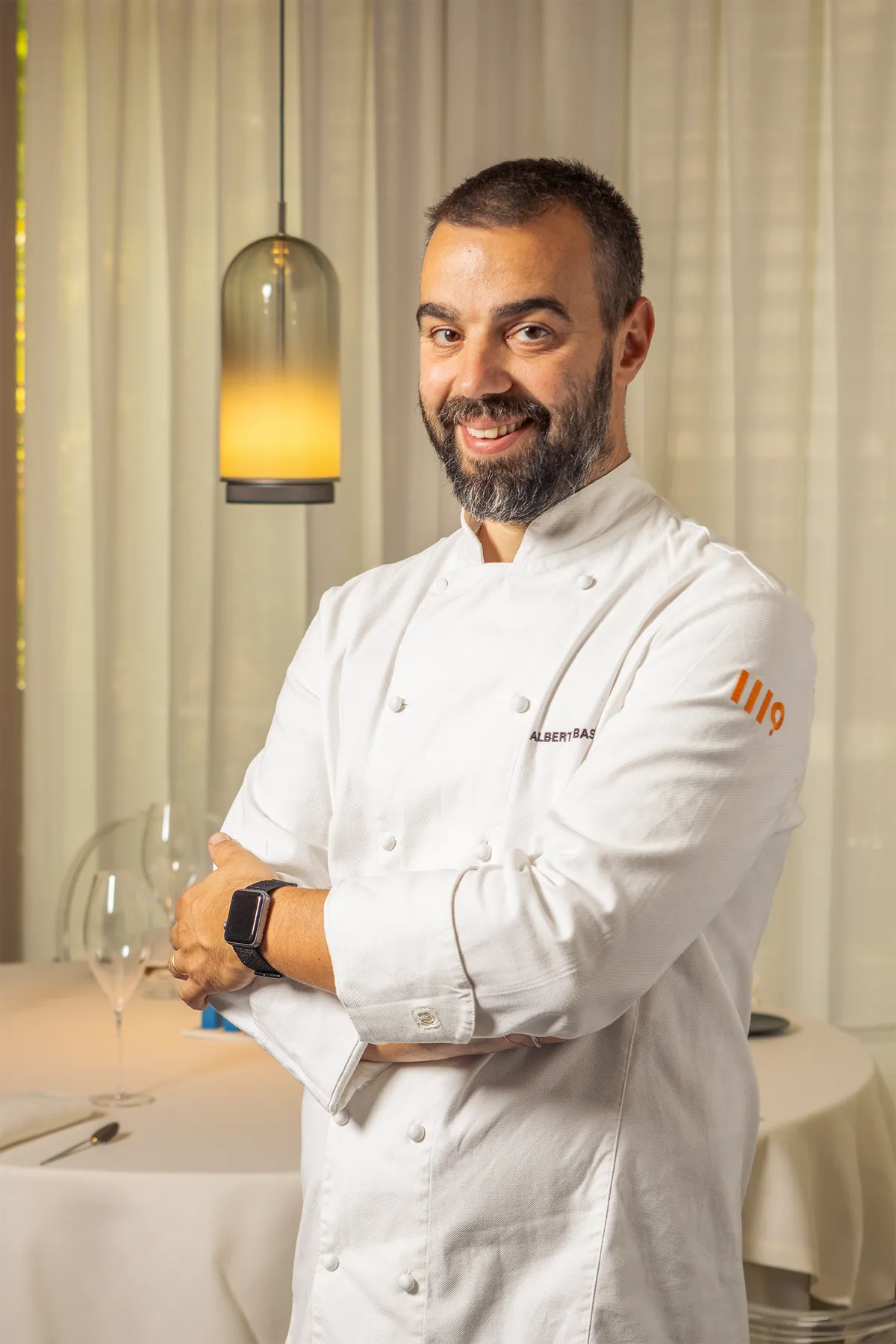
Born in 1984, Alberto Basso embodies one of the most lucid evolutions of contemporary Venetian gastronomy. His technical foundation was forged within one of the shrines of Italian culinary discipline: the Ristorante La Peca of the Portinari brothers. There, for over three years, he held a strategic mantle—chef de partie of first courses and pastry—nurturing a rare, dual syntax: on one hand, a profound sensitivity for carbohydrates, for the sacred tempo of rice and pasta; on the other, the scientific rigor, millimetric precision, and absolute mastery native to the pastry arts.
In 2010, Basso unveiled Ristorante Trequarti in Grancona, within the Val Liona: a name intentionally devoid of rhetoric, where 3/4 is simply the street number of the piazza hosting it. A touch of reality, not a contrived symbol.
His narrative suffered a profound rupture in 2015 with the untimely passing of his partner and co-founder, Stefano Leonardi. It was a point of no return. Confronted with the prospect of closure, Basso chose instead to rebuild the project anew, transforming grief into creative architecture. From this wound, Le Alture was born: an annual benefit that channels gastronomic excellence toward a noble purpose: funding scholarships for students of culinary academies. Here, a mature vision of the chef’s role shines forth: not merely an arbiter of taste, but a custodian of duty, capable of giving back value to the very system that nurtured him.
Today, the identity of Trequarti crystallizes into a formula light only in appearance: Fun Dining. It is a conscious response to the rigid rituals of haute cuisine. The objective is to desacralize without diminishing: allowing the guest to unwind and delight, while remaining enveloped in a sublime level of technical artistry.
Basso’s culinary discourse thrives on contrasts and calculated tensions: hot and cold, sweet and savory, textures in elegant conflict. The iconic ingredients of Venetian tradition — stockfish, polenta — are decontextualized and at times translated into the realm of dessert. Not as a mere exercise in style, but to provoke a playful reflection, a surprise that gently questions memory. Equally symbolic is his decision to serve Gargati pasta by demanding deliberately long waiting times, of up to forty minutes. A counter-cultural, almost political gesture: restoring majesty to anticipation in a world that consumes everything in real time.
Today, Alberto Basso stands as a beacon for the new wave of Italian dining. A member of the JRE since 2016, and currently President for Italy, he guides a network centered on sharing, mentorship, and collective evolution. Meanwhile, his creation, Trequarti, remains a mature table, deeply rooted in the Val Liona yet capable of speaking with an international eloquence: a cuisine that does not disavow technique, but rather wields it to craft freedom.
dialogues
If pasta were a "portrait" of you as a chef, what detail could not be missed? A gesture, an aroma, a texture: where does your first authentic bond with pasta originate?
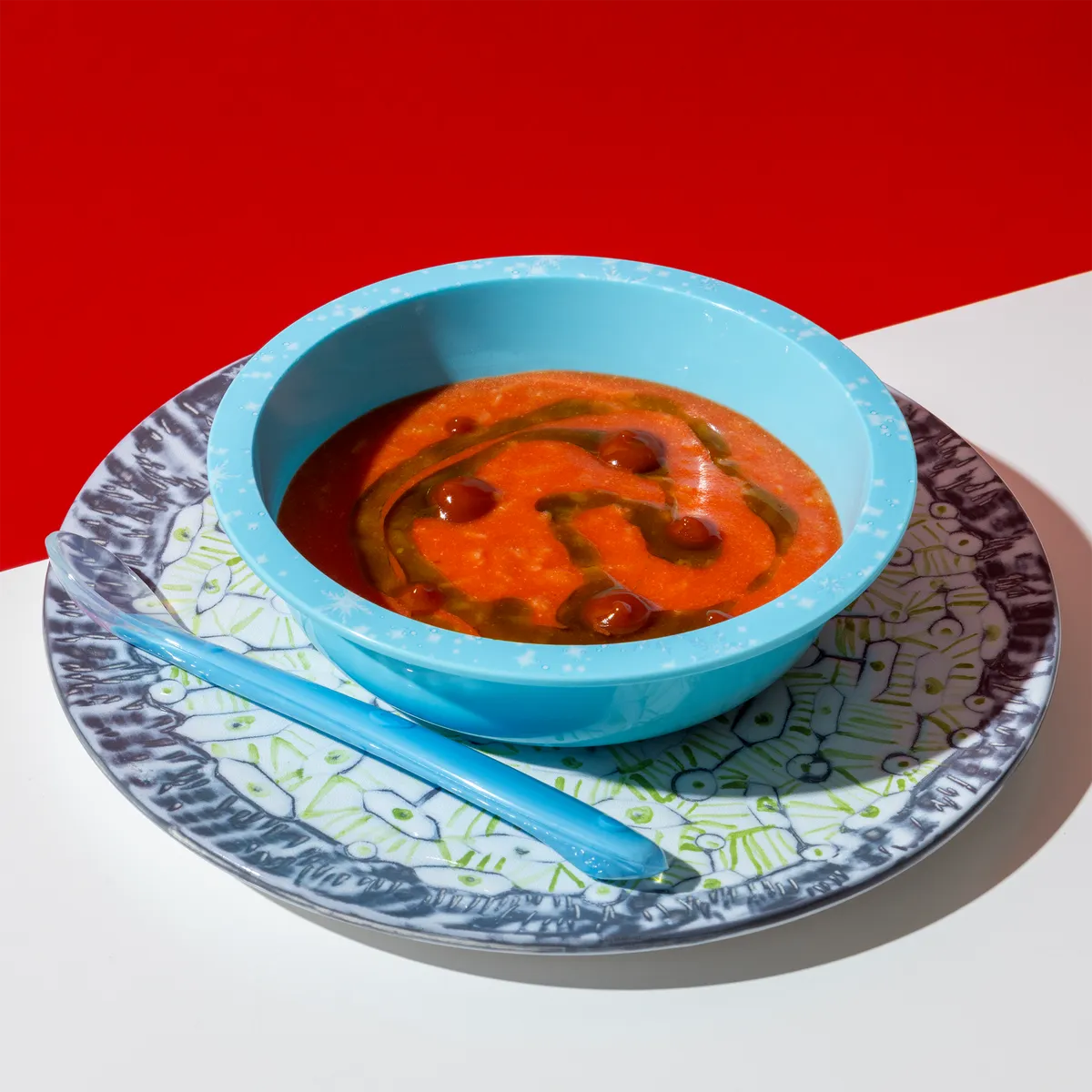
The presence of texture and chewiness could never be absent: to me, pasta must possess a crisp alma. My authentic bond arises from childhood memories of nursery school; the memory of tiny pasta in tomato sauce remains deeply impressed upon me—a simple dish I always devoured with pleasure, representing my first true encounter with this sacred ingredient.
Your journey speaks of lightness that transforms into thought: in what way does "fun dining" alter the narrative of pasta without trivialising it?
Fun dining allows us to elevate the dish into a vessel of memory. We begin with a childhood recollection and refine it to evoke a lightness that is, first and foremost, comprehension: the guest must experience a pure pleasure, free from heavy superstructures. It is a path to rendering cuisine accessible and joyous.
TreQuarti dwells within the landscape of the Berici Hills: how much does the concept of territory (wild herbs, meats, spring waters, seasons) weigh upon your pasta dishes compared to the more "Mediterranean" and narrative impulse?
We follow the sacred rhythm of the seasons, especially that of wild, spontaneous herbs, yet with the awareness that nature never repeats herself: each year, the raw ingredients evolve and must be interpreted 'ex novo'.
Dry, fresh, and filled pastas coexist harmoniously on your menu: how do you compose this culinary "tryptych"? Is it a strict rule, a quest for balance, or a way to bind speed with depth of flavor?
I do not adhere to any rigid rule or technical balance. The choice between dry, fresh, or filled pasta is dictated entirely by a state of mind. It is an instinctive creative process that seeks to convey a specific emotion at that precise moment of the tasting journey.
You speak of your love for "unfashionable" shapes (fusilloni, pasta mista): what do you seek in a shape when designing a dish? Resilience, cavities, the rhythm of the bite, or the capacity to embrace the sauce?
The choice is dictated by the condiment itself. I never impose a shape; it is the dish that "summons" its vessel. It is a form of natural selection where the sauce and the pasta choose one another to guarantee the perfect cadence to the bite and a flawless symphony of flavors.
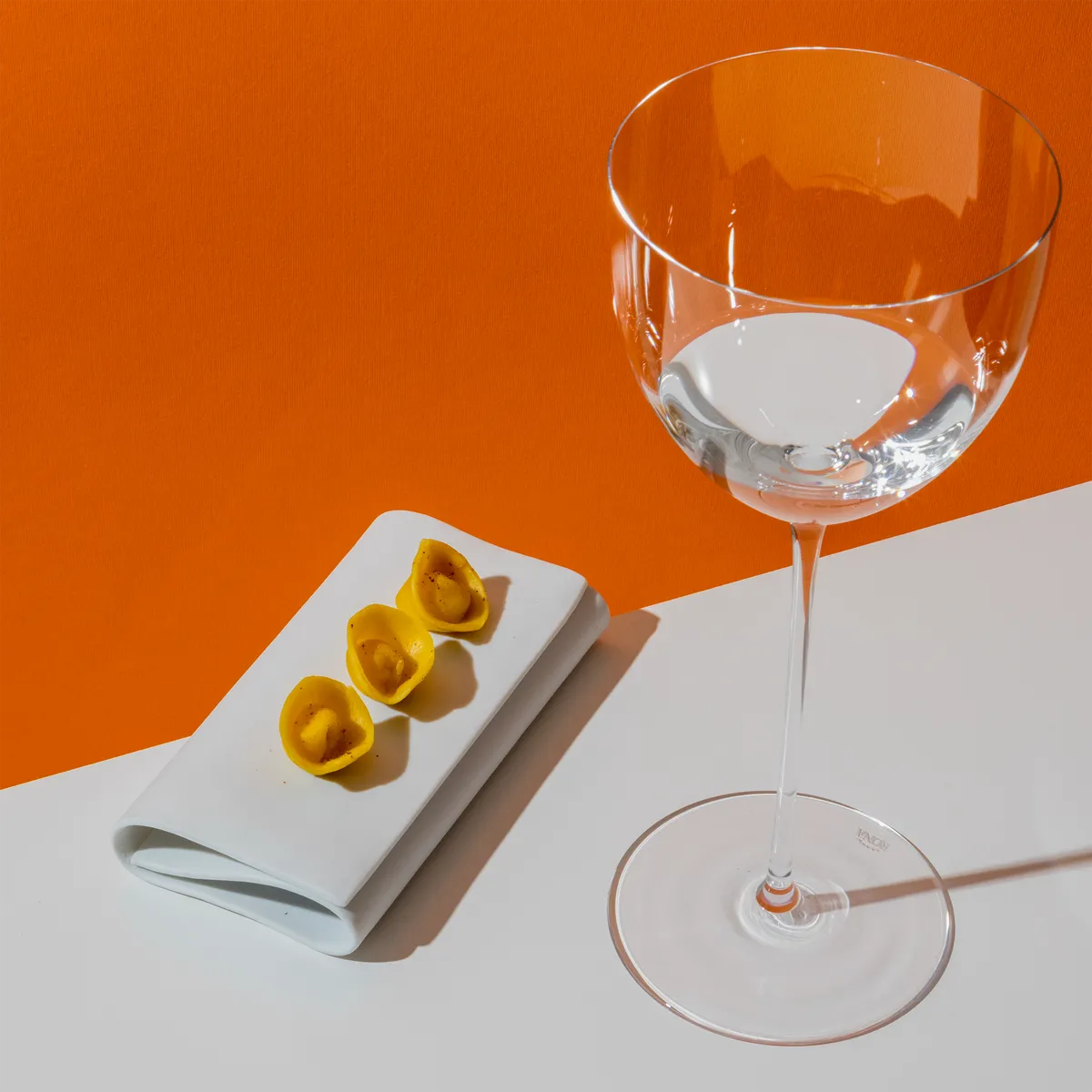
Let us consider the dish “Asiago DOP Riserva JRE PDM presents: Tortellini... by hand” (currently on your menu): how was it conceived, and what technical nuance makes it truly "yours"? What do you wish for the guest to comprehend upon the first bite: an idea, a memory, a surprise, or a perfect balance?
This dish is a tribute to my native land and represents a form of technical maturity. It has been refined many times over, until achieving its current harmony. Upon the first bite, I wish for the guest to experience wonder: it is a poetic synthesis of memory and technique.
Let us discuss the "architecture" of the sauce: what are your technical pillars regarding first courses (jus, broth, fat, acidity, bitterness, heat)? And what is the most common mistake you observe when chefs seek this balance?
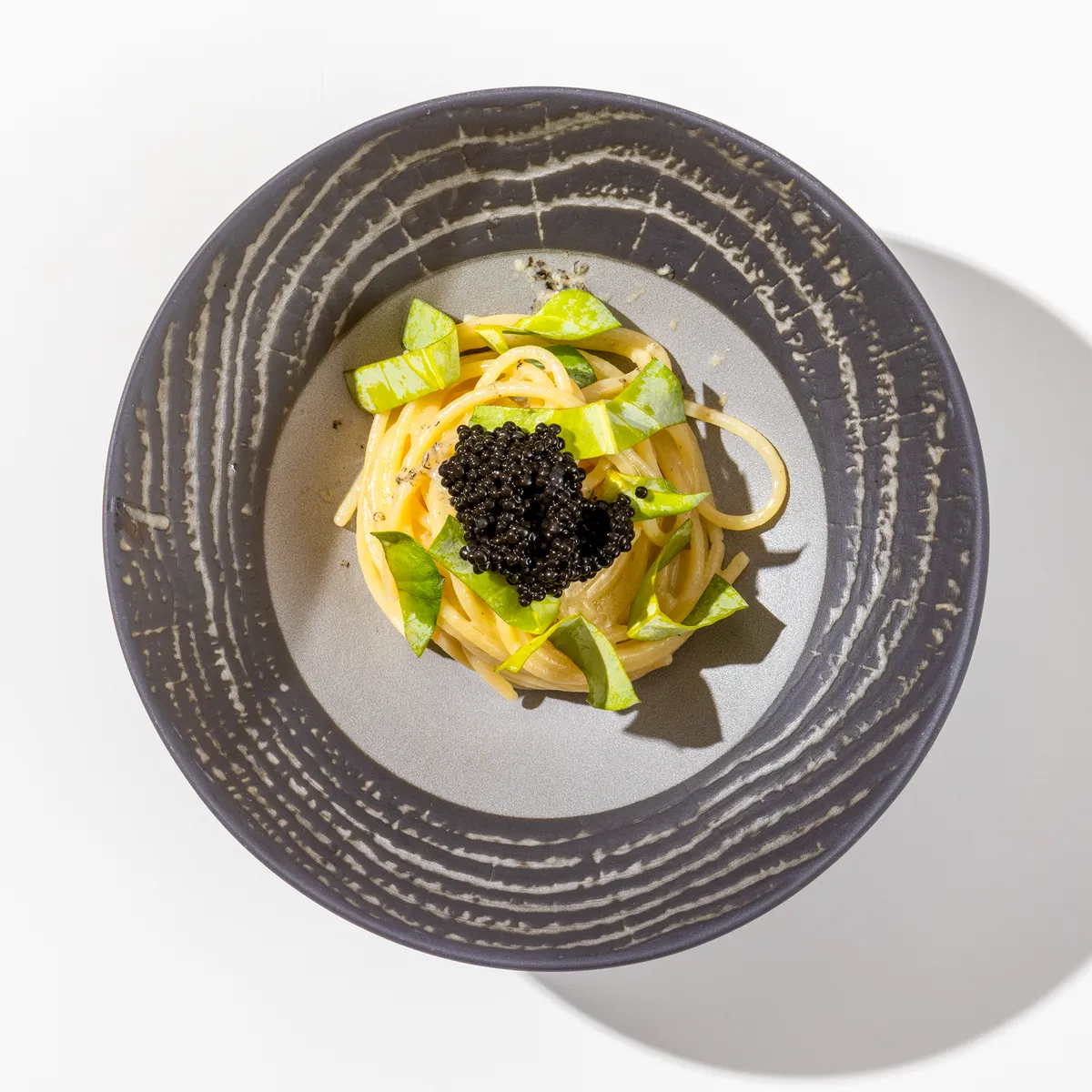
I strive for a harmony calibrated to the intrinsic virtues of the primary ingredient. The most mundane yet unfortunately most frequent error lies in the emulsion, the 'mantecatura'. Too often one encounters disjointed pastas; knowing how to perfectly bind the sauce to the pasta is a technical art that demands profound sensitivity and time.
Dough and raw material: how do you select flours and semolina (and when do you favor egg over water)? Is there a parameter that matters to you above all else—hydration, resting time, elasticity, chewiness?
For fresh pasta, I seek above all elasticity. I employ a meticulously studied blend of flour and semolina to achieve the perfect bite, while a generous use of egg yolk guarantees that tenacious, elastic structure which I consider fundamental.
In your dishes, the orchestration of service seems central: how much do sequence (cooking, emulsion, temperature, immediacy) and the relationship with the rhythm of the dining room influence the success of the pasta?
It influences it entirely: orchestration is everything. There must be an absolute harmony between the kitchen and the dining room; I would compare the restaurant to an orchestral conductor: every instrument must be tuned and perform in unison. At TreQuarti, we are blessed with a perfect synergy, and this is what allows the dish to reach the guest with the necessary temperature and immediacy.
Looking ahead: what is your "next vision" for pasta? A forgotten shape to rediscover, a gesture to salvage, or a philosophy (zero-waste, short supply chains, extreme seasonality) that will truly redefine how we cook first courses?
My vision is conservative in the noblest sense: pasta is the very essence of Italy and must be preserved in its pure identity. Rather than a technical revolution, I wish to salvage a gesture tied to conviviality: the service in the dining room. Just as we do with our Gargati, I would love to return to the sacred ritual of pasta served and placed directly at the table, allowing guests to serve themselves anew in total freedom, thereby reclaiming the warmth and pleasure of sharing.
CURRICULUM VITAE
Born in 1984, Alberto Basso embodies one of the most lucid evolutions of contemporary Venetian gastronomy. His technical foundation was forged within one of the shrines of Italian culinary discipline: the Ristorante La Peca of the Portinari brothers. There, for over three years, he held a strategic mantle—chef de partie of first courses and pastry—nurturing a rare, dual syntax: on one hand, a profound sensitivity for carbohydrates, for the sacred tempo of rice and pasta; on the other, the scientific rigor, millimetric precision, and absolute mastery native to the pastry arts.
In 2010, Basso unveiled Ristorante Trequarti in Grancona, within the Val Liona: a name intentionally devoid of rhetoric, where 3/4 is simply the street number of the piazza hosting it. A touch of reality, not a contrived symbol.
His narrative suffered a profound rupture in 2015 with the untimely passing of his partner and co-founder, Stefano Leonardi. It was a point of no return. Confronted with the prospect of closure, Basso chose instead to rebuild the project anew, transforming grief into creative architecture. From this wound, Le Alture was born: an annual benefit that channels gastronomic excellence toward a noble purpose: funding scholarships for students of culinary academies. Here, a mature vision of the chef’s role shines forth: not merely an arbiter of taste, but a custodian of duty, capable of giving back value to the very system that nurtured him.
Today, the identity of Trequarti crystallizes into a formula light only in appearance: Fun Dining. It is a conscious response to the rigid rituals of haute cuisine. The objective is to desacralize without diminishing: allowing the guest to unwind and delight, while remaining enveloped in a sublime level of technical artistry.
Basso’s culinary discourse thrives on contrasts and calculated tensions: hot and cold, sweet and savory, textures in elegant conflict. The iconic ingredients of Venetian tradition — stockfish, polenta — are decontextualized and at times translated into the realm of dessert. Not as a mere exercise in style, but to provoke a playful reflection, a surprise that gently questions memory. Equally symbolic is his decision to serve Gargati pasta by demanding deliberately long waiting times, of up to forty minutes. A counter-cultural, almost political gesture: restoring majesty to anticipation in a world that consumes everything in real time.
Today, Alberto Basso stands as a beacon for the new wave of Italian dining. A member of the JRE since 2016, and currently President for Italy, he guides a network centered on sharing, mentorship, and collective evolution. Meanwhile, his creation, Trequarti, remains a mature table, deeply rooted in the Val Liona yet capable of speaking with an international eloquence: a cuisine that does not disavow technique, but rather wields it to craft freedom.
dialogues
If pasta were a "portrait" of you as a chef, what detail could not be missed? A gesture, an aroma, a texture: where does your first authentic bond with pasta originate?
The presence of texture and chewiness could never be absent: to me, pasta must possess a crisp alma. My authentic bond arises from childhood memories of nursery school; the memory of tiny pasta in tomato sauce remains deeply impressed upon me—a simple dish I always devoured with pleasure, representing my first true encounter with this sacred ingredient.
Your journey speaks of lightness that transforms into thought: in what way does "fun dining" alter the narrative of pasta without trivialising it?
Fun dining allows us to elevate the dish into a vessel of memory. We begin with a childhood recollection and refine it to evoke a lightness that is, first and foremost, comprehension: the guest must experience a pure pleasure, free from heavy superstructures. It is a path to rendering cuisine accessible and joyous.
TreQuarti dwells within the landscape of the Berici Hills: how much does the concept of territory (wild herbs, meats, spring waters, seasons) weigh upon your pasta dishes compared to the more "Mediterranean" and narrative impulse?
We follow the sacred rhythm of the seasons, especially that of wild, spontaneous herbs, yet with the awareness that nature never repeats herself: each year, the raw ingredients evolve and must be interpreted 'ex novo'.
Dry, fresh, and filled pastas coexist harmoniously on your menu: how do you compose this culinary "tryptych"? Is it a strict rule, a quest for balance, or a way to bind speed with depth of flavor?
I do not adhere to any rigid rule or technical balance. The choice between dry, fresh, or filled pasta is dictated entirely by a state of mind. It is an instinctive creative process that seeks to convey a specific emotion at that precise moment of the tasting journey.
You speak of your love for "unfashionable" shapes (fusilloni, pasta mista): what do you seek in a shape when designing a dish? Resilience, cavities, the rhythm of the bite, or the capacity to embrace the sauce?
The choice is dictated by the condiment itself. I never impose a shape; it is the dish that "summons" its vessel. It is a form of natural selection where the sauce and the pasta choose one another to guarantee the perfect cadence to the bite and a flawless symphony of flavors.
Let us consider the dish “Asiago DOP Riserva JRE PDM presents: Tortellini... by hand” (currently on your menu): how was it conceived, and what technical nuance makes it truly "yours"? What do you wish for the guest to comprehend upon the first bite: an idea, a memory, a surprise, or a perfect balance?
This dish is a tribute to my native land and represents a form of technical maturity. It has been refined many times over, until achieving its current harmony. Upon the first bite, I wish for the guest to experience wonder: it is a poetic synthesis of memory and technique.
Let us discuss the "architecture" of the sauce: what are your technical pillars regarding first courses (jus, broth, fat, acidity, bitterness, heat)? And what is the most common mistake you observe when chefs seek this balance?
I strive for a harmony calibrated to the intrinsic virtues of the primary ingredient. The most mundane yet unfortunately most frequent error lies in the emulsion, the 'mantecatura'. Too often one encounters disjointed pastas; knowing how to perfectly bind the sauce to the pasta is a technical art that demands profound sensitivity and time.
Dough and raw material: how do you select flours and semolina (and when do you favor egg over water)? Is there a parameter that matters to you above all else—hydration, resting time, elasticity, chewiness?
For fresh pasta, I seek above all elasticity. I employ a meticulously studied blend of flour and semolina to achieve the perfect bite, while a generous use of egg yolk guarantees that tenacious, elastic structure which I consider fundamental.
In your dishes, the orchestration of service seems central: how much do sequence (cooking, emulsion, temperature, immediacy) and the relationship with the rhythm of the dining room influence the success of the pasta?
It influences it entirely: orchestration is everything. There must be an absolute harmony between the kitchen and the dining room; I would compare the restaurant to an orchestral conductor: every instrument must be tuned and perform in unison. At TreQuarti, we are blessed with a perfect synergy, and this is what allows the dish to reach the guest with the necessary temperature and immediacy.
Looking ahead: what is your "next vision" for pasta? A forgotten shape to rediscover, a gesture to salvage, or a philosophy (zero-waste, short supply chains, extreme seasonality) that will truly redefine how we cook first courses?
My vision is conservative in the noblest sense: pasta is the very essence of Italy and must be preserved in its pure identity. Rather than a technical revolution, I wish to salvage a gesture tied to conviviality: the service in the dining room. Just as we do with our Gargati, I would love to return to the sacred ritual of pasta served and placed directly at the table, allowing guests to serve themselves anew in total freedom, thereby reclaiming the warmth and pleasure of sharing.
CURRICULUM VITAE
Born in 1984, Alberto Basso embodies one of the most lucid evolutions of contemporary Venetian gastronomy. His technical foundation was forged within one of the shrines of Italian culinary discipline: the Ristorante La Peca of the Portinari brothers. There, for over three years, he held a strategic mantle—chef de partie of first courses and pastry—nurturing a rare, dual syntax: on one hand, a profound sensitivity for carbohydrates, for the sacred tempo of rice and pasta; on the other, the scientific rigor, millimetric precision, and absolute mastery native to the pastry arts.
In 2010, Basso unveiled Ristorante Trequarti in Grancona, within the Val Liona: a name intentionally devoid of rhetoric, where 3/4 is simply the street number of the piazza hosting it. A touch of reality, not a contrived symbol.
His narrative suffered a profound rupture in 2015 with the untimely passing of his partner and co-founder, Stefano Leonardi. It was a point of no return. Confronted with the prospect of closure, Basso chose instead to rebuild the project anew, transforming grief into creative architecture. From this wound, Le Alture was born: an annual benefit that channels gastronomic excellence toward a noble purpose: funding scholarships for students of culinary academies. Here, a mature vision of the chef’s role shines forth: not merely an arbiter of taste, but a custodian of duty, capable of giving back value to the very system that nurtured him.
Today, the identity of Trequarti crystallizes into a formula light only in appearance: Fun Dining. It is a conscious response to the rigid rituals of haute cuisine. The objective is to desacralize without diminishing: allowing the guest to unwind and delight, while remaining enveloped in a sublime level of technical artistry.
Basso’s culinary discourse thrives on contrasts and calculated tensions: hot and cold, sweet and savory, textures in elegant conflict. The iconic ingredients of Venetian tradition — stockfish, polenta — are decontextualized and at times translated into the realm of dessert. Not as a mere exercise in style, but to provoke a playful reflection, a surprise that gently questions memory. Equally symbolic is his decision to serve Gargati pasta by demanding deliberately long waiting times, of up to forty minutes. A counter-cultural, almost political gesture: restoring majesty to anticipation in a world that consumes everything in real time.
Today, Alberto Basso stands as a beacon for the new wave of Italian dining. A member of the JRE since 2016, and currently President for Italy, he guides a network centered on sharing, mentorship, and collective evolution. Meanwhile, his creation, Trequarti, remains a mature table, deeply rooted in the Val Liona yet capable of speaking with an international eloquence: a cuisine that does not disavow technique, but rather wields it to craft freedom.
dialogues
If pasta were a "portrait" of you as a chef, what detail could not be missed? A gesture, an aroma, a texture: where does your first authentic bond with pasta originate?
The presence of texture and chewiness could never be absent: to me, pasta must possess a crisp alma. My authentic bond arises from childhood memories of nursery school; the memory of tiny pasta in tomato sauce remains deeply impressed upon me—a simple dish I always devoured with pleasure, representing my first true encounter with this sacred ingredient.
Your journey speaks of lightness that transforms into thought: in what way does "fun dining" alter the narrative of pasta without trivialising it?
Fun dining allows us to elevate the dish into a vessel of memory. We begin with a childhood recollection and refine it to evoke a lightness that is, first and foremost, comprehension: the guest must experience a pure pleasure, free from heavy superstructures. It is a path to rendering cuisine accessible and joyous.
TreQuarti dwells within the landscape of the Berici Hills: how much does the concept of territory (wild herbs, meats, spring waters, seasons) weigh upon your pasta dishes compared to the more "Mediterranean" and narrative impulse?
We follow the sacred rhythm of the seasons, especially that of wild, spontaneous herbs, yet with the awareness that nature never repeats herself: each year, the raw ingredients evolve and must be interpreted 'ex novo'.
Dry, fresh, and filled pastas coexist harmoniously on your menu: how do you compose this culinary "tryptych"? Is it a strict rule, a quest for balance, or a way to bind speed with depth of flavor?
I do not adhere to any rigid rule or technical balance. The choice between dry, fresh, or filled pasta is dictated entirely by a state of mind. It is an instinctive creative process that seeks to convey a specific emotion at that precise moment of the tasting journey.
You speak of your love for "unfashionable" shapes (fusilloni, pasta mista): what do you seek in a shape when designing a dish? Resilience, cavities, the rhythm of the bite, or the capacity to embrace the sauce?
The choice is dictated by the condiment itself. I never impose a shape; it is the dish that "summons" its vessel. It is a form of natural selection where the sauce and the pasta choose one another to guarantee the perfect cadence to the bite and a flawless symphony of flavors.
Let us consider the dish “Asiago DOP Riserva JRE PDM presents: Tortellini... by hand” (currently on your menu): how was it conceived, and what technical nuance makes it truly "yours"? What do you wish for the guest to comprehend upon the first bite: an idea, a memory, a surprise, or a perfect balance?
This dish is a tribute to my native land and represents a form of technical maturity. It has been refined many times over, until achieving its current harmony. Upon the first bite, I wish for the guest to experience wonder: it is a poetic synthesis of memory and technique.
Let us discuss the "architecture" of the sauce: what are your technical pillars regarding first courses (jus, broth, fat, acidity, bitterness, heat)? And what is the most common mistake you observe when chefs seek this balance?
I strive for a harmony calibrated to the intrinsic virtues of the primary ingredient. The most mundane yet unfortunately most frequent error lies in the emulsion, the 'mantecatura'. Too often one encounters disjointed pastas; knowing how to perfectly bind the sauce to the pasta is a technical art that demands profound sensitivity and time.
Dough and raw material: how do you select flours and semolina (and when do you favor egg over water)? Is there a parameter that matters to you above all else—hydration, resting time, elasticity, chewiness?
For fresh pasta, I seek above all elasticity. I employ a meticulously studied blend of flour and semolina to achieve the perfect bite, while a generous use of egg yolk guarantees that tenacious, elastic structure which I consider fundamental.
In your dishes, the orchestration of service seems central: how much do sequence (cooking, emulsion, temperature, immediacy) and the relationship with the rhythm of the dining room influence the success of the pasta?
It influences it entirely: orchestration is everything. There must be an absolute harmony between the kitchen and the dining room; I would compare the restaurant to an orchestral conductor: every instrument must be tuned and perform in unison. At TreQuarti, we are blessed with a perfect synergy, and this is what allows the dish to reach the guest with the necessary temperature and immediacy.
Looking ahead: what is your "next vision" for pasta? A forgotten shape to rediscover, a gesture to salvage, or a philosophy (zero-waste, short supply chains, extreme seasonality) that will truly redefine how we cook first courses?
My vision is conservative in the noblest sense: pasta is the very essence of Italy and must be preserved in its pure identity. Rather than a technical revolution, I wish to salvage a gesture tied to conviviality: the service in the dining room. Just as we do with our Gargati, I would love to return to the sacred ritual of pasta served and placed directly at the table, allowing guests to serve themselves anew in total freedom, thereby reclaiming the warmth and pleasure of sharing.