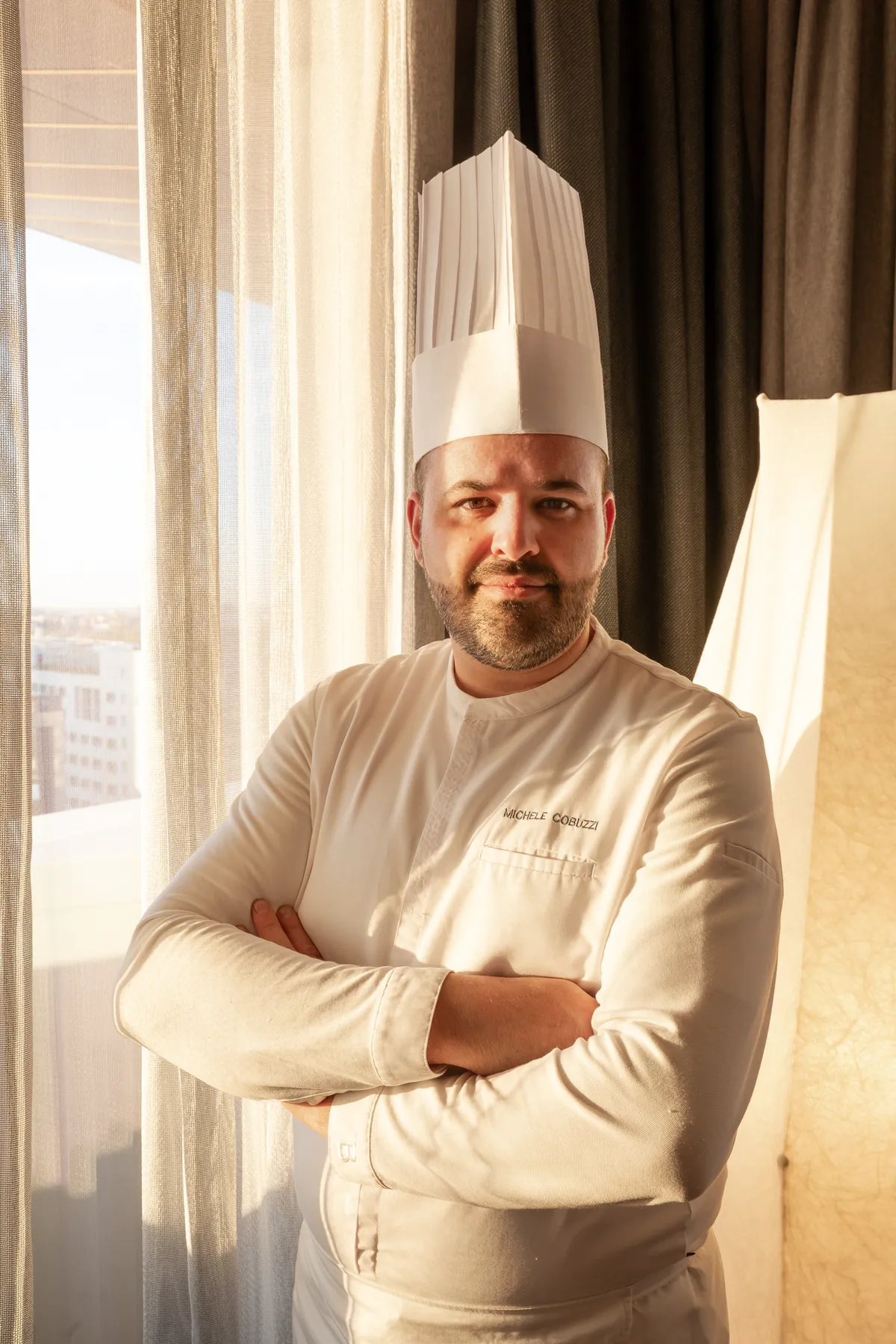
MICHELE COBUZZI
From the Land of Foggia to the Star of Milan
1989
Foggia
Of the Land - Of the Present
MICHELE COBUZZI
From the Land of Foggia to the Star of Milan
1989
Foggia
Of the Land - Of the Present
MICHELE COBUZZI
From the Land of Foggia to the Star of Milan
1989
Foggia
Of the Land - Of the Present
CURRICULUM VITAE
Born in Foggia in 1989, Michele Cobuzzi represents one of the most compelling figures of the "new wave" of Italian chefs who have mastered the art of marrying the territorial identity of the South with the entrepreneurial rigor of the North. His culinary education did not begin in academies, but in the heart of his family's farm in the Tavoliere delle Puglie. There, enveloped by olive groves, orchards, and livestock pastures, Cobuzzi cultivated an almost visceral sensitivity to the raw ingredient, learning the virtue of patience and reverence for nature's biological rhythms. This "pedagogy of the earth" was enriched by domestic tutorials in traditional Apulian gastronomy passed down by his mother, forging a tapestry of identity-driven flavors that would ultimately define his stylistic signature.
After obtaining his diploma from the "L. Einaudi" Hotel School of Foggia in 2008, Cobuzzi demonstrated an early, fierce determination, entering the professional realm at the age of fourteen and sacrificing summer holidays to amass practical experience in local kitchens. He swiftly distinguished himself through an apprenticeship of exceptional caliber—a formative journey traversing some of Europe's most prestigious culinary brigades.
The first momentous step toward the heights of haute cuisine unfolded in Tuscany, at Castel Monastero, where he worked at La Contrada under the aegis of the Gordon Ramsay Holding. Here, guided by chef Nello Cassese, he mastered the Anglo-Saxon discipline of organization and the orchestration of grand kitchen flows while upholding standards of pristine excellence.
Subsequently, he refined his aesthetic and technique at the Ristorante Bracali (2 Michelin Stars) in Maremma, where he learned to transmute the rustic soul of Tuscan flavors into visual poetry. His relocation to Milan marked a defining encounter with the grand Italian heritage at Il Luogo di Aimo e Nadia (2 Michelin Stars), a temple dedicated to the glorification of national produce. The zenith of his technical refinement was realized in Florence, at the legendary Enoteca Pinchiorri (3 Michelin Stars), where he internalized the pursue of absolute perfection and the intricate workings of a world-class gastronomic machine.
The definitive turning point arrived in 2021, when he was chosen by Enrico Bartolini—Italy’s most decorated chef—to direct the culinary offering of the Hotel Milano Verticale | UNA Esperienze.
Within this setting, Cobuzzi nurtures a dual spirit: the approachable character of the contemporary osteria Vertigo, and the exclusive, elevated universe of the fine dining restaurant Anima. It is here that his professional maturity garnered ultimate acclaim: in November 2022, the Michelin Guide bestowed upon him his first Star, praising his gift for narrating the essence of Apulia with a "modern flavor."
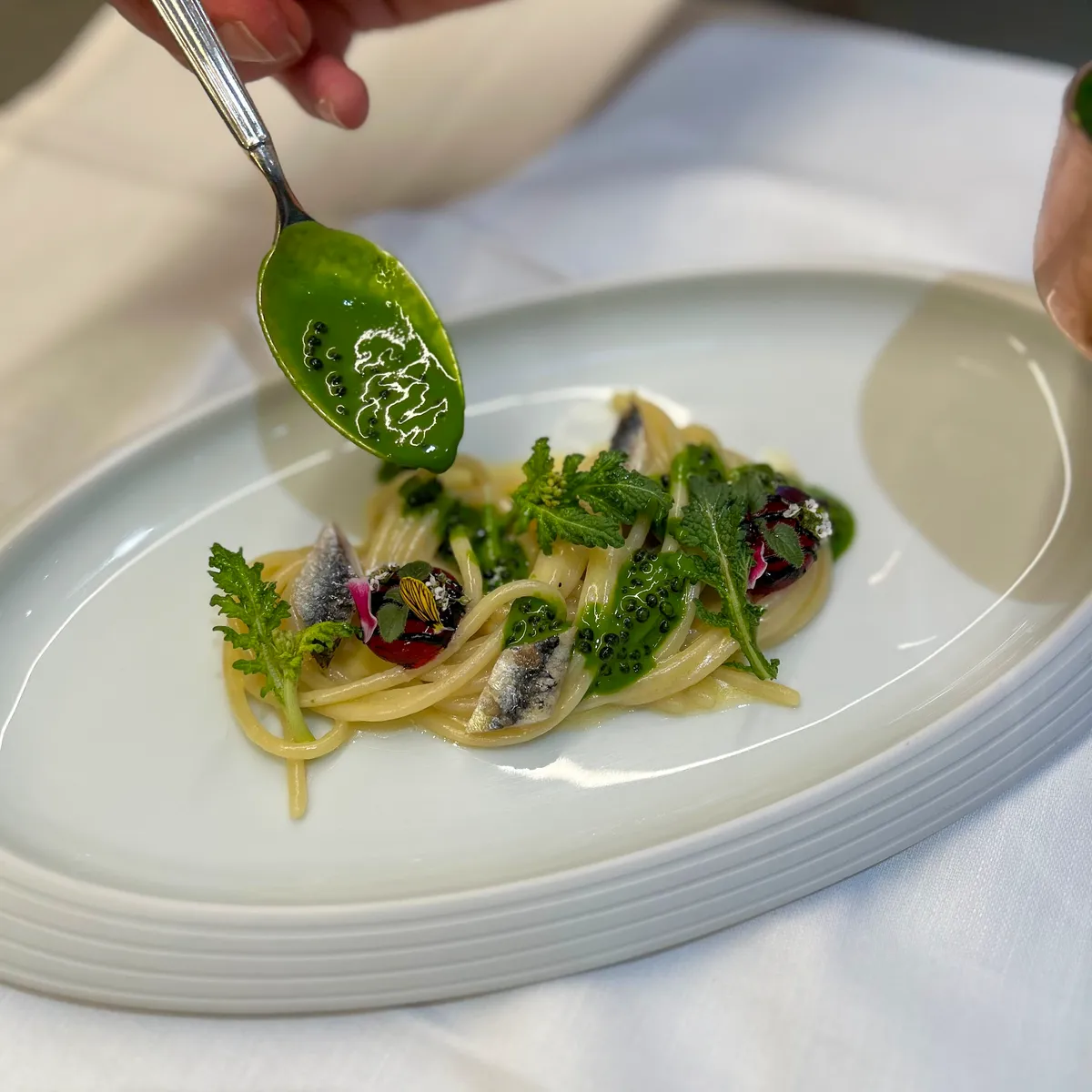
His style is distinguished by a pristine purity on the plate, where "three or four key ingredients" converse without ever eclipsing one another. Cobuzzi frequently plays upon the harmony of contrasts, balancing acidity (derived from citrus or vinegars) with the enveloping sweetness of vegetables, which he treats with the same honor accorded to noble proteins. The degustation menus at Anima, "Intensità" and "Le Mie Certezze," mirror his dual nature: on one hand, bold and technical experimentation; on the other, the comfort of memory and tradition reimagined.
dialogues
Chef, what are the first memories of pasta from your childhood in Foggia? A scent, a gesture, a household shape that still dictates your culinary rhythm today?
Memories are myriad. I was born in the countryside, cradled by the most beautiful and natural elements imaginable. My father cultivated the land and, in particular, by nurturing the wheat we would then craft into pasta: it was a sacred moment for us. To this day, my mother employs the flour derived from the grain sown by my family: a coarse, fragrant flour, dense with fiber, boasting astounding aromas.
The recollections bound to pasta are manifold. Consider, for instance, the classic pasta with tomato sauce: the first I tasted outside my home dates back to my fifteenth year, when I was in Trentino-Alto Adige for my inaugural summer season. It was dreadful. The preserved tomatoes prepared by my mother stood unrivaled.How do you carry those flavors today into the urban landscape of Porta Nuova? What bridge-ingredients and techniques do you employ to preserve their sacred identity?
Apulia is no longer so distant from Milan, and thus I manage to find those same authentic flavors even here. The ingredients to which I am most devoted are those erroneously dismissed as mere "condiments," beginning with olive oil. The gravity I accord to it is such that I collaborate with an estate, La Sartoria Agricola, which tailors a bespoke recipe exclusively to my culinary requirements.
Regarding dry pasta, I align profoundly with the philosophy of Pastificio Mancini, which produces using solely the wheat they cultivate themselves: a supply chain that guarantees sublime quality and a artisanal process elevated by technical precision.
Another singular product is the marasciuolo, a wild, elusive botanical treasure that defies cultivation. Furthermore, there is the wild game sourced from the Umbra Forest, a pristine protected sanctuary within the Gargano National Park. The bond with the land and an almost obsessive pursuit of superlative quality are constants in my daily devotion.What criteria guide your choice between bronze-die extruded dry pasta and freshly rolled or laminated pasta? How do you assess the product?
The choice depends entirely upon the conceptual nature of the dish, how I envision it. If I conceive a dry fusillone, I cannot envision it as fresh pasta, and vice versa.
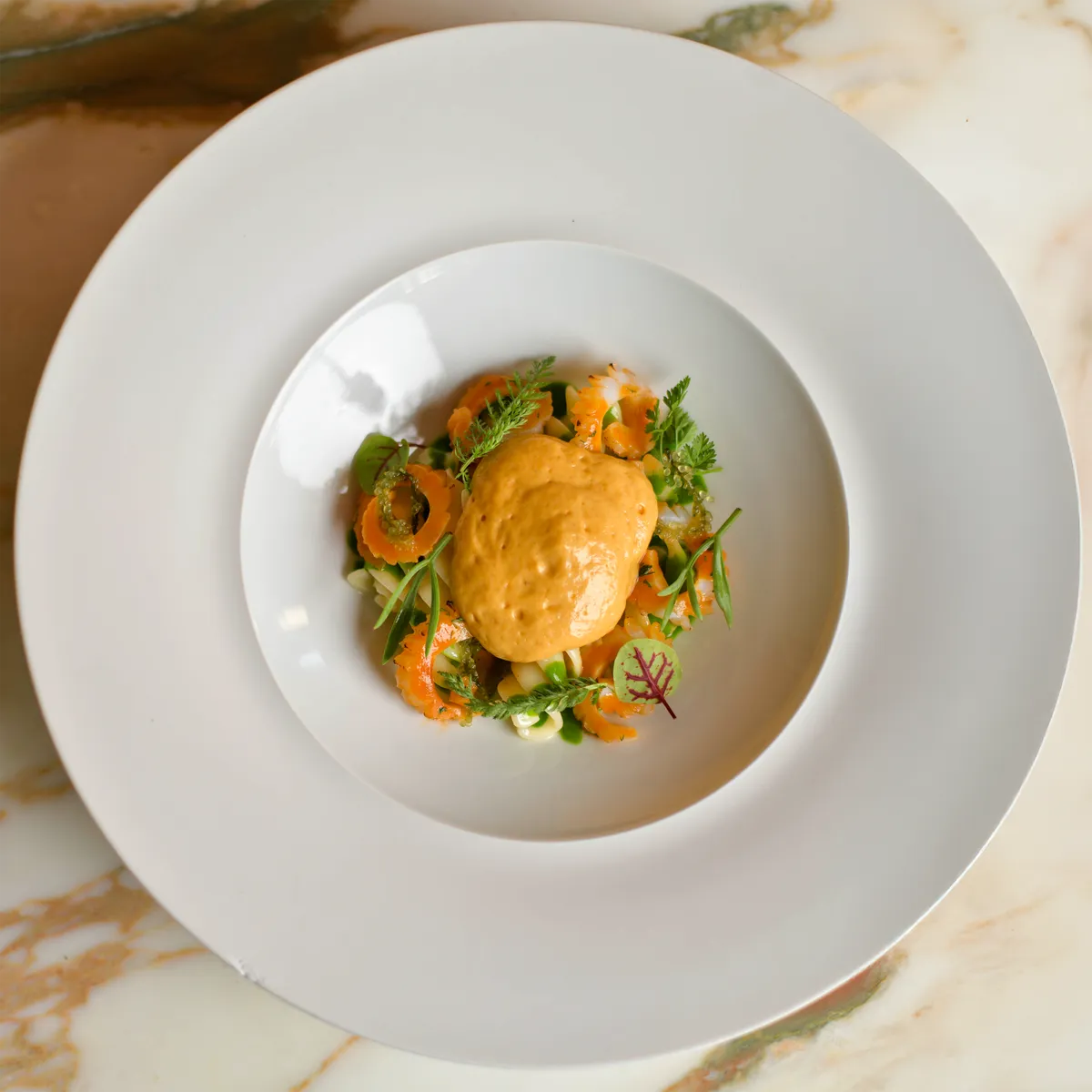
Let me illustrate with an example: my Yuzu Fusillo with chicory, grilled cuttlefish, and chicken emulsion is a complex composition, where the porosity, bite, and structure of the noodle — alongside a restrained release of starch — are crucial. This dry fusillo possesses porous, "creamy" surfaces that forge a perfect union, balancing fats and starches. If a creation is conceived for dry pasta, I cannot truly envision it being "the same" with fresh pasta. And vice versa.What is your golden rule regarding cooking times, salinity (g/L), and starch management to achieve a texture that is "alive" yet never aggressive?
Here we touch upon a crucial tenet: fleeting trends dictate and often distort the cooking of pasta, yet the cultural heritage of Italy must be vigilantly guarded.
Pasta must be cooked in salted water with approximately 9 grams of salt per liter. For me, the cooking must remain traditional: abundant water, the "perfect" measure of salt. Then, during the mantecatura process, four minutes are paramount to finish cooking it in the sauce like a risotto.
Any excess of starch, in my view, disrupts the mastication and, above all, distracts from the true, noble flavor of the pasta. Starch is desirable, but only in precise balance: it must envelop the noodle, allowing one to perceive its porosity and substance. I always adhere to my maxim: "Balance in the kitchen is the triumph of all things."The equilibrium between starch, fat, and liquid: do you employ thermal shocks or "faux risottos" to capture a lustrous finish without heaviness?
I return to my previous reflection: here too, the core lies in the stability of the balance between fats, extractions, and broths, which vary according to the degree of luster we desire, how we wish the pasta to behave, and the ultimate flavor profile.
Regarding "faux risottos," generally speaking, I do not find myself in agreement. I never compromise the cooking method if my medium is dry pasta. When I compose dishes where Italian authenticity must reign supreme — such as a classic tomato pasta — the result must be an impeccable bite, perfectly executed pasta, with temperatures masterfully controlled.Fresh filled pasta: thickness, yolk ratio, humidity, and service endurance. Which parameters guarantee a raviolo that is both intact and succulently bursting?
For my vision of fresh filled pasta, the proportion of egg yolk is paramount: it imparts structure, thickness, porosity, and assists in the rolling process as it contains lecithin, thereby fostering an emulsion. Fresh pasta is, at its heart, an emulsion. The optimal ratio of yolk lends richness, cohesion, and a delightful texture: resilient yet yielding when cooked to perfection.
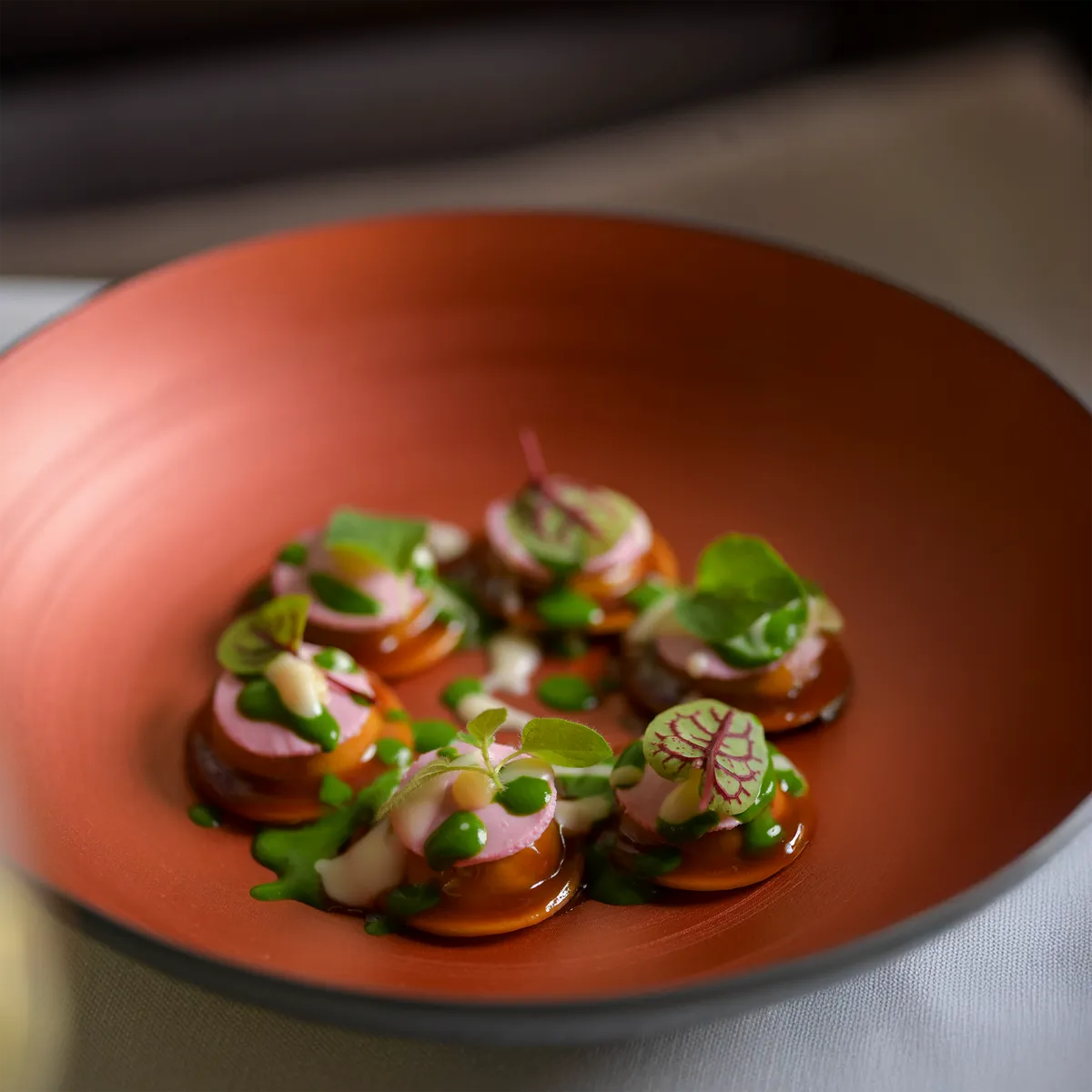
As for the flavor, filled pasta is born to deliver an explosion of its core: to capture the aroma and intensity of what lies within. Just as with my Chicken Buttons: there, one must focus to perceive "only that" — it is umami, intensity, a true revelation, and the pasta envelope, consequence of this, gracefully recedes into the background.
Texture plays an immense role, as does consistency. The perfect humidity is captured during the final rolling, immediately prior to filling: not too dry, and rolled without an excess of flour.Senatore Cappelli, Russello, Simeto, burnt grain: how does the pasta transform? Do you possess a signature blend that you would recognize with closed eyes?
Every flour possesses its own hydration profile and technical character. It often happens that I prepare pasta and, even when using the same recipe, it does not emerge identical. I say this to my brigade as well: knead it by hand, to intimately feel its consistency and porosity. The recipe is but a foundation, yet on any given day it may not manifest in the exact same manner, because flours are never static, and humidity and atmospheric conditions shift. Everything resides in the sensitivity of the artisan: capturing the perfect point of elasticity, which varies from dawn to dusk.
A blend I claim as "my own" is one that works upon a canvas of Tipo 0 flour with a portion of semolina (roughly around 20%, adjusting for the specific shape). When the dough must be rolled to gossamer thinness, I diminish the semolina: indeed, a coarser grain might pose challenges during rolling; I employ it in small measure, just enough to bestow aroma and an enhanced bite.The MICHELIN Guide highlights your garden-focused creations and bakery: how do you compose a vegetarian first course so that it feels complete and not merely "green"?
I direct profound focus toward the botanical realm. A dish may arise from a memory, from a singular ingredient, or from the season that delivers a product we cherish and wish to present upon the table.
I impose no boundaries: I sculpt a dish that achieves a harmonious balance of acidity, richness, deep flavors, and umami. Should it be necessary to introduce an element of umami from meat or fish, I would not hesitate. It is also true that within the tasting journeys at Anima, meat and fish courses reside; yet regarding vegetables, I often prefer to dedicate myself entirely to a fully botanical theme, not least for the intricate layering of flavors, as it possesses the inherent majesty to stand as the undisputed protagonist from beginning to end.In a tasting menu: is pasta an interlude, a climax, or a final memory? How do you calibrate portion, intensity, and persistence?
Here, equilibrium once more becomes decisive. A pasta dish, to be truly realized, must have a narrative thread within the journey, finding its perfect placement as a crescendo of flavors. It must leave an indelible mark without overwhelming the subsequent courses, particularly within an eight-course odyssey, where these eight impressions are demanding and the perception of salinity begins to bloom.
One must calibrate meticulously and decide on the exact message one wishes to convey. In the five-course experience — two antipasti, a first course, a main, and dessert — the Chicken Buttons represent a deeply profound dish, designed to resonate in the very heart of the guest.Milan versus Foggia. An Apulian shape "to be saved" and a contemporary Milanese shape "to be invented" to narrate an evolving Italy?
Of Apulian shapes that must never be forgotten, I could summon many, for within our land, the culture of pasta is vast. Fresh pasta, in its primordial concept, is conceived without egg: simply semolina and water. In this spirit, cavatelli and orecchiette are the timeless classics to be preserved.
As for a "contemporary Milanese" shape, in a Milan that ever paces forward, embracing the ethos of environmental sustainability, I envision something that evokes a circular form as a synonym for cyclicity: a kind of spiral or a hollow disc, almost a "mezzo pacchero" reimagined through a more minimalist lens.
CURRICULUM VITAE
Born in Foggia in 1989, Michele Cobuzzi represents one of the most compelling figures of the "new wave" of Italian chefs who have mastered the art of marrying the territorial identity of the South with the entrepreneurial rigor of the North. His culinary education did not begin in academies, but in the heart of his family's farm in the Tavoliere delle Puglie. There, enveloped by olive groves, orchards, and livestock pastures, Cobuzzi cultivated an almost visceral sensitivity to the raw ingredient, learning the virtue of patience and reverence for nature's biological rhythms. This "pedagogy of the earth" was enriched by domestic tutorials in traditional Apulian gastronomy passed down by his mother, forging a tapestry of identity-driven flavors that would ultimately define his stylistic signature.
After obtaining his diploma from the "L. Einaudi" Hotel School of Foggia in 2008, Cobuzzi demonstrated an early, fierce determination, entering the professional realm at the age of fourteen and sacrificing summer holidays to amass practical experience in local kitchens. He swiftly distinguished himself through an apprenticeship of exceptional caliber—a formative journey traversing some of Europe's most prestigious culinary brigades.
The first momentous step toward the heights of haute cuisine unfolded in Tuscany, at Castel Monastero, where he worked at La Contrada under the aegis of the Gordon Ramsay Holding. Here, guided by chef Nello Cassese, he mastered the Anglo-Saxon discipline of organization and the orchestration of grand kitchen flows while upholding standards of pristine excellence.
Subsequently, he refined his aesthetic and technique at the Ristorante Bracali (2 Michelin Stars) in Maremma, where he learned to transmute the rustic soul of Tuscan flavors into visual poetry. His relocation to Milan marked a defining encounter with the grand Italian heritage at Il Luogo di Aimo e Nadia (2 Michelin Stars), a temple dedicated to the glorification of national produce. The zenith of his technical refinement was realized in Florence, at the legendary Enoteca Pinchiorri (3 Michelin Stars), where he internalized the pursue of absolute perfection and the intricate workings of a world-class gastronomic machine.
The definitive turning point arrived in 2021, when he was chosen by Enrico Bartolini—Italy’s most decorated chef—to direct the culinary offering of the Hotel Milano Verticale | UNA Esperienze.
Within this setting, Cobuzzi nurtures a dual spirit: the approachable character of the contemporary osteria Vertigo, and the exclusive, elevated universe of the fine dining restaurant Anima. It is here that his professional maturity garnered ultimate acclaim: in November 2022, the Michelin Guide bestowed upon him his first Star, praising his gift for narrating the essence of Apulia with a "modern flavor."
His style is distinguished by a pristine purity on the plate, where "three or four key ingredients" converse without ever eclipsing one another. Cobuzzi frequently plays upon the harmony of contrasts, balancing acidity (derived from citrus or vinegars) with the enveloping sweetness of vegetables, which he treats with the same honor accorded to noble proteins. The degustation menus at Anima, "Intensità" and "Le Mie Certezze," mirror his dual nature: on one hand, bold and technical experimentation; on the other, the comfort of memory and tradition reimagined.
dialogues
Chef, what are the first memories of pasta from your childhood in Foggia? A scent, a gesture, a household shape that still dictates your culinary rhythm today?
Memories are myriad. I was born in the countryside, cradled by the most beautiful and natural elements imaginable. My father cultivated the land and, in particular, by nurturing the wheat we would then craft into pasta: it was a sacred moment for us. To this day, my mother employs the flour derived from the grain sown by my family: a coarse, fragrant flour, dense with fiber, boasting astounding aromas.
The recollections bound to pasta are manifold. Consider, for instance, the classic pasta with tomato sauce: the first I tasted outside my home dates back to my fifteenth year, when I was in Trentino-Alto Adige for my inaugural summer season. It was dreadful. The preserved tomatoes prepared by my mother stood unrivaled.How do you carry those flavors today into the urban landscape of Porta Nuova? What bridge-ingredients and techniques do you employ to preserve their sacred identity?
Apulia is no longer so distant from Milan, and thus I manage to find those same authentic flavors even here. The ingredients to which I am most devoted are those erroneously dismissed as mere "condiments," beginning with olive oil. The gravity I accord to it is such that I collaborate with an estate, La Sartoria Agricola, which tailors a bespoke recipe exclusively to my culinary requirements.
Regarding dry pasta, I align profoundly with the philosophy of Pastificio Mancini, which produces using solely the wheat they cultivate themselves: a supply chain that guarantees sublime quality and a artisanal process elevated by technical precision.
Another singular product is the marasciuolo, a wild, elusive botanical treasure that defies cultivation. Furthermore, there is the wild game sourced from the Umbra Forest, a pristine protected sanctuary within the Gargano National Park. The bond with the land and an almost obsessive pursuit of superlative quality are constants in my daily devotion.What criteria guide your choice between bronze-die extruded dry pasta and freshly rolled or laminated pasta? How do you assess the product?
The choice depends entirely upon the conceptual nature of the dish, how I envision it. If I conceive a dry fusillone, I cannot envision it as fresh pasta, and vice versa.
Let me illustrate with an example: my Yuzu Fusillo with chicory, grilled cuttlefish, and chicken emulsion is a complex composition, where the porosity, bite, and structure of the noodle — alongside a restrained release of starch — are crucial. This dry fusillo possesses porous, "creamy" surfaces that forge a perfect union, balancing fats and starches. If a creation is conceived for dry pasta, I cannot truly envision it being "the same" with fresh pasta. And vice versa.What is your golden rule regarding cooking times, salinity (g/L), and starch management to achieve a texture that is "alive" yet never aggressive?
Here we touch upon a crucial tenet: fleeting trends dictate and often distort the cooking of pasta, yet the cultural heritage of Italy must be vigilantly guarded.
Pasta must be cooked in salted water with approximately 9 grams of salt per liter. For me, the cooking must remain traditional: abundant water, the "perfect" measure of salt. Then, during the mantecatura process, four minutes are paramount to finish cooking it in the sauce like a risotto.
Any excess of starch, in my view, disrupts the mastication and, above all, distracts from the true, noble flavor of the pasta. Starch is desirable, but only in precise balance: it must envelop the noodle, allowing one to perceive its porosity and substance. I always adhere to my maxim: "Balance in the kitchen is the triumph of all things."The equilibrium between starch, fat, and liquid: do you employ thermal shocks or "faux risottos" to capture a lustrous finish without heaviness?
I return to my previous reflection: here too, the core lies in the stability of the balance between fats, extractions, and broths, which vary according to the degree of luster we desire, how we wish the pasta to behave, and the ultimate flavor profile.
Regarding "faux risottos," generally speaking, I do not find myself in agreement. I never compromise the cooking method if my medium is dry pasta. When I compose dishes where Italian authenticity must reign supreme — such as a classic tomato pasta — the result must be an impeccable bite, perfectly executed pasta, with temperatures masterfully controlled.Fresh filled pasta: thickness, yolk ratio, humidity, and service endurance. Which parameters guarantee a raviolo that is both intact and succulently bursting?
For my vision of fresh filled pasta, the proportion of egg yolk is paramount: it imparts structure, thickness, porosity, and assists in the rolling process as it contains lecithin, thereby fostering an emulsion. Fresh pasta is, at its heart, an emulsion. The optimal ratio of yolk lends richness, cohesion, and a delightful texture: resilient yet yielding when cooked to perfection.
As for the flavor, filled pasta is born to deliver an explosion of its core: to capture the aroma and intensity of what lies within. Just as with my Chicken Buttons: there, one must focus to perceive "only that" — it is umami, intensity, a true revelation, and the pasta envelope, consequence of this, gracefully recedes into the background.
Texture plays an immense role, as does consistency. The perfect humidity is captured during the final rolling, immediately prior to filling: not too dry, and rolled without an excess of flour.Senatore Cappelli, Russello, Simeto, burnt grain: how does the pasta transform? Do you possess a signature blend that you would recognize with closed eyes?
Every flour possesses its own hydration profile and technical character. It often happens that I prepare pasta and, even when using the same recipe, it does not emerge identical. I say this to my brigade as well: knead it by hand, to intimately feel its consistency and porosity. The recipe is but a foundation, yet on any given day it may not manifest in the exact same manner, because flours are never static, and humidity and atmospheric conditions shift. Everything resides in the sensitivity of the artisan: capturing the perfect point of elasticity, which varies from dawn to dusk.
A blend I claim as "my own" is one that works upon a canvas of Tipo 0 flour with a portion of semolina (roughly around 20%, adjusting for the specific shape). When the dough must be rolled to gossamer thinness, I diminish the semolina: indeed, a coarser grain might pose challenges during rolling; I employ it in small measure, just enough to bestow aroma and an enhanced bite.The MICHELIN Guide highlights your garden-focused creations and bakery: how do you compose a vegetarian first course so that it feels complete and not merely "green"?
I direct profound focus toward the botanical realm. A dish may arise from a memory, from a singular ingredient, or from the season that delivers a product we cherish and wish to present upon the table.
I impose no boundaries: I sculpt a dish that achieves a harmonious balance of acidity, richness, deep flavors, and umami. Should it be necessary to introduce an element of umami from meat or fish, I would not hesitate. It is also true that within the tasting journeys at Anima, meat and fish courses reside; yet regarding vegetables, I often prefer to dedicate myself entirely to a fully botanical theme, not least for the intricate layering of flavors, as it possesses the inherent majesty to stand as the undisputed protagonist from beginning to end.In a tasting menu: is pasta an interlude, a climax, or a final memory? How do you calibrate portion, intensity, and persistence?
Here, equilibrium once more becomes decisive. A pasta dish, to be truly realized, must have a narrative thread within the journey, finding its perfect placement as a crescendo of flavors. It must leave an indelible mark without overwhelming the subsequent courses, particularly within an eight-course odyssey, where these eight impressions are demanding and the perception of salinity begins to bloom.
One must calibrate meticulously and decide on the exact message one wishes to convey. In the five-course experience — two antipasti, a first course, a main, and dessert — the Chicken Buttons represent a deeply profound dish, designed to resonate in the very heart of the guest.Milan versus Foggia. An Apulian shape "to be saved" and a contemporary Milanese shape "to be invented" to narrate an evolving Italy?
Of Apulian shapes that must never be forgotten, I could summon many, for within our land, the culture of pasta is vast. Fresh pasta, in its primordial concept, is conceived without egg: simply semolina and water. In this spirit, cavatelli and orecchiette are the timeless classics to be preserved.
As for a "contemporary Milanese" shape, in a Milan that ever paces forward, embracing the ethos of environmental sustainability, I envision something that evokes a circular form as a synonym for cyclicity: a kind of spiral or a hollow disc, almost a "mezzo pacchero" reimagined through a more minimalist lens.
CURRICULUM VITAE
Born in Foggia in 1989, Michele Cobuzzi represents one of the most compelling figures of the "new wave" of Italian chefs who have mastered the art of marrying the territorial identity of the South with the entrepreneurial rigor of the North. His culinary education did not begin in academies, but in the heart of his family's farm in the Tavoliere delle Puglie. There, enveloped by olive groves, orchards, and livestock pastures, Cobuzzi cultivated an almost visceral sensitivity to the raw ingredient, learning the virtue of patience and reverence for nature's biological rhythms. This "pedagogy of the earth" was enriched by domestic tutorials in traditional Apulian gastronomy passed down by his mother, forging a tapestry of identity-driven flavors that would ultimately define his stylistic signature.
After obtaining his diploma from the "L. Einaudi" Hotel School of Foggia in 2008, Cobuzzi demonstrated an early, fierce determination, entering the professional realm at the age of fourteen and sacrificing summer holidays to amass practical experience in local kitchens. He swiftly distinguished himself through an apprenticeship of exceptional caliber—a formative journey traversing some of Europe's most prestigious culinary brigades.
The first momentous step toward the heights of haute cuisine unfolded in Tuscany, at Castel Monastero, where he worked at La Contrada under the aegis of the Gordon Ramsay Holding. Here, guided by chef Nello Cassese, he mastered the Anglo-Saxon discipline of organization and the orchestration of grand kitchen flows while upholding standards of pristine excellence.
Subsequently, he refined his aesthetic and technique at the Ristorante Bracali (2 Michelin Stars) in Maremma, where he learned to transmute the rustic soul of Tuscan flavors into visual poetry. His relocation to Milan marked a defining encounter with the grand Italian heritage at Il Luogo di Aimo e Nadia (2 Michelin Stars), a temple dedicated to the glorification of national produce. The zenith of his technical refinement was realized in Florence, at the legendary Enoteca Pinchiorri (3 Michelin Stars), where he internalized the pursue of absolute perfection and the intricate workings of a world-class gastronomic machine.
The definitive turning point arrived in 2021, when he was chosen by Enrico Bartolini—Italy’s most decorated chef—to direct the culinary offering of the Hotel Milano Verticale | UNA Esperienze.
Within this setting, Cobuzzi nurtures a dual spirit: the approachable character of the contemporary osteria Vertigo, and the exclusive, elevated universe of the fine dining restaurant Anima. It is here that his professional maturity garnered ultimate acclaim: in November 2022, the Michelin Guide bestowed upon him his first Star, praising his gift for narrating the essence of Apulia with a "modern flavor."
His style is distinguished by a pristine purity on the plate, where "three or four key ingredients" converse without ever eclipsing one another. Cobuzzi frequently plays upon the harmony of contrasts, balancing acidity (derived from citrus or vinegars) with the enveloping sweetness of vegetables, which he treats with the same honor accorded to noble proteins. The degustation menus at Anima, "Intensità" and "Le Mie Certezze," mirror his dual nature: on one hand, bold and technical experimentation; on the other, the comfort of memory and tradition reimagined.
dialogues
Chef, what are the first memories of pasta from your childhood in Foggia? A scent, a gesture, a household shape that still dictates your culinary rhythm today?
Memories are myriad. I was born in the countryside, cradled by the most beautiful and natural elements imaginable. My father cultivated the land and, in particular, by nurturing the wheat we would then craft into pasta: it was a sacred moment for us. To this day, my mother employs the flour derived from the grain sown by my family: a coarse, fragrant flour, dense with fiber, boasting astounding aromas.
The recollections bound to pasta are manifold. Consider, for instance, the classic pasta with tomato sauce: the first I tasted outside my home dates back to my fifteenth year, when I was in Trentino-Alto Adige for my inaugural summer season. It was dreadful. The preserved tomatoes prepared by my mother stood unrivaled.How do you carry those flavors today into the urban landscape of Porta Nuova? What bridge-ingredients and techniques do you employ to preserve their sacred identity?
Apulia is no longer so distant from Milan, and thus I manage to find those same authentic flavors even here. The ingredients to which I am most devoted are those erroneously dismissed as mere "condiments," beginning with olive oil. The gravity I accord to it is such that I collaborate with an estate, La Sartoria Agricola, which tailors a bespoke recipe exclusively to my culinary requirements.
Regarding dry pasta, I align profoundly with the philosophy of Pastificio Mancini, which produces using solely the wheat they cultivate themselves: a supply chain that guarantees sublime quality and a artisanal process elevated by technical precision.
Another singular product is the marasciuolo, a wild, elusive botanical treasure that defies cultivation. Furthermore, there is the wild game sourced from the Umbra Forest, a pristine protected sanctuary within the Gargano National Park. The bond with the land and an almost obsessive pursuit of superlative quality are constants in my daily devotion.What criteria guide your choice between bronze-die extruded dry pasta and freshly rolled or laminated pasta? How do you assess the product?
The choice depends entirely upon the conceptual nature of the dish, how I envision it. If I conceive a dry fusillone, I cannot envision it as fresh pasta, and vice versa.
Let me illustrate with an example: my Yuzu Fusillo with chicory, grilled cuttlefish, and chicken emulsion is a complex composition, where the porosity, bite, and structure of the noodle — alongside a restrained release of starch — are crucial. This dry fusillo possesses porous, "creamy" surfaces that forge a perfect union, balancing fats and starches. If a creation is conceived for dry pasta, I cannot truly envision it being "the same" with fresh pasta. And vice versa.What is your golden rule regarding cooking times, salinity (g/L), and starch management to achieve a texture that is "alive" yet never aggressive?
Here we touch upon a crucial tenet: fleeting trends dictate and often distort the cooking of pasta, yet the cultural heritage of Italy must be vigilantly guarded.
Pasta must be cooked in salted water with approximately 9 grams of salt per liter. For me, the cooking must remain traditional: abundant water, the "perfect" measure of salt. Then, during the mantecatura process, four minutes are paramount to finish cooking it in the sauce like a risotto.
Any excess of starch, in my view, disrupts the mastication and, above all, distracts from the true, noble flavor of the pasta. Starch is desirable, but only in precise balance: it must envelop the noodle, allowing one to perceive its porosity and substance. I always adhere to my maxim: "Balance in the kitchen is the triumph of all things."The equilibrium between starch, fat, and liquid: do you employ thermal shocks or "faux risottos" to capture a lustrous finish without heaviness?
I return to my previous reflection: here too, the core lies in the stability of the balance between fats, extractions, and broths, which vary according to the degree of luster we desire, how we wish the pasta to behave, and the ultimate flavor profile.
Regarding "faux risottos," generally speaking, I do not find myself in agreement. I never compromise the cooking method if my medium is dry pasta. When I compose dishes where Italian authenticity must reign supreme — such as a classic tomato pasta — the result must be an impeccable bite, perfectly executed pasta, with temperatures masterfully controlled.Fresh filled pasta: thickness, yolk ratio, humidity, and service endurance. Which parameters guarantee a raviolo that is both intact and succulently bursting?
For my vision of fresh filled pasta, the proportion of egg yolk is paramount: it imparts structure, thickness, porosity, and assists in the rolling process as it contains lecithin, thereby fostering an emulsion. Fresh pasta is, at its heart, an emulsion. The optimal ratio of yolk lends richness, cohesion, and a delightful texture: resilient yet yielding when cooked to perfection.
As for the flavor, filled pasta is born to deliver an explosion of its core: to capture the aroma and intensity of what lies within. Just as with my Chicken Buttons: there, one must focus to perceive "only that" — it is umami, intensity, a true revelation, and the pasta envelope, consequence of this, gracefully recedes into the background.
Texture plays an immense role, as does consistency. The perfect humidity is captured during the final rolling, immediately prior to filling: not too dry, and rolled without an excess of flour.Senatore Cappelli, Russello, Simeto, burnt grain: how does the pasta transform? Do you possess a signature blend that you would recognize with closed eyes?
Every flour possesses its own hydration profile and technical character. It often happens that I prepare pasta and, even when using the same recipe, it does not emerge identical. I say this to my brigade as well: knead it by hand, to intimately feel its consistency and porosity. The recipe is but a foundation, yet on any given day it may not manifest in the exact same manner, because flours are never static, and humidity and atmospheric conditions shift. Everything resides in the sensitivity of the artisan: capturing the perfect point of elasticity, which varies from dawn to dusk.
A blend I claim as "my own" is one that works upon a canvas of Tipo 0 flour with a portion of semolina (roughly around 20%, adjusting for the specific shape). When the dough must be rolled to gossamer thinness, I diminish the semolina: indeed, a coarser grain might pose challenges during rolling; I employ it in small measure, just enough to bestow aroma and an enhanced bite.The MICHELIN Guide highlights your garden-focused creations and bakery: how do you compose a vegetarian first course so that it feels complete and not merely "green"?
I direct profound focus toward the botanical realm. A dish may arise from a memory, from a singular ingredient, or from the season that delivers a product we cherish and wish to present upon the table.
I impose no boundaries: I sculpt a dish that achieves a harmonious balance of acidity, richness, deep flavors, and umami. Should it be necessary to introduce an element of umami from meat or fish, I would not hesitate. It is also true that within the tasting journeys at Anima, meat and fish courses reside; yet regarding vegetables, I often prefer to dedicate myself entirely to a fully botanical theme, not least for the intricate layering of flavors, as it possesses the inherent majesty to stand as the undisputed protagonist from beginning to end.In a tasting menu: is pasta an interlude, a climax, or a final memory? How do you calibrate portion, intensity, and persistence?
Here, equilibrium once more becomes decisive. A pasta dish, to be truly realized, must have a narrative thread within the journey, finding its perfect placement as a crescendo of flavors. It must leave an indelible mark without overwhelming the subsequent courses, particularly within an eight-course odyssey, where these eight impressions are demanding and the perception of salinity begins to bloom.
One must calibrate meticulously and decide on the exact message one wishes to convey. In the five-course experience — two antipasti, a first course, a main, and dessert — the Chicken Buttons represent a deeply profound dish, designed to resonate in the very heart of the guest.Milan versus Foggia. An Apulian shape "to be saved" and a contemporary Milanese shape "to be invented" to narrate an evolving Italy?
Of Apulian shapes that must never be forgotten, I could summon many, for within our land, the culture of pasta is vast. Fresh pasta, in its primordial concept, is conceived without egg: simply semolina and water. In this spirit, cavatelli and orecchiette are the timeless classics to be preserved.
As for a "contemporary Milanese" shape, in a Milan that ever paces forward, embracing the ethos of environmental sustainability, I envision something that evokes a circular form as a synonym for cyclicity: a kind of spiral or a hollow disc, almost a "mezzo pacchero" reimagined through a more minimalist lens.