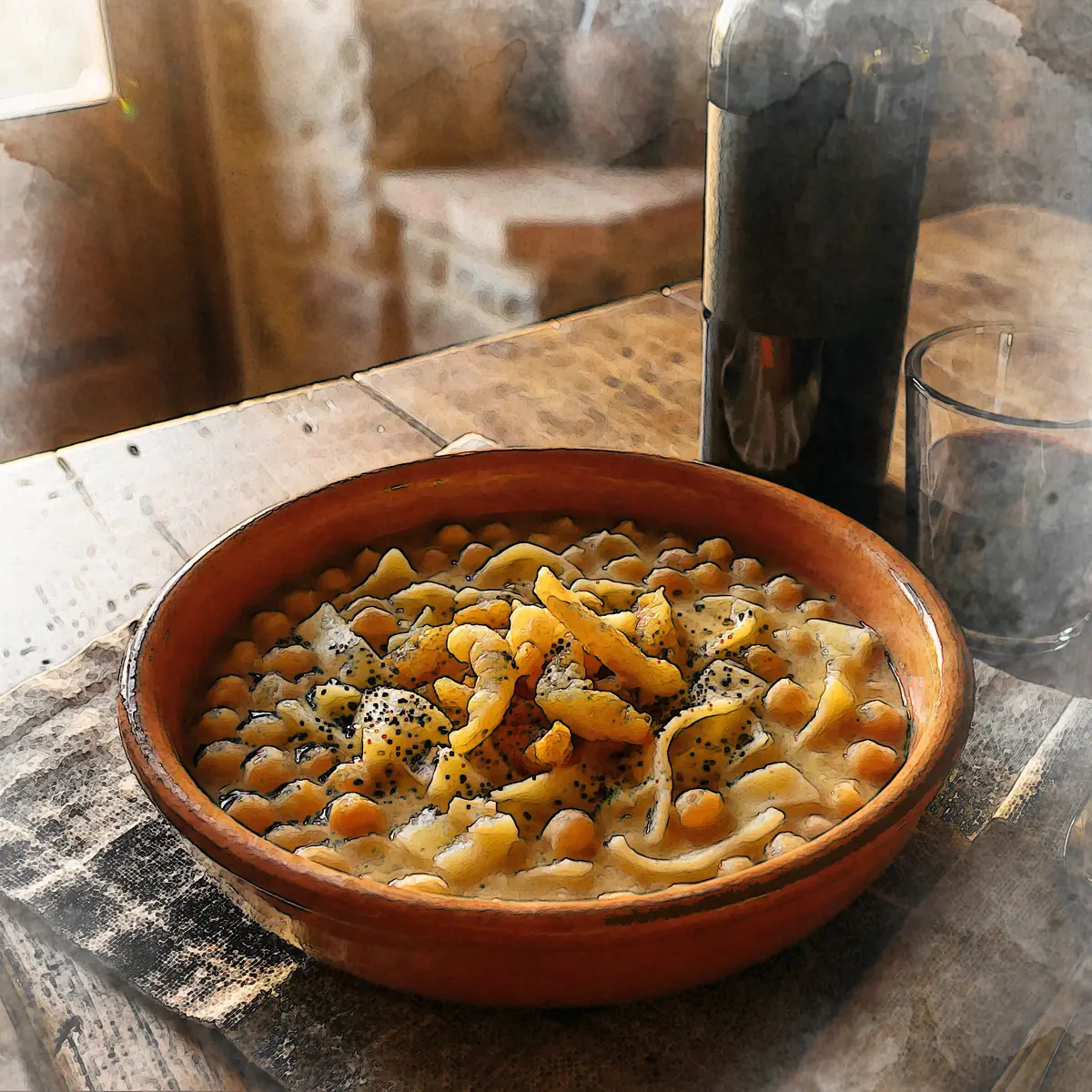
Ciceri e Tria
Re-milled durum wheat semolina, dried chickpeas, extra virgin olive oil, garlic, bay leaf, black pepper
Moderate
Apulia
130 minutes
620 Calories
Ciceri e Tria
Re-milled durum wheat semolina, dried chickpeas, extra virgin olive oil, garlic, bay leaf, black pepper
Moderate
Apulia
130 minutes
620 Calories
Ciceri e Tria
Re-milled durum wheat semolina, dried chickpeas, extra virgin olive oil, garlic, bay leaf, black pepper
Moderate
Apulia
130 minutes
620 Calories
GENESIS
Ciceri e tria stands as the sublime culinary emblem of Salento, a testament of antiquity within the gastronomic heritage of Puglia. The lineage of this dish traces its ancestry to the epoch of Arab dominion; indeed, the appellation "tria" ascends from the Arabic itriya, signifying dried or fried dough. Long before, the Roman poet Horace, within his Satires, evoked a soup of chickpeas and leeks graced with lagane—the ancestors of modern pasta—suggesting that the harmonious union of legumes and wheat sheets was deeply sown in the soil of this land well before the Middle Ages.
This recipe is profoundly intertwined with the feast of Saint Joseph, celebrated on the nineteenth of March, a day when the traditional "Tables of Saint Joseph" were laid to offer sustenance to the impoverished. The singular distinction of this preparation lies in the dual preparation of the pasta: a portion is gently boiled alongside the legumes, whilst the remainder is fried to a golden hue in shimmering, hot oil. This technique, born of the necessity to elevate flavor and texture in the absence of meat, bestows upon the dish a crisp, poetic resonance and the vital sustenance demanded by pastoral labor. From a nutritional perspective, the marriage of pastoral grains and humble legumes provides a complete protein profile, rendering ciceri e tria a cornerstone of the Mediterranean diet in its most humble yet magnificent form.
PORTIONS (FOR 4 PERSONS)
FOR THE PASTA
Re-milled durum wheat semolina
Lukewarm water
Fine sea salt
400 g
200 ml
1 pinch
FOR THE EMBELLISHMENT
Dried chickpeas
Carrot
Stalk of celery
White onion
Clove of garlic
Bay leaves
Extra virgin olive oil
Coarse salt
Black pepper
Peanut oil
300 g
1
1
1
1
2
to taste
to taste
to taste
for frying
CURATION
For the chickpeas:
Submerge the dry chickpeas in an abundance of cold water for at least 12 hours, ideally introducing a pinch of baking soda should the water be particularly hard.
When the period of soaking has run its course, drain and rinse the legumes thoroughly under running water.
Transfer the chickpeas to a generous pot, cover them with cold water, and bring to a gentle boil.
During their cooking, skim the delicate froth that crowns the surface with a slotted spoon.
Introduce the carrot, celery, onion, and bay leaf to the simmering water to infuse their essence, but withhold salt at this stage to prevent the skins of the legumes from toughening.
Allow them to simmer on a gentle flame for approximately 90 minutes, or until the chickpeas are tender yet intact.
Towards the end of their cooking, remove the aromatic herbs and vegetables (carrot, celery, onion), adjust the salt, and preserve the chickpeas in their own cooking broth, keeping them warm.For the fresh pasta:
Arrange the re-milled durum wheat semolina in a well upon a wooden pastry board.
Gradually pour the tepid water and a pinch of salt into the heart of the flour.
Knead with vigor and devotion for about 10 minutes, until you fashion a smooth, homogeneous, and resilient dough.
Envelop the dough in cling film and let it rest at room temperature for 30 minutes to find its composure.
Roll out the pastry with a rolling pin to a thickness that is not too delicate (about 2-3 mm).
Cut the sheet of dough to create short ribbons, approximately 1 cm wide and 4-5 cm long, or twist them gently upon themselves to bestow the traditional silhouette of the "tria".For the seasoning and final symphony of cooking:
In a spacious pan, heat abundant extra virgin olive oil (or seed oil) until it reaches the ideal temperature for frying.
Separate about one third of the fresh pasta and fry it in the boiling oil until it dons a warm amber hue and a crisp, brittle texture.
Drain this fried pasta (the crisp portion, poetically known as "frizzuli") and rest it upon absorbent paper.
In a wide skillet, gently sweat a clove of garlic and, should you desire, a touch of minced rosemary in extra virgin olive oil.
Introduce the cooked chickpeas to the skillet along with a portion of their cooking broth, and bring to a gentle simmer.
Cook the remaining fresh pasta directly in the pot with the chickpeas (adding more hot water or vegetable broth if required) or boil it separately in salted water for a brief moment before marrying it with the legumes.
Once the boiled pasta is cooked and the broth has reduced to fashion a velvety cream, extinguish the flame.
Incorporate the fried pasta that was set aside, stirring with grace to harmonize the textures and flavors.
Serve this warm embrace of a dish immediately, crowned with a fresh grind of black pepper.
aspiration
One may purée a ladleful of cooked chickpeas and return it to the broth, thus bestowing a more velvety creaminess and luxurious density upon the soup.
Should your palate favor fiery sensations, introduce fresh chili pepper to the initial soffritto, awakening the dish's latent warmth.
Discard not the precious cooking water of the chickpeas, for it is steeped in starch and soul, an essential elixir for the ultimate triumph of the dish.
Traditional frying demands the noble use of extra virgin olive oil, which imparts a far more robust and profound character than humble seed oil.


GENESIS
Ciceri e tria stands as the sublime culinary emblem of Salento, a testament of antiquity within the gastronomic heritage of Puglia. The lineage of this dish traces its ancestry to the epoch of Arab dominion; indeed, the appellation "tria" ascends from the Arabic itriya, signifying dried or fried dough. Long before, the Roman poet Horace, within his Satires, evoked a soup of chickpeas and leeks graced with lagane—the ancestors of modern pasta—suggesting that the harmonious union of legumes and wheat sheets was deeply sown in the soil of this land well before the Middle Ages.
This recipe is profoundly intertwined with the feast of Saint Joseph, celebrated on the nineteenth of March, a day when the traditional "Tables of Saint Joseph" were laid to offer sustenance to the impoverished. The singular distinction of this preparation lies in the dual preparation of the pasta: a portion is gently boiled alongside the legumes, whilst the remainder is fried to a golden hue in shimmering, hot oil. This technique, born of the necessity to elevate flavor and texture in the absence of meat, bestows upon the dish a crisp, poetic resonance and the vital sustenance demanded by pastoral labor. From a nutritional perspective, the marriage of pastoral grains and humble legumes provides a complete protein profile, rendering ciceri e tria a cornerstone of the Mediterranean diet in its most humble yet magnificent form.
PORTIONS (FOR 4 PERSONS)
FOR THE PASTA
Re-milled durum wheat semolina
Lukewarm water
Fine sea salt
400 g
200 ml
1 pinch
FOR THE EMBELLISHMENT
Dried chickpeas
Carrot
Stalk of celery
White onion
Clove of garlic
Bay leaves
Extra virgin olive oil
Coarse salt
Black pepper
Peanut oil
300 g
1
1
1
1
2
to taste
to taste
to taste
for frying
CURATION
For the chickpeas:
Submerge the dry chickpeas in an abundance of cold water for at least 12 hours, ideally introducing a pinch of baking soda should the water be particularly hard.
When the period of soaking has run its course, drain and rinse the legumes thoroughly under running water.
Transfer the chickpeas to a generous pot, cover them with cold water, and bring to a gentle boil.
During their cooking, skim the delicate froth that crowns the surface with a slotted spoon.
Introduce the carrot, celery, onion, and bay leaf to the simmering water to infuse their essence, but withhold salt at this stage to prevent the skins of the legumes from toughening.
Allow them to simmer on a gentle flame for approximately 90 minutes, or until the chickpeas are tender yet intact.
Towards the end of their cooking, remove the aromatic herbs and vegetables (carrot, celery, onion), adjust the salt, and preserve the chickpeas in their own cooking broth, keeping them warm.For the fresh pasta:
Arrange the re-milled durum wheat semolina in a well upon a wooden pastry board.
Gradually pour the tepid water and a pinch of salt into the heart of the flour.
Knead with vigor and devotion for about 10 minutes, until you fashion a smooth, homogeneous, and resilient dough.
Envelop the dough in cling film and let it rest at room temperature for 30 minutes to find its composure.
Roll out the pastry with a rolling pin to a thickness that is not too delicate (about 2-3 mm).
Cut the sheet of dough to create short ribbons, approximately 1 cm wide and 4-5 cm long, or twist them gently upon themselves to bestow the traditional silhouette of the "tria".For the seasoning and final symphony of cooking:
In a spacious pan, heat abundant extra virgin olive oil (or seed oil) until it reaches the ideal temperature for frying.
Separate about one third of the fresh pasta and fry it in the boiling oil until it dons a warm amber hue and a crisp, brittle texture.
Drain this fried pasta (the crisp portion, poetically known as "frizzuli") and rest it upon absorbent paper.
In a wide skillet, gently sweat a clove of garlic and, should you desire, a touch of minced rosemary in extra virgin olive oil.
Introduce the cooked chickpeas to the skillet along with a portion of their cooking broth, and bring to a gentle simmer.
Cook the remaining fresh pasta directly in the pot with the chickpeas (adding more hot water or vegetable broth if required) or boil it separately in salted water for a brief moment before marrying it with the legumes.
Once the boiled pasta is cooked and the broth has reduced to fashion a velvety cream, extinguish the flame.
Incorporate the fried pasta that was set aside, stirring with grace to harmonize the textures and flavors.
Serve this warm embrace of a dish immediately, crowned with a fresh grind of black pepper.
aspiration
One may purée a ladleful of cooked chickpeas and return it to the broth, thus bestowing a more velvety creaminess and luxurious density upon the soup.
Should your palate favor fiery sensations, introduce fresh chili pepper to the initial soffritto, awakening the dish's latent warmth.
Discard not the precious cooking water of the chickpeas, for it is steeped in starch and soul, an essential elixir for the ultimate triumph of the dish.
Traditional frying demands the noble use of extra virgin olive oil, which imparts a far more robust and profound character than humble seed oil.
latest culinary creations
GENESIS
Ciceri e tria stands as the sublime culinary emblem of Salento, a testament of antiquity within the gastronomic heritage of Puglia. The lineage of this dish traces its ancestry to the epoch of Arab dominion; indeed, the appellation "tria" ascends from the Arabic itriya, signifying dried or fried dough. Long before, the Roman poet Horace, within his Satires, evoked a soup of chickpeas and leeks graced with lagane—the ancestors of modern pasta—suggesting that the harmonious union of legumes and wheat sheets was deeply sown in the soil of this land well before the Middle Ages.
This recipe is profoundly intertwined with the feast of Saint Joseph, celebrated on the nineteenth of March, a day when the traditional "Tables of Saint Joseph" were laid to offer sustenance to the impoverished. The singular distinction of this preparation lies in the dual preparation of the pasta: a portion is gently boiled alongside the legumes, whilst the remainder is fried to a golden hue in shimmering, hot oil. This technique, born of the necessity to elevate flavor and texture in the absence of meat, bestows upon the dish a crisp, poetic resonance and the vital sustenance demanded by pastoral labor. From a nutritional perspective, the marriage of pastoral grains and humble legumes provides a complete protein profile, rendering ciceri e tria a cornerstone of the Mediterranean diet in its most humble yet magnificent form.
PORTIONS (FOR 4 PERSONS)
FOR THE PASTA
Re-milled durum wheat semolina
Lukewarm water
Fine sea salt
400 g
200 ml
1 pinch
FOR THE EMBELLISHMENT
Dried chickpeas
Carrot
Stalk of celery
White onion
Clove of garlic
Bay leaves
Extra virgin olive oil
Coarse salt
Black pepper
Peanut oil
300 g
1
1
1
1
2
to taste
to taste
to taste
for frying
CURATION
For the chickpeas:
Submerge the dry chickpeas in an abundance of cold water for at least 12 hours, ideally introducing a pinch of baking soda should the water be particularly hard.
When the period of soaking has run its course, drain and rinse the legumes thoroughly under running water.
Transfer the chickpeas to a generous pot, cover them with cold water, and bring to a gentle boil.
During their cooking, skim the delicate froth that crowns the surface with a slotted spoon.
Introduce the carrot, celery, onion, and bay leaf to the simmering water to infuse their essence, but withhold salt at this stage to prevent the skins of the legumes from toughening.
Allow them to simmer on a gentle flame for approximately 90 minutes, or until the chickpeas are tender yet intact.
Towards the end of their cooking, remove the aromatic herbs and vegetables (carrot, celery, onion), adjust the salt, and preserve the chickpeas in their own cooking broth, keeping them warm.For the fresh pasta:
Arrange the re-milled durum wheat semolina in a well upon a wooden pastry board.
Gradually pour the tepid water and a pinch of salt into the heart of the flour.
Knead with vigor and devotion for about 10 minutes, until you fashion a smooth, homogeneous, and resilient dough.
Envelop the dough in cling film and let it rest at room temperature for 30 minutes to find its composure.
Roll out the pastry with a rolling pin to a thickness that is not too delicate (about 2-3 mm).
Cut the sheet of dough to create short ribbons, approximately 1 cm wide and 4-5 cm long, or twist them gently upon themselves to bestow the traditional silhouette of the "tria".For the seasoning and final symphony of cooking:
In a spacious pan, heat abundant extra virgin olive oil (or seed oil) until it reaches the ideal temperature for frying.
Separate about one third of the fresh pasta and fry it in the boiling oil until it dons a warm amber hue and a crisp, brittle texture.
Drain this fried pasta (the crisp portion, poetically known as "frizzuli") and rest it upon absorbent paper.
In a wide skillet, gently sweat a clove of garlic and, should you desire, a touch of minced rosemary in extra virgin olive oil.
Introduce the cooked chickpeas to the skillet along with a portion of their cooking broth, and bring to a gentle simmer.
Cook the remaining fresh pasta directly in the pot with the chickpeas (adding more hot water or vegetable broth if required) or boil it separately in salted water for a brief moment before marrying it with the legumes.
Once the boiled pasta is cooked and the broth has reduced to fashion a velvety cream, extinguish the flame.
Incorporate the fried pasta that was set aside, stirring with grace to harmonize the textures and flavors.
Serve this warm embrace of a dish immediately, crowned with a fresh grind of black pepper.
aspiration
One may purée a ladleful of cooked chickpeas and return it to the broth, thus bestowing a more velvety creaminess and luxurious density upon the soup.
Should your palate favor fiery sensations, introduce fresh chili pepper to the initial soffritto, awakening the dish's latent warmth.
Discard not the precious cooking water of the chickpeas, for it is steeped in starch and soul, an essential elixir for the ultimate triumph of the dish.
Traditional frying demands the noble use of extra virgin olive oil, which imparts a far more robust and profound character than humble seed oil.