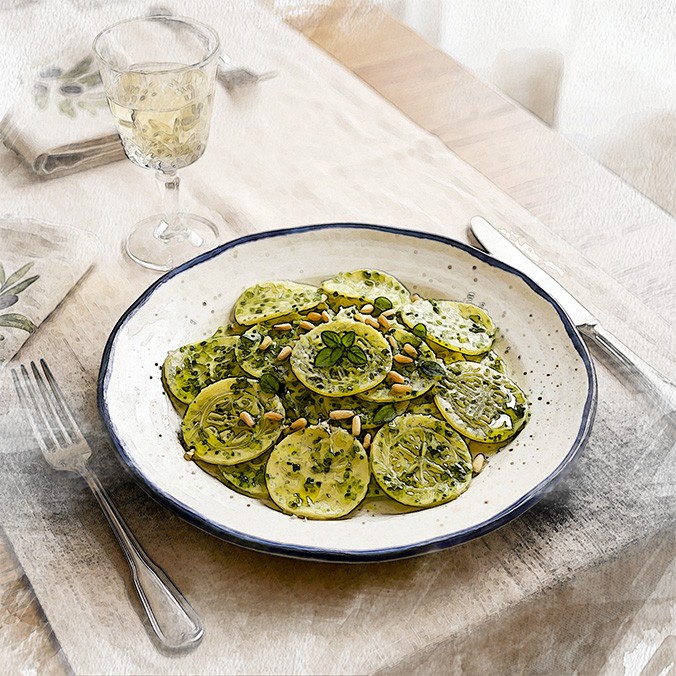
LIGURIAN CORZETTI IN A SYMPHONY OF MARJORAM AND PINE NUT PESTO
Semolina of durum wheat, sweet marjoram, pine nuts, walnuts, Parmigiano Reggiano
A demanding pursuit
Liguria
65 minutes
610 Kcal
LIGURIAN CORZETTI IN A SYMPHONY OF MARJORAM AND PINE NUT PESTO
Semolina of durum wheat, sweet marjoram, pine nuts, walnuts, Parmigiano Reggiano
A demanding pursuit
Liguria
65 minutes
610 Kcal
LIGURIAN CORZETTI IN A SYMPHONY OF MARJORAM AND PINE NUT PESTO
Semolina of durum wheat, sweet marjoram, pine nuts, walnuts, Parmigiano Reggiano
A demanding pursuit
Liguria
65 minutes
610 Kcal
GENESIS
The profound bond between Liguria and the craft of pasta-making boasts ancient roots, dating back to at least the thirteenth century, an era in which the mercantile power of Genoa proudly dominated the wheat routes of the Mediterranean. Despite the historic scarcity of flat agricultural lands, the far-sighted local merchants secured constant provisions by accumulating grain within their ports, ready to be resold or transformed even in times of crisis. This pasta-making culture evolved over generations, nourished by constant exchanges with the Arabic world and favored by the coastal climate, perfectly suited for natural drying under the embrace of the sea breeze.
One of the most refined symbols of this heritage is the corzetti, or croxetti, small, decorated medallions of pasta that were served with honor even at sumptuous royal banquets in 1362. The name may derive from the Provenu00e7al "crosets" or from the cross originally stamped upon the discs of dough. While simple coins were once used to adorn them, over time the artisan "vermicellai" fashioned finely carved wooden stamps bearing the coats of arms of local noble families. These designs served not only an aesthetic and heraldic purpose, but were extraordinarily functional, their relief patterns catching and holding the sauce with exquisite grace.
This recipe embodies the very soul of eastern Ligurian cuisine, wherein the delicacy of fresh marjoram marries the crisp texture of pine nuts and walnuts. The use of the marble mortar, a traditional vessel of Ligurian kitchens, preserves the essential oils of the herbs without warming them, ensuring an unmistakable fragrance that evokes Mediterranean gardens. Preparing corzetti demands both patience and mastery, transforming a simple dough of flour, water, and wine into a culinary masterpiece that celebrates the history of a region cradled between the mountains and the sea.
PORTIONS (FOR 4 PERSONS)
FOR THE FRESHLY KNEADED PASTA
Durum wheat flour
Egg
Tepid water
White wine
400 g
1
65 ml
65 ml
FOR THE EMBELLISHMENT
Pine nuts
Shelled walnuts
Fresh marjoram leaves
Extra virgin olive oil
Parmigiano Reggiano
Pasta cooking water
80 g
50 g
15 g
5 tablespoons
4 tablespoons
To taste
CURATION
For the fresh pasta:
Form a well with the durum wheat flour on a wooden kneading board, and gently pour the egg, wine, and water into the center. Work the elements together, slowly drawing the flour from the inner walls until a compact dough is born. Knead with vigor for several minutes until the texture becomes smooth and yielding under your touch; if necessary, lightly moisten your hands to ease the labor. Leave the dough to rest, wrapped in a cloth, for half an hour at room temperature. Once the time has elapsed, roll out a thin, delicate sheet and cut out the discs. Use the carved wooden stamp to imprint the intricate design onto both sides of each small circle, ensuring the tools are well floured so the dough does not cling to the wood.For the condiment:
In a mixer, unite the pine nuts, walnuts, marjoram, and half of the extra virgin olive oil. Blend in brief pulses to achieve a dense, luxurious cream, taking care not to overheat the delicate leaves. Transfer the mixture to a generous bowl, incorporate the Parmigiano Reggiano and the remaining oil, and season with salt. Should you wish to honor tradition, employ a marble mortar and pestle to crush the ingredients.For the final composition:
Boil the corzetti in abundant salted water for approximately 10 minutes. Retain a portion of the cooking water before draining the pasta. Gently toss the pasta in a pan with the pesto and the reserved water to create a velvety emulsion that seamlessly envelops the embossed details. Serve adorned with whole pine nuts, fragile marjoram leaves, and a final, raw drizzle of extra virgin olive oil.
aspiration
To summon an elevated aroma, employ a mortar of noble marble to crush the herbs, lest the violent blades of a mixer warm and bruise their essence.
Ensure the liquid elements of the dough rest at ambient temperature, thus coaxing the gluten network into its finest, most harmonious structure.
You may substitute a portion of the Parmigiano Reggiano with Fiore Sardo, committing to a profile of greater intensity and bolder character.
Should you lack the traditional mold, fashion the discs with a simple chalice and compose the sacred grooves using the tines of a fork.


GENESIS
The profound bond between Liguria and the craft of pasta-making boasts ancient roots, dating back to at least the thirteenth century, an era in which the mercantile power of Genoa proudly dominated the wheat routes of the Mediterranean. Despite the historic scarcity of flat agricultural lands, the far-sighted local merchants secured constant provisions by accumulating grain within their ports, ready to be resold or transformed even in times of crisis. This pasta-making culture evolved over generations, nourished by constant exchanges with the Arabic world and favored by the coastal climate, perfectly suited for natural drying under the embrace of the sea breeze.
One of the most refined symbols of this heritage is the corzetti, or croxetti, small, decorated medallions of pasta that were served with honor even at sumptuous royal banquets in 1362. The name may derive from the Provenu00e7al "crosets" or from the cross originally stamped upon the discs of dough. While simple coins were once used to adorn them, over time the artisan "vermicellai" fashioned finely carved wooden stamps bearing the coats of arms of local noble families. These designs served not only an aesthetic and heraldic purpose, but were extraordinarily functional, their relief patterns catching and holding the sauce with exquisite grace.
This recipe embodies the very soul of eastern Ligurian cuisine, wherein the delicacy of fresh marjoram marries the crisp texture of pine nuts and walnuts. The use of the marble mortar, a traditional vessel of Ligurian kitchens, preserves the essential oils of the herbs without warming them, ensuring an unmistakable fragrance that evokes Mediterranean gardens. Preparing corzetti demands both patience and mastery, transforming a simple dough of flour, water, and wine into a culinary masterpiece that celebrates the history of a region cradled between the mountains and the sea.
PORTIONS (FOR 4 PERSONS)
FOR THE FRESHLY KNEADED PASTA
Durum wheat flour
Egg
Tepid water
White wine
400 g
1
65 ml
65 ml
FOR THE EMBELLISHMENT
Pine nuts
Shelled walnuts
Fresh marjoram leaves
Extra virgin olive oil
Parmigiano Reggiano
Pasta cooking water
80 g
50 g
15 g
5 tablespoons
4 tablespoons
To taste
CURATION
For the fresh pasta:
Form a well with the durum wheat flour on a wooden kneading board, and gently pour the egg, wine, and water into the center. Work the elements together, slowly drawing the flour from the inner walls until a compact dough is born. Knead with vigor for several minutes until the texture becomes smooth and yielding under your touch; if necessary, lightly moisten your hands to ease the labor. Leave the dough to rest, wrapped in a cloth, for half an hour at room temperature. Once the time has elapsed, roll out a thin, delicate sheet and cut out the discs. Use the carved wooden stamp to imprint the intricate design onto both sides of each small circle, ensuring the tools are well floured so the dough does not cling to the wood.For the condiment:
In a mixer, unite the pine nuts, walnuts, marjoram, and half of the extra virgin olive oil. Blend in brief pulses to achieve a dense, luxurious cream, taking care not to overheat the delicate leaves. Transfer the mixture to a generous bowl, incorporate the Parmigiano Reggiano and the remaining oil, and season with salt. Should you wish to honor tradition, employ a marble mortar and pestle to crush the ingredients.For the final composition:
Boil the corzetti in abundant salted water for approximately 10 minutes. Retain a portion of the cooking water before draining the pasta. Gently toss the pasta in a pan with the pesto and the reserved water to create a velvety emulsion that seamlessly envelops the embossed details. Serve adorned with whole pine nuts, fragile marjoram leaves, and a final, raw drizzle of extra virgin olive oil.
aspiration
To summon an elevated aroma, employ a mortar of noble marble to crush the herbs, lest the violent blades of a mixer warm and bruise their essence.
Ensure the liquid elements of the dough rest at ambient temperature, thus coaxing the gluten network into its finest, most harmonious structure.
You may substitute a portion of the Parmigiano Reggiano with Fiore Sardo, committing to a profile of greater intensity and bolder character.
Should you lack the traditional mold, fashion the discs with a simple chalice and compose the sacred grooves using the tines of a fork.
latest culinary creations
GENESIS
The profound bond between Liguria and the craft of pasta-making boasts ancient roots, dating back to at least the thirteenth century, an era in which the mercantile power of Genoa proudly dominated the wheat routes of the Mediterranean. Despite the historic scarcity of flat agricultural lands, the far-sighted local merchants secured constant provisions by accumulating grain within their ports, ready to be resold or transformed even in times of crisis. This pasta-making culture evolved over generations, nourished by constant exchanges with the Arabic world and favored by the coastal climate, perfectly suited for natural drying under the embrace of the sea breeze.
One of the most refined symbols of this heritage is the corzetti, or croxetti, small, decorated medallions of pasta that were served with honor even at sumptuous royal banquets in 1362. The name may derive from the Provenu00e7al "crosets" or from the cross originally stamped upon the discs of dough. While simple coins were once used to adorn them, over time the artisan "vermicellai" fashioned finely carved wooden stamps bearing the coats of arms of local noble families. These designs served not only an aesthetic and heraldic purpose, but were extraordinarily functional, their relief patterns catching and holding the sauce with exquisite grace.
This recipe embodies the very soul of eastern Ligurian cuisine, wherein the delicacy of fresh marjoram marries the crisp texture of pine nuts and walnuts. The use of the marble mortar, a traditional vessel of Ligurian kitchens, preserves the essential oils of the herbs without warming them, ensuring an unmistakable fragrance that evokes Mediterranean gardens. Preparing corzetti demands both patience and mastery, transforming a simple dough of flour, water, and wine into a culinary masterpiece that celebrates the history of a region cradled between the mountains and the sea.
PORTIONS (FOR 4 PERSONS)
FOR THE FRESHLY KNEADED PASTA
Durum wheat flour
Egg
Tepid water
White wine
400 g
1
65 ml
65 ml
FOR THE EMBELLISHMENT
Pine nuts
Shelled walnuts
Fresh marjoram leaves
Extra virgin olive oil
Parmigiano Reggiano
Pasta cooking water
80 g
50 g
15 g
5 tablespoons
4 tablespoons
To taste
CURATION
For the fresh pasta:
Form a well with the durum wheat flour on a wooden kneading board, and gently pour the egg, wine, and water into the center. Work the elements together, slowly drawing the flour from the inner walls until a compact dough is born. Knead with vigor for several minutes until the texture becomes smooth and yielding under your touch; if necessary, lightly moisten your hands to ease the labor. Leave the dough to rest, wrapped in a cloth, for half an hour at room temperature. Once the time has elapsed, roll out a thin, delicate sheet and cut out the discs. Use the carved wooden stamp to imprint the intricate design onto both sides of each small circle, ensuring the tools are well floured so the dough does not cling to the wood.For the condiment:
In a mixer, unite the pine nuts, walnuts, marjoram, and half of the extra virgin olive oil. Blend in brief pulses to achieve a dense, luxurious cream, taking care not to overheat the delicate leaves. Transfer the mixture to a generous bowl, incorporate the Parmigiano Reggiano and the remaining oil, and season with salt. Should you wish to honor tradition, employ a marble mortar and pestle to crush the ingredients.For the final composition:
Boil the corzetti in abundant salted water for approximately 10 minutes. Retain a portion of the cooking water before draining the pasta. Gently toss the pasta in a pan with the pesto and the reserved water to create a velvety emulsion that seamlessly envelops the embossed details. Serve adorned with whole pine nuts, fragile marjoram leaves, and a final, raw drizzle of extra virgin olive oil.
aspiration
To summon an elevated aroma, employ a mortar of noble marble to crush the herbs, lest the violent blades of a mixer warm and bruise their essence.
Ensure the liquid elements of the dough rest at ambient temperature, thus coaxing the gluten network into its finest, most harmonious structure.
You may substitute a portion of the Parmigiano Reggiano with Fiore Sardo, committing to a profile of greater intensity and bolder character.
Should you lack the traditional mold, fashion the discs with a simple chalice and compose the sacred grooves using the tines of a fork.