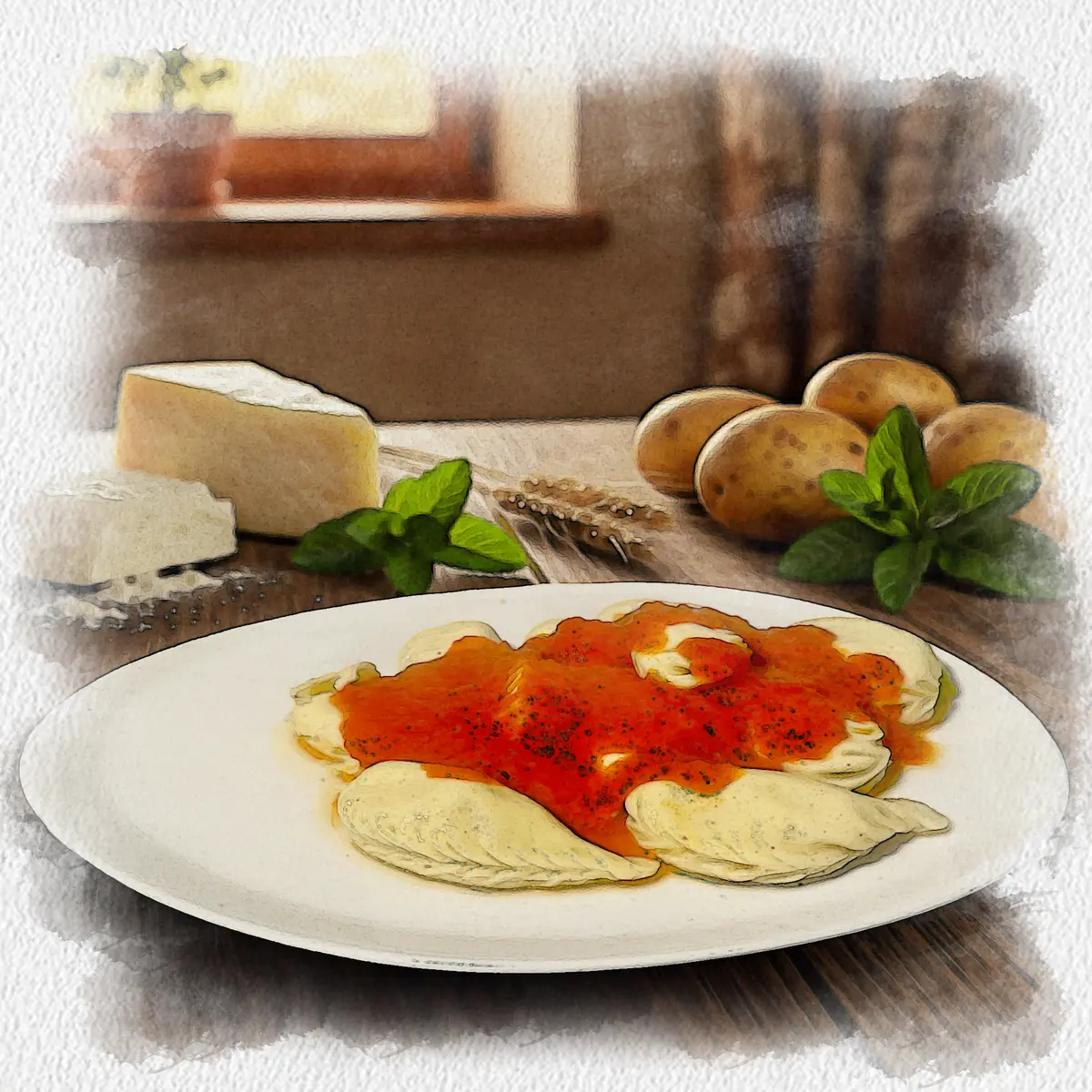
SARDINIAN CULURGIONES of OGLIASTRA
Re-milled durum wheat semolina, Farina flour 00, mountain-born potatoes, Extra Virgin Olive Oil, aged and fresh Sardinian Pecorino, aromatic mint, and sweet basil.
A demanding pursuit
Sardinia
120 minutes
450
SARDINIAN CULURGIONES of OGLIASTRA
Re-milled durum wheat semolina, Farina flour 00, mountain-born potatoes, Extra Virgin Olive Oil, aged and fresh Sardinian Pecorino, aromatic mint, and sweet basil.
A demanding pursuit
Sardinia
120 minutes
450
SARDINIAN CULURGIONES of OGLIASTRA
Re-milled durum wheat semolina, Farina flour 00, mountain-born potatoes, Extra Virgin Olive Oil, aged and fresh Sardinian Pecorino, aromatic mint, and sweet basil.
A demanding pursuit
Sardinia
120 minutes
450
GENESIS
The history of Culurgiones dell'Ogliastra is deeply rooted in the agropastoral culture of this mountainous region of eastern Sardinia. Although no precise date of origin exists, the earliest written accounts date back to the nascent years of the nineteenth century, when they were chronicled as "culurgionis de casu" (cheese culurgiones) in texts dedicated to Sardinian culinary art.
Nevertheless, it is highly probable that their lineage is even more ancient, evolving from simple preparations fashioned from the local bounties of the earth. The introduction of potato cultivation in Ogliastra during the nineteenth century marked a crucial epoch, giving rise to the creation of the filling composed of potato, Sardinian pecorino, and mint—which remains the traditional, distinctive signature of this land.
The name "culurgiones" possesses an uncertain etymology, with two primary hypotheses whispering of the pasta's form: "culleus" (a leather pouch) or "cuna" (a cradle or enclave).
The characteristic wheat-ear closure ("sa spighitta" in the Sardinian tongue) is a defining and identity-shaping element of Culurgiones dell'Ogliastra. This manual sealing is not merely an embellishment, but carries a profound symbolic weight, representing an homage to the earth and a sacred wish for prosperity in the wheat harvest.
Traditionally, Culurgiones were crafted for momentous occasions, such as the harvest, sacred feasts, and, in certain communities like Ulassai, to commemorate the departed. They were esteemed as a precious offering, frequently exchanged as a noble token of esteem and enduring friendship.
Today, Culurgiones dell'Ogliastra are enshrined in the Official Journal of the European Union with the PGI (Protected Geographical Indication) designation, a testament to their sacred bond with the terroir and their preeminence in Sardinian culture and gastronomy. Their artisanal creation, with the signature wheat-ear closure wrought rigorously by hand, endures as a symbol of the mastery and heritage of the women of Ogliastra.
PORTIONS (FOR 4 PERSONS)
FOR THE PASTA
Re-milled semolina
Flour '00'
Lukewarm water
Extra virgin olive oil
Salt
150 g
250 g
approximately 200 ml
1 tablespoon
a pinch
FOR THE CREATION'S HEART
Yellow-fleshed potatoes
Aged Sardinian Pecorino
Fresh "fiscidu" Sardinian Pecorino
Fresh mint leaves
A glove of garlic (optional)
Spoons of extra virgin olive oil
Salt and black pepper
Grated zest (optional)
1 kg
150 g
50 g
8-10
1
4-5
as needed
1/2 lemon
ELIXIR
Passata of sun-ripened tomatoes
Clove of garlic
Extra virgin olive oil
Fresh basil
Grated Sardinian Pecorino
500 g
1
to taste
to taste
to taste
CURATION
Prepare the sacred filling:
Boil the potatoes in their jackets in abundant salted water until they yield to the touch.
Drain them, peel them whilst still hot, and pass them immediately through a potato ricer or crush with a fork to achieve a silken, smooth purée.
In a spacious bowl, unite the potato purée, the two varieties of grated pecorino, the finely ribboned mint leaves, the minced garlic (should you desire its presence), the extra virgin olive oil, salt, pepper, and the grated zest of lemon (an optional whisper of brightness).
Mingle all ingredients thoroughly until a harmonious and flavorful alchemy is achieved. Taste, and adjust the salt and pepper as your palate dictates.
Cover the bowl with film and allow the filling to rest in the cool of the refrigerator for at least one hour, or ideally for several hours—even overnight—so that the flavors may weave themselves together in perfect harmony.For the pastry:
Upon a wooden board or in a spacious bowl, blend the re-milled semolina and flour with a pinch of salt.
Fashion a well in the center, and gently pour in the extra virgin olive oil and the tepid water, a little at a time.
Begin to knead with your hands, gradually drawing the flour into the liquid until a smooth, supple, and cohesive dough is born.
Work the dough with devotion for approximately 10 to 15 minutes. If necessary, add a mere droplet of water or dusting of flour to achieve the perfect texture.
Shape the dough into a sphere, wrap it in film, and let it rest at room temperature for at least 30 minutes, allowing the gluten to relax and become pliable for rolling.
Divide it into smaller portions to ease the craftsman's work.
Roll each portion with a rolling pin or a pasta machine until you obtain a fine, translucent sheet (approximately 1-2 mm in thickness).Grace the culurgiones with form:
With a circular pastry cutter of some 7-8 cm in diameter (or a glass), fashion discs from the dough.
Place a generous spoonful of the rich filling at the heart of each disc.
Now begins the most artistic ritual, the signature wheat-ear closure (or "sa spighitta"). Though methods may vary, the essence lies in pinching and sealing the edges of the dough to construct a woven braid resembling an ear of wheat.
Initiate the pattern on one side of the filling, pinching the edge of the dough with your fingertips.
Then, gently press the pinched edge inward and pinch again, creating a delicate fold.
Continue this rhythmic dance along the entire curve of the disc, slightly overlapping the folds to weave the wheat-ear motif.
Seal the terminal point securely to ensure the precious filling does not escape during its baptism in water.
As these culinary treasures are shaped, arrange them upon a lightly floured tray to prevent them from clinging to one another.Prepare the sauce:
Gently color a clove of garlic in a thread of extra virgin olive oil within a pan.
Introduce the tomato purée and a pinch of salt, allowing it to simmer over a gentle flame for 10-15 minutes, coaxing out its natural sweetness.The cooking of the culurgiones:
Bring a generous pot of salted water to a rolling boil.
Gently immerse the culurgiones into the boiling water, a few at a time, so as not to crowd them.
Simmer them for some 3 to 5 minutes from the moment they float to the surface, or until the pastry is cooked, yet retains a noble "al dente" firmness.The final touch:
To finish, adorn with a few fresh basil leaves.
Dress the culurgiones with the warm pomodoro sauce and a lavish snowfall of grated Sardinian pecorino.
aspiration
Selecting potatoes of noble quality and authentic Sardinian pecorino will exert a profound influence upon the ultimate harmony of flavors.
The rest of the dough: neglect not the designated period of repose for the dough, for it yields a grace that renders the rolling and shaping most effortless.
The art of the seal: should your first attempts at binding the dough falter in beauty, fear not; with dedicated practice, the hands shall master this sacred gesture.
These culurgiones may be preserved through the cold. Arrange them upon a flour-dusted canvas without touch, and commit them to the freezer's embrace. Once frozen, they may be gathered into culinary bags. Cook them directly from their frozen state, granting them but a few extra moments within the boiling waters.


GENESIS
The history of Culurgiones dell'Ogliastra is deeply rooted in the agropastoral culture of this mountainous region of eastern Sardinia. Although no precise date of origin exists, the earliest written accounts date back to the nascent years of the nineteenth century, when they were chronicled as "culurgionis de casu" (cheese culurgiones) in texts dedicated to Sardinian culinary art.
Nevertheless, it is highly probable that their lineage is even more ancient, evolving from simple preparations fashioned from the local bounties of the earth. The introduction of potato cultivation in Ogliastra during the nineteenth century marked a crucial epoch, giving rise to the creation of the filling composed of potato, Sardinian pecorino, and mint—which remains the traditional, distinctive signature of this land.
The name "culurgiones" possesses an uncertain etymology, with two primary hypotheses whispering of the pasta's form: "culleus" (a leather pouch) or "cuna" (a cradle or enclave).
The characteristic wheat-ear closure ("sa spighitta" in the Sardinian tongue) is a defining and identity-shaping element of Culurgiones dell'Ogliastra. This manual sealing is not merely an embellishment, but carries a profound symbolic weight, representing an homage to the earth and a sacred wish for prosperity in the wheat harvest.
Traditionally, Culurgiones were crafted for momentous occasions, such as the harvest, sacred feasts, and, in certain communities like Ulassai, to commemorate the departed. They were esteemed as a precious offering, frequently exchanged as a noble token of esteem and enduring friendship.
Today, Culurgiones dell'Ogliastra are enshrined in the Official Journal of the European Union with the PGI (Protected Geographical Indication) designation, a testament to their sacred bond with the terroir and their preeminence in Sardinian culture and gastronomy. Their artisanal creation, with the signature wheat-ear closure wrought rigorously by hand, endures as a symbol of the mastery and heritage of the women of Ogliastra.
PORTIONS (FOR 4 PERSONS)
FOR THE PASTA
Re-milled semolina
Flour '00'
Lukewarm water
Extra virgin olive oil
Salt
150 g
250 g
approximately 200 ml
1 tablespoon
a pinch
FOR THE CREATION'S HEART
Yellow-fleshed potatoes
Aged Sardinian Pecorino
Fresh "fiscidu" Sardinian Pecorino
Fresh mint leaves
A glove of garlic (optional)
Spoons of extra virgin olive oil
Salt and black pepper
Grated zest (optional)
1 kg
150 g
50 g
8-10
1
4-5
as needed
1/2 lemon
ELIXIR
Passata of sun-ripened tomatoes
Clove of garlic
Extra virgin olive oil
Fresh basil
Grated Sardinian Pecorino
500 g
1
to taste
to taste
to taste
CURATION
Prepare the sacred filling:
Boil the potatoes in their jackets in abundant salted water until they yield to the touch.
Drain them, peel them whilst still hot, and pass them immediately through a potato ricer or crush with a fork to achieve a silken, smooth purée.
In a spacious bowl, unite the potato purée, the two varieties of grated pecorino, the finely ribboned mint leaves, the minced garlic (should you desire its presence), the extra virgin olive oil, salt, pepper, and the grated zest of lemon (an optional whisper of brightness).
Mingle all ingredients thoroughly until a harmonious and flavorful alchemy is achieved. Taste, and adjust the salt and pepper as your palate dictates.
Cover the bowl with film and allow the filling to rest in the cool of the refrigerator for at least one hour, or ideally for several hours—even overnight—so that the flavors may weave themselves together in perfect harmony.For the pastry:
Upon a wooden board or in a spacious bowl, blend the re-milled semolina and flour with a pinch of salt.
Fashion a well in the center, and gently pour in the extra virgin olive oil and the tepid water, a little at a time.
Begin to knead with your hands, gradually drawing the flour into the liquid until a smooth, supple, and cohesive dough is born.
Work the dough with devotion for approximately 10 to 15 minutes. If necessary, add a mere droplet of water or dusting of flour to achieve the perfect texture.
Shape the dough into a sphere, wrap it in film, and let it rest at room temperature for at least 30 minutes, allowing the gluten to relax and become pliable for rolling.
Divide it into smaller portions to ease the craftsman's work.
Roll each portion with a rolling pin or a pasta machine until you obtain a fine, translucent sheet (approximately 1-2 mm in thickness).Grace the culurgiones with form:
With a circular pastry cutter of some 7-8 cm in diameter (or a glass), fashion discs from the dough.
Place a generous spoonful of the rich filling at the heart of each disc.
Now begins the most artistic ritual, the signature wheat-ear closure (or "sa spighitta"). Though methods may vary, the essence lies in pinching and sealing the edges of the dough to construct a woven braid resembling an ear of wheat.
Initiate the pattern on one side of the filling, pinching the edge of the dough with your fingertips.
Then, gently press the pinched edge inward and pinch again, creating a delicate fold.
Continue this rhythmic dance along the entire curve of the disc, slightly overlapping the folds to weave the wheat-ear motif.
Seal the terminal point securely to ensure the precious filling does not escape during its baptism in water.
As these culinary treasures are shaped, arrange them upon a lightly floured tray to prevent them from clinging to one another.Prepare the sauce:
Gently color a clove of garlic in a thread of extra virgin olive oil within a pan.
Introduce the tomato purée and a pinch of salt, allowing it to simmer over a gentle flame for 10-15 minutes, coaxing out its natural sweetness.The cooking of the culurgiones:
Bring a generous pot of salted water to a rolling boil.
Gently immerse the culurgiones into the boiling water, a few at a time, so as not to crowd them.
Simmer them for some 3 to 5 minutes from the moment they float to the surface, or until the pastry is cooked, yet retains a noble "al dente" firmness.The final touch:
To finish, adorn with a few fresh basil leaves.
Dress the culurgiones with the warm pomodoro sauce and a lavish snowfall of grated Sardinian pecorino.
aspiration
Selecting potatoes of noble quality and authentic Sardinian pecorino will exert a profound influence upon the ultimate harmony of flavors.
The rest of the dough: neglect not the designated period of repose for the dough, for it yields a grace that renders the rolling and shaping most effortless.
The art of the seal: should your first attempts at binding the dough falter in beauty, fear not; with dedicated practice, the hands shall master this sacred gesture.
These culurgiones may be preserved through the cold. Arrange them upon a flour-dusted canvas without touch, and commit them to the freezer's embrace. Once frozen, they may be gathered into culinary bags. Cook them directly from their frozen state, granting them but a few extra moments within the boiling waters.
latest culinary creations
GENESIS
The history of Culurgiones dell'Ogliastra is deeply rooted in the agropastoral culture of this mountainous region of eastern Sardinia. Although no precise date of origin exists, the earliest written accounts date back to the nascent years of the nineteenth century, when they were chronicled as "culurgionis de casu" (cheese culurgiones) in texts dedicated to Sardinian culinary art.
Nevertheless, it is highly probable that their lineage is even more ancient, evolving from simple preparations fashioned from the local bounties of the earth. The introduction of potato cultivation in Ogliastra during the nineteenth century marked a crucial epoch, giving rise to the creation of the filling composed of potato, Sardinian pecorino, and mint—which remains the traditional, distinctive signature of this land.
The name "culurgiones" possesses an uncertain etymology, with two primary hypotheses whispering of the pasta's form: "culleus" (a leather pouch) or "cuna" (a cradle or enclave).
The characteristic wheat-ear closure ("sa spighitta" in the Sardinian tongue) is a defining and identity-shaping element of Culurgiones dell'Ogliastra. This manual sealing is not merely an embellishment, but carries a profound symbolic weight, representing an homage to the earth and a sacred wish for prosperity in the wheat harvest.
Traditionally, Culurgiones were crafted for momentous occasions, such as the harvest, sacred feasts, and, in certain communities like Ulassai, to commemorate the departed. They were esteemed as a precious offering, frequently exchanged as a noble token of esteem and enduring friendship.
Today, Culurgiones dell'Ogliastra are enshrined in the Official Journal of the European Union with the PGI (Protected Geographical Indication) designation, a testament to their sacred bond with the terroir and their preeminence in Sardinian culture and gastronomy. Their artisanal creation, with the signature wheat-ear closure wrought rigorously by hand, endures as a symbol of the mastery and heritage of the women of Ogliastra.
PORTIONS (FOR 4 PERSONS)
FOR THE PASTA
Re-milled semolina
Flour '00'
Lukewarm water
Extra virgin olive oil
Salt
150 g
250 g
approximately 200 ml
1 tablespoon
a pinch
FOR THE CREATION'S HEART
Yellow-fleshed potatoes
Aged Sardinian Pecorino
Fresh "fiscidu" Sardinian Pecorino
Fresh mint leaves
A glove of garlic (optional)
Spoons of extra virgin olive oil
Salt and black pepper
Grated zest (optional)
1 kg
150 g
50 g
8-10
1
4-5
as needed
1/2 lemon
ELIXIR
Passata of sun-ripened tomatoes
Clove of garlic
Extra virgin olive oil
Fresh basil
Grated Sardinian Pecorino
500 g
1
to taste
to taste
to taste
CURATION
Prepare the sacred filling:
Boil the potatoes in their jackets in abundant salted water until they yield to the touch.
Drain them, peel them whilst still hot, and pass them immediately through a potato ricer or crush with a fork to achieve a silken, smooth purée.
In a spacious bowl, unite the potato purée, the two varieties of grated pecorino, the finely ribboned mint leaves, the minced garlic (should you desire its presence), the extra virgin olive oil, salt, pepper, and the grated zest of lemon (an optional whisper of brightness).
Mingle all ingredients thoroughly until a harmonious and flavorful alchemy is achieved. Taste, and adjust the salt and pepper as your palate dictates.
Cover the bowl with film and allow the filling to rest in the cool of the refrigerator for at least one hour, or ideally for several hours—even overnight—so that the flavors may weave themselves together in perfect harmony.For the pastry:
Upon a wooden board or in a spacious bowl, blend the re-milled semolina and flour with a pinch of salt.
Fashion a well in the center, and gently pour in the extra virgin olive oil and the tepid water, a little at a time.
Begin to knead with your hands, gradually drawing the flour into the liquid until a smooth, supple, and cohesive dough is born.
Work the dough with devotion for approximately 10 to 15 minutes. If necessary, add a mere droplet of water or dusting of flour to achieve the perfect texture.
Shape the dough into a sphere, wrap it in film, and let it rest at room temperature for at least 30 minutes, allowing the gluten to relax and become pliable for rolling.
Divide it into smaller portions to ease the craftsman's work.
Roll each portion with a rolling pin or a pasta machine until you obtain a fine, translucent sheet (approximately 1-2 mm in thickness).Grace the culurgiones with form:
With a circular pastry cutter of some 7-8 cm in diameter (or a glass), fashion discs from the dough.
Place a generous spoonful of the rich filling at the heart of each disc.
Now begins the most artistic ritual, the signature wheat-ear closure (or "sa spighitta"). Though methods may vary, the essence lies in pinching and sealing the edges of the dough to construct a woven braid resembling an ear of wheat.
Initiate the pattern on one side of the filling, pinching the edge of the dough with your fingertips.
Then, gently press the pinched edge inward and pinch again, creating a delicate fold.
Continue this rhythmic dance along the entire curve of the disc, slightly overlapping the folds to weave the wheat-ear motif.
Seal the terminal point securely to ensure the precious filling does not escape during its baptism in water.
As these culinary treasures are shaped, arrange them upon a lightly floured tray to prevent them from clinging to one another.Prepare the sauce:
Gently color a clove of garlic in a thread of extra virgin olive oil within a pan.
Introduce the tomato purée and a pinch of salt, allowing it to simmer over a gentle flame for 10-15 minutes, coaxing out its natural sweetness.The cooking of the culurgiones:
Bring a generous pot of salted water to a rolling boil.
Gently immerse the culurgiones into the boiling water, a few at a time, so as not to crowd them.
Simmer them for some 3 to 5 minutes from the moment they float to the surface, or until the pastry is cooked, yet retains a noble "al dente" firmness.The final touch:
To finish, adorn with a few fresh basil leaves.
Dress the culurgiones with the warm pomodoro sauce and a lavish snowfall of grated Sardinian pecorino.
aspiration
Selecting potatoes of noble quality and authentic Sardinian pecorino will exert a profound influence upon the ultimate harmony of flavors.
The rest of the dough: neglect not the designated period of repose for the dough, for it yields a grace that renders the rolling and shaping most effortless.
The art of the seal: should your first attempts at binding the dough falter in beauty, fear not; with dedicated practice, the hands shall master this sacred gesture.
These culurgiones may be preserved through the cold. Arrange them upon a flour-dusted canvas without touch, and commit them to the freezer's embrace. Once frozen, they may be gathered into culinary bags. Cook them directly from their frozen state, granting them but a few extra moments within the boiling waters.