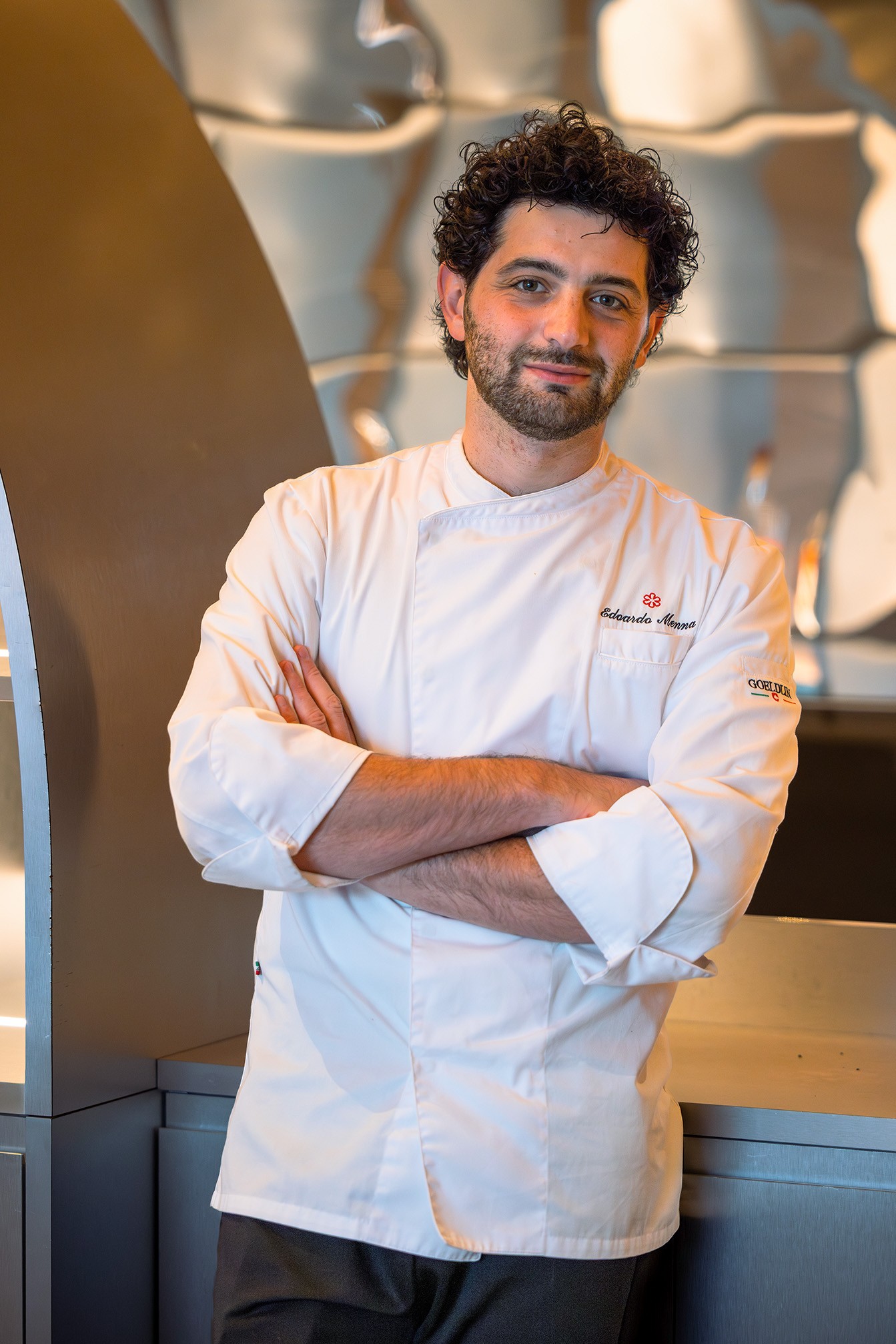
EDOARDO MENNA
pasta as a Mediterranean gesture, spanning Tuscany, Corsica, and the sea
1995
Montespertoli
Mediterranean - Contemporary
EDOARDO MENNA
pasta as a Mediterranean gesture, spanning Tuscany, Corsica, and the sea
1995
Montespertoli
Mediterranean - Contemporary
EDOARDO MENNA
pasta as a Mediterranean gesture, spanning Tuscany, Corsica, and the sea
1995
Montespertoli
Mediterranean - Contemporary
CURRICULUM VITAE
Edoardo Menna, born in 1995 and originating from Montespertoli, embodies in his journey a Tuscany that is neither clamorous nor loudly proclaimed, but rather preserved in the sacredness of gesture: a profound reverence for the raw material, a devotion to the proper rhythm of the seasons, and the memory of the sea harvested in kitchens where the product becomes a mother tongue.
Today, he holds the mantle of Executive Chef at Finestra by Italo Bassi, in Bonifacio, Southern Corsica: a harbor where Italy, Corsica, and France coalesce into a contemporary Mediterranean cuisine—precise, luminous, and deeply anchored to the purity of the product.
His culinary lineage began alongside Luciano Zazzeri at the renowned La Pineta in Marina di Bibbona: a school of the sea, of restraint, and of truth, where fish is never mere ornament, but raw grammar. From there, his path expanded beyond Italian borders into the legendary French houses of Alain Ducasse and Yannick Alléno, sanctuaries where Menna refined his discipline, technique, rigor, and sense of composition.
In 2023, he arrived in Bonifacio at the side of the master Italo Bassi. Finestra became his theater of synthesis: a dining room poised overlooking the port, almost on the threshold between keel and horizon, and a kitchen that eschews shocking artistry in pursuit of pure equilibrium. Here, Italian memory dialogues with the Corsican maquis, with the sea, citrus fruits, wild herbs, local fishermen, the island's artisanal cheeses, the depth of classic sauces, and the refinement of French technique.
The Michelin star awarded to Finestra in 2025 and reaffirmed in 2026 marks a momentous milestone: not only for the restaurant—the very first starred establishment in the history of Bonifacio—but for a "nouvelle vague" of Italian chefs capable of inhabiting the Mediterranean as a shared, living language. Within Menna’s cuisine, precision and immediacy, elegance and substance, memory and modernity coexist in perfect harmony.
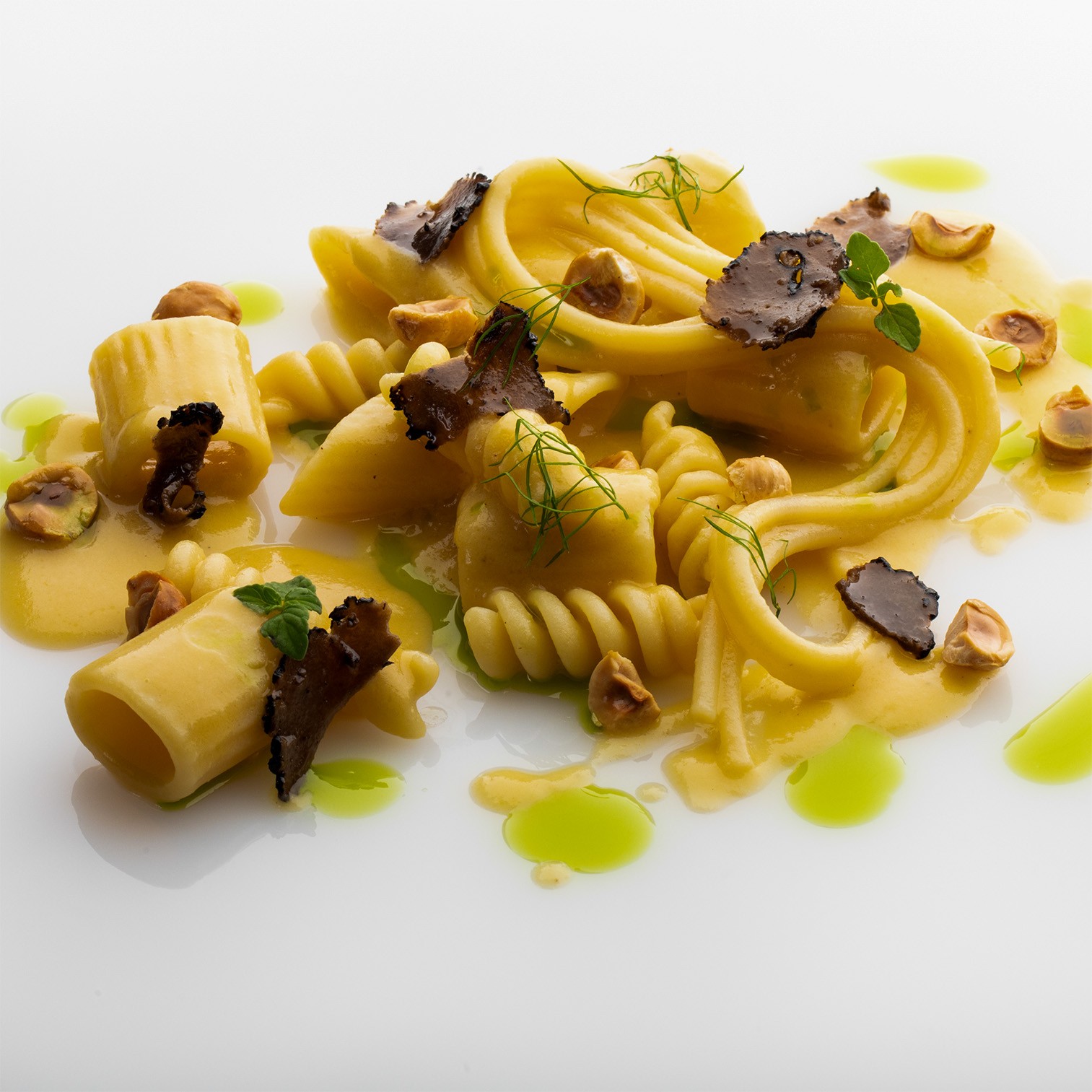
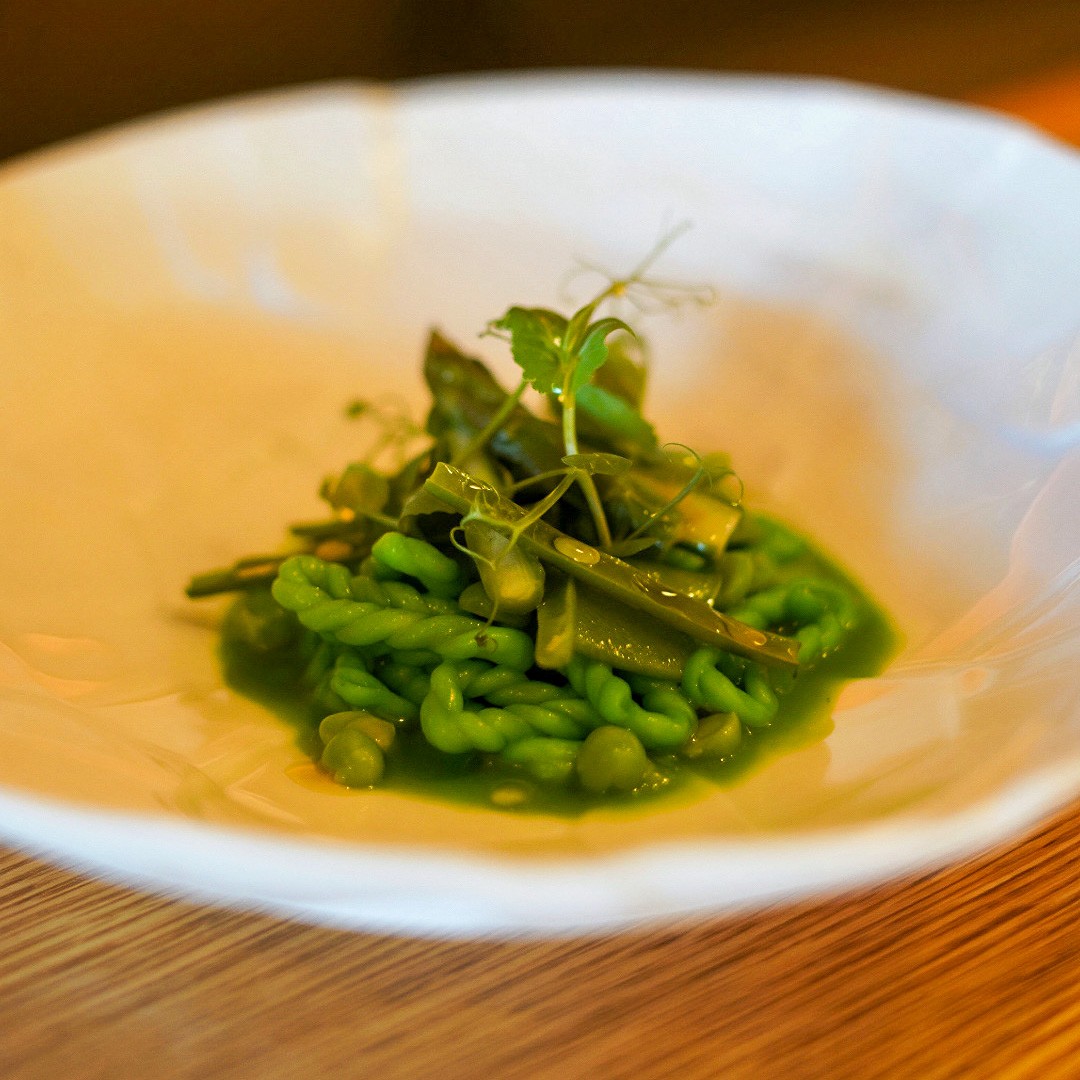
In his hands, pasta reverts to its finest state: a physical form molded by thought—filled pasta, gnocchi, ravioli, fried doughs, Italian culinary heritage reinterpreted with technical mastery and a Mediterranean gaze. This is no fossilized nostalgia, but a nomadic, living medium, capable of binding root and journey, Tuscany and Corsica, hearth and frontier.
In Bonifacio, Edoardo Menna thus crafts a cuisine that is youthful yet already mature, ambitious yet never abstract, exquisitely capable of revealing whence it came, and, above all, toward which radiant horizon it intends to sail.
dialogues
In Bonifacio, at a restaurant overlooking the harbor, where Italy and Corsica seem to gaze at each other from opposing shores, pasta becomes almost a language of the frontier. What does it represent for you within this gastronomic landscape?
For me, pasta is a sacred matter. It is one of the simplest and most authentic ways to narrate who I am: a country boy raised in Tuscany, who today cooks in a place where French gastronomy merges with Italian fragrances and exalts majestic Mediterranean products. In Bonifacio, pasta is not nostalgia: it is a bridge. It unites my cultural and professional heritage with what this terroir demands of me each day.
Your cuisine arises from an illustrious training, yet today it inhabits a most peculiar realm: Southern Corsica, the sea, the fishermen, the producers, the artisans. How does all of this enter into a first course?
They enter through the main portal, quite literally. The fishermen call me early in the morning — sometimes all too early, I say this with a smile, of course — and offer me the catch of the day: I devote myself to that, using pasta as the medium. I propose Italo-Corsican dishes with an identity bound to my journey, which is often revealed through the sauces. I adore sauces! Upon this concept, I construct various dishes for our Italian restaurant, D'Amore. If I perform my craft well, you sense them in the flavor, the measure, the purity of the dish.
Pasta carries with it a deeply Italian identity. In Corsica, within the French culinary horizon, how does one prevent it from dissolving into picturesque nostalgia, transforming it instead into a contemporary language?
By not allowing it to become a caricature of Italy. Pasta here must not resemble a souvenir: it must be vibrant and contemporary, while remaining comforting and delectable. It is a powerful instrument we are blessed to possess, revered and appreciated on a global scale. We must harness it and not make of it a parody, but rather a luscious vessel to narrate your origins and, above all, your future horizons.
On the menu of Finestra appears the Double raviolo, with a dual filling — burrata and slow-cooked guinea fowl — light Parmesan cream and fresh thyme. How is such a dish conceived, built between technical precision, Italian memory, and profound depth of flavor?
Here we speak of the signature dish of Chef Italo Bassi, with whom I have had the pleasure of collaborating for several years now. It is a symbol of cohesion and exquisite teamwork, much like the two fillings walking hand in hand within the double raviolo. It is a dish both indulgent, technical, and comforting: a luminous example of the style of cuisine we strive to bring to the table.
In a raviolo, more than anywhere else, everything relies on precise proportion: the pasta sheet, the filling, the sealing, the sauce, the temperature. What is, in your view, the exact moment when technique ceases to show itself and begins to evoke emotion?
When you no longer perceive it. When the pasta sheet, the filling, the sauce, and the temperature coexist without duel. Technique is paramount, but it must never claim supremacy. The precise moment is when the guest no longer contemplates how the dish was executed, but only how deeply it has touched them.
The Mediterranean is often narrated through the sea, yet in pasta, it can also emerge through the scrubland, the wild herbs, the cheeses, the oils, the citrus fruits, the vegetal notes. Which Corsican ingredients captivate you most today when conceiving a pasta dish?
It is natural to think of the magnificent seafood we have in Corsica, but as you have so rightly pointed out, this island is not merely the sea. There is a very important inland soul that gifts us exceptional chestnuts, from which is derived a flour that I transform into an envelope: mini ravioli del plin filled with foie gras and Mantuan fruit mustard. An element that becomes an indispensable ingredient for me is the fragrance of the surrounding scrubland, the famous “herbes du maquis”: wild thyme, rosemary, juniper, myrtle, and sage, which are fundamental to every concept that is subsequently transformed into an offering.
The cuisine of Finestra seems to seek a counterweight between elegance and character, between French rigor and Italian sensitivity. In pasta, where is this dual belonging most profoundly recognized?
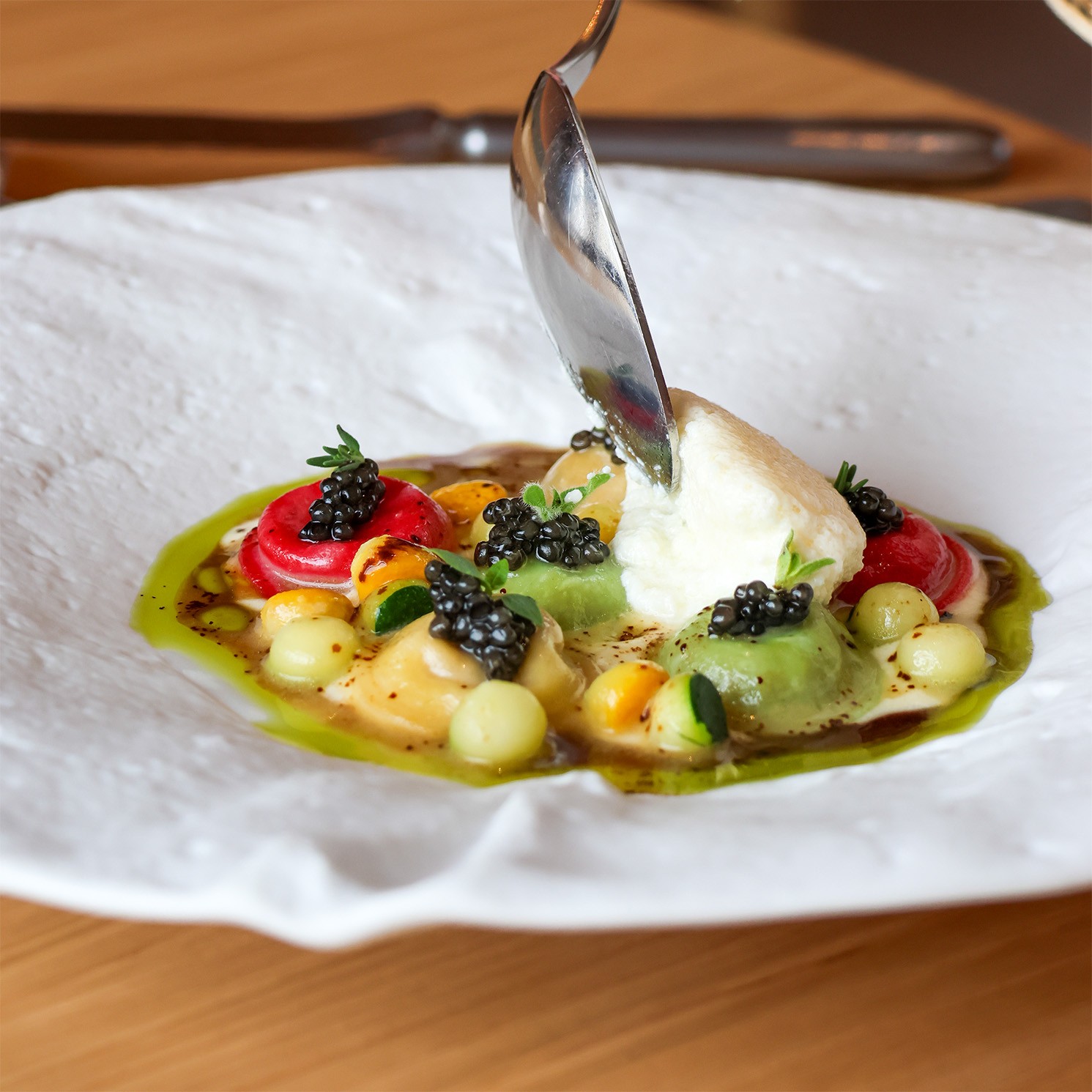
It is observed in the structure of the dish and in the profound respect for the context. On one side lies the Italian culture of taste and memory; on the other, the precision, the restraint, the elegance that this place demands. I endeavor to weave these two worlds together without force. A beautiful testament is the Bottoni filled with ratatouille — which in Tuscany we call “buglione” — served with a few grains of Italian caviar, aromatic herbs, and an extraction of eggplant and licorice.
You work alongside Italo Bassi, an authoritative figure of Italian haute cuisine. What does it mean for a young chef to safeguard such a monumental vision without relinquishing their own voice?
It means to learn deeply and to imitate sparingly. With Italo, I share a strong bond, a true discipline, an elevated standard. However, in the kitchen, you must possess the courage to dare and to walk with your own stride, without becoming a mere carbon copy. You need an identity, and here I am also fortunate to enjoy the absolute trust of the maestro Italo Bassi.
Pasta possesses a deeply domestic 'vis,' yet in a gastronomic restaurant, it is subjected to a far more complex construction. How does one preserve its immediacy without rendering it commonplace?
By treating it with reverence. Pasta is domestic, yes, but it need not be simplistic. In a gastronomic restaurant, we must preserve its indulgent soul, whilst elevating it to the highest heights. It takes very little to make it sublime, and, by the same token, just as little to ruin it.
Looking to the future, what role do you envision for pasta in Mediterranean haute cuisine: will it be ever more memory, ever more technique, or perhaps a new form of shared identity?
I believe pasta will continue to be the universal language of the Mediterranean. Softly, it will become ever more technical, yet without losing its memory. And above all, without losing its truth. Because in the end, pasta needs no elaborate explanation: when it is exquisite, it is understood immediately. And if it is not understood at once, it perhaps means we have over-complicated what should have been left to 'journey' on its own.
CURRICULUM VITAE
Edoardo Menna, born in 1995 and originating from Montespertoli, embodies in his journey a Tuscany that is neither clamorous nor loudly proclaimed, but rather preserved in the sacredness of gesture: a profound reverence for the raw material, a devotion to the proper rhythm of the seasons, and the memory of the sea harvested in kitchens where the product becomes a mother tongue.
Today, he holds the mantle of Executive Chef at Finestra by Italo Bassi, in Bonifacio, Southern Corsica: a harbor where Italy, Corsica, and France coalesce into a contemporary Mediterranean cuisine—precise, luminous, and deeply anchored to the purity of the product.
His culinary lineage began alongside Luciano Zazzeri at the renowned La Pineta in Marina di Bibbona: a school of the sea, of restraint, and of truth, where fish is never mere ornament, but raw grammar. From there, his path expanded beyond Italian borders into the legendary French houses of Alain Ducasse and Yannick Alléno, sanctuaries where Menna refined his discipline, technique, rigor, and sense of composition.
In 2023, he arrived in Bonifacio at the side of the master Italo Bassi. Finestra became his theater of synthesis: a dining room poised overlooking the port, almost on the threshold between keel and horizon, and a kitchen that eschews shocking artistry in pursuit of pure equilibrium. Here, Italian memory dialogues with the Corsican maquis, with the sea, citrus fruits, wild herbs, local fishermen, the island's artisanal cheeses, the depth of classic sauces, and the refinement of French technique.
The Michelin star awarded to Finestra in 2025 and reaffirmed in 2026 marks a momentous milestone: not only for the restaurant—the very first starred establishment in the history of Bonifacio—but for a "nouvelle vague" of Italian chefs capable of inhabiting the Mediterranean as a shared, living language. Within Menna’s cuisine, precision and immediacy, elegance and substance, memory and modernity coexist in perfect harmony.
In his hands, pasta reverts to its finest state: a physical form molded by thought—filled pasta, gnocchi, ravioli, fried doughs, Italian culinary heritage reinterpreted with technical mastery and a Mediterranean gaze. This is no fossilized nostalgia, but a nomadic, living medium, capable of binding root and journey, Tuscany and Corsica, hearth and frontier.
In Bonifacio, Edoardo Menna thus crafts a cuisine that is youthful yet already mature, ambitious yet never abstract, exquisitely capable of revealing whence it came, and, above all, toward which radiant horizon it intends to sail.
dialogues
In Bonifacio, at a restaurant overlooking the harbor, where Italy and Corsica seem to gaze at each other from opposing shores, pasta becomes almost a language of the frontier. What does it represent for you within this gastronomic landscape?
For me, pasta is a sacred matter. It is one of the simplest and most authentic ways to narrate who I am: a country boy raised in Tuscany, who today cooks in a place where French gastronomy merges with Italian fragrances and exalts majestic Mediterranean products. In Bonifacio, pasta is not nostalgia: it is a bridge. It unites my cultural and professional heritage with what this terroir demands of me each day.
Your cuisine arises from an illustrious training, yet today it inhabits a most peculiar realm: Southern Corsica, the sea, the fishermen, the producers, the artisans. How does all of this enter into a first course?
They enter through the main portal, quite literally. The fishermen call me early in the morning — sometimes all too early, I say this with a smile, of course — and offer me the catch of the day: I devote myself to that, using pasta as the medium. I propose Italo-Corsican dishes with an identity bound to my journey, which is often revealed through the sauces. I adore sauces! Upon this concept, I construct various dishes for our Italian restaurant, D'Amore. If I perform my craft well, you sense them in the flavor, the measure, the purity of the dish.
Pasta carries with it a deeply Italian identity. In Corsica, within the French culinary horizon, how does one prevent it from dissolving into picturesque nostalgia, transforming it instead into a contemporary language?
By not allowing it to become a caricature of Italy. Pasta here must not resemble a souvenir: it must be vibrant and contemporary, while remaining comforting and delectable. It is a powerful instrument we are blessed to possess, revered and appreciated on a global scale. We must harness it and not make of it a parody, but rather a luscious vessel to narrate your origins and, above all, your future horizons.
On the menu of Finestra appears the Double raviolo, with a dual filling — burrata and slow-cooked guinea fowl — light Parmesan cream and fresh thyme. How is such a dish conceived, built between technical precision, Italian memory, and profound depth of flavor?
Here we speak of the signature dish of Chef Italo Bassi, with whom I have had the pleasure of collaborating for several years now. It is a symbol of cohesion and exquisite teamwork, much like the two fillings walking hand in hand within the double raviolo. It is a dish both indulgent, technical, and comforting: a luminous example of the style of cuisine we strive to bring to the table.
In a raviolo, more than anywhere else, everything relies on precise proportion: the pasta sheet, the filling, the sealing, the sauce, the temperature. What is, in your view, the exact moment when technique ceases to show itself and begins to evoke emotion?
When you no longer perceive it. When the pasta sheet, the filling, the sauce, and the temperature coexist without duel. Technique is paramount, but it must never claim supremacy. The precise moment is when the guest no longer contemplates how the dish was executed, but only how deeply it has touched them.
The Mediterranean is often narrated through the sea, yet in pasta, it can also emerge through the scrubland, the wild herbs, the cheeses, the oils, the citrus fruits, the vegetal notes. Which Corsican ingredients captivate you most today when conceiving a pasta dish?
It is natural to think of the magnificent seafood we have in Corsica, but as you have so rightly pointed out, this island is not merely the sea. There is a very important inland soul that gifts us exceptional chestnuts, from which is derived a flour that I transform into an envelope: mini ravioli del plin filled with foie gras and Mantuan fruit mustard. An element that becomes an indispensable ingredient for me is the fragrance of the surrounding scrubland, the famous “herbes du maquis”: wild thyme, rosemary, juniper, myrtle, and sage, which are fundamental to every concept that is subsequently transformed into an offering.
The cuisine of Finestra seems to seek a counterweight between elegance and character, between French rigor and Italian sensitivity. In pasta, where is this dual belonging most profoundly recognized?
It is observed in the structure of the dish and in the profound respect for the context. On one side lies the Italian culture of taste and memory; on the other, the precision, the restraint, the elegance that this place demands. I endeavor to weave these two worlds together without force. A beautiful testament is the Bottoni filled with ratatouille — which in Tuscany we call “buglione” — served with a few grains of Italian caviar, aromatic herbs, and an extraction of eggplant and licorice.
You work alongside Italo Bassi, an authoritative figure of Italian haute cuisine. What does it mean for a young chef to safeguard such a monumental vision without relinquishing their own voice?
It means to learn deeply and to imitate sparingly. With Italo, I share a strong bond, a true discipline, an elevated standard. However, in the kitchen, you must possess the courage to dare and to walk with your own stride, without becoming a mere carbon copy. You need an identity, and here I am also fortunate to enjoy the absolute trust of the maestro Italo Bassi.
Pasta possesses a deeply domestic 'vis,' yet in a gastronomic restaurant, it is subjected to a far more complex construction. How does one preserve its immediacy without rendering it commonplace?
By treating it with reverence. Pasta is domestic, yes, but it need not be simplistic. In a gastronomic restaurant, we must preserve its indulgent soul, whilst elevating it to the highest heights. It takes very little to make it sublime, and, by the same token, just as little to ruin it.
Looking to the future, what role do you envision for pasta in Mediterranean haute cuisine: will it be ever more memory, ever more technique, or perhaps a new form of shared identity?
I believe pasta will continue to be the universal language of the Mediterranean. Softly, it will become ever more technical, yet without losing its memory. And above all, without losing its truth. Because in the end, pasta needs no elaborate explanation: when it is exquisite, it is understood immediately. And if it is not understood at once, it perhaps means we have over-complicated what should have been left to 'journey' on its own.
CURRICULUM VITAE
Edoardo Menna, born in 1995 and originating from Montespertoli, embodies in his journey a Tuscany that is neither clamorous nor loudly proclaimed, but rather preserved in the sacredness of gesture: a profound reverence for the raw material, a devotion to the proper rhythm of the seasons, and the memory of the sea harvested in kitchens where the product becomes a mother tongue.
Today, he holds the mantle of Executive Chef at Finestra by Italo Bassi, in Bonifacio, Southern Corsica: a harbor where Italy, Corsica, and France coalesce into a contemporary Mediterranean cuisine—precise, luminous, and deeply anchored to the purity of the product.
His culinary lineage began alongside Luciano Zazzeri at the renowned La Pineta in Marina di Bibbona: a school of the sea, of restraint, and of truth, where fish is never mere ornament, but raw grammar. From there, his path expanded beyond Italian borders into the legendary French houses of Alain Ducasse and Yannick Alléno, sanctuaries where Menna refined his discipline, technique, rigor, and sense of composition.
In 2023, he arrived in Bonifacio at the side of the master Italo Bassi. Finestra became his theater of synthesis: a dining room poised overlooking the port, almost on the threshold between keel and horizon, and a kitchen that eschews shocking artistry in pursuit of pure equilibrium. Here, Italian memory dialogues with the Corsican maquis, with the sea, citrus fruits, wild herbs, local fishermen, the island's artisanal cheeses, the depth of classic sauces, and the refinement of French technique.
The Michelin star awarded to Finestra in 2025 and reaffirmed in 2026 marks a momentous milestone: not only for the restaurant—the very first starred establishment in the history of Bonifacio—but for a "nouvelle vague" of Italian chefs capable of inhabiting the Mediterranean as a shared, living language. Within Menna’s cuisine, precision and immediacy, elegance and substance, memory and modernity coexist in perfect harmony.
In his hands, pasta reverts to its finest state: a physical form molded by thought—filled pasta, gnocchi, ravioli, fried doughs, Italian culinary heritage reinterpreted with technical mastery and a Mediterranean gaze. This is no fossilized nostalgia, but a nomadic, living medium, capable of binding root and journey, Tuscany and Corsica, hearth and frontier.
In Bonifacio, Edoardo Menna thus crafts a cuisine that is youthful yet already mature, ambitious yet never abstract, exquisitely capable of revealing whence it came, and, above all, toward which radiant horizon it intends to sail.
dialogues
In Bonifacio, at a restaurant overlooking the harbor, where Italy and Corsica seem to gaze at each other from opposing shores, pasta becomes almost a language of the frontier. What does it represent for you within this gastronomic landscape?
For me, pasta is a sacred matter. It is one of the simplest and most authentic ways to narrate who I am: a country boy raised in Tuscany, who today cooks in a place where French gastronomy merges with Italian fragrances and exalts majestic Mediterranean products. In Bonifacio, pasta is not nostalgia: it is a bridge. It unites my cultural and professional heritage with what this terroir demands of me each day.
Your cuisine arises from an illustrious training, yet today it inhabits a most peculiar realm: Southern Corsica, the sea, the fishermen, the producers, the artisans. How does all of this enter into a first course?
They enter through the main portal, quite literally. The fishermen call me early in the morning — sometimes all too early, I say this with a smile, of course — and offer me the catch of the day: I devote myself to that, using pasta as the medium. I propose Italo-Corsican dishes with an identity bound to my journey, which is often revealed through the sauces. I adore sauces! Upon this concept, I construct various dishes for our Italian restaurant, D'Amore. If I perform my craft well, you sense them in the flavor, the measure, the purity of the dish.
Pasta carries with it a deeply Italian identity. In Corsica, within the French culinary horizon, how does one prevent it from dissolving into picturesque nostalgia, transforming it instead into a contemporary language?
By not allowing it to become a caricature of Italy. Pasta here must not resemble a souvenir: it must be vibrant and contemporary, while remaining comforting and delectable. It is a powerful instrument we are blessed to possess, revered and appreciated on a global scale. We must harness it and not make of it a parody, but rather a luscious vessel to narrate your origins and, above all, your future horizons.
On the menu of Finestra appears the Double raviolo, with a dual filling — burrata and slow-cooked guinea fowl — light Parmesan cream and fresh thyme. How is such a dish conceived, built between technical precision, Italian memory, and profound depth of flavor?
Here we speak of the signature dish of Chef Italo Bassi, with whom I have had the pleasure of collaborating for several years now. It is a symbol of cohesion and exquisite teamwork, much like the two fillings walking hand in hand within the double raviolo. It is a dish both indulgent, technical, and comforting: a luminous example of the style of cuisine we strive to bring to the table.
In a raviolo, more than anywhere else, everything relies on precise proportion: the pasta sheet, the filling, the sealing, the sauce, the temperature. What is, in your view, the exact moment when technique ceases to show itself and begins to evoke emotion?
When you no longer perceive it. When the pasta sheet, the filling, the sauce, and the temperature coexist without duel. Technique is paramount, but it must never claim supremacy. The precise moment is when the guest no longer contemplates how the dish was executed, but only how deeply it has touched them.
The Mediterranean is often narrated through the sea, yet in pasta, it can also emerge through the scrubland, the wild herbs, the cheeses, the oils, the citrus fruits, the vegetal notes. Which Corsican ingredients captivate you most today when conceiving a pasta dish?
It is natural to think of the magnificent seafood we have in Corsica, but as you have so rightly pointed out, this island is not merely the sea. There is a very important inland soul that gifts us exceptional chestnuts, from which is derived a flour that I transform into an envelope: mini ravioli del plin filled with foie gras and Mantuan fruit mustard. An element that becomes an indispensable ingredient for me is the fragrance of the surrounding scrubland, the famous “herbes du maquis”: wild thyme, rosemary, juniper, myrtle, and sage, which are fundamental to every concept that is subsequently transformed into an offering.
The cuisine of Finestra seems to seek a counterweight between elegance and character, between French rigor and Italian sensitivity. In pasta, where is this dual belonging most profoundly recognized?
It is observed in the structure of the dish and in the profound respect for the context. On one side lies the Italian culture of taste and memory; on the other, the precision, the restraint, the elegance that this place demands. I endeavor to weave these two worlds together without force. A beautiful testament is the Bottoni filled with ratatouille — which in Tuscany we call “buglione” — served with a few grains of Italian caviar, aromatic herbs, and an extraction of eggplant and licorice.
You work alongside Italo Bassi, an authoritative figure of Italian haute cuisine. What does it mean for a young chef to safeguard such a monumental vision without relinquishing their own voice?
It means to learn deeply and to imitate sparingly. With Italo, I share a strong bond, a true discipline, an elevated standard. However, in the kitchen, you must possess the courage to dare and to walk with your own stride, without becoming a mere carbon copy. You need an identity, and here I am also fortunate to enjoy the absolute trust of the maestro Italo Bassi.
Pasta possesses a deeply domestic 'vis,' yet in a gastronomic restaurant, it is subjected to a far more complex construction. How does one preserve its immediacy without rendering it commonplace?
By treating it with reverence. Pasta is domestic, yes, but it need not be simplistic. In a gastronomic restaurant, we must preserve its indulgent soul, whilst elevating it to the highest heights. It takes very little to make it sublime, and, by the same token, just as little to ruin it.
Looking to the future, what role do you envision for pasta in Mediterranean haute cuisine: will it be ever more memory, ever more technique, or perhaps a new form of shared identity?
I believe pasta will continue to be the universal language of the Mediterranean. Softly, it will become ever more technical, yet without losing its memory. And above all, without losing its truth. Because in the end, pasta needs no elaborate explanation: when it is exquisite, it is understood immediately. And if it is not understood at once, it perhaps means we have over-complicated what should have been left to 'journey' on its own.