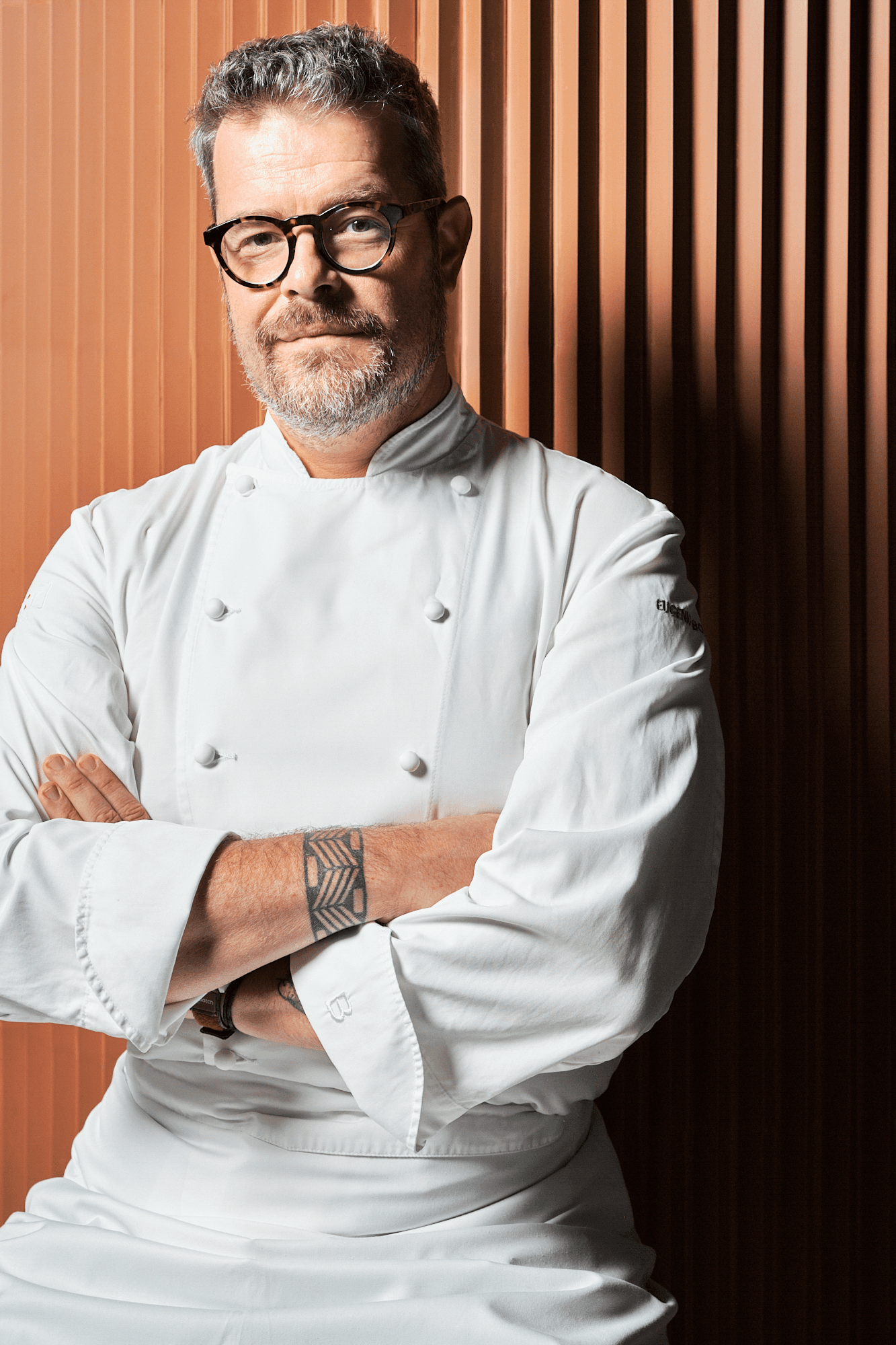
EUGENIO BOER
The Pronouncement of Taste
1978
Voorburg (NL)
Evocative - Contemporanea
EUGENIO BOER
The Pronouncement of Taste
1978
Voorburg (NL)
Evocative - Contemporanea
EUGENIO BOER
The Pronouncement of Taste
1978
Voorburg (NL)
Evocative - Contemporanea
CURRICULUM VITAE
“Born by chance in Italy” on May 8th, 1978, half-Italian and half-Dutch, Eugenio Boer was raised in the Netherlands, in Voorburg, until the age of seven, when his family relocated to Italy, to Sestri Levante (GE), following his father, then a commercial agent. His passion for the culinary arts ignited very early, when at just three years of age he began to knead dough alongside his maternal grandmother, a professional chef who had moved to the Low Countries, bringing with her an Imperia pasta maker. At twelve, he insisted on working in a restaurant, yet his father wished for him to continue his studies. He thus found a compromise, attending school in the morning and working in the afternoon, maintaining a balance that led him to graduate in accounting while simultaneously learning the foundations of cooking, practicing in various restaurants in Sestri, including Pescador and S. Anna. After a six-year apprenticeship in Liguria, he landed in Sicily, at the Osteria dei Vespri in Palermo, where he remained for two years. He then moved to Germany, to Berlin, spending three years at Bacco – "the restaurant of Berlin's Dolce Vita", the city's first Italian establishment – before continuing at Vau, where he engaged with a vast and highly structured brigade, learning the true meaning of organization and precision. He then resolved to return to Italy, to Palermo, where he worked at the Osteria dei Vespri for nearly five years, becoming the sous-chef to Alberto Rizzo, guardian of a profound heritage regarding pasta dishes—ranging from the sumptuous and rich, of clear Palermitan heritage, to fresh stuffed pasta, courtesy of his Parmese origins. He continued his refinement under Gaetano Trovato at Arnolfo in Colle Val d'Elsa (SI), where he absorbed the essence of the "grand establishment," embracing the concept of intensity of flavors tempered with an exquisite, absolute elegance.
He then arrived at La Leggenda dei Frati, in Monteriggioni, remaining in the province of Siena for four years, until landing in 2011 in South Tyrol, at St. Hubertus, with Norbert Niederkofler. There he discovered mountain gastronomy, appreciating the profound attachment to a "demanding" territory, as well as the sense of family conveyed to him by the kitchen brigade. Later, he arrived in Milan, where he dedicated himself to a pioneering project centered on natural wine: Enocratia.
A fortunate encounter with Stefano Saturnino then led him to open Fishbar de Milan, an innovative concept that allowed him to embrace a smarter, more youthful, and highly accessible dining realm. In December 2014, he launched Essenza, which in November 2017 earned him his first Michelin Star.
In June of the following year, in Milan, he opened [bu:r], his own restaurant—with a name designed to dispel any doubt regarding the pronunciation of the Chef's surname—together with his wife, Carlotta Perilli.
dialogues
When did you realize that pasta would be your mother tongue? Recount for us briefly the scene: the place, the hands, the aroma, a kitchen sound you have never forgotten. (A tactile detail that still returns to your doughs today?)
It may seem absurd — and ultimately it is a little absurd. I was about three years old, and I clearly remember the arrival of my grandmother Carlotta, known as Rosa, at our home in Holland. She cooked every day, indefatigably. I would wake up and run to the kitchen: I remained hypnotized by her gestures and by what those gestures brought forth — not merely dishes, but emotions.
The first craft I learned to master was fresh pasta: above all, the meticulousness and patience with which it was bestowed upon me. And then I remember my father when he returned home: she would see him, embrace him tightly, and they would offer gratitude to each other in a language that was a kneading together of Italian (Genoese) and Dutch. The final result was always the same: love. This is my “secret” ingredient when I knead — the memory of a love.If you had to identify yourself as a pasta shape: which cut, which thickness, which porosity would you be? And in what sauce would you recognize your character—docile, rough, angular? (A culinary portrait-dish that demonstrates this)
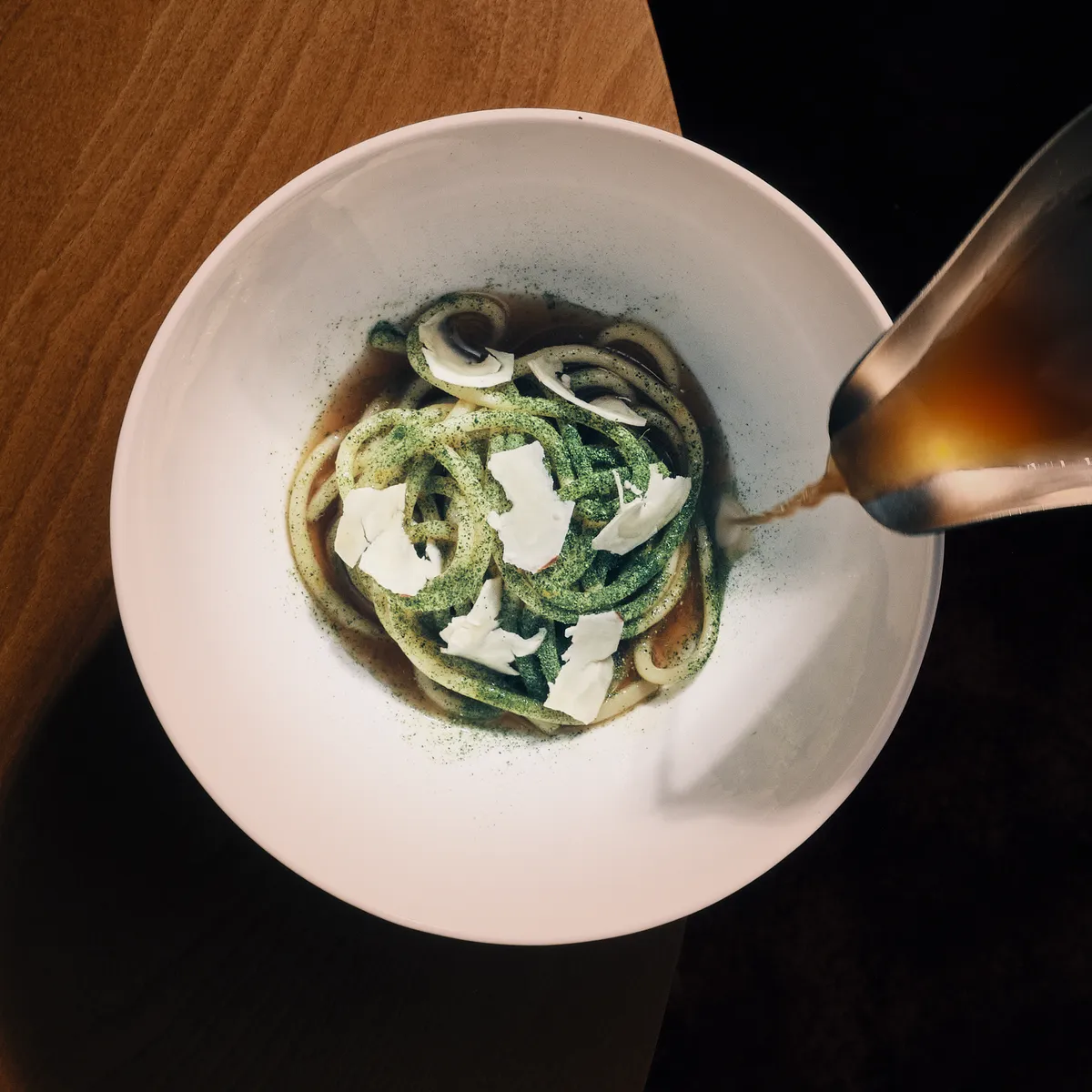
Were I a dry pasta shape, I would be a rough, porous spaghetto. If, instead, I were fresh pasta, I would be a stuffed pasta: for the filling can become anything at all, rendering the possibilities — and the creativity — almost limitless.
If I were a sauce, I would surely be a Genoese pesto made in a mortar: rough, “exhausting,” aromatic, pungent… yet also enveloping.What do you obstinately defend in tradition, and what have you learned, through arduous labor, to transcend? (An ancient gesture that you have “transcribed” into contemporary culinary grammar)
I defend the philosophy that pasta must remain at the very heart of the plate: its soul, the reason why — among other things — we are celebrated throughout the world. Not to denature it as an exercise in style, but rather to elevate it (if indeed there were ever a need) into something even more singular.
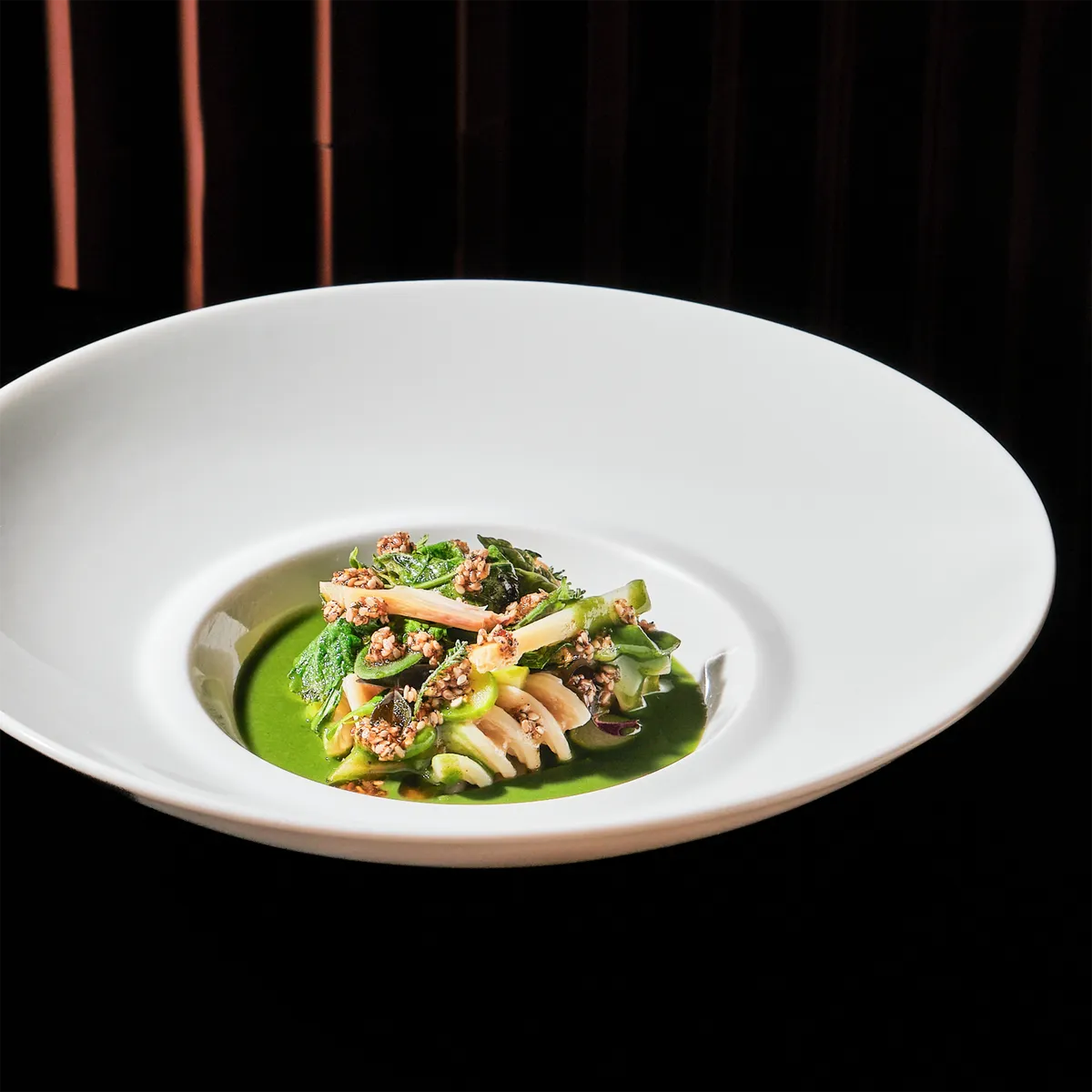
And what I have learned to transcend, with great effort, is the wariness toward ingredients “not meant for a first course”: for example, fruit, which I employ often. An open mind, when guided by taste, does not betray: it expands horizons.Where was the concept born, which trials have you burned through, what mistake guided you to the definitive shape? (Crafting notes: broths, concentrations, mantecatura, plating)
The concept was born of a desire to make the pasta — dry or fresh — the fulcrum, not a mere vehicle or accessory. A key ingredient not simply “because it is pasta,” but because it is contemplated and worked with the same reverence as any noble raw material.
And so, broths, cooking techniques, and layers of taste become the instruments to sublime it. Even scorching it, as we are currently doing with a dish on our menu. Or working with the concept of “over-cooking,” which is rewarding us with great satisfaction.
When you estrange yourself from what is “usually done,” you often perceive things you would otherwise miss: the “incorrect” ceases to be a taboo (“betraying tradition”) and becomes a “why not?”. And from there, a path to be explored — and sometimes to be trodden.Salting in three stages, starch as a binder, the moment of repose before plating: what is your sequence to achieve the exact poetic phrase upon the palate? (How do you measure the “perfect” density: by eye, ladle, thermometer, or stopwatch?)
The methodologies we employ to “close” our dishes are diverse: not all of our pastas necessarily require a mantecatura emulsion.
For the salt in the water, we have determined quantities that harmonize beautifully in relation to the other elements of the recipe — hence, they change according to the dish. To remain bound to a single method and merely “regulate” it would be limiting. In general, in the architecture of a dish, letting oneself be guided by taste is fundamental: and it is also the finest way to keep the culinary brigade’s palate forever vigilant.In what way does your pasta translate territories and migrations without lapsing into mere imitation? (A concrete example: a shape, an herb, a water that transformed a dish.)
A chef must possess a vision, a philosophy. Mine is to tell stories: tradition is a starting spark, never the finish line.
At times, this means accentuating an aromatic herb, or introducing another; playing on the affinities between ingredients, textures, and memories. Even the cooking water can become a vessel of flavors and recollections.
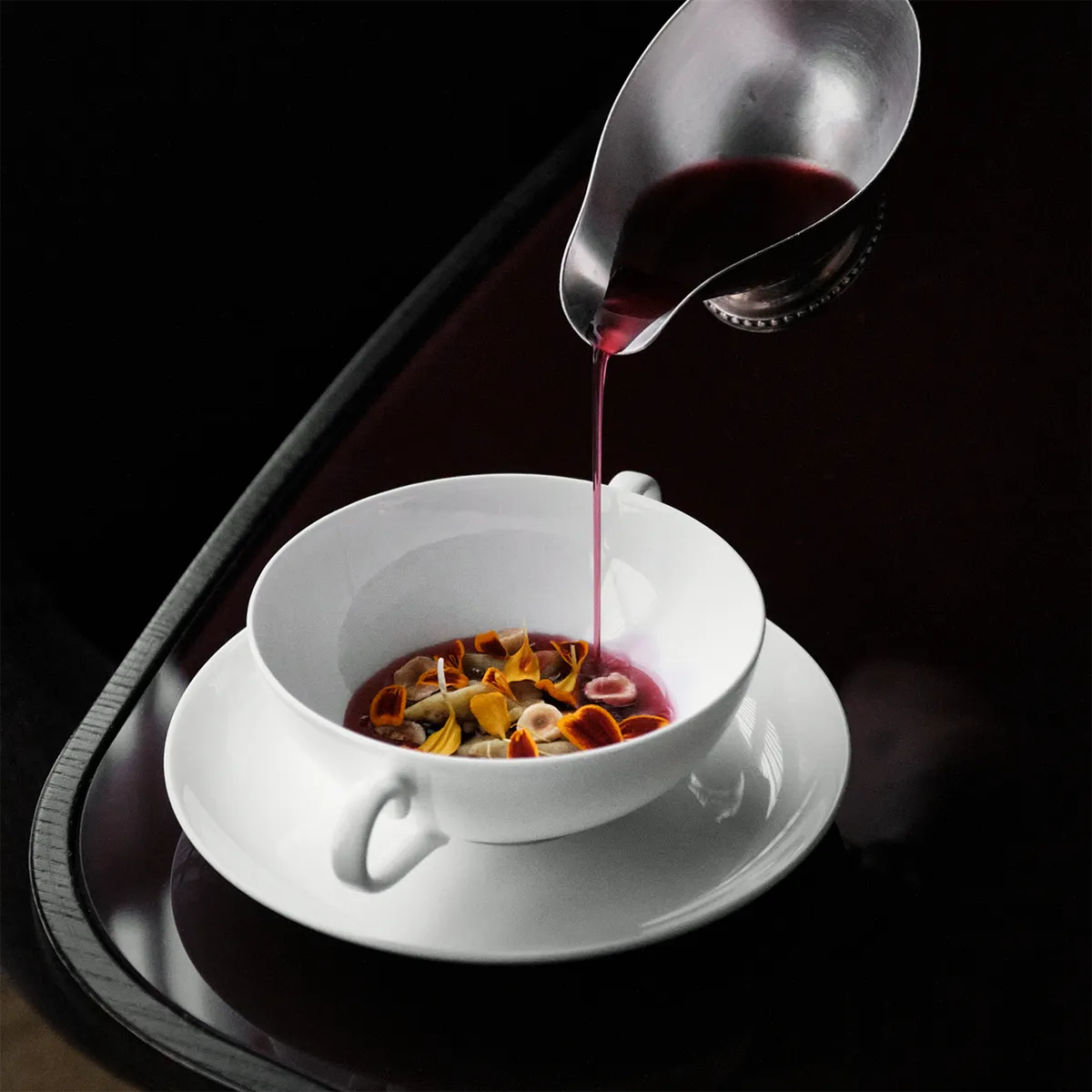
More than ten years ago, I crafted the Spaghetto from Pastificio dei Campi cooked in lapsang souchong, with saffron potatoes, sea urchins, and an extraction of parsley: a dish with a southern heart that, nonetheless, had chosen to make a brief pilgrimage to China.An uncomfortable choice that rendered your path more authentic: supplier, waste, energy, price, portion. (Which metric do you watch closely to prevent ethics from dissolving into a mere slogan?)
The most decisive choice was to distance myself from certain distribution logics and work instead on research and a direct, personal relationship with every supplier. It demands time, vast amounts of time, but it reaches our guests as a tangible testament to the supply chain: farmers, shepherds, and artisans are not mere “contacts,” they are collaborators who breathe life into the project.
In parallel, minimizing waste to the absolute limit — at times even to the detriment of aesthetics — and utilizing ingredients in their entirety: this too demands a toll in resources and energy. Yet, I am convinced that these sacrifices are felt on the plate, truly elevating its worth.
The word “sustainable” should no longer be deemed an added value: it should be a way of living our craft with conscience, devoid of glamour.Reposes, maturations, reductions, pauses in the dining room: where does time bestow flavor, and where does it steal essence away? (A case in which time rescued a dish… and one in which it betrayed it.)
I believe that certain sous-vide cookery can homogenize textures and flatten flavors, particularly if repeated multiple times across a menu. If I employ it, I prefer to limit it to a single plate; whereas I am reappreciating it for capturing broths or essences.
Then there is a matter linked to service: today, time can become a deterrent to the experience. Overly prolonged lunches or dinners are not always an enrichment. In our case, the reading of the guests is immediate, thanks in part to my wife, Carlotta: her empathy allows us to modulate the tempo of the service to their true desires. Today, “empathy” is a cardinal word, if one wishes to serve beautifully.
On the plates, I am pragmatic: I have no interest in placing obstacles in my own path. Contextualizing everything allows us to work with greater mastery, reducing error and rendering the guest happy.A gamble with pasta that you would take again tomorrow, and one you would never repeat today: what did both teach you? (How do you safeguard the “noble” error in the laboratory?)
I do not believe “noble errors” exist: there are only mistakes that should never reach the plate. I speak of technique. Then, regarding taste, a subjective element always enters — but the foundation must be unassailable.
What reform do you dream of for Italian gastronomy, and what destiny do you envision for pasta ten years from now—supply chain, training, the honest price, hospitality? (A promise you feel ready to make to your guests?)
I dream of fiscal recognition and protection for all establishments — restaurants, trattorias, pizzerias, paninoteche — that champion true quality, thereby allowing more honorable wages and a finer life for employees (and for those who lead the business). It is unjust to place on the same level those who work with solemnity and pathfinders who live by shortcuts or “tourist-trap” mentalities.
This would also elevate education, in both state and private institutions, in the kitchen as well as in the dining room. Returning to a more rigorous education would restore value to everything: from the learning process to the final act of service, returning hospitality to the throne it deserves — above all else.
Our promise to our guests is simple: they will always remain the sole protagonists of the evening.
CURRICULUM VITAE
“Born by chance in Italy” on May 8th, 1978, half-Italian and half-Dutch, Eugenio Boer was raised in the Netherlands, in Voorburg, until the age of seven, when his family relocated to Italy, to Sestri Levante (GE), following his father, then a commercial agent. His passion for the culinary arts ignited very early, when at just three years of age he began to knead dough alongside his maternal grandmother, a professional chef who had moved to the Low Countries, bringing with her an Imperia pasta maker. At twelve, he insisted on working in a restaurant, yet his father wished for him to continue his studies. He thus found a compromise, attending school in the morning and working in the afternoon, maintaining a balance that led him to graduate in accounting while simultaneously learning the foundations of cooking, practicing in various restaurants in Sestri, including Pescador and S. Anna. After a six-year apprenticeship in Liguria, he landed in Sicily, at the Osteria dei Vespri in Palermo, where he remained for two years. He then moved to Germany, to Berlin, spending three years at Bacco – "the restaurant of Berlin's Dolce Vita", the city's first Italian establishment – before continuing at Vau, where he engaged with a vast and highly structured brigade, learning the true meaning of organization and precision. He then resolved to return to Italy, to Palermo, where he worked at the Osteria dei Vespri for nearly five years, becoming the sous-chef to Alberto Rizzo, guardian of a profound heritage regarding pasta dishes—ranging from the sumptuous and rich, of clear Palermitan heritage, to fresh stuffed pasta, courtesy of his Parmese origins. He continued his refinement under Gaetano Trovato at Arnolfo in Colle Val d'Elsa (SI), where he absorbed the essence of the "grand establishment," embracing the concept of intensity of flavors tempered with an exquisite, absolute elegance.
He then arrived at La Leggenda dei Frati, in Monteriggioni, remaining in the province of Siena for four years, until landing in 2011 in South Tyrol, at St. Hubertus, with Norbert Niederkofler. There he discovered mountain gastronomy, appreciating the profound attachment to a "demanding" territory, as well as the sense of family conveyed to him by the kitchen brigade. Later, he arrived in Milan, where he dedicated himself to a pioneering project centered on natural wine: Enocratia.
A fortunate encounter with Stefano Saturnino then led him to open Fishbar de Milan, an innovative concept that allowed him to embrace a smarter, more youthful, and highly accessible dining realm. In December 2014, he launched Essenza, which in November 2017 earned him his first Michelin Star.
In June of the following year, in Milan, he opened [bu:r], his own restaurant—with a name designed to dispel any doubt regarding the pronunciation of the Chef's surname—together with his wife, Carlotta Perilli.
dialogues
When did you realize that pasta would be your mother tongue? Recount for us briefly the scene: the place, the hands, the aroma, a kitchen sound you have never forgotten. (A tactile detail that still returns to your doughs today?)
It may seem absurd — and ultimately it is a little absurd. I was about three years old, and I clearly remember the arrival of my grandmother Carlotta, known as Rosa, at our home in Holland. She cooked every day, indefatigably. I would wake up and run to the kitchen: I remained hypnotized by her gestures and by what those gestures brought forth — not merely dishes, but emotions.
The first craft I learned to master was fresh pasta: above all, the meticulousness and patience with which it was bestowed upon me. And then I remember my father when he returned home: she would see him, embrace him tightly, and they would offer gratitude to each other in a language that was a kneading together of Italian (Genoese) and Dutch. The final result was always the same: love. This is my “secret” ingredient when I knead — the memory of a love.If you had to identify yourself as a pasta shape: which cut, which thickness, which porosity would you be? And in what sauce would you recognize your character—docile, rough, angular? (A culinary portrait-dish that demonstrates this)
Were I a dry pasta shape, I would be a rough, porous spaghetto. If, instead, I were fresh pasta, I would be a stuffed pasta: for the filling can become anything at all, rendering the possibilities — and the creativity — almost limitless.
If I were a sauce, I would surely be a Genoese pesto made in a mortar: rough, “exhausting,” aromatic, pungent… yet also enveloping.What do you obstinately defend in tradition, and what have you learned, through arduous labor, to transcend? (An ancient gesture that you have “transcribed” into contemporary culinary grammar)
I defend the philosophy that pasta must remain at the very heart of the plate: its soul, the reason why — among other things — we are celebrated throughout the world. Not to denature it as an exercise in style, but rather to elevate it (if indeed there were ever a need) into something even more singular.
And what I have learned to transcend, with great effort, is the wariness toward ingredients “not meant for a first course”: for example, fruit, which I employ often. An open mind, when guided by taste, does not betray: it expands horizons.Where was the concept born, which trials have you burned through, what mistake guided you to the definitive shape? (Crafting notes: broths, concentrations, mantecatura, plating)
The concept was born of a desire to make the pasta — dry or fresh — the fulcrum, not a mere vehicle or accessory. A key ingredient not simply “because it is pasta,” but because it is contemplated and worked with the same reverence as any noble raw material.
And so, broths, cooking techniques, and layers of taste become the instruments to sublime it. Even scorching it, as we are currently doing with a dish on our menu. Or working with the concept of “over-cooking,” which is rewarding us with great satisfaction.
When you estrange yourself from what is “usually done,” you often perceive things you would otherwise miss: the “incorrect” ceases to be a taboo (“betraying tradition”) and becomes a “why not?”. And from there, a path to be explored — and sometimes to be trodden.Salting in three stages, starch as a binder, the moment of repose before plating: what is your sequence to achieve the exact poetic phrase upon the palate? (How do you measure the “perfect” density: by eye, ladle, thermometer, or stopwatch?)
The methodologies we employ to “close” our dishes are diverse: not all of our pastas necessarily require a mantecatura emulsion.
For the salt in the water, we have determined quantities that harmonize beautifully in relation to the other elements of the recipe — hence, they change according to the dish. To remain bound to a single method and merely “regulate” it would be limiting. In general, in the architecture of a dish, letting oneself be guided by taste is fundamental: and it is also the finest way to keep the culinary brigade’s palate forever vigilant.In what way does your pasta translate territories and migrations without lapsing into mere imitation? (A concrete example: a shape, an herb, a water that transformed a dish.)
A chef must possess a vision, a philosophy. Mine is to tell stories: tradition is a starting spark, never the finish line.
At times, this means accentuating an aromatic herb, or introducing another; playing on the affinities between ingredients, textures, and memories. Even the cooking water can become a vessel of flavors and recollections.
More than ten years ago, I crafted the Spaghetto from Pastificio dei Campi cooked in lapsang souchong, with saffron potatoes, sea urchins, and an extraction of parsley: a dish with a southern heart that, nonetheless, had chosen to make a brief pilgrimage to China.An uncomfortable choice that rendered your path more authentic: supplier, waste, energy, price, portion. (Which metric do you watch closely to prevent ethics from dissolving into a mere slogan?)
The most decisive choice was to distance myself from certain distribution logics and work instead on research and a direct, personal relationship with every supplier. It demands time, vast amounts of time, but it reaches our guests as a tangible testament to the supply chain: farmers, shepherds, and artisans are not mere “contacts,” they are collaborators who breathe life into the project.
In parallel, minimizing waste to the absolute limit — at times even to the detriment of aesthetics — and utilizing ingredients in their entirety: this too demands a toll in resources and energy. Yet, I am convinced that these sacrifices are felt on the plate, truly elevating its worth.
The word “sustainable” should no longer be deemed an added value: it should be a way of living our craft with conscience, devoid of glamour.Reposes, maturations, reductions, pauses in the dining room: where does time bestow flavor, and where does it steal essence away? (A case in which time rescued a dish… and one in which it betrayed it.)
I believe that certain sous-vide cookery can homogenize textures and flatten flavors, particularly if repeated multiple times across a menu. If I employ it, I prefer to limit it to a single plate; whereas I am reappreciating it for capturing broths or essences.
Then there is a matter linked to service: today, time can become a deterrent to the experience. Overly prolonged lunches or dinners are not always an enrichment. In our case, the reading of the guests is immediate, thanks in part to my wife, Carlotta: her empathy allows us to modulate the tempo of the service to their true desires. Today, “empathy” is a cardinal word, if one wishes to serve beautifully.
On the plates, I am pragmatic: I have no interest in placing obstacles in my own path. Contextualizing everything allows us to work with greater mastery, reducing error and rendering the guest happy.A gamble with pasta that you would take again tomorrow, and one you would never repeat today: what did both teach you? (How do you safeguard the “noble” error in the laboratory?)
I do not believe “noble errors” exist: there are only mistakes that should never reach the plate. I speak of technique. Then, regarding taste, a subjective element always enters — but the foundation must be unassailable.
What reform do you dream of for Italian gastronomy, and what destiny do you envision for pasta ten years from now—supply chain, training, the honest price, hospitality? (A promise you feel ready to make to your guests?)
I dream of fiscal recognition and protection for all establishments — restaurants, trattorias, pizzerias, paninoteche — that champion true quality, thereby allowing more honorable wages and a finer life for employees (and for those who lead the business). It is unjust to place on the same level those who work with solemnity and pathfinders who live by shortcuts or “tourist-trap” mentalities.
This would also elevate education, in both state and private institutions, in the kitchen as well as in the dining room. Returning to a more rigorous education would restore value to everything: from the learning process to the final act of service, returning hospitality to the throne it deserves — above all else.
Our promise to our guests is simple: they will always remain the sole protagonists of the evening.
CURRICULUM VITAE
“Born by chance in Italy” on May 8th, 1978, half-Italian and half-Dutch, Eugenio Boer was raised in the Netherlands, in Voorburg, until the age of seven, when his family relocated to Italy, to Sestri Levante (GE), following his father, then a commercial agent. His passion for the culinary arts ignited very early, when at just three years of age he began to knead dough alongside his maternal grandmother, a professional chef who had moved to the Low Countries, bringing with her an Imperia pasta maker. At twelve, he insisted on working in a restaurant, yet his father wished for him to continue his studies. He thus found a compromise, attending school in the morning and working in the afternoon, maintaining a balance that led him to graduate in accounting while simultaneously learning the foundations of cooking, practicing in various restaurants in Sestri, including Pescador and S. Anna. After a six-year apprenticeship in Liguria, he landed in Sicily, at the Osteria dei Vespri in Palermo, where he remained for two years. He then moved to Germany, to Berlin, spending three years at Bacco – "the restaurant of Berlin's Dolce Vita", the city's first Italian establishment – before continuing at Vau, where he engaged with a vast and highly structured brigade, learning the true meaning of organization and precision. He then resolved to return to Italy, to Palermo, where he worked at the Osteria dei Vespri for nearly five years, becoming the sous-chef to Alberto Rizzo, guardian of a profound heritage regarding pasta dishes—ranging from the sumptuous and rich, of clear Palermitan heritage, to fresh stuffed pasta, courtesy of his Parmese origins. He continued his refinement under Gaetano Trovato at Arnolfo in Colle Val d'Elsa (SI), where he absorbed the essence of the "grand establishment," embracing the concept of intensity of flavors tempered with an exquisite, absolute elegance.
He then arrived at La Leggenda dei Frati, in Monteriggioni, remaining in the province of Siena for four years, until landing in 2011 in South Tyrol, at St. Hubertus, with Norbert Niederkofler. There he discovered mountain gastronomy, appreciating the profound attachment to a "demanding" territory, as well as the sense of family conveyed to him by the kitchen brigade. Later, he arrived in Milan, where he dedicated himself to a pioneering project centered on natural wine: Enocratia.
A fortunate encounter with Stefano Saturnino then led him to open Fishbar de Milan, an innovative concept that allowed him to embrace a smarter, more youthful, and highly accessible dining realm. In December 2014, he launched Essenza, which in November 2017 earned him his first Michelin Star.
In June of the following year, in Milan, he opened [bu:r], his own restaurant—with a name designed to dispel any doubt regarding the pronunciation of the Chef's surname—together with his wife, Carlotta Perilli.
dialogues
When did you realize that pasta would be your mother tongue? Recount for us briefly the scene: the place, the hands, the aroma, a kitchen sound you have never forgotten. (A tactile detail that still returns to your doughs today?)
It may seem absurd — and ultimately it is a little absurd. I was about three years old, and I clearly remember the arrival of my grandmother Carlotta, known as Rosa, at our home in Holland. She cooked every day, indefatigably. I would wake up and run to the kitchen: I remained hypnotized by her gestures and by what those gestures brought forth — not merely dishes, but emotions.
The first craft I learned to master was fresh pasta: above all, the meticulousness and patience with which it was bestowed upon me. And then I remember my father when he returned home: she would see him, embrace him tightly, and they would offer gratitude to each other in a language that was a kneading together of Italian (Genoese) and Dutch. The final result was always the same: love. This is my “secret” ingredient when I knead — the memory of a love.If you had to identify yourself as a pasta shape: which cut, which thickness, which porosity would you be? And in what sauce would you recognize your character—docile, rough, angular? (A culinary portrait-dish that demonstrates this)
Were I a dry pasta shape, I would be a rough, porous spaghetto. If, instead, I were fresh pasta, I would be a stuffed pasta: for the filling can become anything at all, rendering the possibilities — and the creativity — almost limitless.
If I were a sauce, I would surely be a Genoese pesto made in a mortar: rough, “exhausting,” aromatic, pungent… yet also enveloping.What do you obstinately defend in tradition, and what have you learned, through arduous labor, to transcend? (An ancient gesture that you have “transcribed” into contemporary culinary grammar)
I defend the philosophy that pasta must remain at the very heart of the plate: its soul, the reason why — among other things — we are celebrated throughout the world. Not to denature it as an exercise in style, but rather to elevate it (if indeed there were ever a need) into something even more singular.
And what I have learned to transcend, with great effort, is the wariness toward ingredients “not meant for a first course”: for example, fruit, which I employ often. An open mind, when guided by taste, does not betray: it expands horizons.Where was the concept born, which trials have you burned through, what mistake guided you to the definitive shape? (Crafting notes: broths, concentrations, mantecatura, plating)
The concept was born of a desire to make the pasta — dry or fresh — the fulcrum, not a mere vehicle or accessory. A key ingredient not simply “because it is pasta,” but because it is contemplated and worked with the same reverence as any noble raw material.
And so, broths, cooking techniques, and layers of taste become the instruments to sublime it. Even scorching it, as we are currently doing with a dish on our menu. Or working with the concept of “over-cooking,” which is rewarding us with great satisfaction.
When you estrange yourself from what is “usually done,” you often perceive things you would otherwise miss: the “incorrect” ceases to be a taboo (“betraying tradition”) and becomes a “why not?”. And from there, a path to be explored — and sometimes to be trodden.Salting in three stages, starch as a binder, the moment of repose before plating: what is your sequence to achieve the exact poetic phrase upon the palate? (How do you measure the “perfect” density: by eye, ladle, thermometer, or stopwatch?)
The methodologies we employ to “close” our dishes are diverse: not all of our pastas necessarily require a mantecatura emulsion.
For the salt in the water, we have determined quantities that harmonize beautifully in relation to the other elements of the recipe — hence, they change according to the dish. To remain bound to a single method and merely “regulate” it would be limiting. In general, in the architecture of a dish, letting oneself be guided by taste is fundamental: and it is also the finest way to keep the culinary brigade’s palate forever vigilant.In what way does your pasta translate territories and migrations without lapsing into mere imitation? (A concrete example: a shape, an herb, a water that transformed a dish.)
A chef must possess a vision, a philosophy. Mine is to tell stories: tradition is a starting spark, never the finish line.
At times, this means accentuating an aromatic herb, or introducing another; playing on the affinities between ingredients, textures, and memories. Even the cooking water can become a vessel of flavors and recollections.
More than ten years ago, I crafted the Spaghetto from Pastificio dei Campi cooked in lapsang souchong, with saffron potatoes, sea urchins, and an extraction of parsley: a dish with a southern heart that, nonetheless, had chosen to make a brief pilgrimage to China.An uncomfortable choice that rendered your path more authentic: supplier, waste, energy, price, portion. (Which metric do you watch closely to prevent ethics from dissolving into a mere slogan?)
The most decisive choice was to distance myself from certain distribution logics and work instead on research and a direct, personal relationship with every supplier. It demands time, vast amounts of time, but it reaches our guests as a tangible testament to the supply chain: farmers, shepherds, and artisans are not mere “contacts,” they are collaborators who breathe life into the project.
In parallel, minimizing waste to the absolute limit — at times even to the detriment of aesthetics — and utilizing ingredients in their entirety: this too demands a toll in resources and energy. Yet, I am convinced that these sacrifices are felt on the plate, truly elevating its worth.
The word “sustainable” should no longer be deemed an added value: it should be a way of living our craft with conscience, devoid of glamour.Reposes, maturations, reductions, pauses in the dining room: where does time bestow flavor, and where does it steal essence away? (A case in which time rescued a dish… and one in which it betrayed it.)
I believe that certain sous-vide cookery can homogenize textures and flatten flavors, particularly if repeated multiple times across a menu. If I employ it, I prefer to limit it to a single plate; whereas I am reappreciating it for capturing broths or essences.
Then there is a matter linked to service: today, time can become a deterrent to the experience. Overly prolonged lunches or dinners are not always an enrichment. In our case, the reading of the guests is immediate, thanks in part to my wife, Carlotta: her empathy allows us to modulate the tempo of the service to their true desires. Today, “empathy” is a cardinal word, if one wishes to serve beautifully.
On the plates, I am pragmatic: I have no interest in placing obstacles in my own path. Contextualizing everything allows us to work with greater mastery, reducing error and rendering the guest happy.A gamble with pasta that you would take again tomorrow, and one you would never repeat today: what did both teach you? (How do you safeguard the “noble” error in the laboratory?)
I do not believe “noble errors” exist: there are only mistakes that should never reach the plate. I speak of technique. Then, regarding taste, a subjective element always enters — but the foundation must be unassailable.
What reform do you dream of for Italian gastronomy, and what destiny do you envision for pasta ten years from now—supply chain, training, the honest price, hospitality? (A promise you feel ready to make to your guests?)
I dream of fiscal recognition and protection for all establishments — restaurants, trattorias, pizzerias, paninoteche — that champion true quality, thereby allowing more honorable wages and a finer life for employees (and for those who lead the business). It is unjust to place on the same level those who work with solemnity and pathfinders who live by shortcuts or “tourist-trap” mentalities.
This would also elevate education, in both state and private institutions, in the kitchen as well as in the dining room. Returning to a more rigorous education would restore value to everything: from the learning process to the final act of service, returning hospitality to the throne it deserves — above all else.
Our promise to our guests is simple: they will always remain the sole protagonists of the evening.