CURRICULUM VITAE
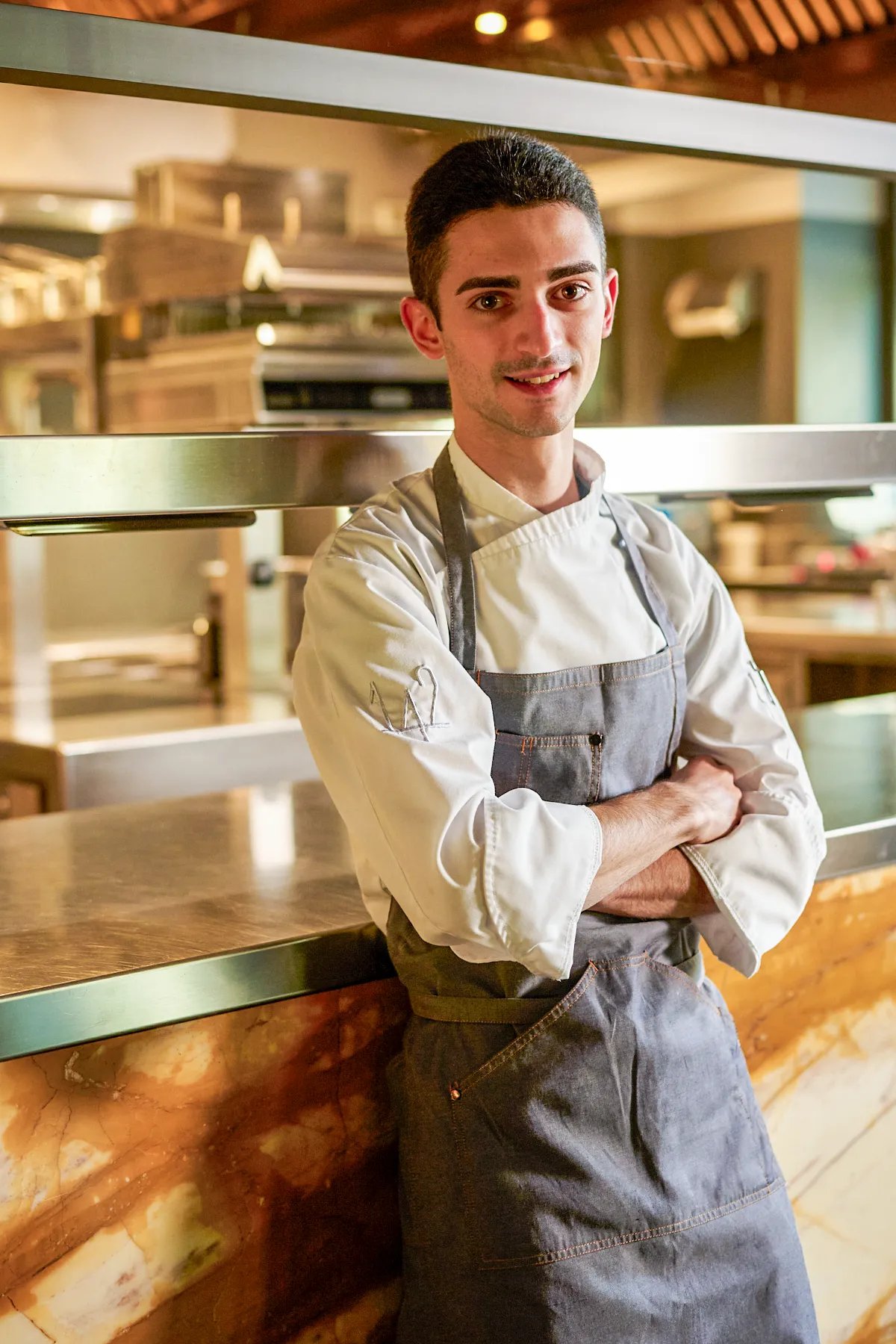
Born in the year 2000, raised on the thresholds of Milan, Federico Zappalà belongs to that new generation of culinary artists in whom instinct is seamlessly bound to discipline. His calling germinated early, within a familial sanctuary where gastronomy was a daily ritual, an avenue of curiosity, a training of the gaze: by the side of his father, a food photographer and passionate cook, he embraced not only the essence of flavor, but also the grace of form, of detail, of composition. It was there that his sensibility flourished, leading him to envision the plate as an exquisite harmony between substance and visual poetry.
Following his education at the prestigious Carlo Porta Culinary Institute in Milan, his path wound through some of the most historic kitchens: from Antica Osteria del Ponte to Enoteca Pinchiorri, from Joia to the Hôtel de Paris in Monte Carlo, within the brigade of Le Grill by Groupe Alain Ducasse, and finally to La Madernassa alongside Michelangelo Mammoliti. These experiences, diverse in their aesthetic languages and philosophies, refined his precision and helped shape a deeply conscious gastronomic vision.
Returning to Milan in 2020, he continued his journey between Motelombroso and the Aosta Valley, collaborating with Paolo Griffa at Petit Royal and Caffè Nazionale. These were years of profound maturation, in which technical rigor intertwined with a grander freedom of interpretation, and the kitchen evolved into a sanctuary of personal introspection. At the dawn of 2025, he arrived at 142 Restaurant, first as Sous Chef and subsequently as Executive Chef, assuming the helm of a hearth to which he now seeks to bestow his own distinct voice.
His creative expression is in fluid movement, defined by creative tensions that he masterfully balances despite his youth—balancing impulse and restraint, technical wizardry and soulfulness, creative instinct and the rigorous discipline of the craft.
dialogues
Chef, let us begin at the dawn: what is your earliest memory associated with pasta, that which still rises to your mind today when you conceive of cuisine as a gesture of identity?
Pasta has ever been woven into the fabric of my daily life; I possess no singular, precise memory bound to one sole moment. It was simply always there. Thus, rather than with a specific episode, I associate it with a continuous bond with the table, the pleasure of gathering, and the grace of sharing.
Your cuisine appears to arise from listening to the ingredient and its context. Within this horizon, what place does pasta occupy: comfort food, a technical canvas, or an author's signature language?
I believe that listening is an essential element of our quest. It is always the first step of my creative process, whether it lies hidden in the study and research of the raw material, or concealed within the words and thoughts of producers, artisans, and artists.
Pasta never occupies a static or sterile role.
Beyond being a versatile ingredient, it is an integral part of our daily life and culture. For this very reason, I believe it has the power to astonish, pursuing both classicism and innovation, memory and surprise.
I allow it to become a willing "victim" of our inquiry and our creative process, following and yielding to it. I wish for it to emerge as the protagonist only upon the plate, once all elements are reunited.
To me, this is not a devaluation, but rather a way to elevate the profound role it holds within our culture. It is a ductile ingredient, which effortlessly claims its central role and, above all, one which we all recognize as iconic.
Depending on the path, it finds its destiny: at times it exalts contrasts, at others it follows the flow of taste, and at others still, it renders the dish more comforting.Milan is a swift, layered city, rich with diverse influences. In what manner does this environment enter your pasta dishes, without causing them to lose their heritage and core recognition?
The roots of an ingredient such as pasta, in Italy, reside in the history and the intimate knowledge of a product that has always represented us as a people.
Its role is not the fruit of study, but rather dwells within our culture and society.
For this reason, I believe that outside influences can only ever be grand opportunities. Its central role, to me, is intrinsic to our identity and is scarcely ever overshadowed.Today, many chefs employ pasta as a realm of creative freedom. For you, where lies the boundary between contemporary interpretation and reverence for the dish's memory?
I prefer not to define limits or boundaries. I believe that imposing them upon oneself is the true limitation.
When speaking of ingredients as sacred and symbolic as pasta, a division is often created between tradition and innovation, as though they could not co-exist. I believe this to be a fallacy.
Being an ingredient of such noble value, I believe it can stand at the heart of grand creative exploration, naturally preserving its roots and finding the perfect equilibrium, without ever losing or forgetting reverence for the product itself.In your work, one senses a profound devotion to the botanical world and the precision of taste. When you compose a pasta dish, where do you begin: from the shape, the sauce, the acidity, the bitterness, or the seasonal raw material?
I always delight in beginning from a concept, an inspiration, or a narrative capable of guiding me through my research.
Following the idea toward the discovery of new creative pathways, and then transitioning to the tangible pursuit of taste, the seasonality of products and raw materials is often the genesis of my work.
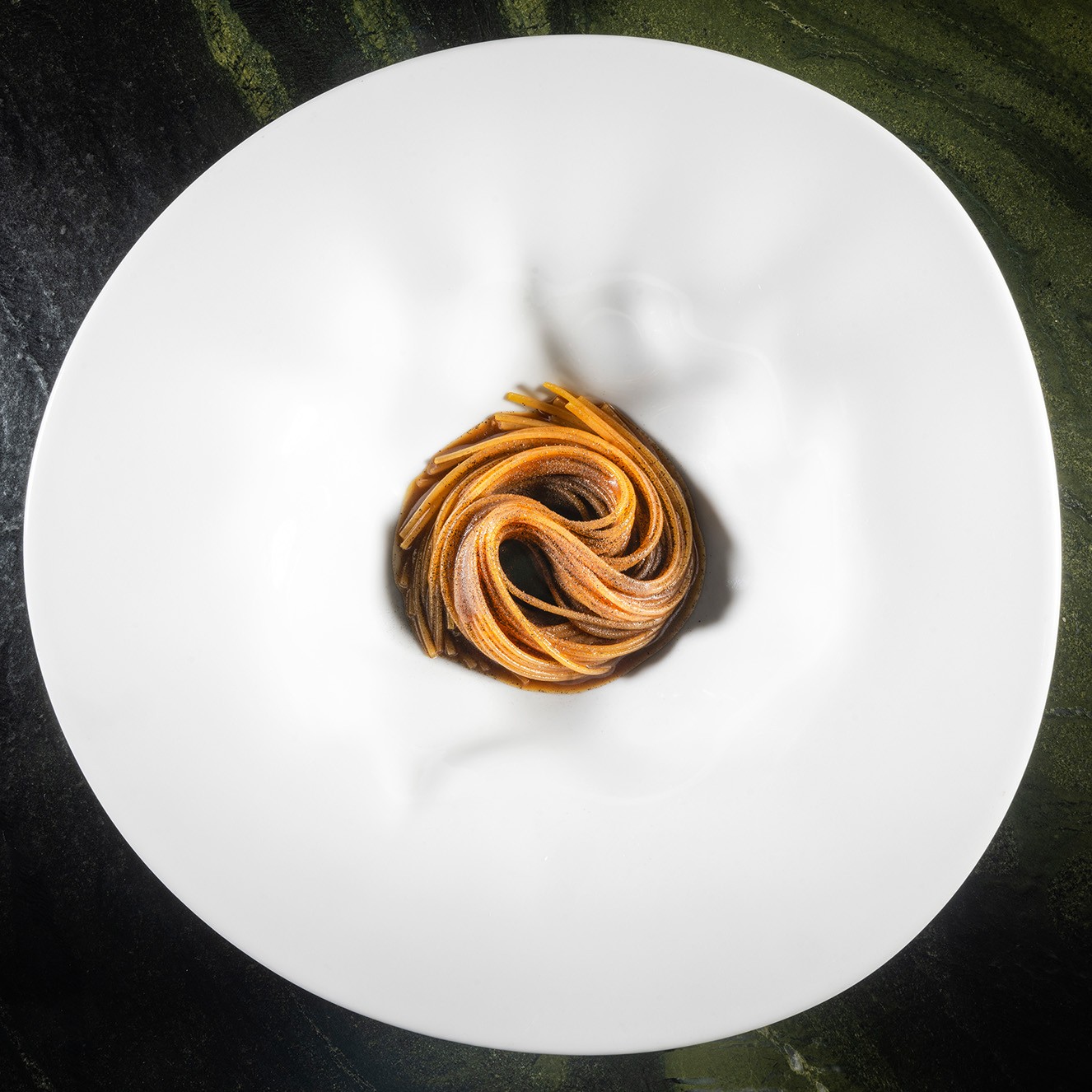
When it comes to pasta, I always like to begin with the ingredient that will accompany it. I build the harmony, crafting the sauces, condiments, or cooking liquids, only then to seek out the most fitting shape, variety, or dough.On the menu, Linguine, celeriac, lemon, and black tea is a dish that seems to wager everything on precision. How did you work with starch, acidity, the fatty component, and aromatic infusion to bestow tension, cohesion, and depth upon the dish?
Following the process I have just described, I began with the idea of crafting a dish that could cultivate a powerful contrast between essentialism and complexity, creating an expectation of simplicity only to assert itself, upon tasting, with strength and character.
Everything began with the celeriac; we created a broth that would maximize its flavor, highlighting its sweet and toasted notes.
From this arose the idea of marrying it with pasta by using it as the cooking liquid, allowing the two elements to merge, intensifying the taste even further and harnessing the starch in search of creaminess and enveloping warmth.
The lemon and the smoked black tea, meanwhile, conspired to "close the circle." I wanted them to follow the flavor, lengthening and completing it—where the greener, more vegetal note is elevated by the freshness and acidity of the citrus, while the more toasted, resinous note is amplified by the woody, intense, and smoky fragrance of the lapsang souchong tea.Is there a shape of pasta that you feel is most uniquely yours today? One that best allows you to express tension, elegance, and depth?
Rather than a single shape, I would say I am enamored with two distinct categories: long pasta in general, and very small shapes, such as ditalini, anellini, or pipette.
I believe that both are beautifully suited to escaping the classic pasta-and-sauce paradigm, proving more adaptable to diverse preparations. Another aspect shared by these two categories, which I find to be of immense value, is tied to the physical gesture: that of twirling the spaghetti, and in the other case, of using the spoon. I cherish the way the simplicity of the gesture can add a comforting, symbolic trait, even to a more complex and contemporary flavor profile.Pasta, more than other culinary creations, offers no forgiveness: cooking times, starch extraction, emulsification, serving temperature. What, in your view, is the technical detail that truly defines the boundary between a good dish and a magnificent dish of pasta?
The true difference surely lies in the symphony of these details. They are often simple yet precise gestures, each becoming essential in the architecture of a great dish.
Above all, however, I believe the most critical detail resides in the final moments of preparation, when one dresses or manteca-emulsifies the pasta. In that instant, no matter how precise the recipe, it is sensitivity alone that makes the difference. In that fleeting second, no timer or scale can aid us; it is a labor of the eye, the hand, experience, and execution.You belong to a young but already "highly exposed" generation. Do you believe that pasta can still surprise in haute cuisine today, or is the true challenge to restore to it truth rather than spectacle?
As I have touched upon before, I believe pasta can surprise both in its most classic, traditional guise and in a more innovative, contemporary expression. I think the true challenge lies in successfully finding the precise harmony that yields from knowledge, understanding, discovery, and creativity.
What I expect from myself, from my generation, and from those yet to come, is a journey dedicated to questioning the dogmas of Haute Cuisine, in search of identities that are increasingly defined, concrete, and comprehensible.Let us pose our customary final question regarding the future: how do you envision the tomorrow of pasta in contemporary Italian dining? More essential, more territorial, more technical, or more liberated?
Looking to the future, I would say more liberated. Free to be memory, to evolve, and to encounter grand artistic interpretations.
CURRICULUM VITAE
Born in the year 2000, raised on the thresholds of Milan, Federico Zappalà belongs to that new generation of culinary artists in whom instinct is seamlessly bound to discipline. His calling germinated early, within a familial sanctuary where gastronomy was a daily ritual, an avenue of curiosity, a training of the gaze: by the side of his father, a food photographer and passionate cook, he embraced not only the essence of flavor, but also the grace of form, of detail, of composition. It was there that his sensibility flourished, leading him to envision the plate as an exquisite harmony between substance and visual poetry.
Following his education at the prestigious Carlo Porta Culinary Institute in Milan, his path wound through some of the most historic kitchens: from Antica Osteria del Ponte to Enoteca Pinchiorri, from Joia to the Hôtel de Paris in Monte Carlo, within the brigade of Le Grill by Groupe Alain Ducasse, and finally to La Madernassa alongside Michelangelo Mammoliti. These experiences, diverse in their aesthetic languages and philosophies, refined his precision and helped shape a deeply conscious gastronomic vision.
Returning to Milan in 2020, he continued his journey between Motelombroso and the Aosta Valley, collaborating with Paolo Griffa at Petit Royal and Caffè Nazionale. These were years of profound maturation, in which technical rigor intertwined with a grander freedom of interpretation, and the kitchen evolved into a sanctuary of personal introspection. At the dawn of 2025, he arrived at 142 Restaurant, first as Sous Chef and subsequently as Executive Chef, assuming the helm of a hearth to which he now seeks to bestow his own distinct voice.
His creative expression is in fluid movement, defined by creative tensions that he masterfully balances despite his youth—balancing impulse and restraint, technical wizardry and soulfulness, creative instinct and the rigorous discipline of the craft.
dialogues
Chef, let us begin at the dawn: what is your earliest memory associated with pasta, that which still rises to your mind today when you conceive of cuisine as a gesture of identity?
Pasta has ever been woven into the fabric of my daily life; I possess no singular, precise memory bound to one sole moment. It was simply always there. Thus, rather than with a specific episode, I associate it with a continuous bond with the table, the pleasure of gathering, and the grace of sharing.
Your cuisine appears to arise from listening to the ingredient and its context. Within this horizon, what place does pasta occupy: comfort food, a technical canvas, or an author's signature language?
I believe that listening is an essential element of our quest. It is always the first step of my creative process, whether it lies hidden in the study and research of the raw material, or concealed within the words and thoughts of producers, artisans, and artists.
Pasta never occupies a static or sterile role.
Beyond being a versatile ingredient, it is an integral part of our daily life and culture. For this very reason, I believe it has the power to astonish, pursuing both classicism and innovation, memory and surprise.
I allow it to become a willing "victim" of our inquiry and our creative process, following and yielding to it. I wish for it to emerge as the protagonist only upon the plate, once all elements are reunited.
To me, this is not a devaluation, but rather a way to elevate the profound role it holds within our culture. It is a ductile ingredient, which effortlessly claims its central role and, above all, one which we all recognize as iconic.
Depending on the path, it finds its destiny: at times it exalts contrasts, at others it follows the flow of taste, and at others still, it renders the dish more comforting.Milan is a swift, layered city, rich with diverse influences. In what manner does this environment enter your pasta dishes, without causing them to lose their heritage and core recognition?
The roots of an ingredient such as pasta, in Italy, reside in the history and the intimate knowledge of a product that has always represented us as a people.
Its role is not the fruit of study, but rather dwells within our culture and society.
For this reason, I believe that outside influences can only ever be grand opportunities. Its central role, to me, is intrinsic to our identity and is scarcely ever overshadowed.Today, many chefs employ pasta as a realm of creative freedom. For you, where lies the boundary between contemporary interpretation and reverence for the dish's memory?
I prefer not to define limits or boundaries. I believe that imposing them upon oneself is the true limitation.
When speaking of ingredients as sacred and symbolic as pasta, a division is often created between tradition and innovation, as though they could not co-exist. I believe this to be a fallacy.
Being an ingredient of such noble value, I believe it can stand at the heart of grand creative exploration, naturally preserving its roots and finding the perfect equilibrium, without ever losing or forgetting reverence for the product itself.In your work, one senses a profound devotion to the botanical world and the precision of taste. When you compose a pasta dish, where do you begin: from the shape, the sauce, the acidity, the bitterness, or the seasonal raw material?
I always delight in beginning from a concept, an inspiration, or a narrative capable of guiding me through my research.
Following the idea toward the discovery of new creative pathways, and then transitioning to the tangible pursuit of taste, the seasonality of products and raw materials is often the genesis of my work.
When it comes to pasta, I always like to begin with the ingredient that will accompany it. I build the harmony, crafting the sauces, condiments, or cooking liquids, only then to seek out the most fitting shape, variety, or dough.On the menu, Linguine, celeriac, lemon, and black tea is a dish that seems to wager everything on precision. How did you work with starch, acidity, the fatty component, and aromatic infusion to bestow tension, cohesion, and depth upon the dish?
Following the process I have just described, I began with the idea of crafting a dish that could cultivate a powerful contrast between essentialism and complexity, creating an expectation of simplicity only to assert itself, upon tasting, with strength and character.
Everything began with the celeriac; we created a broth that would maximize its flavor, highlighting its sweet and toasted notes.
From this arose the idea of marrying it with pasta by using it as the cooking liquid, allowing the two elements to merge, intensifying the taste even further and harnessing the starch in search of creaminess and enveloping warmth.
The lemon and the smoked black tea, meanwhile, conspired to "close the circle." I wanted them to follow the flavor, lengthening and completing it—where the greener, more vegetal note is elevated by the freshness and acidity of the citrus, while the more toasted, resinous note is amplified by the woody, intense, and smoky fragrance of the lapsang souchong tea.Is there a shape of pasta that you feel is most uniquely yours today? One that best allows you to express tension, elegance, and depth?
Rather than a single shape, I would say I am enamored with two distinct categories: long pasta in general, and very small shapes, such as ditalini, anellini, or pipette.
I believe that both are beautifully suited to escaping the classic pasta-and-sauce paradigm, proving more adaptable to diverse preparations. Another aspect shared by these two categories, which I find to be of immense value, is tied to the physical gesture: that of twirling the spaghetti, and in the other case, of using the spoon. I cherish the way the simplicity of the gesture can add a comforting, symbolic trait, even to a more complex and contemporary flavor profile.Pasta, more than other culinary creations, offers no forgiveness: cooking times, starch extraction, emulsification, serving temperature. What, in your view, is the technical detail that truly defines the boundary between a good dish and a magnificent dish of pasta?
The true difference surely lies in the symphony of these details. They are often simple yet precise gestures, each becoming essential in the architecture of a great dish.
Above all, however, I believe the most critical detail resides in the final moments of preparation, when one dresses or manteca-emulsifies the pasta. In that instant, no matter how precise the recipe, it is sensitivity alone that makes the difference. In that fleeting second, no timer or scale can aid us; it is a labor of the eye, the hand, experience, and execution.You belong to a young but already "highly exposed" generation. Do you believe that pasta can still surprise in haute cuisine today, or is the true challenge to restore to it truth rather than spectacle?
As I have touched upon before, I believe pasta can surprise both in its most classic, traditional guise and in a more innovative, contemporary expression. I think the true challenge lies in successfully finding the precise harmony that yields from knowledge, understanding, discovery, and creativity.
What I expect from myself, from my generation, and from those yet to come, is a journey dedicated to questioning the dogmas of Haute Cuisine, in search of identities that are increasingly defined, concrete, and comprehensible.Let us pose our customary final question regarding the future: how do you envision the tomorrow of pasta in contemporary Italian dining? More essential, more territorial, more technical, or more liberated?
Looking to the future, I would say more liberated. Free to be memory, to evolve, and to encounter grand artistic interpretations.
CURRICULUM VITAE
Born in the year 2000, raised on the thresholds of Milan, Federico Zappalà belongs to that new generation of culinary artists in whom instinct is seamlessly bound to discipline. His calling germinated early, within a familial sanctuary where gastronomy was a daily ritual, an avenue of curiosity, a training of the gaze: by the side of his father, a food photographer and passionate cook, he embraced not only the essence of flavor, but also the grace of form, of detail, of composition. It was there that his sensibility flourished, leading him to envision the plate as an exquisite harmony between substance and visual poetry.
Following his education at the prestigious Carlo Porta Culinary Institute in Milan, his path wound through some of the most historic kitchens: from Antica Osteria del Ponte to Enoteca Pinchiorri, from Joia to the Hôtel de Paris in Monte Carlo, within the brigade of Le Grill by Groupe Alain Ducasse, and finally to La Madernassa alongside Michelangelo Mammoliti. These experiences, diverse in their aesthetic languages and philosophies, refined his precision and helped shape a deeply conscious gastronomic vision.
Returning to Milan in 2020, he continued his journey between Motelombroso and the Aosta Valley, collaborating with Paolo Griffa at Petit Royal and Caffè Nazionale. These were years of profound maturation, in which technical rigor intertwined with a grander freedom of interpretation, and the kitchen evolved into a sanctuary of personal introspection. At the dawn of 2025, he arrived at 142 Restaurant, first as Sous Chef and subsequently as Executive Chef, assuming the helm of a hearth to which he now seeks to bestow his own distinct voice.
His creative expression is in fluid movement, defined by creative tensions that he masterfully balances despite his youth—balancing impulse and restraint, technical wizardry and soulfulness, creative instinct and the rigorous discipline of the craft.
dialogues
Chef, let us begin at the dawn: what is your earliest memory associated with pasta, that which still rises to your mind today when you conceive of cuisine as a gesture of identity?
Pasta has ever been woven into the fabric of my daily life; I possess no singular, precise memory bound to one sole moment. It was simply always there. Thus, rather than with a specific episode, I associate it with a continuous bond with the table, the pleasure of gathering, and the grace of sharing.
Your cuisine appears to arise from listening to the ingredient and its context. Within this horizon, what place does pasta occupy: comfort food, a technical canvas, or an author's signature language?
I believe that listening is an essential element of our quest. It is always the first step of my creative process, whether it lies hidden in the study and research of the raw material, or concealed within the words and thoughts of producers, artisans, and artists.
Pasta never occupies a static or sterile role.
Beyond being a versatile ingredient, it is an integral part of our daily life and culture. For this very reason, I believe it has the power to astonish, pursuing both classicism and innovation, memory and surprise.
I allow it to become a willing "victim" of our inquiry and our creative process, following and yielding to it. I wish for it to emerge as the protagonist only upon the plate, once all elements are reunited.
To me, this is not a devaluation, but rather a way to elevate the profound role it holds within our culture. It is a ductile ingredient, which effortlessly claims its central role and, above all, one which we all recognize as iconic.
Depending on the path, it finds its destiny: at times it exalts contrasts, at others it follows the flow of taste, and at others still, it renders the dish more comforting.Milan is a swift, layered city, rich with diverse influences. In what manner does this environment enter your pasta dishes, without causing them to lose their heritage and core recognition?
The roots of an ingredient such as pasta, in Italy, reside in the history and the intimate knowledge of a product that has always represented us as a people.
Its role is not the fruit of study, but rather dwells within our culture and society.
For this reason, I believe that outside influences can only ever be grand opportunities. Its central role, to me, is intrinsic to our identity and is scarcely ever overshadowed.Today, many chefs employ pasta as a realm of creative freedom. For you, where lies the boundary between contemporary interpretation and reverence for the dish's memory?
I prefer not to define limits or boundaries. I believe that imposing them upon oneself is the true limitation.
When speaking of ingredients as sacred and symbolic as pasta, a division is often created between tradition and innovation, as though they could not co-exist. I believe this to be a fallacy.
Being an ingredient of such noble value, I believe it can stand at the heart of grand creative exploration, naturally preserving its roots and finding the perfect equilibrium, without ever losing or forgetting reverence for the product itself.In your work, one senses a profound devotion to the botanical world and the precision of taste. When you compose a pasta dish, where do you begin: from the shape, the sauce, the acidity, the bitterness, or the seasonal raw material?
I always delight in beginning from a concept, an inspiration, or a narrative capable of guiding me through my research.
Following the idea toward the discovery of new creative pathways, and then transitioning to the tangible pursuit of taste, the seasonality of products and raw materials is often the genesis of my work.
When it comes to pasta, I always like to begin with the ingredient that will accompany it. I build the harmony, crafting the sauces, condiments, or cooking liquids, only then to seek out the most fitting shape, variety, or dough.On the menu, Linguine, celeriac, lemon, and black tea is a dish that seems to wager everything on precision. How did you work with starch, acidity, the fatty component, and aromatic infusion to bestow tension, cohesion, and depth upon the dish?
Following the process I have just described, I began with the idea of crafting a dish that could cultivate a powerful contrast between essentialism and complexity, creating an expectation of simplicity only to assert itself, upon tasting, with strength and character.
Everything began with the celeriac; we created a broth that would maximize its flavor, highlighting its sweet and toasted notes.
From this arose the idea of marrying it with pasta by using it as the cooking liquid, allowing the two elements to merge, intensifying the taste even further and harnessing the starch in search of creaminess and enveloping warmth.
The lemon and the smoked black tea, meanwhile, conspired to "close the circle." I wanted them to follow the flavor, lengthening and completing it—where the greener, more vegetal note is elevated by the freshness and acidity of the citrus, while the more toasted, resinous note is amplified by the woody, intense, and smoky fragrance of the lapsang souchong tea.Is there a shape of pasta that you feel is most uniquely yours today? One that best allows you to express tension, elegance, and depth?
Rather than a single shape, I would say I am enamored with two distinct categories: long pasta in general, and very small shapes, such as ditalini, anellini, or pipette.
I believe that both are beautifully suited to escaping the classic pasta-and-sauce paradigm, proving more adaptable to diverse preparations. Another aspect shared by these two categories, which I find to be of immense value, is tied to the physical gesture: that of twirling the spaghetti, and in the other case, of using the spoon. I cherish the way the simplicity of the gesture can add a comforting, symbolic trait, even to a more complex and contemporary flavor profile.Pasta, more than other culinary creations, offers no forgiveness: cooking times, starch extraction, emulsification, serving temperature. What, in your view, is the technical detail that truly defines the boundary between a good dish and a magnificent dish of pasta?
The true difference surely lies in the symphony of these details. They are often simple yet precise gestures, each becoming essential in the architecture of a great dish.
Above all, however, I believe the most critical detail resides in the final moments of preparation, when one dresses or manteca-emulsifies the pasta. In that instant, no matter how precise the recipe, it is sensitivity alone that makes the difference. In that fleeting second, no timer or scale can aid us; it is a labor of the eye, the hand, experience, and execution.You belong to a young but already "highly exposed" generation. Do you believe that pasta can still surprise in haute cuisine today, or is the true challenge to restore to it truth rather than spectacle?
As I have touched upon before, I believe pasta can surprise both in its most classic, traditional guise and in a more innovative, contemporary expression. I think the true challenge lies in successfully finding the precise harmony that yields from knowledge, understanding, discovery, and creativity.
What I expect from myself, from my generation, and from those yet to come, is a journey dedicated to questioning the dogmas of Haute Cuisine, in search of identities that are increasingly defined, concrete, and comprehensible.Let us pose our customary final question regarding the future: how do you envision the tomorrow of pasta in contemporary Italian dining? More essential, more territorial, more technical, or more liberated?
Looking to the future, I would say more liberated. Free to be memory, to evolve, and to encounter grand artistic interpretations.