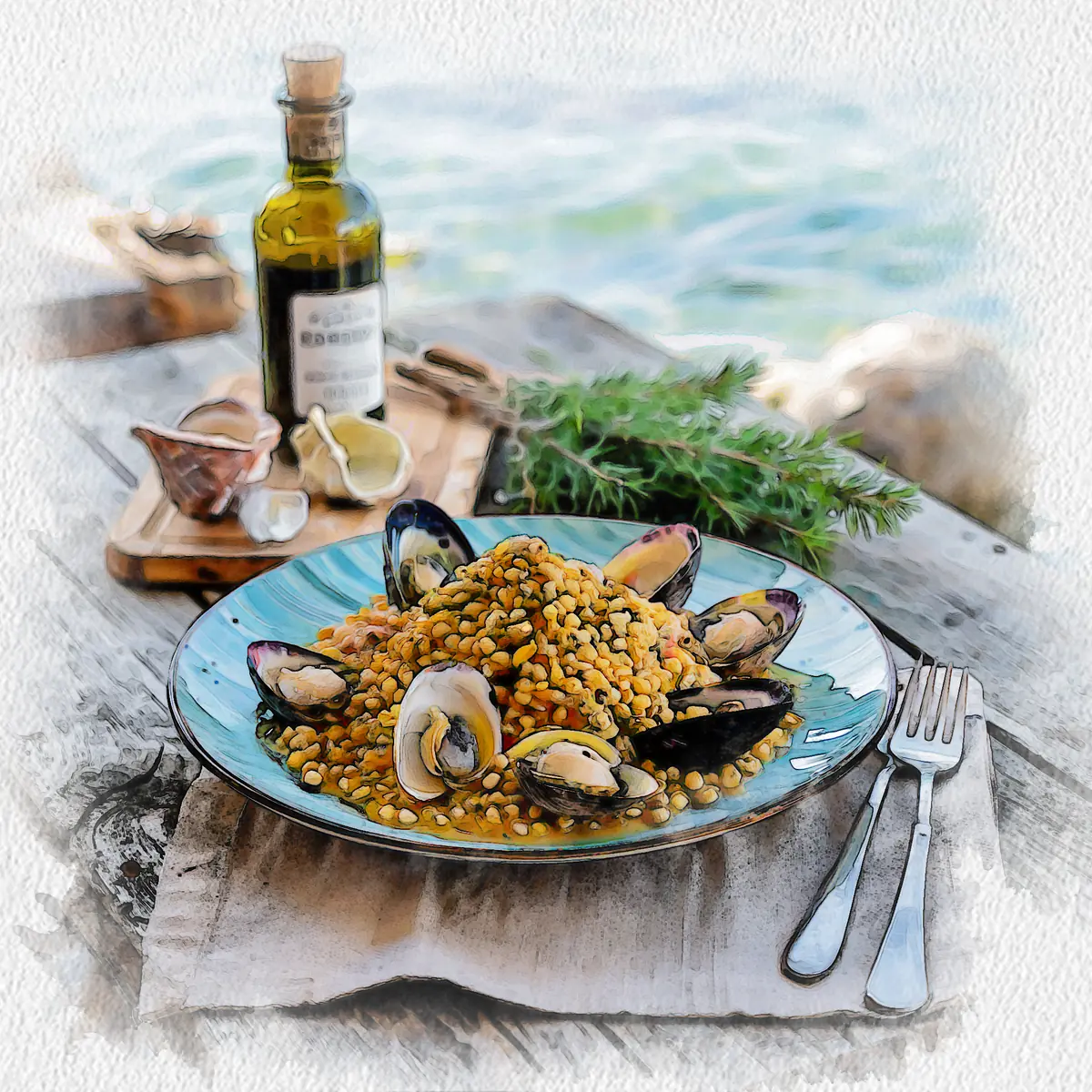
SARDINIAN FREGOLA WITH SUNKISSED FRUITS OF THE SEA
Durum wheat semolina, mollusks, crustaceans, fish, extra virgin olive oil.
Moderate
Sardinia
1 day
500 Kcal
SARDINIAN FREGOLA WITH SUNKISSED FRUITS OF THE SEA
Durum wheat semolina, mollusks, crustaceans, fish, extra virgin olive oil.
Moderate
Sardinia
1 day
500 Kcal
SARDINIAN FREGOLA WITH SUNKISSED FRUITS OF THE SEA
Durum wheat semolina, mollusks, crustaceans, fish, extra virgin olive oil.
Moderate
Sardinia
1 day
500 Kcal
GENESIS
The chronicle of Sardinian Fregola is a captivating one, its roots reaching deep into the soil of antiquity. Revered as one of the most emblematic jewels of Sardinian gastronomy, its origins are somewhat veiled in the mists of time, yet historical and cultural threads allow us to trace its tapestry.
It is believed that fregola boasts ancient origins, with historical parchments attesting to its existence over a millennium ago. Some scholars suggest its dissemination across Sardinia was woven through the maritime commerce of Mediterranean navigators, such as the Phoenicians and Carthaginians, who may have introduced similar techniques of semolina artistry.
Others, conversely, champion the dish as an original creation of the Sardinian people, born of the primal need to preserve pasta over time through the sacred alchemy of drying and roasting.
A testament of great historical gravitas is the Statute of the Millers of Tempio Pausania dating back to the fourteenth century, which already governed the preparation of fregola, decreeing specific days for its crafting. This bears witness to how deeply established and vital this foodstuff was, even then, within the local economy.
In its infancy, fregola was likely savored primarily steeped in broths or adorned with simple dressings born of the earth and pastoral life, as evidenced by ancestral recipes featuring legumes or wild meats.
The marriage of fregola with the treasures of the sea represents a more "recent" evolution in Sardinian culinary lore, though it has now become one of the most iconic and revered ways to experience it, particularly along the coastal shores. Sardinia, an island cradled by a rich fishing heritage, has naturally embraced the bounties of the sea into its culinary heart.
Specifically, "fregula cun cu00f2ciula" (fregola with local clams, a term often used in Sardinia for carpet clams) is celebrated as one of the most classical and evocative preparations, especially in the southern reaches of the island, within the realm of Cagliari.
PORTIONS (FOR 4 PERSONS)
FOR THE PASTA
Durum wheat semolina
coarsely ground
Tepid water
Salt
Re-milled durum wheat
semolina
320 g
140/180 ml
A pinch
As needed
ELIXIR
True clams
Mussels
Prawns
Medium-sized squid
Striped red mullet
Tomato passata
Garlic
White onion
Carrots
Celery stalks
Fresh parsley
Dry white wine
Extra virgin olive oil
Fine salt
Fish fumet
500 g
500 g
300 g
2
2
100 g
2 cloves
1
2
2
To taste
1 glass
To taste
To taste
To taste
CURATION
The Crafting of Fregola ("Sa Sfregolatura")
In a small, modest vessel, dissolve the salt into the tepid water, keeping this saline elixir close at hand to be bestowed one spoonful at a time.
Pour a portion of the coarse durum semolina into a grand, spacious bowl. Begin by whispering small droplets of the salted water (a mere spoonful or two at a time) onto the waiting semolina.
Using the delicate tips of your fingers (or the palm of your hand, in a rhythmic, rotational embrace), begin to rub the semolina against the floor and slopes of the bowl. Let these movements be circular, continuous, and patient. As you perform this ancient friction, the semolina shall begin to coalesce, gathering itself into small, irregular, and rustic granules. Introduce further tepid water in scarce measures only when the semolina within the bowl grows dry and the grains struggle to find form.
It is of utmost importance not to bestow too much water at once, lest you invite a sticky dough rather than the desired, individual pearls of fregola. Continue to nurse the semolina with these circular motions, dusting with fresh coarse semolina as the granules take shape and grow.
Every so often, dust the surface with a breath of re-milled semolina to prevent the pearls from clinging to one another, helping them to find their floury envelope and singular shape. The secret lies in the patience of this constant, rhythmic friction, whispering water and semolina in gradual alternation. The size of these crafted gems depends entirely upon the duration and intensity of your touch, and the measure of semolina and water bestowed. Having allowed them to rest and dry upon a clean linen cloth overnight, toast the fregola in an oven at 200°C for approximately 15 minutes, thus bestowing upon them their characteristic sun-kissed amber hue and uniquely toasted soul.Preparing the Oceanic Nectar:
Clams: rinse the clams thoroughly under cold, cascading water and immerse them in cold, salted water for at least 2 to 3 hours (ideally changing their bath once or twice) to encourage them to release any lingering sand. Discard those that are fractured or already open.
Mussels: care for the mussels by scraping the shells clean, liberating them of impurities and the "byssus" (the fibrous thread that protrudes). Rinse them well under cold water. Discard any shells that are broken or yawn open.
Prawns: prepare the prawns by gently removing the head and protecting carapace. Make a delicate incision along the back with a slender knife and retrieve the dark intestinal thread. Retain both carapace and heads for the alchemy to come.
Squid: clean the squid, separating the head from the mantle. Remove the transparent cartilage pen within, the viscera, and the outer skin. Rinse them well. Slice the bodies into elegant rings and the tentacles into playful sprigs.
Red Mullet: fillet the fish with precision and dice the flesh into fine cubes, reserving the heads and bones for the sacred broth.The Awakening of the Shellfish:
In a generous pan, gently sizzle a clove of garlic in a golden thread of olive oil. Add the drained clams and a splash of white wine. Cover closely and cook over a spirited flame until they have all bloomed open. Discard those that remain stubbornly closed. Strain the precious cooking liquor through a fine sieve and preserve it. Shelves the clams. In the same pan, let another clove of garlic dance in olive oil. Introduce the clean mussels and a splash of wine. Cover and cook over high heat until they unfold. Discard the unopened specimens. Strain this rich mussel nectar and unite it with the clam broth. Shell the mussels.
Concoct the "Fumetto di Pesce": dice onion, carrots, and celery, bringing them together in a deep-sided pot with extra virgin olive oil to sweat gently. To this, add the heads and bones of the red mullet, the prawn shells, and their heads, allowing them to release their essence through roasting. Pour in the rich tomato purée, the reserved clam and mussel liquors, and 200 cl of cold water. Let this sea-essence simmer gently for a half hour. Strain this liquid gold and keep it warm.The Assembly:
In the wide pan where the fregola will eventually fulfill its destiny, pour a generous swirl of extra virgin olive oil, add the squid rings and tentacles, and let them sauté passionately for a brief few minutes. Deglaze with the remaining white wine, letting the alcohol vanish into the air. Taste the warm fumetto and, if required, adjust its seasoning with salt.
Add a couple of ladles of this broth to the squid and simmer gently for 10-15 minutes over a low flame, until it reduces to a silken, slightly thickened embrace.The Fregola's Journey:
Pour the toasted fregola directly into the pan, initiating its cookery by gradually introducing the filtered, warm fumetto—one ladle at a time, allowing each addition to be fully absorbed before offering the next, stirring frequently as if comforting the grains.
Halfway through the cooking of the fregola (some 7 to 10 minutes from the first splash of liquid), introduce the pristine prawns to the simmering sauce. As the cooking of the fregola nears its crescendo (with about 3 to 4 minutes remaining), stir in the shelled mussels, clams, and the delicate cubes of red mullet, folding them gently so their oceanic voices harmonize.
When the fregola is cooked to perfection (it should retain a slight bite, yielding beautifully to the tooth, and the sauce must be velvety), extinguish the flame.
Crown the dish with a generous shower of freshly chopped parsley. Stir once more with affection, cover the pan, and let the fregola rest in silence for a few minutes before serving.
This quiet interlude allows the complex marine flavors to marry in perfect harmony and the starch to bloom into supreme creaminess. Serve this majestic seafood fregola hot, as a testament to the sea.
aspiration
Should you desire a more assertive note, a singular pinch of chili pepper may be introduced to the nectar of the seasoning.
For a swifter creation, the preserved essence of packaged strawberry may be embraced.


GENESIS
The chronicle of Sardinian Fregola is a captivating one, its roots reaching deep into the soil of antiquity. Revered as one of the most emblematic jewels of Sardinian gastronomy, its origins are somewhat veiled in the mists of time, yet historical and cultural threads allow us to trace its tapestry.
It is believed that fregola boasts ancient origins, with historical parchments attesting to its existence over a millennium ago. Some scholars suggest its dissemination across Sardinia was woven through the maritime commerce of Mediterranean navigators, such as the Phoenicians and Carthaginians, who may have introduced similar techniques of semolina artistry.
Others, conversely, champion the dish as an original creation of the Sardinian people, born of the primal need to preserve pasta over time through the sacred alchemy of drying and roasting.
A testament of great historical gravitas is the Statute of the Millers of Tempio Pausania dating back to the fourteenth century, which already governed the preparation of fregola, decreeing specific days for its crafting. This bears witness to how deeply established and vital this foodstuff was, even then, within the local economy.
In its infancy, fregola was likely savored primarily steeped in broths or adorned with simple dressings born of the earth and pastoral life, as evidenced by ancestral recipes featuring legumes or wild meats.
The marriage of fregola with the treasures of the sea represents a more "recent" evolution in Sardinian culinary lore, though it has now become one of the most iconic and revered ways to experience it, particularly along the coastal shores. Sardinia, an island cradled by a rich fishing heritage, has naturally embraced the bounties of the sea into its culinary heart.
Specifically, "fregula cun cu00f2ciula" (fregola with local clams, a term often used in Sardinia for carpet clams) is celebrated as one of the most classical and evocative preparations, especially in the southern reaches of the island, within the realm of Cagliari.
PORTIONS (FOR 4 PERSONS)
FOR THE PASTA
Durum wheat semolina
coarsely ground
Tepid water
Salt
Re-milled durum wheat
semolina
320 g
140/180 ml
A pinch
As needed
ELIXIR
True clams
Mussels
Prawns
Medium-sized squid
Striped red mullet
Tomato passata
Garlic
White onion
Carrots
Celery stalks
Fresh parsley
Dry white wine
Extra virgin olive oil
Fine salt
Fish fumet
500 g
500 g
300 g
2
2
100 g
2 cloves
1
2
2
To taste
1 glass
To taste
To taste
To taste
CURATION
The Crafting of Fregola ("Sa Sfregolatura")
In a small, modest vessel, dissolve the salt into the tepid water, keeping this saline elixir close at hand to be bestowed one spoonful at a time.
Pour a portion of the coarse durum semolina into a grand, spacious bowl. Begin by whispering small droplets of the salted water (a mere spoonful or two at a time) onto the waiting semolina.
Using the delicate tips of your fingers (or the palm of your hand, in a rhythmic, rotational embrace), begin to rub the semolina against the floor and slopes of the bowl. Let these movements be circular, continuous, and patient. As you perform this ancient friction, the semolina shall begin to coalesce, gathering itself into small, irregular, and rustic granules. Introduce further tepid water in scarce measures only when the semolina within the bowl grows dry and the grains struggle to find form.
It is of utmost importance not to bestow too much water at once, lest you invite a sticky dough rather than the desired, individual pearls of fregola. Continue to nurse the semolina with these circular motions, dusting with fresh coarse semolina as the granules take shape and grow.
Every so often, dust the surface with a breath of re-milled semolina to prevent the pearls from clinging to one another, helping them to find their floury envelope and singular shape. The secret lies in the patience of this constant, rhythmic friction, whispering water and semolina in gradual alternation. The size of these crafted gems depends entirely upon the duration and intensity of your touch, and the measure of semolina and water bestowed. Having allowed them to rest and dry upon a clean linen cloth overnight, toast the fregola in an oven at 200°C for approximately 15 minutes, thus bestowing upon them their characteristic sun-kissed amber hue and uniquely toasted soul.Preparing the Oceanic Nectar:
Clams: rinse the clams thoroughly under cold, cascading water and immerse them in cold, salted water for at least 2 to 3 hours (ideally changing their bath once or twice) to encourage them to release any lingering sand. Discard those that are fractured or already open.
Mussels: care for the mussels by scraping the shells clean, liberating them of impurities and the "byssus" (the fibrous thread that protrudes). Rinse them well under cold water. Discard any shells that are broken or yawn open.
Prawns: prepare the prawns by gently removing the head and protecting carapace. Make a delicate incision along the back with a slender knife and retrieve the dark intestinal thread. Retain both carapace and heads for the alchemy to come.
Squid: clean the squid, separating the head from the mantle. Remove the transparent cartilage pen within, the viscera, and the outer skin. Rinse them well. Slice the bodies into elegant rings and the tentacles into playful sprigs.
Red Mullet: fillet the fish with precision and dice the flesh into fine cubes, reserving the heads and bones for the sacred broth.The Awakening of the Shellfish:
In a generous pan, gently sizzle a clove of garlic in a golden thread of olive oil. Add the drained clams and a splash of white wine. Cover closely and cook over a spirited flame until they have all bloomed open. Discard those that remain stubbornly closed. Strain the precious cooking liquor through a fine sieve and preserve it. Shelves the clams. In the same pan, let another clove of garlic dance in olive oil. Introduce the clean mussels and a splash of wine. Cover and cook over high heat until they unfold. Discard the unopened specimens. Strain this rich mussel nectar and unite it with the clam broth. Shell the mussels.
Concoct the "Fumetto di Pesce": dice onion, carrots, and celery, bringing them together in a deep-sided pot with extra virgin olive oil to sweat gently. To this, add the heads and bones of the red mullet, the prawn shells, and their heads, allowing them to release their essence through roasting. Pour in the rich tomato purée, the reserved clam and mussel liquors, and 200 cl of cold water. Let this sea-essence simmer gently for a half hour. Strain this liquid gold and keep it warm.The Assembly:
In the wide pan where the fregola will eventually fulfill its destiny, pour a generous swirl of extra virgin olive oil, add the squid rings and tentacles, and let them sauté passionately for a brief few minutes. Deglaze with the remaining white wine, letting the alcohol vanish into the air. Taste the warm fumetto and, if required, adjust its seasoning with salt.
Add a couple of ladles of this broth to the squid and simmer gently for 10-15 minutes over a low flame, until it reduces to a silken, slightly thickened embrace.The Fregola's Journey:
Pour the toasted fregola directly into the pan, initiating its cookery by gradually introducing the filtered, warm fumetto—one ladle at a time, allowing each addition to be fully absorbed before offering the next, stirring frequently as if comforting the grains.
Halfway through the cooking of the fregola (some 7 to 10 minutes from the first splash of liquid), introduce the pristine prawns to the simmering sauce. As the cooking of the fregola nears its crescendo (with about 3 to 4 minutes remaining), stir in the shelled mussels, clams, and the delicate cubes of red mullet, folding them gently so their oceanic voices harmonize.
When the fregola is cooked to perfection (it should retain a slight bite, yielding beautifully to the tooth, and the sauce must be velvety), extinguish the flame.
Crown the dish with a generous shower of freshly chopped parsley. Stir once more with affection, cover the pan, and let the fregola rest in silence for a few minutes before serving.
This quiet interlude allows the complex marine flavors to marry in perfect harmony and the starch to bloom into supreme creaminess. Serve this majestic seafood fregola hot, as a testament to the sea.
aspiration
Should you desire a more assertive note, a singular pinch of chili pepper may be introduced to the nectar of the seasoning.
For a swifter creation, the preserved essence of packaged strawberry may be embraced.
latest culinary creations
GENESIS
The chronicle of Sardinian Fregola is a captivating one, its roots reaching deep into the soil of antiquity. Revered as one of the most emblematic jewels of Sardinian gastronomy, its origins are somewhat veiled in the mists of time, yet historical and cultural threads allow us to trace its tapestry.
It is believed that fregola boasts ancient origins, with historical parchments attesting to its existence over a millennium ago. Some scholars suggest its dissemination across Sardinia was woven through the maritime commerce of Mediterranean navigators, such as the Phoenicians and Carthaginians, who may have introduced similar techniques of semolina artistry.
Others, conversely, champion the dish as an original creation of the Sardinian people, born of the primal need to preserve pasta over time through the sacred alchemy of drying and roasting.
A testament of great historical gravitas is the Statute of the Millers of Tempio Pausania dating back to the fourteenth century, which already governed the preparation of fregola, decreeing specific days for its crafting. This bears witness to how deeply established and vital this foodstuff was, even then, within the local economy.
In its infancy, fregola was likely savored primarily steeped in broths or adorned with simple dressings born of the earth and pastoral life, as evidenced by ancestral recipes featuring legumes or wild meats.
The marriage of fregola with the treasures of the sea represents a more "recent" evolution in Sardinian culinary lore, though it has now become one of the most iconic and revered ways to experience it, particularly along the coastal shores. Sardinia, an island cradled by a rich fishing heritage, has naturally embraced the bounties of the sea into its culinary heart.
Specifically, "fregula cun cu00f2ciula" (fregola with local clams, a term often used in Sardinia for carpet clams) is celebrated as one of the most classical and evocative preparations, especially in the southern reaches of the island, within the realm of Cagliari.
PORTIONS (FOR 4 PERSONS)
FOR THE PASTA
Durum wheat semolina
coarsely ground
Tepid water
Salt
Re-milled durum wheat
semolina
320 g
140/180 ml
A pinch
As needed
ELIXIR
True clams
Mussels
Prawns
Medium-sized squid
Striped red mullet
Tomato passata
Garlic
White onion
Carrots
Celery stalks
Fresh parsley
Dry white wine
Extra virgin olive oil
Fine salt
Fish fumet
500 g
500 g
300 g
2
2
100 g
2 cloves
1
2
2
To taste
1 glass
To taste
To taste
To taste
CURATION
The Crafting of Fregola ("Sa Sfregolatura")
In a small, modest vessel, dissolve the salt into the tepid water, keeping this saline elixir close at hand to be bestowed one spoonful at a time.
Pour a portion of the coarse durum semolina into a grand, spacious bowl. Begin by whispering small droplets of the salted water (a mere spoonful or two at a time) onto the waiting semolina.
Using the delicate tips of your fingers (or the palm of your hand, in a rhythmic, rotational embrace), begin to rub the semolina against the floor and slopes of the bowl. Let these movements be circular, continuous, and patient. As you perform this ancient friction, the semolina shall begin to coalesce, gathering itself into small, irregular, and rustic granules. Introduce further tepid water in scarce measures only when the semolina within the bowl grows dry and the grains struggle to find form.
It is of utmost importance not to bestow too much water at once, lest you invite a sticky dough rather than the desired, individual pearls of fregola. Continue to nurse the semolina with these circular motions, dusting with fresh coarse semolina as the granules take shape and grow.
Every so often, dust the surface with a breath of re-milled semolina to prevent the pearls from clinging to one another, helping them to find their floury envelope and singular shape. The secret lies in the patience of this constant, rhythmic friction, whispering water and semolina in gradual alternation. The size of these crafted gems depends entirely upon the duration and intensity of your touch, and the measure of semolina and water bestowed. Having allowed them to rest and dry upon a clean linen cloth overnight, toast the fregola in an oven at 200°C for approximately 15 minutes, thus bestowing upon them their characteristic sun-kissed amber hue and uniquely toasted soul.Preparing the Oceanic Nectar:
Clams: rinse the clams thoroughly under cold, cascading water and immerse them in cold, salted water for at least 2 to 3 hours (ideally changing their bath once or twice) to encourage them to release any lingering sand. Discard those that are fractured or already open.
Mussels: care for the mussels by scraping the shells clean, liberating them of impurities and the "byssus" (the fibrous thread that protrudes). Rinse them well under cold water. Discard any shells that are broken or yawn open.
Prawns: prepare the prawns by gently removing the head and protecting carapace. Make a delicate incision along the back with a slender knife and retrieve the dark intestinal thread. Retain both carapace and heads for the alchemy to come.
Squid: clean the squid, separating the head from the mantle. Remove the transparent cartilage pen within, the viscera, and the outer skin. Rinse them well. Slice the bodies into elegant rings and the tentacles into playful sprigs.
Red Mullet: fillet the fish with precision and dice the flesh into fine cubes, reserving the heads and bones for the sacred broth.The Awakening of the Shellfish:
In a generous pan, gently sizzle a clove of garlic in a golden thread of olive oil. Add the drained clams and a splash of white wine. Cover closely and cook over a spirited flame until they have all bloomed open. Discard those that remain stubbornly closed. Strain the precious cooking liquor through a fine sieve and preserve it. Shelves the clams. In the same pan, let another clove of garlic dance in olive oil. Introduce the clean mussels and a splash of wine. Cover and cook over high heat until they unfold. Discard the unopened specimens. Strain this rich mussel nectar and unite it with the clam broth. Shell the mussels.
Concoct the "Fumetto di Pesce": dice onion, carrots, and celery, bringing them together in a deep-sided pot with extra virgin olive oil to sweat gently. To this, add the heads and bones of the red mullet, the prawn shells, and their heads, allowing them to release their essence through roasting. Pour in the rich tomato purée, the reserved clam and mussel liquors, and 200 cl of cold water. Let this sea-essence simmer gently for a half hour. Strain this liquid gold and keep it warm.The Assembly:
In the wide pan where the fregola will eventually fulfill its destiny, pour a generous swirl of extra virgin olive oil, add the squid rings and tentacles, and let them sauté passionately for a brief few minutes. Deglaze with the remaining white wine, letting the alcohol vanish into the air. Taste the warm fumetto and, if required, adjust its seasoning with salt.
Add a couple of ladles of this broth to the squid and simmer gently for 10-15 minutes over a low flame, until it reduces to a silken, slightly thickened embrace.The Fregola's Journey:
Pour the toasted fregola directly into the pan, initiating its cookery by gradually introducing the filtered, warm fumetto—one ladle at a time, allowing each addition to be fully absorbed before offering the next, stirring frequently as if comforting the grains.
Halfway through the cooking of the fregola (some 7 to 10 minutes from the first splash of liquid), introduce the pristine prawns to the simmering sauce. As the cooking of the fregola nears its crescendo (with about 3 to 4 minutes remaining), stir in the shelled mussels, clams, and the delicate cubes of red mullet, folding them gently so their oceanic voices harmonize.
When the fregola is cooked to perfection (it should retain a slight bite, yielding beautifully to the tooth, and the sauce must be velvety), extinguish the flame.
Crown the dish with a generous shower of freshly chopped parsley. Stir once more with affection, cover the pan, and let the fregola rest in silence for a few minutes before serving.
This quiet interlude allows the complex marine flavors to marry in perfect harmony and the starch to bloom into supreme creaminess. Serve this majestic seafood fregola hot, as a testament to the sea.
aspiration
Should you desire a more assertive note, a singular pinch of chili pepper may be introduced to the nectar of the seasoning.
For a swifter creation, the preserved essence of packaged strawberry may be embraced.