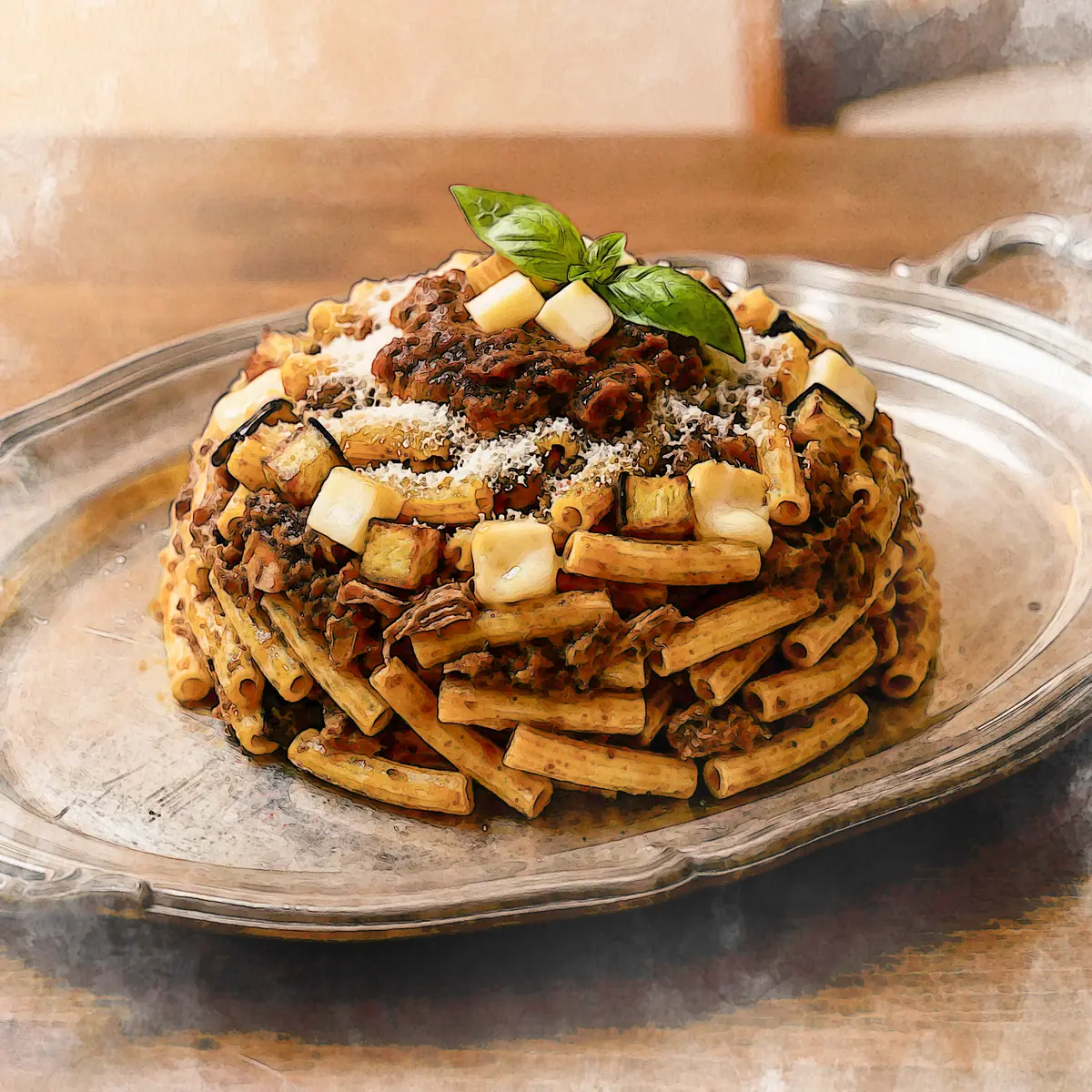
THE MATCHSTICK OF THE LAZZARI
Pork tenderloin 'Gallinella', pork rib 'Tracchie', artisanal sausage, beef muscle, San Marzano tomatoes, aubergine, and smoked scamorza cheese
A demanding pursuit
Campania
9 hours
920 Kcal
THE MATCHSTICK OF THE LAZZARI
Pork tenderloin 'Gallinella', pork rib 'Tracchie', artisanal sausage, beef muscle, San Marzano tomatoes, aubergine, and smoked scamorza cheese
A demanding pursuit
Campania
9 hours
920 Kcal
THE MATCHSTICK OF THE LAZZARI
Pork tenderloin 'Gallinella', pork rib 'Tracchie', artisanal sausage, beef muscle, San Marzano tomatoes, aubergine, and smoked scamorza cheese
A demanding pursuit
Campania
9 hours
920 Kcal
GENESIS
The genesis of "Il Cerino dei Lazzari" strikes its roots deep within the complex social stratifications of Bourbon Naples, standing as a sublime confluence where the aristocratic culinary art of the Monzù meets the visceral authenticity of the common people. Historically, the term "Cerino"—or "Timballo Flammand"—denoted an opulent, vertical preparation, sculpted in the likeness of a taper (hence its name), composed of bucatini bound by a rich farce of chicken and béchamel, often presented with an alcohol-fueled flame flickering at its crown to enrapture the guests of the court.
This modern reimagining, crafted amidst the heritage-revival efforts for the UNESCO candidacy of Italian gastronomy, performs an inverse philological alchemy: it divests the timballo of its rigid French constraints to embrace the wild identity of the "Lazzari," the Neapolitan populace who, in the eighteenth century, transitioned from leaf-eaters to devout consumers of macaroni.
The dish replaces the traditional bucatini with short, ridged pasta, masterfully designed to cradle an intensely concentrated reduction of Neapolitan ragù. This is no mere sauce, but the sacred fruit of a slow, whispered simmer—the ritual "pappuliare"—which coaxes humble yet flavorful cuts (such as the pork shank and ribs) into a dark, lustrous glaze. The addition of aubergine and smoked scamorza is no idle embellishment, but a reverent tribute to the art of culinary salvage and the robust flavors of the ancient alleyways, culminating in a creation that is both a historical monument and an act of visceral devotion.
PORTIONS (FOR 4 PERSONS)
FOR THE PASTA
Maccheroni rigati
400 g
FOR THE EMBELLISHMENT
Pork shin
Pork ribs (Tracchie)
Beef shank
Pork sausages
Copper onion
Sieved tomato purée
Tomato paste concentrate
A chalice of red wine
Extra virgin olive oil
Salt
Violet eggplant
Smoked scamorza cheese
Seed oil
Parmigiano Reggiano
Fresh basil
300 g
300 g
200 g
2
1
1.5 l
100 g
to taste
to taste
1
150 g
for frying
to taste
to taste
CURATION
For the condiment:
Begin by choosing a spacious pan, preferably crafted of terracotta or tinned copper. Pour a generous ribbon of extra virgin olive oil and let it warm. Introduce the cuts of meat (the gallinella, the pork ribs, the beef shank, and the sausage) ensuring they do not crowd one another. Sear the meat over a lively flame on all sides until a deep, uniform golden-brown crust is achieved; this step is essential to seal in the juices. Remove the meat from the pan and set it aside.
Within the very same fond, place the finely minced onion and allow it to sweat gently until it turns translucent. Return the meat to the pan and raise the flame. Deglaze with the red wine and await the complete evaporation of its spirit. Add the tomato paste and let it toast for a couple of minutes in the hot fat. Pour in the tomato passata and season with salt.
When the sauce begins its simmer, move the pan to the smallest burner at its lowest setting. The ragù must not boil violently, but must "pappuliare"—that is, whisper with tiny, breathing bubbles. Leave it to cook for at least 6 to 8 hours, stirring from time to time, until the sauce has become dark, dense, and the oil has separated from the tomato, rising to the surface. Once cooked, retrieve the pork ribs and the whole cuts of meat (which you shall serve aside) and leave the smaller, tenderly shredded pieces of gallinella behind in the sauce.For the aubergines and the filling:
Wash the aubergine and cut it into cubes of about one centimetre, preserving the skin. Bring the seed oil to temperature (170°C) and fry the cubes until they are golden and crisp. Drain them upon absorbent paper to banish any excess oil. Cut the smoked scamorza cheese into cubes of the same size as the aubergines.For the pasta and the finish:
Cook the macaroni in abundant salted water. Drain the pasta very al dente, reserving a splash of its cooking water. Transfer the macaroni directly into a wide pan with a lavish portion of the reduced ragù. Toss vigorously over a lively flame to marry starch and sauce. Extinguish the flame and fold in the fried aubergines and half of the scamorza, tossing swiftly to distribute the ingredients.
Plate the pasta, fashioning a nest or dome in the centre, evoking the shape of the historic "cerino". Nap the dish with one final spoonful of boiling ragù. Scatter the remaining cubes of scamorza over the top, complete with a dusting of Parmigiano Reggiano, and adorn with a leaf of fresh basil.
aspiration
Prepare the ragu00f9 the day prior; this period of repose allows the flavors to weave together in harmony and the sauce to settle, rendering the final mantecatura truly sublime.
Incorporate pasta bronze-drawn, ensuring it retains its noble structure during cooking and embraces the sauce with grace.
Should the "gallinella" of pork elude your butcher, seek the muscle of the shank or the posterior "campanello", specifying that it is destined for a slow and poetic braising.


GENESIS
The genesis of "Il Cerino dei Lazzari" strikes its roots deep within the complex social stratifications of Bourbon Naples, standing as a sublime confluence where the aristocratic culinary art of the Monzù meets the visceral authenticity of the common people. Historically, the term "Cerino"—or "Timballo Flammand"—denoted an opulent, vertical preparation, sculpted in the likeness of a taper (hence its name), composed of bucatini bound by a rich farce of chicken and béchamel, often presented with an alcohol-fueled flame flickering at its crown to enrapture the guests of the court.
This modern reimagining, crafted amidst the heritage-revival efforts for the UNESCO candidacy of Italian gastronomy, performs an inverse philological alchemy: it divests the timballo of its rigid French constraints to embrace the wild identity of the "Lazzari," the Neapolitan populace who, in the eighteenth century, transitioned from leaf-eaters to devout consumers of macaroni.
The dish replaces the traditional bucatini with short, ridged pasta, masterfully designed to cradle an intensely concentrated reduction of Neapolitan ragù. This is no mere sauce, but the sacred fruit of a slow, whispered simmer—the ritual "pappuliare"—which coaxes humble yet flavorful cuts (such as the pork shank and ribs) into a dark, lustrous glaze. The addition of aubergine and smoked scamorza is no idle embellishment, but a reverent tribute to the art of culinary salvage and the robust flavors of the ancient alleyways, culminating in a creation that is both a historical monument and an act of visceral devotion.
PORTIONS (FOR 4 PERSONS)
FOR THE PASTA
Maccheroni rigati
400 g
FOR THE EMBELLISHMENT
Pork shin
Pork ribs (Tracchie)
Beef shank
Pork sausages
Copper onion
Sieved tomato purée
Tomato paste concentrate
A chalice of red wine
Extra virgin olive oil
Salt
Violet eggplant
Smoked scamorza cheese
Seed oil
Parmigiano Reggiano
Fresh basil
300 g
300 g
200 g
2
1
1.5 l
100 g
to taste
to taste
1
150 g
for frying
to taste
to taste
CURATION
For the condiment:
Begin by choosing a spacious pan, preferably crafted of terracotta or tinned copper. Pour a generous ribbon of extra virgin olive oil and let it warm. Introduce the cuts of meat (the gallinella, the pork ribs, the beef shank, and the sausage) ensuring they do not crowd one another. Sear the meat over a lively flame on all sides until a deep, uniform golden-brown crust is achieved; this step is essential to seal in the juices. Remove the meat from the pan and set it aside.
Within the very same fond, place the finely minced onion and allow it to sweat gently until it turns translucent. Return the meat to the pan and raise the flame. Deglaze with the red wine and await the complete evaporation of its spirit. Add the tomato paste and let it toast for a couple of minutes in the hot fat. Pour in the tomato passata and season with salt.
When the sauce begins its simmer, move the pan to the smallest burner at its lowest setting. The ragù must not boil violently, but must "pappuliare"—that is, whisper with tiny, breathing bubbles. Leave it to cook for at least 6 to 8 hours, stirring from time to time, until the sauce has become dark, dense, and the oil has separated from the tomato, rising to the surface. Once cooked, retrieve the pork ribs and the whole cuts of meat (which you shall serve aside) and leave the smaller, tenderly shredded pieces of gallinella behind in the sauce.For the aubergines and the filling:
Wash the aubergine and cut it into cubes of about one centimetre, preserving the skin. Bring the seed oil to temperature (170°C) and fry the cubes until they are golden and crisp. Drain them upon absorbent paper to banish any excess oil. Cut the smoked scamorza cheese into cubes of the same size as the aubergines.For the pasta and the finish:
Cook the macaroni in abundant salted water. Drain the pasta very al dente, reserving a splash of its cooking water. Transfer the macaroni directly into a wide pan with a lavish portion of the reduced ragù. Toss vigorously over a lively flame to marry starch and sauce. Extinguish the flame and fold in the fried aubergines and half of the scamorza, tossing swiftly to distribute the ingredients.
Plate the pasta, fashioning a nest or dome in the centre, evoking the shape of the historic "cerino". Nap the dish with one final spoonful of boiling ragù. Scatter the remaining cubes of scamorza over the top, complete with a dusting of Parmigiano Reggiano, and adorn with a leaf of fresh basil.
aspiration
Prepare the ragu00f9 the day prior; this period of repose allows the flavors to weave together in harmony and the sauce to settle, rendering the final mantecatura truly sublime.
Incorporate pasta bronze-drawn, ensuring it retains its noble structure during cooking and embraces the sauce with grace.
Should the "gallinella" of pork elude your butcher, seek the muscle of the shank or the posterior "campanello", specifying that it is destined for a slow and poetic braising.
latest culinary creations
GENESIS
The genesis of "Il Cerino dei Lazzari" strikes its roots deep within the complex social stratifications of Bourbon Naples, standing as a sublime confluence where the aristocratic culinary art of the Monzù meets the visceral authenticity of the common people. Historically, the term "Cerino"—or "Timballo Flammand"—denoted an opulent, vertical preparation, sculpted in the likeness of a taper (hence its name), composed of bucatini bound by a rich farce of chicken and béchamel, often presented with an alcohol-fueled flame flickering at its crown to enrapture the guests of the court.
This modern reimagining, crafted amidst the heritage-revival efforts for the UNESCO candidacy of Italian gastronomy, performs an inverse philological alchemy: it divests the timballo of its rigid French constraints to embrace the wild identity of the "Lazzari," the Neapolitan populace who, in the eighteenth century, transitioned from leaf-eaters to devout consumers of macaroni.
The dish replaces the traditional bucatini with short, ridged pasta, masterfully designed to cradle an intensely concentrated reduction of Neapolitan ragù. This is no mere sauce, but the sacred fruit of a slow, whispered simmer—the ritual "pappuliare"—which coaxes humble yet flavorful cuts (such as the pork shank and ribs) into a dark, lustrous glaze. The addition of aubergine and smoked scamorza is no idle embellishment, but a reverent tribute to the art of culinary salvage and the robust flavors of the ancient alleyways, culminating in a creation that is both a historical monument and an act of visceral devotion.
PORTIONS (FOR 4 PERSONS)
FOR THE PASTA
Maccheroni rigati
400 g
FOR THE EMBELLISHMENT
Pork shin
Pork ribs (Tracchie)
Beef shank
Pork sausages
Copper onion
Sieved tomato purée
Tomato paste concentrate
A chalice of red wine
Extra virgin olive oil
Salt
Violet eggplant
Smoked scamorza cheese
Seed oil
Parmigiano Reggiano
Fresh basil
300 g
300 g
200 g
2
1
1.5 l
100 g
to taste
to taste
1
150 g
for frying
to taste
to taste
CURATION
For the condiment:
Begin by choosing a spacious pan, preferably crafted of terracotta or tinned copper. Pour a generous ribbon of extra virgin olive oil and let it warm. Introduce the cuts of meat (the gallinella, the pork ribs, the beef shank, and the sausage) ensuring they do not crowd one another. Sear the meat over a lively flame on all sides until a deep, uniform golden-brown crust is achieved; this step is essential to seal in the juices. Remove the meat from the pan and set it aside.
Within the very same fond, place the finely minced onion and allow it to sweat gently until it turns translucent. Return the meat to the pan and raise the flame. Deglaze with the red wine and await the complete evaporation of its spirit. Add the tomato paste and let it toast for a couple of minutes in the hot fat. Pour in the tomato passata and season with salt.
When the sauce begins its simmer, move the pan to the smallest burner at its lowest setting. The ragù must not boil violently, but must "pappuliare"—that is, whisper with tiny, breathing bubbles. Leave it to cook for at least 6 to 8 hours, stirring from time to time, until the sauce has become dark, dense, and the oil has separated from the tomato, rising to the surface. Once cooked, retrieve the pork ribs and the whole cuts of meat (which you shall serve aside) and leave the smaller, tenderly shredded pieces of gallinella behind in the sauce.For the aubergines and the filling:
Wash the aubergine and cut it into cubes of about one centimetre, preserving the skin. Bring the seed oil to temperature (170°C) and fry the cubes until they are golden and crisp. Drain them upon absorbent paper to banish any excess oil. Cut the smoked scamorza cheese into cubes of the same size as the aubergines.For the pasta and the finish:
Cook the macaroni in abundant salted water. Drain the pasta very al dente, reserving a splash of its cooking water. Transfer the macaroni directly into a wide pan with a lavish portion of the reduced ragù. Toss vigorously over a lively flame to marry starch and sauce. Extinguish the flame and fold in the fried aubergines and half of the scamorza, tossing swiftly to distribute the ingredients.
Plate the pasta, fashioning a nest or dome in the centre, evoking the shape of the historic "cerino". Nap the dish with one final spoonful of boiling ragù. Scatter the remaining cubes of scamorza over the top, complete with a dusting of Parmigiano Reggiano, and adorn with a leaf of fresh basil.
aspiration
Prepare the ragu00f9 the day prior; this period of repose allows the flavors to weave together in harmony and the sauce to settle, rendering the final mantecatura truly sublime.
Incorporate pasta bronze-drawn, ensuring it retains its noble structure during cooking and embraces the sauce with grace.
Should the "gallinella" of pork elude your butcher, seek the muscle of the shank or the posterior "campanello", specifying that it is destined for a slow and poetic braising.