WHEAT BECOMING LEGIBLE
When pasta unveils its sacred journey from field to table
5/15/26
WHEAT BECOMING LEGIBLE
When pasta unveils its sacred journey from field to table
5/15/26
WHEAT BECOMING LEGIBLE
When pasta unveils its sacred journey from field to table
5/15/26
At times, pasta asks only to be read.
This occurs when a package ceases to be a mere vessel, a promise of flavor, and becomes instead a threshold: a gateway into the physical journey of what it holds and, therefore, communicates.
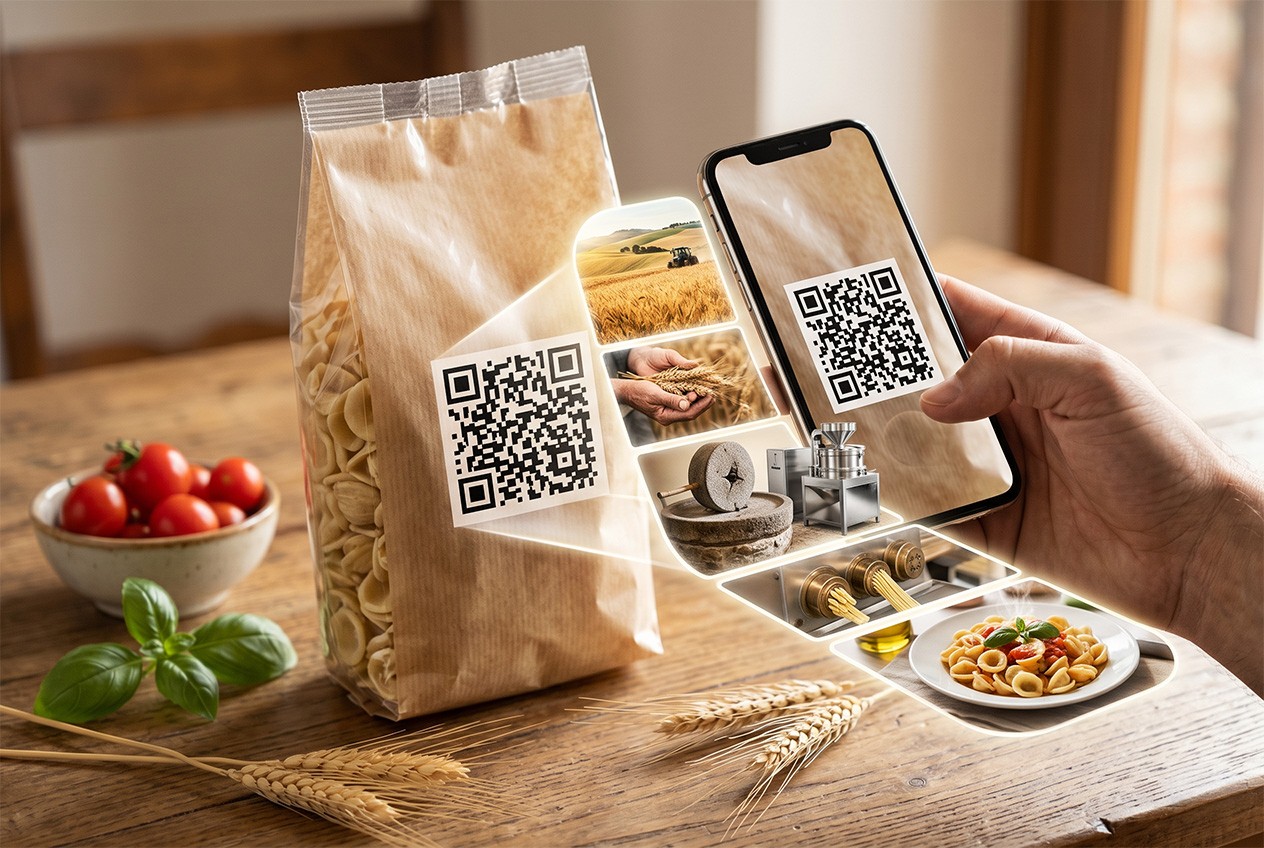
This is the essence of the new milestone presented by Granoro at TuttoFood Milano 2026: a QR code on the packaging of the u2018Dedicatou2019 line to reconstruct the lineage of Apulian durum wheat, from the field to the mill, from the mill to the pastificio, and finally to the shapes destined for the table.
The gesture is minimal, almost domestic: one scans a code. Yet, behind this action unfolds a gastronomic geography. Fields, farmers, cultivated varieties, distances traversed, certifications, and stages of transformation. Here, u2018blockchainu2019 technology appeals not as a buzzword, but as an instrument of truth: a way to render visible what so often remains veiled behind the humble facade of a box of pasta.
The u201cDedicatou201d line is born of a dedicated chain of durum wheat cultivated in Apulia, uniting approximately 350 farms and spanning over 15,000 hectares of sacred cultivation. These are figures that speak not simply of a production scheme, but of a profound relationship: between industry and agriculture, between terroir and transformation, between the sower and, ultimately, the epicure.
Pasta, the daily bread of our tables, thus becomes a small and comforting edible map. No longer merely semolina and water, but landscape, labor, distance, agricultural destiny, and responsibility.
For MILLEUNAPASTA, the revelation lies precisely here: not, of course, in the code itself, nor in technology as contemporary ornament, but in the precious opportunity to restore visibility to the raw material. For every shape is born long before the die-extrusion. It begins in the field, in the ear of wheat, in the nobility of the grain, in the silent covenant between the earth and culinary evolution.
If pasta is memory, then its origin must likewise be remembered. And perhaps the future of gastronomy will increasingly depend on this: not only dining well, but understanding more deeply. Gazing upon a box of pasta and discerning, behind its orderly form, the long, wondrous, and complex odyssey of the wheat that brought it to life.


At times, pasta asks only to be read.
This occurs when a package ceases to be a mere vessel, a promise of flavor, and becomes instead a threshold: a gateway into the physical journey of what it holds and, therefore, communicates.
This is the essence of the new milestone presented by Granoro at TuttoFood Milano 2026: a QR code on the packaging of the u2018Dedicatou2019 line to reconstruct the lineage of Apulian durum wheat, from the field to the mill, from the mill to the pastificio, and finally to the shapes destined for the table.
The gesture is minimal, almost domestic: one scans a code. Yet, behind this action unfolds a gastronomic geography. Fields, farmers, cultivated varieties, distances traversed, certifications, and stages of transformation. Here, u2018blockchainu2019 technology appeals not as a buzzword, but as an instrument of truth: a way to render visible what so often remains veiled behind the humble facade of a box of pasta.
The u201cDedicatou201d line is born of a dedicated chain of durum wheat cultivated in Apulia, uniting approximately 350 farms and spanning over 15,000 hectares of sacred cultivation. These are figures that speak not simply of a production scheme, but of a profound relationship: between industry and agriculture, between terroir and transformation, between the sower and, ultimately, the epicure.
Pasta, the daily bread of our tables, thus becomes a small and comforting edible map. No longer merely semolina and water, but landscape, labor, distance, agricultural destiny, and responsibility.
For MILLEUNAPASTA, the revelation lies precisely here: not, of course, in the code itself, nor in technology as contemporary ornament, but in the precious opportunity to restore visibility to the raw material. For every shape is born long before the die-extrusion. It begins in the field, in the ear of wheat, in the nobility of the grain, in the silent covenant between the earth and culinary evolution.
If pasta is memory, then its origin must likewise be remembered. And perhaps the future of gastronomy will increasingly depend on this: not only dining well, but understanding more deeply. Gazing upon a box of pasta and discerning, behind its orderly form, the long, wondrous, and complex odyssey of the wheat that brought it to life.
At times, pasta asks only to be read.
This occurs when a package ceases to be a mere vessel, a promise of flavor, and becomes instead a threshold: a gateway into the physical journey of what it holds and, therefore, communicates.
This is the essence of the new milestone presented by Granoro at TuttoFood Milano 2026: a QR code on the packaging of the u2018Dedicatou2019 line to reconstruct the lineage of Apulian durum wheat, from the field to the mill, from the mill to the pastificio, and finally to the shapes destined for the table.
The gesture is minimal, almost domestic: one scans a code. Yet, behind this action unfolds a gastronomic geography. Fields, farmers, cultivated varieties, distances traversed, certifications, and stages of transformation. Here, u2018blockchainu2019 technology appeals not as a buzzword, but as an instrument of truth: a way to render visible what so often remains veiled behind the humble facade of a box of pasta.
The u201cDedicatou201d line is born of a dedicated chain of durum wheat cultivated in Apulia, uniting approximately 350 farms and spanning over 15,000 hectares of sacred cultivation. These are figures that speak not simply of a production scheme, but of a profound relationship: between industry and agriculture, between terroir and transformation, between the sower and, ultimately, the epicure.
Pasta, the daily bread of our tables, thus becomes a small and comforting edible map. No longer merely semolina and water, but landscape, labor, distance, agricultural destiny, and responsibility.
For MILLEUNAPASTA, the revelation lies precisely here: not, of course, in the code itself, nor in technology as contemporary ornament, but in the precious opportunity to restore visibility to the raw material. For every shape is born long before the die-extrusion. It begins in the field, in the ear of wheat, in the nobility of the grain, in the silent covenant between the earth and culinary evolution.
If pasta is memory, then its origin must likewise be remembered. And perhaps the future of gastronomy will increasingly depend on this: not only dining well, but understanding more deeply. Gazing upon a box of pasta and discerning, behind its orderly form, the long, wondrous, and complex odyssey of the wheat that brought it to life.