genesis
There are lands that cradle a heritage so deeply woven into the fabric of daily life as to seem invisible even to those who dwell therein. Morgongiori, a pocket of life resting at the feet of Mount Arci, is one such sanctuary. For generations, the Lorighittas remained a purely domestic liturgy: a sacred pasta fashioned in the intimacy of homes, primarily on the eve of great solemnities, entrusted to the diligent and feminine hands of the village and perpetuated without the aid of written parchment, but solely through silent observation and memory.
In the year 2000, the Massa family took a step that, back then, seemed almost contrarian: they founded the first atelier entirely dedicated to the creation of Lorighittas. Not to diminish a noble tradition into a mere commodity, but to guard it against the specter of oblivion.
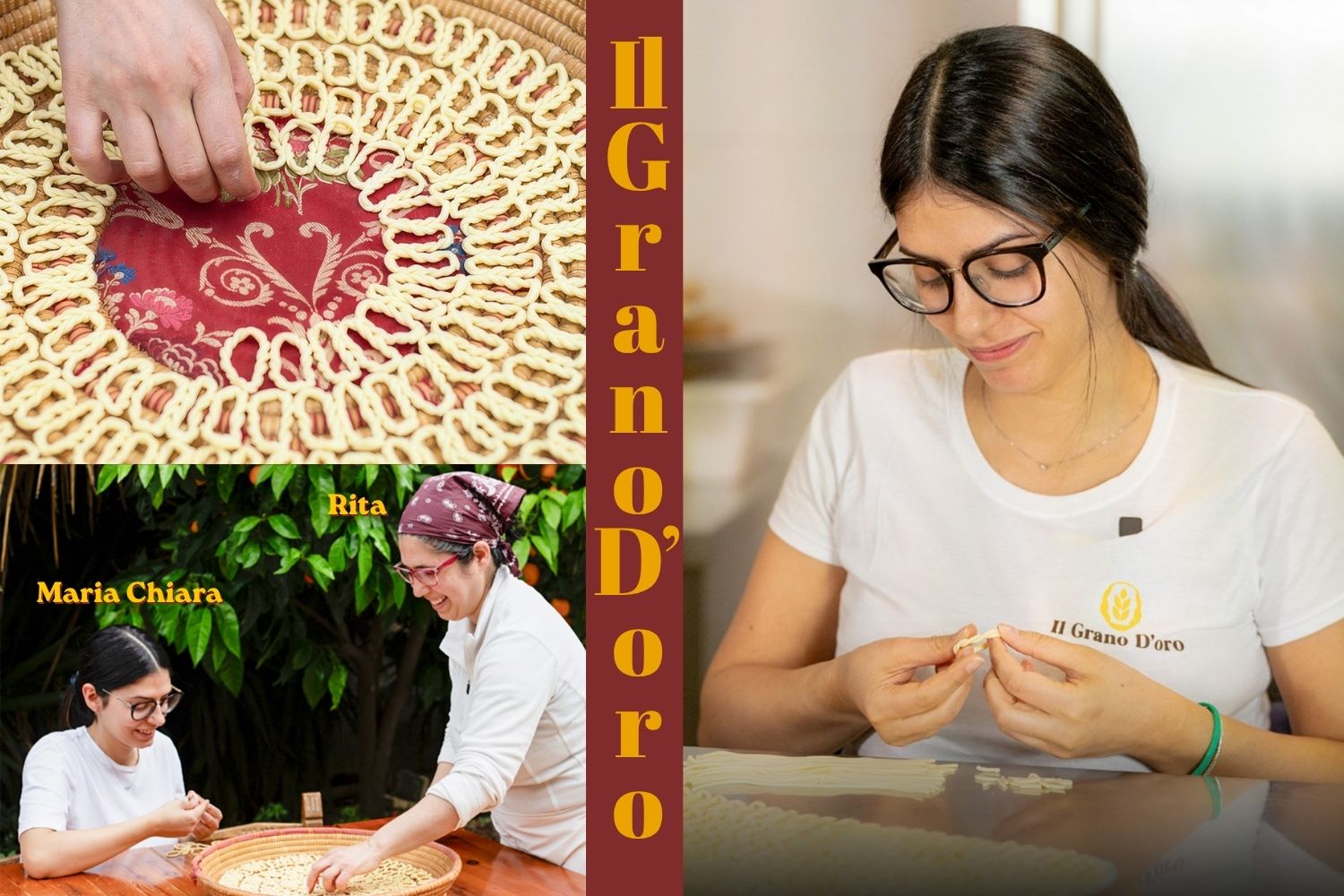
Behind this choice lies, above all, the ancestral feminine wisdom of the family. It was Maria Chiara’s mother and maternal aunt, Rita Atzeni, who brought into the workshop a ritual gesture that, until then, belonged solely to the domestic hearth. It is by virtue of their hands that a practice destined for the private table succeeded in gracing the wider world, without ever forfeiting its irreplaceable character.
In 2022, a transition occurred, as natural as it was delicate. The stewardship of this heritage passed to the youthful Maria Chiara Massa, who grasped the familial torch, infusing the workshop with a vibrant touch of modernity. Alongside the preservation of artisanal continuity, she introduced a contemporary narrative, whispering to the wider world a story that nonetheless continues to be born of the selfsame terroir, with the selfsame rites, and with the selfsame reverence for ancestral custom.
Thus, Il Grano d'Oro remains an intimate family atelier, while standing as the guardian of a collective memory belonging to Morgongiori and, through Morgongiori, to the vast heritage of Italian pasta.
alchemy
The magic of the Il Grano d’Oro atelier resides in that minuscule interval separating the thumb from the index finger.
It is there that the Lorighitta takes shape—arguably one of the most complex pastas of Italian tradition. From a single, gossamer strand of semolina, an embrace perfectly coiled upon itself is born, fashioned with a sinuous velocity and a precision that only decades of devotion can render spontaneous.
Its name evokes the "loriga," the iron ring of the draft oxen: imagery of a Sardinia where physical toil, the herds, and the earth shared the very same landscape. From that ancient, rustic symbol blooms a form that, to this day, defines an entire community.
The ritual of its creation remains essentially unaltered. The thread of dough is wound twice around the fingers, braided with swift movements, and finally sealed into a ring. No single lorighitta is perfectly identical to another. It is precisely this exquisite, subtle imperfection that speaks of the human hand's sacred presence.
Maria Chiara Massa is steadfast in upholding a principle that transcends mere gastronomy. The Lorighittas do not belong generically to Sardinia: they belong to Morgongiori. Just as every land guards its own dialect, so each community preserves its own geography of pasta. In the Nuorese region dwell the golden threads of Su Filindeu; here, instead, it is the intricate weave of the Lorighittas that narrates the history of the place.
Alongside this specialty, the atelier continues to craft Sa Fregua—still obtained by slowly rubbing the semolina within terracotta vessels according to local tradition—and the Malloreddus, today also shaped through bronze dies to preserve that essential roughness destined to hold the sauce.
When at last the Lorighittas grace the plate, often accompanied by traditional sauces of free-range hen or wild boar, they bestow something far beyond flavor. The braided texture continues to reveal itself on the palate, transforming a daily act of sustenance into a small exercise of memory, telling of the land wherein they germinated, the hands that sheepfolded them, and the time that continues, silently, to dwell within them.
provenance
final heritages


genesis
There are lands that cradle a heritage so deeply woven into the fabric of daily life as to seem invisible even to those who dwell therein. Morgongiori, a pocket of life resting at the feet of Mount Arci, is one such sanctuary. For generations, the Lorighittas remained a purely domestic liturgy: a sacred pasta fashioned in the intimacy of homes, primarily on the eve of great solemnities, entrusted to the diligent and feminine hands of the village and perpetuated without the aid of written parchment, but solely through silent observation and memory.
In the year 2000, the Massa family took a step that, back then, seemed almost contrarian: they founded the first atelier entirely dedicated to the creation of Lorighittas. Not to diminish a noble tradition into a mere commodity, but to guard it against the specter of oblivion.
Behind this choice lies, above all, the ancestral feminine wisdom of the family. It was Maria Chiara’s mother and maternal aunt, Rita Atzeni, who brought into the workshop a ritual gesture that, until then, belonged solely to the domestic hearth. It is by virtue of their hands that a practice destined for the private table succeeded in gracing the wider world, without ever forfeiting its irreplaceable character.
In 2022, a transition occurred, as natural as it was delicate. The stewardship of this heritage passed to the youthful Maria Chiara Massa, who grasped the familial torch, infusing the workshop with a vibrant touch of modernity. Alongside the preservation of artisanal continuity, she introduced a contemporary narrative, whispering to the wider world a story that nonetheless continues to be born of the selfsame terroir, with the selfsame rites, and with the selfsame reverence for ancestral custom.
Thus, Il Grano d'Oro remains an intimate family atelier, while standing as the guardian of a collective memory belonging to Morgongiori and, through Morgongiori, to the vast heritage of Italian pasta.
alchemy
The magic of the Il Grano d’Oro atelier resides in that minuscule interval separating the thumb from the index finger.
It is there that the Lorighitta takes shape—arguably one of the most complex pastas of Italian tradition. From a single, gossamer strand of semolina, an embrace perfectly coiled upon itself is born, fashioned with a sinuous velocity and a precision that only decades of devotion can render spontaneous.
Its name evokes the "loriga," the iron ring of the draft oxen: imagery of a Sardinia where physical toil, the herds, and the earth shared the very same landscape. From that ancient, rustic symbol blooms a form that, to this day, defines an entire community.
The ritual of its creation remains essentially unaltered. The thread of dough is wound twice around the fingers, braided with swift movements, and finally sealed into a ring. No single lorighitta is perfectly identical to another. It is precisely this exquisite, subtle imperfection that speaks of the human hand's sacred presence.
Maria Chiara Massa is steadfast in upholding a principle that transcends mere gastronomy. The Lorighittas do not belong generically to Sardinia: they belong to Morgongiori. Just as every land guards its own dialect, so each community preserves its own geography of pasta. In the Nuorese region dwell the golden threads of Su Filindeu; here, instead, it is the intricate weave of the Lorighittas that narrates the history of the place.
Alongside this specialty, the atelier continues to craft Sa Fregua—still obtained by slowly rubbing the semolina within terracotta vessels according to local tradition—and the Malloreddus, today also shaped through bronze dies to preserve that essential roughness destined to hold the sauce.
When at last the Lorighittas grace the plate, often accompanied by traditional sauces of free-range hen or wild boar, they bestow something far beyond flavor. The braided texture continues to reveal itself on the palate, transforming a daily act of sustenance into a small exercise of memory, telling of the land wherein they germinated, the hands that sheepfolded them, and the time that continues, silently, to dwell within them.
provenance
final heritages
genesis
There are lands that cradle a heritage so deeply woven into the fabric of daily life as to seem invisible even to those who dwell therein. Morgongiori, a pocket of life resting at the feet of Mount Arci, is one such sanctuary. For generations, the Lorighittas remained a purely domestic liturgy: a sacred pasta fashioned in the intimacy of homes, primarily on the eve of great solemnities, entrusted to the diligent and feminine hands of the village and perpetuated without the aid of written parchment, but solely through silent observation and memory.
In the year 2000, the Massa family took a step that, back then, seemed almost contrarian: they founded the first atelier entirely dedicated to the creation of Lorighittas. Not to diminish a noble tradition into a mere commodity, but to guard it against the specter of oblivion.
Behind this choice lies, above all, the ancestral feminine wisdom of the family. It was Maria Chiara’s mother and maternal aunt, Rita Atzeni, who brought into the workshop a ritual gesture that, until then, belonged solely to the domestic hearth. It is by virtue of their hands that a practice destined for the private table succeeded in gracing the wider world, without ever forfeiting its irreplaceable character.
In 2022, a transition occurred, as natural as it was delicate. The stewardship of this heritage passed to the youthful Maria Chiara Massa, who grasped the familial torch, infusing the workshop with a vibrant touch of modernity. Alongside the preservation of artisanal continuity, she introduced a contemporary narrative, whispering to the wider world a story that nonetheless continues to be born of the selfsame terroir, with the selfsame rites, and with the selfsame reverence for ancestral custom.
Thus, Il Grano d'Oro remains an intimate family atelier, while standing as the guardian of a collective memory belonging to Morgongiori and, through Morgongiori, to the vast heritage of Italian pasta.
alchemy
The magic of the Il Grano d’Oro atelier resides in that minuscule interval separating the thumb from the index finger.
It is there that the Lorighitta takes shape—arguably one of the most complex pastas of Italian tradition. From a single, gossamer strand of semolina, an embrace perfectly coiled upon itself is born, fashioned with a sinuous velocity and a precision that only decades of devotion can render spontaneous.
Its name evokes the "loriga," the iron ring of the draft oxen: imagery of a Sardinia where physical toil, the herds, and the earth shared the very same landscape. From that ancient, rustic symbol blooms a form that, to this day, defines an entire community.
The ritual of its creation remains essentially unaltered. The thread of dough is wound twice around the fingers, braided with swift movements, and finally sealed into a ring. No single lorighitta is perfectly identical to another. It is precisely this exquisite, subtle imperfection that speaks of the human hand's sacred presence.
Maria Chiara Massa is steadfast in upholding a principle that transcends mere gastronomy. The Lorighittas do not belong generically to Sardinia: they belong to Morgongiori. Just as every land guards its own dialect, so each community preserves its own geography of pasta. In the Nuorese region dwell the golden threads of Su Filindeu; here, instead, it is the intricate weave of the Lorighittas that narrates the history of the place.
Alongside this specialty, the atelier continues to craft Sa Fregua—still obtained by slowly rubbing the semolina within terracotta vessels according to local tradition—and the Malloreddus, today also shaped through bronze dies to preserve that essential roughness destined to hold the sauce.
When at last the Lorighittas grace the plate, often accompanied by traditional sauces of free-range hen or wild boar, they bestow something far beyond flavor. The braided texture continues to reveal itself on the palate, transforming a daily act of sustenance into a small exercise of memory, telling of the land wherein they germinated, the hands that sheepfolded them, and the time that continues, silently, to dwell within them.