genesis
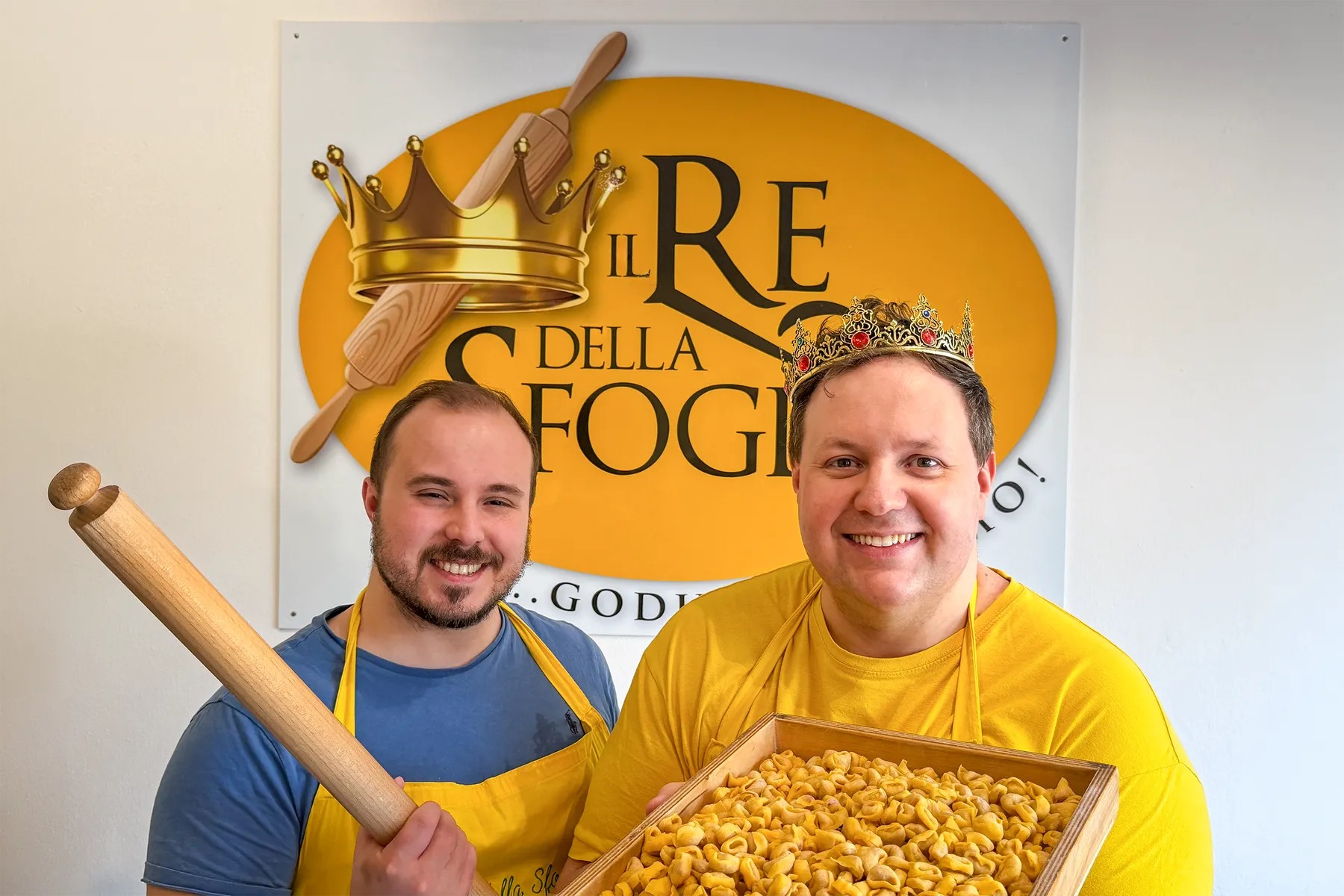
There are callings that do not sprout from a deliberate choice, but from a comforting, loving familiarity: from the rhythmic cadence of the rolling pin, from the dusty scent of flour, from the steam of a broth rising lazily in a Sunday kitchen. For Beniamino Baleotti, the u201cKing of the Sfoglia,u201d everything begins there: within the familial bosom of a tradition not explained, but absorbed and, in turn, practiced; not taught through words, but transmitted through affectionate closeness. On one side stands grandmother Clara, Tyrolean; on the other stands Clarice, Bolognese, who when he was a small child placed an egg in his hands, a dusting of flour, a minimal gesture already capable of harboring a destiny.
His most profound education precedes any formal school: it is the silent yet rigorous tutelage of the gaze, a childhood spent observing expert, womanly hands transform humble ingredients into ritual, technique, and identity. Culinary school would follow later, to offer grammar and discipline to a predisposition already declared. Yet the sfoglia, the true one, Baleotti learned at home, in the sagacious eloquence of the Emilian kitchen and from the words of grandmother Clarice: u201ca fistful of flour, an egg, and begin.u201d Everything else comes from patience, from repetition, from devotion.
With time, this natural inclination became a craft and transformed into a signature. In Pianoro, amidst the Bolognese hills, within a family trajectory that since the nineties revolved around hospitality and agritourism, Beniamino refined his art, brought it to competitions, made it recognizable even to the grand television audience, but above all, returned it to the place where it most belongs: the artisan workshop. Between the end of April 2018 and the years that followed, he launched his workshop of fresh pasta made with the rolling pin, born as a tangible fortress against the standardization of the machine and against the haste of the present age. And if today the project has expanded to Castel Maggiore, with a larger and more gastronomic venue shared with his younger brother Nathan, the symbolic heart remains Pianoro: the place where the sfoglia continues to be a practice of fingers, of memory, and of truth.
alchemy
The enchantments of Beniamino Baleotti reside not in fleeting sensation, but in enduring presence. In his extraordinary capacity to weave together precision and warmth, protocol and intimacy, masterly craft and ancestral narrative. His pastas do not seek to astonish; they seek to remain true to that Bolognese tradition which, to remain vital, must never degenerate into mere mannerism. Thus, the natural sovereign of this atelier is the tortellino: an emblematic form, a vessel of identity that here preserves the rigor of the rule alongside the soul of the domestic recipe, proving how the hand, the rhythm, the pressure, and the kinetic energy of the gesture can still yield a qualitative transcendence that no machine can truly replicate.
Alongside the tortellino unfolds a repertoire that guards the most eloquent lexicon of Emilia: seasonal tortelloni, green balanzoni of ricotta and mortadella, tagliatelle, lasagne, strichetti, garganelli, strozzapreti. Yet, the lineage of this workshop manifests perhaps even more brightly elsewhere: in the resolution never to let the minor, peripheral, and nearly forgotten preparations evaporate. It is here that Baleotti’s work assumes the mantle of an active guardianship. Emblematic in this regard is the pappa nel sacco — or soup in a pouch — an ancient kinsman of the imperial soup: a dough of flour, eggs, butter, and Parmigiano, simmered at length in broth within a cloth, then sliced and returned to its own liquid essence. A dish that stands as an artifact of civilization rescued from oblivion.
The path of Beniamino Baleotti is an eternal vow of devotion. Devotion to Bologna, to its cuisine of broth and rolled pastry, to the matriarchal wisdom from which all begins, and to an ideal of craftsmanship that never severs technique from affection; for in Pianoro, one crosses the threshold of an establishment that does not crystallize into a relic, but continues to flourish as a living touch.
provenance
final heritages


genesis
There are callings that do not sprout from a deliberate choice, but from a comforting, loving familiarity: from the rhythmic cadence of the rolling pin, from the dusty scent of flour, from the steam of a broth rising lazily in a Sunday kitchen. For Beniamino Baleotti, the u201cKing of the Sfoglia,u201d everything begins there: within the familial bosom of a tradition not explained, but absorbed and, in turn, practiced; not taught through words, but transmitted through affectionate closeness. On one side stands grandmother Clara, Tyrolean; on the other stands Clarice, Bolognese, who when he was a small child placed an egg in his hands, a dusting of flour, a minimal gesture already capable of harboring a destiny.
His most profound education precedes any formal school: it is the silent yet rigorous tutelage of the gaze, a childhood spent observing expert, womanly hands transform humble ingredients into ritual, technique, and identity. Culinary school would follow later, to offer grammar and discipline to a predisposition already declared. Yet the sfoglia, the true one, Baleotti learned at home, in the sagacious eloquence of the Emilian kitchen and from the words of grandmother Clarice: u201ca fistful of flour, an egg, and begin.u201d Everything else comes from patience, from repetition, from devotion.
With time, this natural inclination became a craft and transformed into a signature. In Pianoro, amidst the Bolognese hills, within a family trajectory that since the nineties revolved around hospitality and agritourism, Beniamino refined his art, brought it to competitions, made it recognizable even to the grand television audience, but above all, returned it to the place where it most belongs: the artisan workshop. Between the end of April 2018 and the years that followed, he launched his workshop of fresh pasta made with the rolling pin, born as a tangible fortress against the standardization of the machine and against the haste of the present age. And if today the project has expanded to Castel Maggiore, with a larger and more gastronomic venue shared with his younger brother Nathan, the symbolic heart remains Pianoro: the place where the sfoglia continues to be a practice of fingers, of memory, and of truth.
alchemy
The enchantments of Beniamino Baleotti reside not in fleeting sensation, but in enduring presence. In his extraordinary capacity to weave together precision and warmth, protocol and intimacy, masterly craft and ancestral narrative. His pastas do not seek to astonish; they seek to remain true to that Bolognese tradition which, to remain vital, must never degenerate into mere mannerism. Thus, the natural sovereign of this atelier is the tortellino: an emblematic form, a vessel of identity that here preserves the rigor of the rule alongside the soul of the domestic recipe, proving how the hand, the rhythm, the pressure, and the kinetic energy of the gesture can still yield a qualitative transcendence that no machine can truly replicate.
Alongside the tortellino unfolds a repertoire that guards the most eloquent lexicon of Emilia: seasonal tortelloni, green balanzoni of ricotta and mortadella, tagliatelle, lasagne, strichetti, garganelli, strozzapreti. Yet, the lineage of this workshop manifests perhaps even more brightly elsewhere: in the resolution never to let the minor, peripheral, and nearly forgotten preparations evaporate. It is here that Baleotti’s work assumes the mantle of an active guardianship. Emblematic in this regard is the pappa nel sacco — or soup in a pouch — an ancient kinsman of the imperial soup: a dough of flour, eggs, butter, and Parmigiano, simmered at length in broth within a cloth, then sliced and returned to its own liquid essence. A dish that stands as an artifact of civilization rescued from oblivion.
The path of Beniamino Baleotti is an eternal vow of devotion. Devotion to Bologna, to its cuisine of broth and rolled pastry, to the matriarchal wisdom from which all begins, and to an ideal of craftsmanship that never severs technique from affection; for in Pianoro, one crosses the threshold of an establishment that does not crystallize into a relic, but continues to flourish as a living touch.
provenance
final heritages
genesis
There are callings that do not sprout from a deliberate choice, but from a comforting, loving familiarity: from the rhythmic cadence of the rolling pin, from the dusty scent of flour, from the steam of a broth rising lazily in a Sunday kitchen. For Beniamino Baleotti, the u201cKing of the Sfoglia,u201d everything begins there: within the familial bosom of a tradition not explained, but absorbed and, in turn, practiced; not taught through words, but transmitted through affectionate closeness. On one side stands grandmother Clara, Tyrolean; on the other stands Clarice, Bolognese, who when he was a small child placed an egg in his hands, a dusting of flour, a minimal gesture already capable of harboring a destiny.
His most profound education precedes any formal school: it is the silent yet rigorous tutelage of the gaze, a childhood spent observing expert, womanly hands transform humble ingredients into ritual, technique, and identity. Culinary school would follow later, to offer grammar and discipline to a predisposition already declared. Yet the sfoglia, the true one, Baleotti learned at home, in the sagacious eloquence of the Emilian kitchen and from the words of grandmother Clarice: u201ca fistful of flour, an egg, and begin.u201d Everything else comes from patience, from repetition, from devotion.
With time, this natural inclination became a craft and transformed into a signature. In Pianoro, amidst the Bolognese hills, within a family trajectory that since the nineties revolved around hospitality and agritourism, Beniamino refined his art, brought it to competitions, made it recognizable even to the grand television audience, but above all, returned it to the place where it most belongs: the artisan workshop. Between the end of April 2018 and the years that followed, he launched his workshop of fresh pasta made with the rolling pin, born as a tangible fortress against the standardization of the machine and against the haste of the present age. And if today the project has expanded to Castel Maggiore, with a larger and more gastronomic venue shared with his younger brother Nathan, the symbolic heart remains Pianoro: the place where the sfoglia continues to be a practice of fingers, of memory, and of truth.
alchemy
The enchantments of Beniamino Baleotti reside not in fleeting sensation, but in enduring presence. In his extraordinary capacity to weave together precision and warmth, protocol and intimacy, masterly craft and ancestral narrative. His pastas do not seek to astonish; they seek to remain true to that Bolognese tradition which, to remain vital, must never degenerate into mere mannerism. Thus, the natural sovereign of this atelier is the tortellino: an emblematic form, a vessel of identity that here preserves the rigor of the rule alongside the soul of the domestic recipe, proving how the hand, the rhythm, the pressure, and the kinetic energy of the gesture can still yield a qualitative transcendence that no machine can truly replicate.
Alongside the tortellino unfolds a repertoire that guards the most eloquent lexicon of Emilia: seasonal tortelloni, green balanzoni of ricotta and mortadella, tagliatelle, lasagne, strichetti, garganelli, strozzapreti. Yet, the lineage of this workshop manifests perhaps even more brightly elsewhere: in the resolution never to let the minor, peripheral, and nearly forgotten preparations evaporate. It is here that Baleotti’s work assumes the mantle of an active guardianship. Emblematic in this regard is the pappa nel sacco — or soup in a pouch — an ancient kinsman of the imperial soup: a dough of flour, eggs, butter, and Parmigiano, simmered at length in broth within a cloth, then sliced and returned to its own liquid essence. A dish that stands as an artifact of civilization rescued from oblivion.
The path of Beniamino Baleotti is an eternal vow of devotion. Devotion to Bologna, to its cuisine of broth and rolled pastry, to the matriarchal wisdom from which all begins, and to an ideal of craftsmanship that never severs technique from affection; for in Pianoro, one crosses the threshold of an establishment that does not crystallize into a relic, but continues to flourish as a living touch.