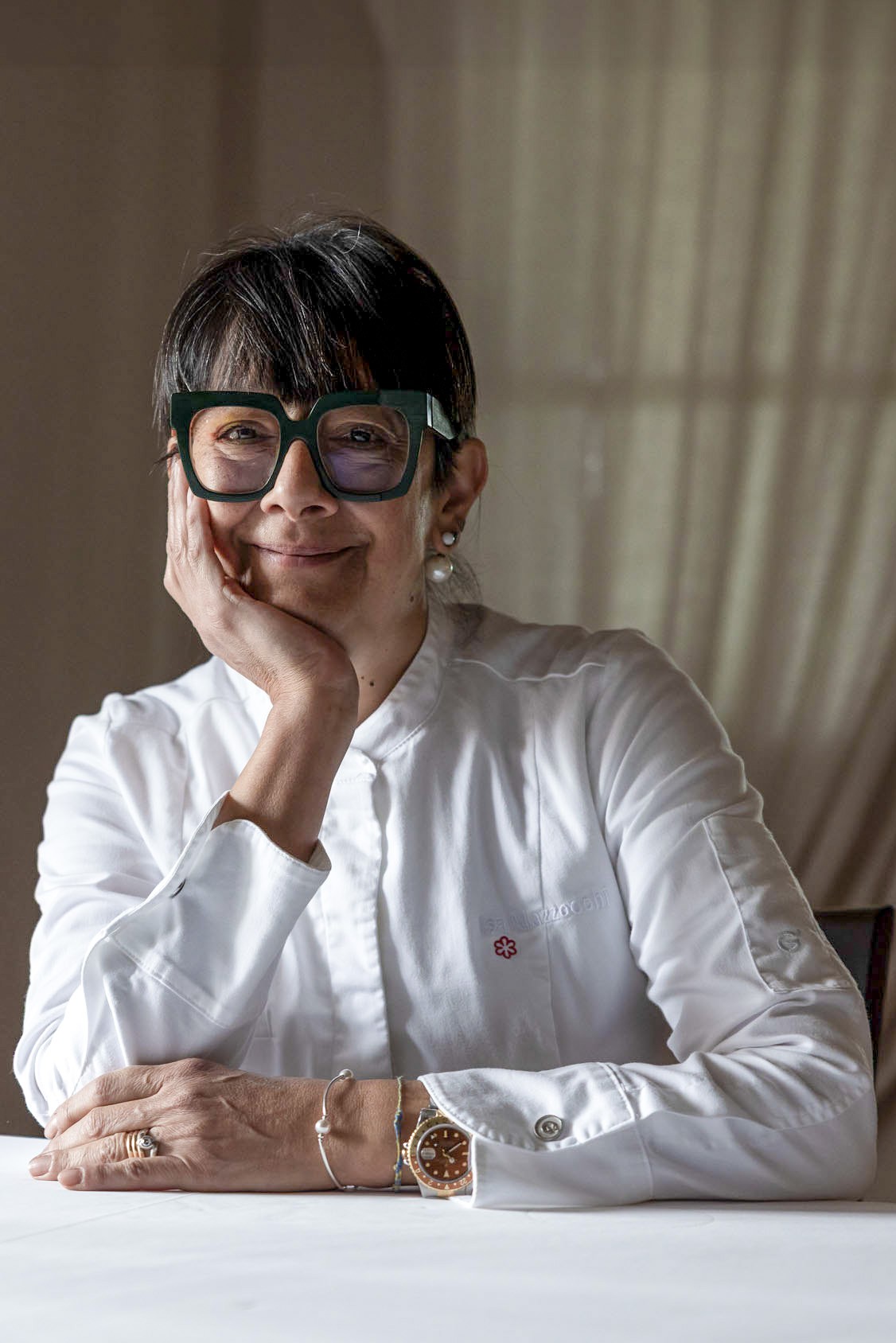
ISA MAZZOCCHI
measure and memory of the terroir
1968
Borgonovo Val Tidone
Of the Land - Of the Present
ISA MAZZOCCHI
measure and memory of the terroir
1968
Borgonovo Val Tidone
Of the Land - Of the Present
ISA MAZZOCCHI
measure and memory of the terroir
1968
Borgonovo Val Tidone
Of the Land - Of the Present
CURRICULUM VITAE
Isa Mazzocchi was born in Borgonovo Val Tidone, within the Piacenza territory, on February 28th, 1968. Her gastronomic narrative unfolded early, within a precise domestic geography: that of Bilegno, a small hamlet where her parents' tavern was not merely a place of sustenance, but a daily sanctuary of community. In 1989, alongside her sister Monica, Isa embraced this inheritance, giving life to the restaurant La Palta, a name which, in the local Piacenza dialect, recalls the village tobacco shop: a tangible memory of a space that has always interwoven culinary art, service, and domestic life.
Upon graduating from the Hotel School of Salsomaggiore Terme, she refined her craft under the tutelage of Georges Cogny and, at a tender age, was awarded the bronze medal at the Commis de Cuisine competition of the Chaîne des Rôtisseurs in Nice. Over the years, she continued to sculpt her culinary lexicon through profound experiences alongside the great masters of Italian gastronomy, from Gualtiero Marchesi to Gianfranco Vissani, and from Herbert Hintner to Filippo Chiappini Dattilo, without ever severing the primal tie to her native soil.
To this gastronomic education, forged of masters, trials, and apprenticeships, Isa joined further journeys of knowledge u2014 from the u00c9cole du Chocolat to Lu2019u00c9toile u2014 as well as a prominent presence in major Italian and international culinary congresses.
Her cuisine is born of this dual allegiance: to ancestral memory and to relentless research. It is a cuisine rooted in the earth, yet never stagnant; Piacentine in its very soul, yet capable of traversing time with poise, intelligence, and contemporary grace. Beppe Severgnini, in the pages of Corriere della Sera, described her as a chef of "soft equilibrium": a phrase that perfectly captures her manner at the stove, balanced between rigor and delicacy, identity and receptive listening.
The Michelin star, bestowed in the 2012 Guide and reaffirmed for 2026, consecrated a path both coherent and profoundly personal. In 2021, the Michelin Guide further honored her with the Chef Donna Award by Veuve Clicquot, acknowledging her powerful kinship with the terroir and her gift for transforming gastronomy into a timeless experience, suspended gracefully between past, present, and future.
As an external lecturer at Alma, the International School of Italian Cuisine in Colorno, and the University of Parma, vice-president of Chef to Chef since 2009, and Grande Dame Veuve Clicquot since 2016, Isa Mazzocchi continues to speak an essential truth: the most authentic cuisine is not born of superficial effect, but of depth. From a place long inhabited. From a memory tenderly kept. From a hand capable of breathing life into tradition, turning it into a living voice.
dialogues
Pasta, in her hands, never seems to be merely a first course: it often evokes memory, domestic geography, and hereditary belonging. When did you realize that an essential part of your culinary artistry resided precisely there?
It was the patrons who made me realize this. When certain gestures have been part of your life since time immemorial, you do not fully perceive what they carry within. Memory, domestic geography, and family history become almost ordinary to those who live them daily.
Then, gazing more closely at the dishes, especially those of pasta, I understood that within some of them lay a deeper memory: medieval and Renaissance preparations, more contemporary creations, but also very intimate recollections. Myself as a child, for instance, watching pasta being crafted at home.
Domestic geography resides in this: a constellation of places, gestures, and moments lived so deeply that they seem ordinary. Yet ordinary they are not, especially for those who eventually encounter them on the plate.La Palta was born and remains deeply rooted in the Piacenza territory. How much does it matter, in your conception of pasta, to work within such a precise, identity-rich terroir?
La Palta is rooted here and here it shall remain. Even the name is a symbol of the land: in the Piacentino dialect, it signifies “tobacco shop.” It is a vernacular word, bound to this patch of earth. In Milan, conversely, “palta” means mud, and some have even asked why we chose such an unappealing name. But here, that word possesses another history, another lineage. I live and work in Emilia-Romagna, the ancestral home of fresh stuffed pasta.
In your creations, one always senses a dual tension: on one hand, devotion to tradition; on the other, refinement, lightness, and contemporary grace. How does one strike the perfect balance between preservation and metamorphosis?
The perfect balance is born of knowledge. One must school oneself deeply in tradition, but also in technique and the demands of the present era. Only thus can a dish evolve without severing its sacred bond with its origins.
Once, here in the countryside, pasta was prepared with few eggs, for the egg was a precious commodity. Today, I work upon a different harmony between flour and egg, to achieve a more contemporary texture, better suited to our current style of appreciation.
Then, cookery, the volume of water, and the seasonality of the raw ingredients all play their part. These are details we consider commonplace today, yet in times past they depended heavily upon domestic economy and whatever the earth deigned to offer.Your braided tortelli have become a minor emblem: there is beauty, technique, and above all, identity. What do they represent today on the journey of La Palta?
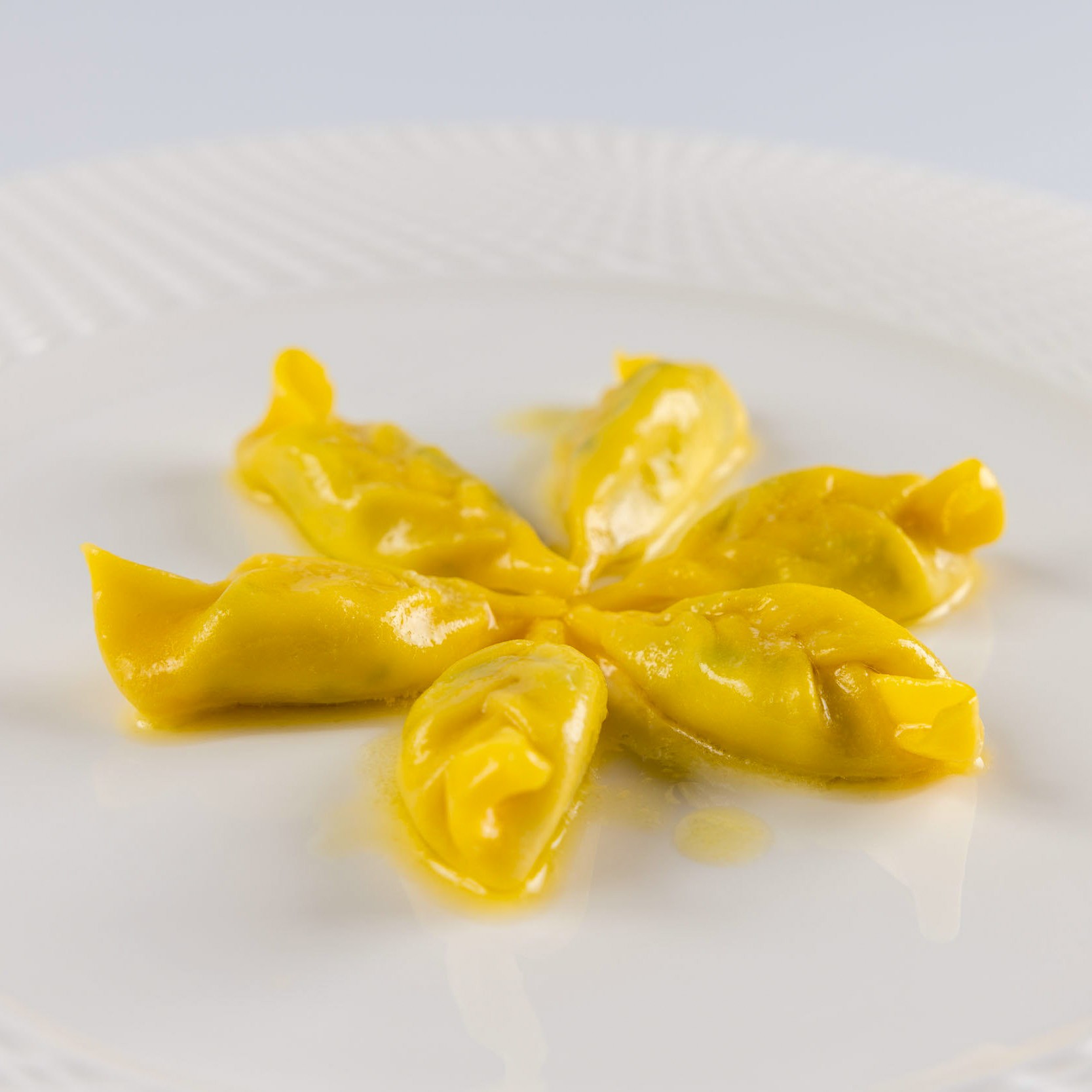
Piacentini tortelli are an ode to beauty. Visually, they are already a masterpiece. They burgeon from a filling of ricotta and wild herbs—which in various guises is found elsewhere—but it is the intricate braiding of the pasta that renders them peerless.
In the mouth, too, they conjure a singular sensation: one begins at the tip, with two overlapping veils of pasta; then one reaches the center, where the folds multiply, offering substance, presence, and texture. The tail dissolves, while the heart remains more structured. According to legend, they were born in the fourteenth century to mark the arrival of Petrarch in this land. It is a tale that suggests so much: a dish can enshrine not only flavor, but history, culture, and memory.You chose to dedicate space to a menu entirely centered on artisanal pasta. Was this a natural evolution or a deliberate declaration of what you wished to express?
The pasta menu was born from certain gentle provocations. Nicolò Scaglione and Andrea Petrini, upon visiting La Palta, would tell us that the pasta they tasted here was unlike anything found elsewhere. Our patrons, too, prompted us to reflect: many would order a pasta dish as an appetizer, then as a first course, and again as a main. Some would have welcomed it almost as dessert!
For us in Emilia-Romagna, pasta risks being taken for granted. One might say you are born with a piece of dough in your hands to seal, to braid, to shape… In my youth, I looked towards French cuisine, Nouvelle Cuisine, towards dishes that seemed unattainable to me. Then you mature, and you realize the profound weight of what you already carried within.
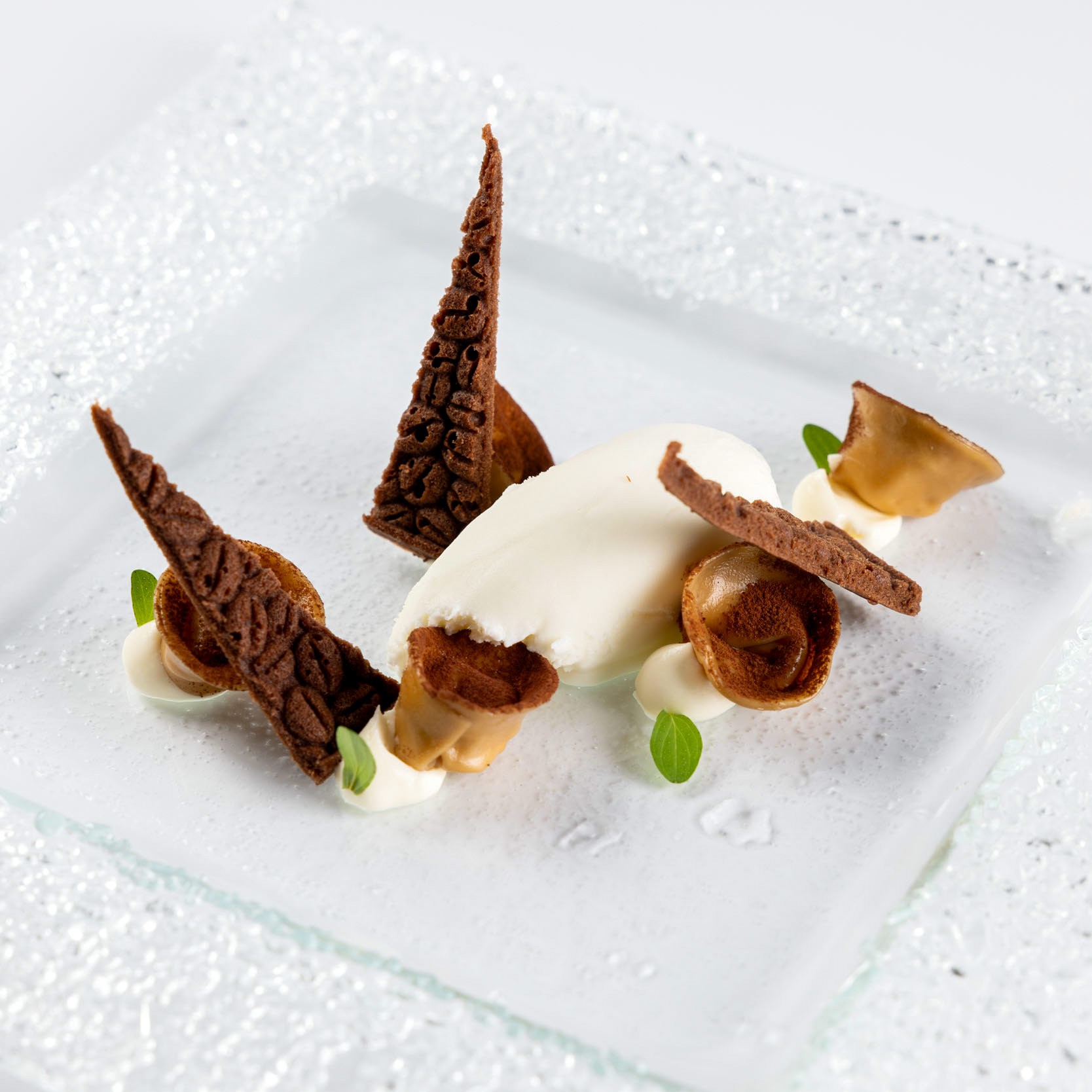
Crafting a menu solely devoted to pasta is no simple feat. We studied recipes, preparations, cooking vessels, and tableware. Every dish has a receptacle designed specifically for it. From this path emerged also the dessert by my nephew Luca Sogni, son of my sister Monica: a Tiramisù Raviolo, kneaded with espresso coffee in place of water.The revival of Pastiss seems to possess a value that transcends the plate: it is almost an act of cultural stewardship. When you bring to the table a preparation so dense with history, do you feel more the weight of responsibility or the joy of rebirth?
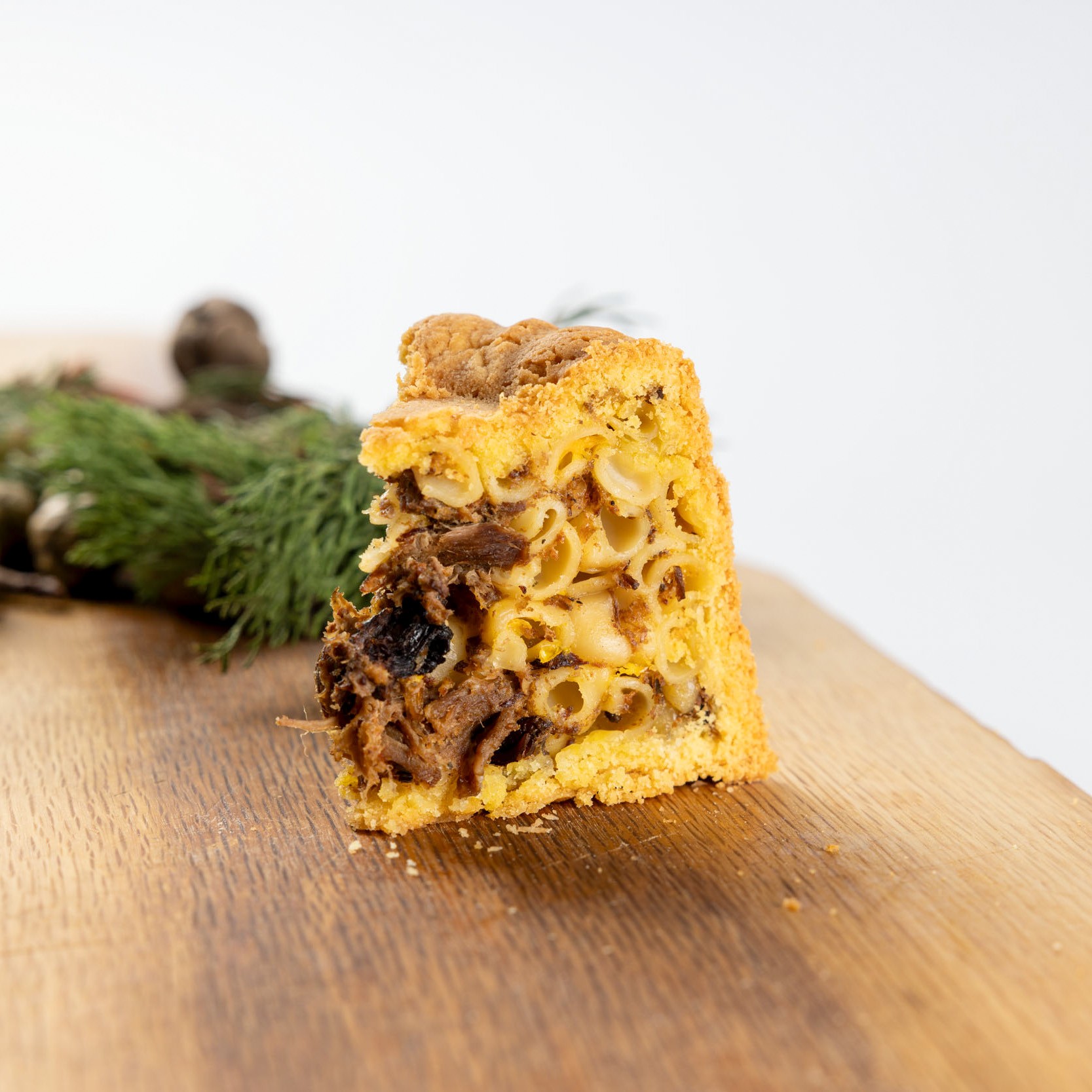
Acutely, the joy of rebirth. For me, Pastiss holds a supreme value, for it is the dish our mother would prepare for us during festive seasons, when time allowed for its creation.
We returned it to the menu, though initially I was rather hesitant. It is an arduous, complex, and delicate preparation. I wondered how we would manage it during service. Then we deliberated, rehearsed, and structured our labor.
Today, its success is so absolute that there is no more debate: it must be crafted. And these lengthy preparations bring you back into contact with reality. One must not always rush; one must take time, and the Pastiss commands you to do just that!Crafting great pasta in an haute cuisine establishment means working on minute, almost invisible details. What is the technical nuance that truly changes everything for you?
The decisive detail is the intimate knowledge of the living product. Not only of the ingredients but of the seasons, the climate, and the atmospheric conditions of the day.
In summer, pasta can only be prepared in the cool of early morning; in winter, it is best worked in the early afternoon. Humidity, heat, sun, wind: every element exerts its influence.
Moreover, beyond the formula, a profound sensibility is required. It is fundamental to exist in perfect harmony with the dough. Only thus does one truly attain the pinnacle of the art.In your kitchen, pasta is never virtuosity for its own sake. It remains legible, comforting, and hospitable. How important is it to you that a dish continues to speak to the heart and not merely to the intellect?
It is of paramount importance, for this is my culinary essence. It is who I am. My studies, my artistic journey, my lived experience all lead me there. I could not cook in any other manner.
This does not mean I do not cherish experimentation or the intellectual concept residing within a dish. I am deeply interested in observing how other chefs work on research, concept, and technique, even when they pursue paths vastly different from mine. Yet, I desire my cuisine to be comprehensible, to weave a tapestry of connection with those who receive it, and to speak to the emotional sanctuary of memory. I have no interest in virtuosity as an end in itself: it is vital to me that a dish translates clearly, that it is readable, and that it preserves a form of hospitality."Over the years, you have forged a deeply coherent, personal, and feminine voice. In what way has pasta been one of the most honest vessels for this voice?
For me, the culinary craft is a total vision; it does not pertain to pasta alone. Yet indeed, pasta, precisely because it is bound to gesture, to devotion, and to transmission, has certainly been one of the most significant vessels. You cannot betray it. But in truth, you cannot betray any dish. What you are, your artistic integrity, your way of beholding the world—you infuse this into everything you touch.
Looking ahead, what destiny do you envision for Italian signature pasta, and what role do you wish La Palta to continue playing in this grand narrative?
When I contemplate the creations that define Italy, pasta is ever at the center. If you pose this question to a traveler arriving from any corner of the globe, the first word on their lips is pasta. Or pizza.
In modern haute cuisine, I behold magnificent pasta creations, realized by master chefs, and an increasingly ardent desire from guests: they yearn to encounter it upon the menus. For a chef, it is akin to a painter having a palette of colors at their disposal. You can transform it, interpret it, leave it pristine, craft it with eggs or without, dry or hydrated; play with forms, doughs, textures; it is a malleable, sensitive medium, deeply expressive and in constant ferment: it allows the chef to continue questioning, creating, and discovering anew a fresh form to tell a story.
As for La Palta, I hope this journey may continue with my nephew, my son, and my daughter, who are gradually joining our ranks. I dream that the harmony woven over these years will be carried forward by their hands, and that they, too, may find their unique path.
CURRICULUM VITAE
Isa Mazzocchi was born in Borgonovo Val Tidone, within the Piacenza territory, on February 28th, 1968. Her gastronomic narrative unfolded early, within a precise domestic geography: that of Bilegno, a small hamlet where her parents' tavern was not merely a place of sustenance, but a daily sanctuary of community. In 1989, alongside her sister Monica, Isa embraced this inheritance, giving life to the restaurant La Palta, a name which, in the local Piacenza dialect, recalls the village tobacco shop: a tangible memory of a space that has always interwoven culinary art, service, and domestic life.
Upon graduating from the Hotel School of Salsomaggiore Terme, she refined her craft under the tutelage of Georges Cogny and, at a tender age, was awarded the bronze medal at the Commis de Cuisine competition of the Chaîne des Rôtisseurs in Nice. Over the years, she continued to sculpt her culinary lexicon through profound experiences alongside the great masters of Italian gastronomy, from Gualtiero Marchesi to Gianfranco Vissani, and from Herbert Hintner to Filippo Chiappini Dattilo, without ever severing the primal tie to her native soil.
To this gastronomic education, forged of masters, trials, and apprenticeships, Isa joined further journeys of knowledge u2014 from the u00c9cole du Chocolat to Lu2019u00c9toile u2014 as well as a prominent presence in major Italian and international culinary congresses.
Her cuisine is born of this dual allegiance: to ancestral memory and to relentless research. It is a cuisine rooted in the earth, yet never stagnant; Piacentine in its very soul, yet capable of traversing time with poise, intelligence, and contemporary grace. Beppe Severgnini, in the pages of Corriere della Sera, described her as a chef of "soft equilibrium": a phrase that perfectly captures her manner at the stove, balanced between rigor and delicacy, identity and receptive listening.
The Michelin star, bestowed in the 2012 Guide and reaffirmed for 2026, consecrated a path both coherent and profoundly personal. In 2021, the Michelin Guide further honored her with the Chef Donna Award by Veuve Clicquot, acknowledging her powerful kinship with the terroir and her gift for transforming gastronomy into a timeless experience, suspended gracefully between past, present, and future.
As an external lecturer at Alma, the International School of Italian Cuisine in Colorno, and the University of Parma, vice-president of Chef to Chef since 2009, and Grande Dame Veuve Clicquot since 2016, Isa Mazzocchi continues to speak an essential truth: the most authentic cuisine is not born of superficial effect, but of depth. From a place long inhabited. From a memory tenderly kept. From a hand capable of breathing life into tradition, turning it into a living voice.
dialogues
Pasta, in her hands, never seems to be merely a first course: it often evokes memory, domestic geography, and hereditary belonging. When did you realize that an essential part of your culinary artistry resided precisely there?
It was the patrons who made me realize this. When certain gestures have been part of your life since time immemorial, you do not fully perceive what they carry within. Memory, domestic geography, and family history become almost ordinary to those who live them daily.
Then, gazing more closely at the dishes, especially those of pasta, I understood that within some of them lay a deeper memory: medieval and Renaissance preparations, more contemporary creations, but also very intimate recollections. Myself as a child, for instance, watching pasta being crafted at home.
Domestic geography resides in this: a constellation of places, gestures, and moments lived so deeply that they seem ordinary. Yet ordinary they are not, especially for those who eventually encounter them on the plate.La Palta was born and remains deeply rooted in the Piacenza territory. How much does it matter, in your conception of pasta, to work within such a precise, identity-rich terroir?
La Palta is rooted here and here it shall remain. Even the name is a symbol of the land: in the Piacentino dialect, it signifies “tobacco shop.” It is a vernacular word, bound to this patch of earth. In Milan, conversely, “palta” means mud, and some have even asked why we chose such an unappealing name. But here, that word possesses another history, another lineage. I live and work in Emilia-Romagna, the ancestral home of fresh stuffed pasta.
In your creations, one always senses a dual tension: on one hand, devotion to tradition; on the other, refinement, lightness, and contemporary grace. How does one strike the perfect balance between preservation and metamorphosis?
The perfect balance is born of knowledge. One must school oneself deeply in tradition, but also in technique and the demands of the present era. Only thus can a dish evolve without severing its sacred bond with its origins.
Once, here in the countryside, pasta was prepared with few eggs, for the egg was a precious commodity. Today, I work upon a different harmony between flour and egg, to achieve a more contemporary texture, better suited to our current style of appreciation.
Then, cookery, the volume of water, and the seasonality of the raw ingredients all play their part. These are details we consider commonplace today, yet in times past they depended heavily upon domestic economy and whatever the earth deigned to offer.Your braided tortelli have become a minor emblem: there is beauty, technique, and above all, identity. What do they represent today on the journey of La Palta?
Piacentini tortelli are an ode to beauty. Visually, they are already a masterpiece. They burgeon from a filling of ricotta and wild herbs—which in various guises is found elsewhere—but it is the intricate braiding of the pasta that renders them peerless.
In the mouth, too, they conjure a singular sensation: one begins at the tip, with two overlapping veils of pasta; then one reaches the center, where the folds multiply, offering substance, presence, and texture. The tail dissolves, while the heart remains more structured. According to legend, they were born in the fourteenth century to mark the arrival of Petrarch in this land. It is a tale that suggests so much: a dish can enshrine not only flavor, but history, culture, and memory.You chose to dedicate space to a menu entirely centered on artisanal pasta. Was this a natural evolution or a deliberate declaration of what you wished to express?
The pasta menu was born from certain gentle provocations. Nicolò Scaglione and Andrea Petrini, upon visiting La Palta, would tell us that the pasta they tasted here was unlike anything found elsewhere. Our patrons, too, prompted us to reflect: many would order a pasta dish as an appetizer, then as a first course, and again as a main. Some would have welcomed it almost as dessert!
For us in Emilia-Romagna, pasta risks being taken for granted. One might say you are born with a piece of dough in your hands to seal, to braid, to shape… In my youth, I looked towards French cuisine, Nouvelle Cuisine, towards dishes that seemed unattainable to me. Then you mature, and you realize the profound weight of what you already carried within.
Crafting a menu solely devoted to pasta is no simple feat. We studied recipes, preparations, cooking vessels, and tableware. Every dish has a receptacle designed specifically for it. From this path emerged also the dessert by my nephew Luca Sogni, son of my sister Monica: a Tiramisù Raviolo, kneaded with espresso coffee in place of water.The revival of Pastiss seems to possess a value that transcends the plate: it is almost an act of cultural stewardship. When you bring to the table a preparation so dense with history, do you feel more the weight of responsibility or the joy of rebirth?
Acutely, the joy of rebirth. For me, Pastiss holds a supreme value, for it is the dish our mother would prepare for us during festive seasons, when time allowed for its creation.
We returned it to the menu, though initially I was rather hesitant. It is an arduous, complex, and delicate preparation. I wondered how we would manage it during service. Then we deliberated, rehearsed, and structured our labor.
Today, its success is so absolute that there is no more debate: it must be crafted. And these lengthy preparations bring you back into contact with reality. One must not always rush; one must take time, and the Pastiss commands you to do just that!Crafting great pasta in an haute cuisine establishment means working on minute, almost invisible details. What is the technical nuance that truly changes everything for you?
The decisive detail is the intimate knowledge of the living product. Not only of the ingredients but of the seasons, the climate, and the atmospheric conditions of the day.
In summer, pasta can only be prepared in the cool of early morning; in winter, it is best worked in the early afternoon. Humidity, heat, sun, wind: every element exerts its influence.
Moreover, beyond the formula, a profound sensibility is required. It is fundamental to exist in perfect harmony with the dough. Only thus does one truly attain the pinnacle of the art.In your kitchen, pasta is never virtuosity for its own sake. It remains legible, comforting, and hospitable. How important is it to you that a dish continues to speak to the heart and not merely to the intellect?
It is of paramount importance, for this is my culinary essence. It is who I am. My studies, my artistic journey, my lived experience all lead me there. I could not cook in any other manner.
This does not mean I do not cherish experimentation or the intellectual concept residing within a dish. I am deeply interested in observing how other chefs work on research, concept, and technique, even when they pursue paths vastly different from mine. Yet, I desire my cuisine to be comprehensible, to weave a tapestry of connection with those who receive it, and to speak to the emotional sanctuary of memory. I have no interest in virtuosity as an end in itself: it is vital to me that a dish translates clearly, that it is readable, and that it preserves a form of hospitality."Over the years, you have forged a deeply coherent, personal, and feminine voice. In what way has pasta been one of the most honest vessels for this voice?
For me, the culinary craft is a total vision; it does not pertain to pasta alone. Yet indeed, pasta, precisely because it is bound to gesture, to devotion, and to transmission, has certainly been one of the most significant vessels. You cannot betray it. But in truth, you cannot betray any dish. What you are, your artistic integrity, your way of beholding the world—you infuse this into everything you touch.
Looking ahead, what destiny do you envision for Italian signature pasta, and what role do you wish La Palta to continue playing in this grand narrative?
When I contemplate the creations that define Italy, pasta is ever at the center. If you pose this question to a traveler arriving from any corner of the globe, the first word on their lips is pasta. Or pizza.
In modern haute cuisine, I behold magnificent pasta creations, realized by master chefs, and an increasingly ardent desire from guests: they yearn to encounter it upon the menus. For a chef, it is akin to a painter having a palette of colors at their disposal. You can transform it, interpret it, leave it pristine, craft it with eggs or without, dry or hydrated; play with forms, doughs, textures; it is a malleable, sensitive medium, deeply expressive and in constant ferment: it allows the chef to continue questioning, creating, and discovering anew a fresh form to tell a story.
As for La Palta, I hope this journey may continue with my nephew, my son, and my daughter, who are gradually joining our ranks. I dream that the harmony woven over these years will be carried forward by their hands, and that they, too, may find their unique path.
CURRICULUM VITAE
Isa Mazzocchi was born in Borgonovo Val Tidone, within the Piacenza territory, on February 28th, 1968. Her gastronomic narrative unfolded early, within a precise domestic geography: that of Bilegno, a small hamlet where her parents' tavern was not merely a place of sustenance, but a daily sanctuary of community. In 1989, alongside her sister Monica, Isa embraced this inheritance, giving life to the restaurant La Palta, a name which, in the local Piacenza dialect, recalls the village tobacco shop: a tangible memory of a space that has always interwoven culinary art, service, and domestic life.
Upon graduating from the Hotel School of Salsomaggiore Terme, she refined her craft under the tutelage of Georges Cogny and, at a tender age, was awarded the bronze medal at the Commis de Cuisine competition of the Chaîne des Rôtisseurs in Nice. Over the years, she continued to sculpt her culinary lexicon through profound experiences alongside the great masters of Italian gastronomy, from Gualtiero Marchesi to Gianfranco Vissani, and from Herbert Hintner to Filippo Chiappini Dattilo, without ever severing the primal tie to her native soil.
To this gastronomic education, forged of masters, trials, and apprenticeships, Isa joined further journeys of knowledge u2014 from the u00c9cole du Chocolat to Lu2019u00c9toile u2014 as well as a prominent presence in major Italian and international culinary congresses.
Her cuisine is born of this dual allegiance: to ancestral memory and to relentless research. It is a cuisine rooted in the earth, yet never stagnant; Piacentine in its very soul, yet capable of traversing time with poise, intelligence, and contemporary grace. Beppe Severgnini, in the pages of Corriere della Sera, described her as a chef of "soft equilibrium": a phrase that perfectly captures her manner at the stove, balanced between rigor and delicacy, identity and receptive listening.
The Michelin star, bestowed in the 2012 Guide and reaffirmed for 2026, consecrated a path both coherent and profoundly personal. In 2021, the Michelin Guide further honored her with the Chef Donna Award by Veuve Clicquot, acknowledging her powerful kinship with the terroir and her gift for transforming gastronomy into a timeless experience, suspended gracefully between past, present, and future.
As an external lecturer at Alma, the International School of Italian Cuisine in Colorno, and the University of Parma, vice-president of Chef to Chef since 2009, and Grande Dame Veuve Clicquot since 2016, Isa Mazzocchi continues to speak an essential truth: the most authentic cuisine is not born of superficial effect, but of depth. From a place long inhabited. From a memory tenderly kept. From a hand capable of breathing life into tradition, turning it into a living voice.
dialogues
Pasta, in her hands, never seems to be merely a first course: it often evokes memory, domestic geography, and hereditary belonging. When did you realize that an essential part of your culinary artistry resided precisely there?
It was the patrons who made me realize this. When certain gestures have been part of your life since time immemorial, you do not fully perceive what they carry within. Memory, domestic geography, and family history become almost ordinary to those who live them daily.
Then, gazing more closely at the dishes, especially those of pasta, I understood that within some of them lay a deeper memory: medieval and Renaissance preparations, more contemporary creations, but also very intimate recollections. Myself as a child, for instance, watching pasta being crafted at home.
Domestic geography resides in this: a constellation of places, gestures, and moments lived so deeply that they seem ordinary. Yet ordinary they are not, especially for those who eventually encounter them on the plate.La Palta was born and remains deeply rooted in the Piacenza territory. How much does it matter, in your conception of pasta, to work within such a precise, identity-rich terroir?
La Palta is rooted here and here it shall remain. Even the name is a symbol of the land: in the Piacentino dialect, it signifies “tobacco shop.” It is a vernacular word, bound to this patch of earth. In Milan, conversely, “palta” means mud, and some have even asked why we chose such an unappealing name. But here, that word possesses another history, another lineage. I live and work in Emilia-Romagna, the ancestral home of fresh stuffed pasta.
In your creations, one always senses a dual tension: on one hand, devotion to tradition; on the other, refinement, lightness, and contemporary grace. How does one strike the perfect balance between preservation and metamorphosis?
The perfect balance is born of knowledge. One must school oneself deeply in tradition, but also in technique and the demands of the present era. Only thus can a dish evolve without severing its sacred bond with its origins.
Once, here in the countryside, pasta was prepared with few eggs, for the egg was a precious commodity. Today, I work upon a different harmony between flour and egg, to achieve a more contemporary texture, better suited to our current style of appreciation.
Then, cookery, the volume of water, and the seasonality of the raw ingredients all play their part. These are details we consider commonplace today, yet in times past they depended heavily upon domestic economy and whatever the earth deigned to offer.Your braided tortelli have become a minor emblem: there is beauty, technique, and above all, identity. What do they represent today on the journey of La Palta?
Piacentini tortelli are an ode to beauty. Visually, they are already a masterpiece. They burgeon from a filling of ricotta and wild herbs—which in various guises is found elsewhere—but it is the intricate braiding of the pasta that renders them peerless.
In the mouth, too, they conjure a singular sensation: one begins at the tip, with two overlapping veils of pasta; then one reaches the center, where the folds multiply, offering substance, presence, and texture. The tail dissolves, while the heart remains more structured. According to legend, they were born in the fourteenth century to mark the arrival of Petrarch in this land. It is a tale that suggests so much: a dish can enshrine not only flavor, but history, culture, and memory.You chose to dedicate space to a menu entirely centered on artisanal pasta. Was this a natural evolution or a deliberate declaration of what you wished to express?
The pasta menu was born from certain gentle provocations. Nicolò Scaglione and Andrea Petrini, upon visiting La Palta, would tell us that the pasta they tasted here was unlike anything found elsewhere. Our patrons, too, prompted us to reflect: many would order a pasta dish as an appetizer, then as a first course, and again as a main. Some would have welcomed it almost as dessert!
For us in Emilia-Romagna, pasta risks being taken for granted. One might say you are born with a piece of dough in your hands to seal, to braid, to shape… In my youth, I looked towards French cuisine, Nouvelle Cuisine, towards dishes that seemed unattainable to me. Then you mature, and you realize the profound weight of what you already carried within.
Crafting a menu solely devoted to pasta is no simple feat. We studied recipes, preparations, cooking vessels, and tableware. Every dish has a receptacle designed specifically for it. From this path emerged also the dessert by my nephew Luca Sogni, son of my sister Monica: a Tiramisù Raviolo, kneaded with espresso coffee in place of water.The revival of Pastiss seems to possess a value that transcends the plate: it is almost an act of cultural stewardship. When you bring to the table a preparation so dense with history, do you feel more the weight of responsibility or the joy of rebirth?
Acutely, the joy of rebirth. For me, Pastiss holds a supreme value, for it is the dish our mother would prepare for us during festive seasons, when time allowed for its creation.
We returned it to the menu, though initially I was rather hesitant. It is an arduous, complex, and delicate preparation. I wondered how we would manage it during service. Then we deliberated, rehearsed, and structured our labor.
Today, its success is so absolute that there is no more debate: it must be crafted. And these lengthy preparations bring you back into contact with reality. One must not always rush; one must take time, and the Pastiss commands you to do just that!Crafting great pasta in an haute cuisine establishment means working on minute, almost invisible details. What is the technical nuance that truly changes everything for you?
The decisive detail is the intimate knowledge of the living product. Not only of the ingredients but of the seasons, the climate, and the atmospheric conditions of the day.
In summer, pasta can only be prepared in the cool of early morning; in winter, it is best worked in the early afternoon. Humidity, heat, sun, wind: every element exerts its influence.
Moreover, beyond the formula, a profound sensibility is required. It is fundamental to exist in perfect harmony with the dough. Only thus does one truly attain the pinnacle of the art.In your kitchen, pasta is never virtuosity for its own sake. It remains legible, comforting, and hospitable. How important is it to you that a dish continues to speak to the heart and not merely to the intellect?
It is of paramount importance, for this is my culinary essence. It is who I am. My studies, my artistic journey, my lived experience all lead me there. I could not cook in any other manner.
This does not mean I do not cherish experimentation or the intellectual concept residing within a dish. I am deeply interested in observing how other chefs work on research, concept, and technique, even when they pursue paths vastly different from mine. Yet, I desire my cuisine to be comprehensible, to weave a tapestry of connection with those who receive it, and to speak to the emotional sanctuary of memory. I have no interest in virtuosity as an end in itself: it is vital to me that a dish translates clearly, that it is readable, and that it preserves a form of hospitality."Over the years, you have forged a deeply coherent, personal, and feminine voice. In what way has pasta been one of the most honest vessels for this voice?
For me, the culinary craft is a total vision; it does not pertain to pasta alone. Yet indeed, pasta, precisely because it is bound to gesture, to devotion, and to transmission, has certainly been one of the most significant vessels. You cannot betray it. But in truth, you cannot betray any dish. What you are, your artistic integrity, your way of beholding the world—you infuse this into everything you touch.
Looking ahead, what destiny do you envision for Italian signature pasta, and what role do you wish La Palta to continue playing in this grand narrative?
When I contemplate the creations that define Italy, pasta is ever at the center. If you pose this question to a traveler arriving from any corner of the globe, the first word on their lips is pasta. Or pizza.
In modern haute cuisine, I behold magnificent pasta creations, realized by master chefs, and an increasingly ardent desire from guests: they yearn to encounter it upon the menus. For a chef, it is akin to a painter having a palette of colors at their disposal. You can transform it, interpret it, leave it pristine, craft it with eggs or without, dry or hydrated; play with forms, doughs, textures; it is a malleable, sensitive medium, deeply expressive and in constant ferment: it allows the chef to continue questioning, creating, and discovering anew a fresh form to tell a story.
As for La Palta, I hope this journey may continue with my nephew, my son, and my daughter, who are gradually joining our ranks. I dream that the harmony woven over these years will be carried forward by their hands, and that they, too, may find their unique path.