KNÖDEL-GATE
when the manifesto enters the kitchen
1/16/26
KNÖDEL-GATE
when the manifesto enters the kitchen
1/16/26
KNÖDEL-GATE
when the manifesto enters the kitchen
1/16/26
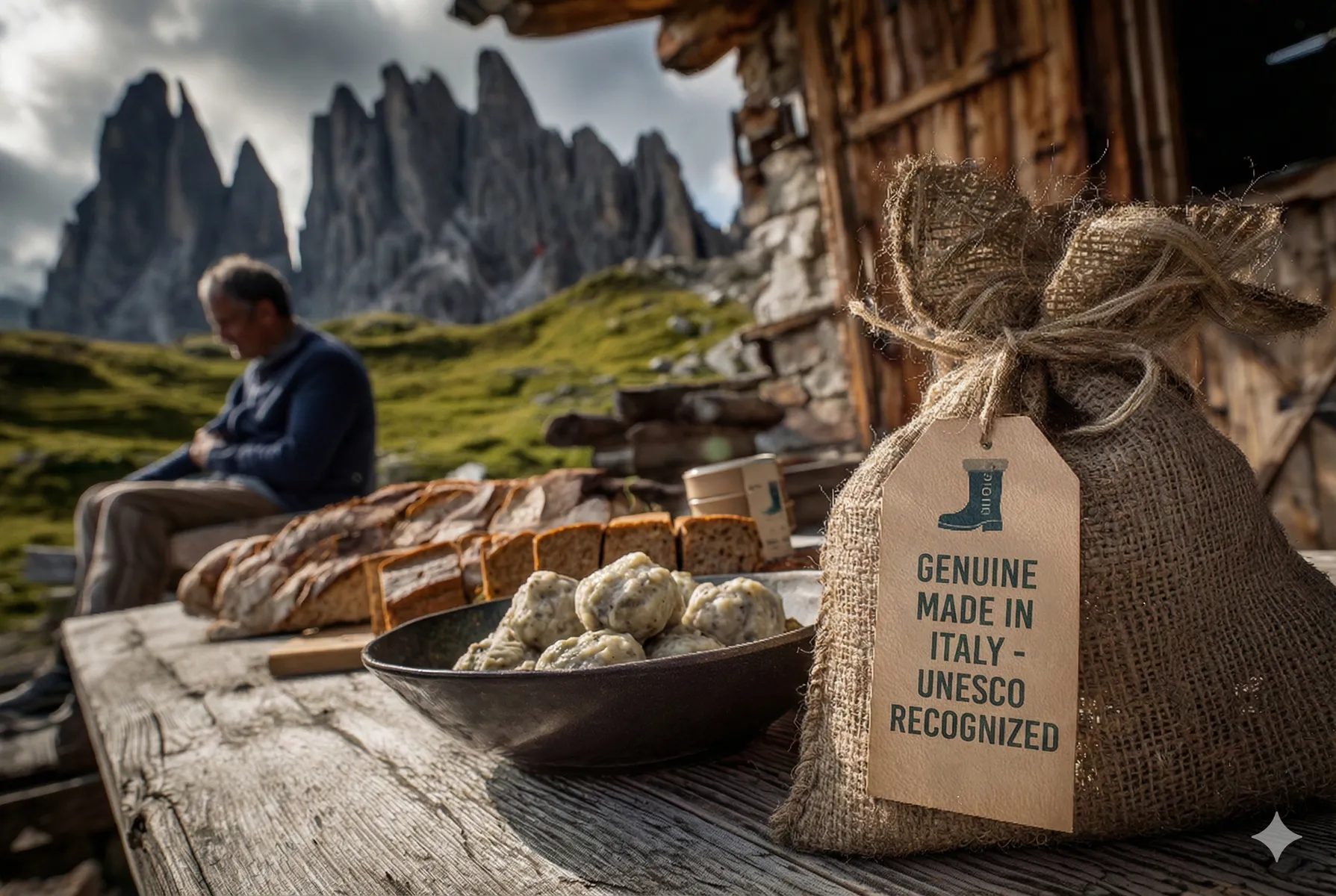
From «Südtirol ist nicht Italien» to «Knödel sind nicht italienisch»: the provocation of the German-language press in South Tyrol returns the question of belonging to the plate, only days after the Unesco recognition of Italian cuisine as intangible cultural heritage. In the crosshairs land the canederli, a South Tyrolean gastronomic symbol, claimed as “non-Italian” and, therefore, alien to a national supremacy which a part of the territory does not feel as its own.
The spark is cultural before it is gastronomic. For when cuisine is celebrated as heritage, it ceases to be mere technique and domestic memory: it becomes a public narrative, a banner, a vessel of identity. And in an area historically traversed by linguistic and political fractures, even a dough of bread and speck can transform into a declaration.
In recent hours, the discussion has broadened: from satire on “Italian cuisine” inflected in a South Tyrolean key, to more innocent (yet revealing) disputes over how canederli should be served — in broth or with butter — to the reactions of local politics, divided between those who downplay and those who revive the theme of autonomy as a separate identity.
The paradox, however, is best viewed when widening the lens. While outside Italian borders Italian sounding continues to flourish — labels mimicking the Italian tongue to sell “quasi-Italy” on shelves, with highly significant economic damage estimates — South Tyrol chooses an opposing gesture: to refuse inclusion. Not for lack of tradition, but because the very frame that subsumes it is contested.
What does this controversy tell us, beyond yet another “canederli-gate”? That cuisine never coincides perfectly with the State. It is a geography of exchanges, of migrations, of moving frontiers: Ladin, Central European, Alpine, and Italian all at once. To reduce it to exclusive property — or, conversely, to deny its citizenship — is always a simplification.
For MILLEUNAPASTA, the news is also a reminder: to defend the authenticity of Made in Italy in the world does not mean to rigidify the idea of Italianness, but to know how to narrate it in its plurality. Because heritage, when it is alive, does not expel: it stratifies.


From «Südtirol ist nicht Italien» to «Knödel sind nicht italienisch»: the provocation of the German-language press in South Tyrol returns the question of belonging to the plate, only days after the Unesco recognition of Italian cuisine as intangible cultural heritage. In the crosshairs land the canederli, a South Tyrolean gastronomic symbol, claimed as “non-Italian” and, therefore, alien to a national supremacy which a part of the territory does not feel as its own.
The spark is cultural before it is gastronomic. For when cuisine is celebrated as heritage, it ceases to be mere technique and domestic memory: it becomes a public narrative, a banner, a vessel of identity. And in an area historically traversed by linguistic and political fractures, even a dough of bread and speck can transform into a declaration.
In recent hours, the discussion has broadened: from satire on “Italian cuisine” inflected in a South Tyrolean key, to more innocent (yet revealing) disputes over how canederli should be served — in broth or with butter — to the reactions of local politics, divided between those who downplay and those who revive the theme of autonomy as a separate identity.
The paradox, however, is best viewed when widening the lens. While outside Italian borders Italian sounding continues to flourish — labels mimicking the Italian tongue to sell “quasi-Italy” on shelves, with highly significant economic damage estimates — South Tyrol chooses an opposing gesture: to refuse inclusion. Not for lack of tradition, but because the very frame that subsumes it is contested.
What does this controversy tell us, beyond yet another “canederli-gate”? That cuisine never coincides perfectly with the State. It is a geography of exchanges, of migrations, of moving frontiers: Ladin, Central European, Alpine, and Italian all at once. To reduce it to exclusive property — or, conversely, to deny its citizenship — is always a simplification.
For MILLEUNAPASTA, the news is also a reminder: to defend the authenticity of Made in Italy in the world does not mean to rigidify the idea of Italianness, but to know how to narrate it in its plurality. Because heritage, when it is alive, does not expel: it stratifies.
From «Südtirol ist nicht Italien» to «Knödel sind nicht italienisch»: the provocation of the German-language press in South Tyrol returns the question of belonging to the plate, only days after the Unesco recognition of Italian cuisine as intangible cultural heritage. In the crosshairs land the canederli, a South Tyrolean gastronomic symbol, claimed as “non-Italian” and, therefore, alien to a national supremacy which a part of the territory does not feel as its own.
The spark is cultural before it is gastronomic. For when cuisine is celebrated as heritage, it ceases to be mere technique and domestic memory: it becomes a public narrative, a banner, a vessel of identity. And in an area historically traversed by linguistic and political fractures, even a dough of bread and speck can transform into a declaration.
In recent hours, the discussion has broadened: from satire on “Italian cuisine” inflected in a South Tyrolean key, to more innocent (yet revealing) disputes over how canederli should be served — in broth or with butter — to the reactions of local politics, divided between those who downplay and those who revive the theme of autonomy as a separate identity.
The paradox, however, is best viewed when widening the lens. While outside Italian borders Italian sounding continues to flourish — labels mimicking the Italian tongue to sell “quasi-Italy” on shelves, with highly significant economic damage estimates — South Tyrol chooses an opposing gesture: to refuse inclusion. Not for lack of tradition, but because the very frame that subsumes it is contested.
What does this controversy tell us, beyond yet another “canederli-gate”? That cuisine never coincides perfectly with the State. It is a geography of exchanges, of migrations, of moving frontiers: Ladin, Central European, Alpine, and Italian all at once. To reduce it to exclusive property — or, conversely, to deny its citizenship — is always a simplification.
For MILLEUNAPASTA, the news is also a reminder: to defend the authenticity of Made in Italy in the world does not mean to rigidify the idea of Italianness, but to know how to narrate it in its plurality. Because heritage, when it is alive, does not expel: it stratifies.