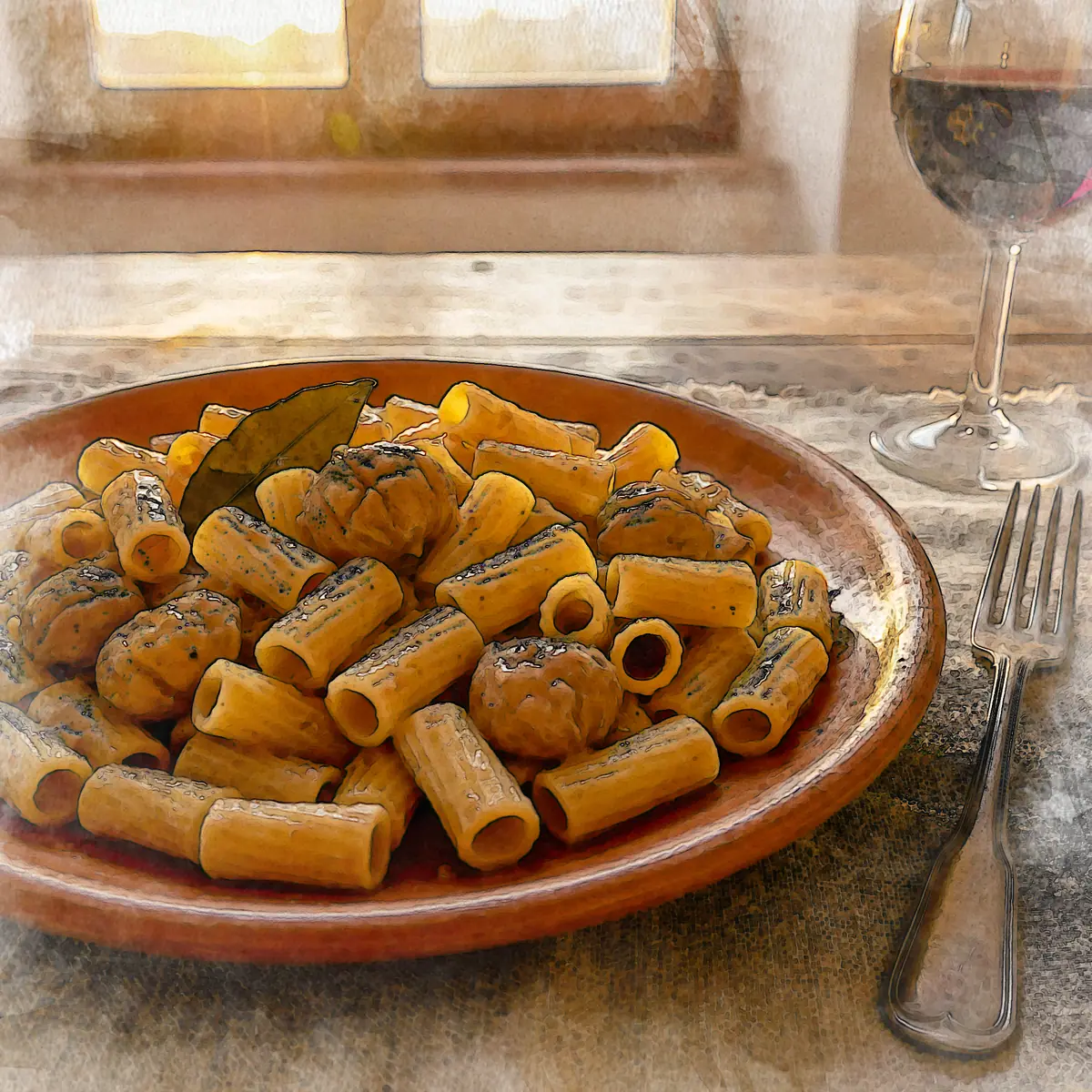
THE PASTELLESSA
Dried chestnuts, Short pasta, Chili pepper, Bay leaf
Effortless
Campania
One hundred minutes
580 Kilocalories
THE PASTELLESSA
Dried chestnuts, Short pasta, Chili pepper, Bay leaf
Effortless
Campania
One hundred minutes
580 Kilocalories
THE PASTELLESSA
Dried chestnuts, Short pasta, Chili pepper, Bay leaf
Effortless
Campania
One hundred minutes
580 Kilocalories
GENESIS
The pastellessa is a dish deeply rooted in the rural traditions of Macerata Campania, in the province of Caserta. This dish stands as the very emblem of the feast of Saint Anthony the Abbot, celebrated on the seventeenth of January—a solemnity that transforms the town into a stage of archaic sounds and flavours. The term pastellessa likely derives from the method of cooking boiled chestnuts, which in the local dialect are called by this very name. The recipe was born as a humble dish, capable of providing sustenance to the peasants and the Bottari—the percussionists who, during the festival, parade upon great carts drawn by tractors, striking barrels, vats, and scythes with ancestral rhythms destined to ward off evil.
Its preparation demands patience, for the dried chestnuts must be rehydrated through an entire night before being boiled. This culinary rite is inseparable from the religious and folkloric significance of the feast: Saint Anthony, protector of animals and of fire, is honoured with grand bonfires and the music of the Bottari. The cadenced sound of their instruments recalls the very pulse of the earth and the struggle against adversity. In this sacred context, the pastellessa is not mere sustenance, but a symbol of communal cohesion and historical identity.
The ingredients are simple, reflecting the seasonal bounty of the region, where the chestnut represented a vital resource for enduring the harsh winter months. Traditionally, the pasta is cooked alongside the chestnuts or added thereafter, creating a creamy and savoury marriage of flavours, often enriched by a touch of chili pepper to warm the soul during the January processions. Even today, every family of Macerata Campania guards its own variation, passing down from generation to generation the secret of this dish, which wafts with the fragrance of history and popular devotion.
PORTIONS (FOR 4 PERSONS)
FOR THE PASTA
Petit-cut pasta (mezze maniche, tubetti)
320g
FOR THE EMBELLISHMENT
Dried chestnuts
Garlic
Bay laurel
Spicy chili pepper
Extra virgin olive oil
Salt
300g
1 clove
1 leaf
1
to taste
to taste
CURATION
For the preparation of the chestnuts:
On the eve of creation, submerge the dried chestnuts in an abundance of cool water to awaken. On the following morn, rinse them thoroughly and cradle them in a generous pot, submerged within water. Bestow a single bay leaf and a whisper of salt. Allow them to simmer gently over a low flame for approximately an hour and a half, until they yield to tenderness yet retain their noble form. Once cooked, drain them, reserving a portion of their precious cooking elixir.For the seasoning:
In a spacious pan, pour a generous ribbon of extra virgin olive oil and gently sauté the clove of garlic alongside the fiery chili pepper. Once the garlic has bathed in gold, withdraw it and introduce the boiled chestnuts. Allow them to absorb the essences over a spirited flame for a few moments, stirring with utmost delicacy to preserve the integrity of the fruits. Should the base become too dry, bestow a ladle of the reserved chestnut elixir to weave a silken, creamy foundation.For the pasta:
Bring a vessel of salted water to a triumphant boil and cook the short pasta, honoring the sacred timing written upon its vessel. Drain it swiftly while still "al dente" and cast it directly into the pan with the chestnut symphony. Sauté all together for a fleeting couple of minutes, uniting, if destiny requires, more of the cooking water to bind the flavors into a harmonious, velvety embrace. Ensure the pasta is beautifully cloaked in this gastronomy before presenting it to the table.
aspiration
You may bestow a touch of crispness upon the dish, garnishing it with toasted walnut kernels.
For an even more savory rendition, some choose to introduce a hint of tomato paste whilst the garlic gently browns.
Should you cherish robust flavors, a dusting of Pecorino Romano at the finish of the cooking process will elevate the sweet essence of the chestnuts.


GENESIS
The pastellessa is a dish deeply rooted in the rural traditions of Macerata Campania, in the province of Caserta. This dish stands as the very emblem of the feast of Saint Anthony the Abbot, celebrated on the seventeenth of January—a solemnity that transforms the town into a stage of archaic sounds and flavours. The term pastellessa likely derives from the method of cooking boiled chestnuts, which in the local dialect are called by this very name. The recipe was born as a humble dish, capable of providing sustenance to the peasants and the Bottari—the percussionists who, during the festival, parade upon great carts drawn by tractors, striking barrels, vats, and scythes with ancestral rhythms destined to ward off evil.
Its preparation demands patience, for the dried chestnuts must be rehydrated through an entire night before being boiled. This culinary rite is inseparable from the religious and folkloric significance of the feast: Saint Anthony, protector of animals and of fire, is honoured with grand bonfires and the music of the Bottari. The cadenced sound of their instruments recalls the very pulse of the earth and the struggle against adversity. In this sacred context, the pastellessa is not mere sustenance, but a symbol of communal cohesion and historical identity.
The ingredients are simple, reflecting the seasonal bounty of the region, where the chestnut represented a vital resource for enduring the harsh winter months. Traditionally, the pasta is cooked alongside the chestnuts or added thereafter, creating a creamy and savoury marriage of flavours, often enriched by a touch of chili pepper to warm the soul during the January processions. Even today, every family of Macerata Campania guards its own variation, passing down from generation to generation the secret of this dish, which wafts with the fragrance of history and popular devotion.
PORTIONS (FOR 4 PERSONS)
FOR THE PASTA
Petit-cut pasta (mezze maniche, tubetti)
320g
FOR THE EMBELLISHMENT
Dried chestnuts
Garlic
Bay laurel
Spicy chili pepper
Extra virgin olive oil
Salt
300g
1 clove
1 leaf
1
to taste
to taste
CURATION
For the preparation of the chestnuts:
On the eve of creation, submerge the dried chestnuts in an abundance of cool water to awaken. On the following morn, rinse them thoroughly and cradle them in a generous pot, submerged within water. Bestow a single bay leaf and a whisper of salt. Allow them to simmer gently over a low flame for approximately an hour and a half, until they yield to tenderness yet retain their noble form. Once cooked, drain them, reserving a portion of their precious cooking elixir.For the seasoning:
In a spacious pan, pour a generous ribbon of extra virgin olive oil and gently sauté the clove of garlic alongside the fiery chili pepper. Once the garlic has bathed in gold, withdraw it and introduce the boiled chestnuts. Allow them to absorb the essences over a spirited flame for a few moments, stirring with utmost delicacy to preserve the integrity of the fruits. Should the base become too dry, bestow a ladle of the reserved chestnut elixir to weave a silken, creamy foundation.For the pasta:
Bring a vessel of salted water to a triumphant boil and cook the short pasta, honoring the sacred timing written upon its vessel. Drain it swiftly while still "al dente" and cast it directly into the pan with the chestnut symphony. Sauté all together for a fleeting couple of minutes, uniting, if destiny requires, more of the cooking water to bind the flavors into a harmonious, velvety embrace. Ensure the pasta is beautifully cloaked in this gastronomy before presenting it to the table.
aspiration
You may bestow a touch of crispness upon the dish, garnishing it with toasted walnut kernels.
For an even more savory rendition, some choose to introduce a hint of tomato paste whilst the garlic gently browns.
Should you cherish robust flavors, a dusting of Pecorino Romano at the finish of the cooking process will elevate the sweet essence of the chestnuts.
latest culinary creations
GENESIS
The pastellessa is a dish deeply rooted in the rural traditions of Macerata Campania, in the province of Caserta. This dish stands as the very emblem of the feast of Saint Anthony the Abbot, celebrated on the seventeenth of January—a solemnity that transforms the town into a stage of archaic sounds and flavours. The term pastellessa likely derives from the method of cooking boiled chestnuts, which in the local dialect are called by this very name. The recipe was born as a humble dish, capable of providing sustenance to the peasants and the Bottari—the percussionists who, during the festival, parade upon great carts drawn by tractors, striking barrels, vats, and scythes with ancestral rhythms destined to ward off evil.
Its preparation demands patience, for the dried chestnuts must be rehydrated through an entire night before being boiled. This culinary rite is inseparable from the religious and folkloric significance of the feast: Saint Anthony, protector of animals and of fire, is honoured with grand bonfires and the music of the Bottari. The cadenced sound of their instruments recalls the very pulse of the earth and the struggle against adversity. In this sacred context, the pastellessa is not mere sustenance, but a symbol of communal cohesion and historical identity.
The ingredients are simple, reflecting the seasonal bounty of the region, where the chestnut represented a vital resource for enduring the harsh winter months. Traditionally, the pasta is cooked alongside the chestnuts or added thereafter, creating a creamy and savoury marriage of flavours, often enriched by a touch of chili pepper to warm the soul during the January processions. Even today, every family of Macerata Campania guards its own variation, passing down from generation to generation the secret of this dish, which wafts with the fragrance of history and popular devotion.
PORTIONS (FOR 4 PERSONS)
FOR THE PASTA
Petit-cut pasta (mezze maniche, tubetti)
320g
FOR THE EMBELLISHMENT
Dried chestnuts
Garlic
Bay laurel
Spicy chili pepper
Extra virgin olive oil
Salt
300g
1 clove
1 leaf
1
to taste
to taste
CURATION
For the preparation of the chestnuts:
On the eve of creation, submerge the dried chestnuts in an abundance of cool water to awaken. On the following morn, rinse them thoroughly and cradle them in a generous pot, submerged within water. Bestow a single bay leaf and a whisper of salt. Allow them to simmer gently over a low flame for approximately an hour and a half, until they yield to tenderness yet retain their noble form. Once cooked, drain them, reserving a portion of their precious cooking elixir.For the seasoning:
In a spacious pan, pour a generous ribbon of extra virgin olive oil and gently sauté the clove of garlic alongside the fiery chili pepper. Once the garlic has bathed in gold, withdraw it and introduce the boiled chestnuts. Allow them to absorb the essences over a spirited flame for a few moments, stirring with utmost delicacy to preserve the integrity of the fruits. Should the base become too dry, bestow a ladle of the reserved chestnut elixir to weave a silken, creamy foundation.For the pasta:
Bring a vessel of salted water to a triumphant boil and cook the short pasta, honoring the sacred timing written upon its vessel. Drain it swiftly while still "al dente" and cast it directly into the pan with the chestnut symphony. Sauté all together for a fleeting couple of minutes, uniting, if destiny requires, more of the cooking water to bind the flavors into a harmonious, velvety embrace. Ensure the pasta is beautifully cloaked in this gastronomy before presenting it to the table.
aspiration
You may bestow a touch of crispness upon the dish, garnishing it with toasted walnut kernels.
For an even more savory rendition, some choose to introduce a hint of tomato paste whilst the garlic gently browns.
Should you cherish robust flavors, a dusting of Pecorino Romano at the finish of the cooking process will elevate the sweet essence of the chestnuts.