genesis
There are endeavors that do not emerge from a mere "niche," but from an urgent, physiological necessity: that of restoring to the table what a diagnosis would seem to snatch away 'ex abrupto' u2014 the ritual, the Sunday gathering, pasta as a shared familial vocabulary. Rediscovered flavor is precisely this: an artisanal atelier that does not merely "compensate" for tradition, but restores it to circulation, without exile or shortcut.
The stage is set long before 2014. It begins in 1995, when Antonella Saglioni discovered she was celiac, in an era when celiac disease was almost a language without a dictionary: a scarce few products u2014 often flavorless and pedestrian u2014 subsidized by the state and found only in pharmacies.
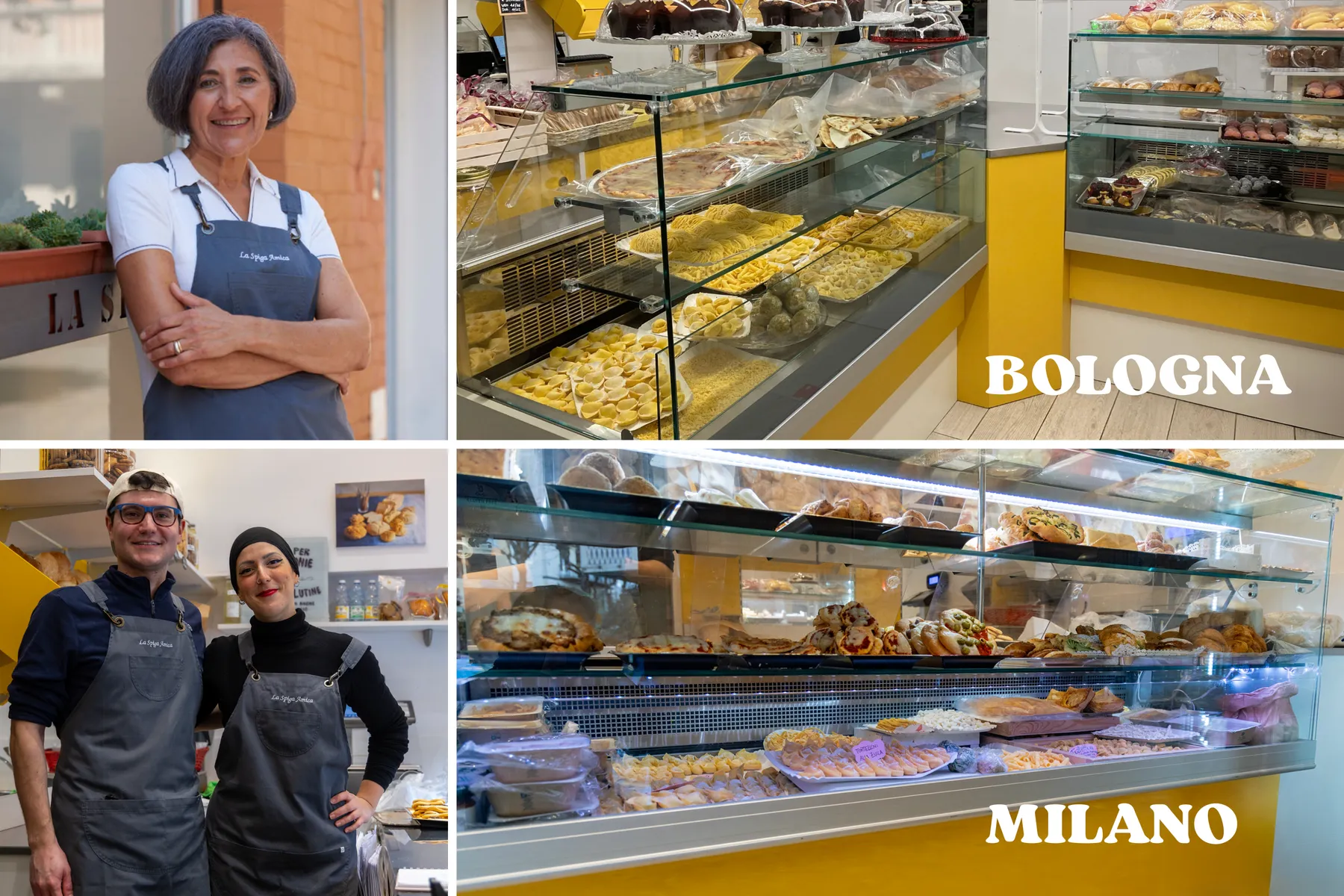
In 2014, in Bologna, that intimate experience assumed a concrete form: the atelier was born. Not as a simple business, but as an act of sanctuary. For celiac disease, within the Saglioni household, did not remain an isolated narrative: it also touched her three children. Thus, the urgency transformed into a sacred mission: kneading by hand the bread, pasta, and heritage pastries in their gluten-free variations, so that no one u2014 at the banquet of life u2014 should ever again feel like a "guest" or, worse, an "exception," an "exile."
From that moment, the evolution was swift yet harmonious: the project flourished without surrendering its soul. Following the consolidation of the Bolognese temple of taste, Milan beckoned in 2019: a second boutique, replenished daily with fresh epicurean creations departing at dawn from Emilia, like a daily bridge between the cradle of origin and the metropolis. Today, the brigade exceeds ten artisans, and remains a deeply familial affair thanks to the constant presence of Pietro, Antonellau2019s second-born: for certain enterprises, to sustain themselves, require masterly technique u2014 but to endure, they demand blood, heritage, and profound devotion.
alchemy
To craft fresh pasta without the embrace of gluten is no mere "adaptation"; it is an exercise in equilibrium, a delicate domestic physics. The dough, bereft of that elastic scaffolding that typically sustains the sheet, risks tearing, crumbling, a fragile surrender.
Here, the remedy lies not in disguise, but in architecture: eggs serve as essential support (and a mark of identity, for a pasta that strives to remain truly "fresh"), alongside a meticulously designed blend of gluten-free flours, yielding a sheet that yields to stretching, sealing, and sculpting.
The result is a pasta that, upon cooking, demands no indulgence; its temperament and yield rival those of traditional fresh pasta. Above all, it does not forfeit the ultimate grace: the sensory experience. That gentle toothsomeness, that structural integrity that allows the filling to remain a promise—not an escape.
The recipe collection draws from the ancestral heritage of the home: rustic, genuine creations of "grandma’s" lineage, thoughtfully reimagined for the gluten-free kitchen—not to mimic, but to reclaim.
Tortellini: the very heart of the home, the clearest emblem of a tradition worthily restored; then Tortelloni, highly coveted, with an explicit devotion to the pumpkin-filled variant; and Balanzoni: a signature of identity—green pasta pockets cradling ricotta and the opulent filling of the tortellino.
The parade continues with "broth classics" such as Passatelli and Zuppa Imperiale, designed to recreate the culinary lexicon of family Sundays. Naturally, there is no shortage of Lasagna al ragù (often offered in its golden pasta variation) and Rosette filled with ham, possessing that comforting charm of a kitchen that "knows no haste."
Lastly, a selection of leavened creations: here, the alchemy becomes almost civil, addressing one of the most painful voids for those with celiac disease: artisanal fresh bread. Pullman loaves and tender rolls transform from mere products into a daily embrace.
provenance
final heritages


genesis
There are endeavors that do not emerge from a mere "niche," but from an urgent, physiological necessity: that of restoring to the table what a diagnosis would seem to snatch away 'ex abrupto' u2014 the ritual, the Sunday gathering, pasta as a shared familial vocabulary. Rediscovered flavor is precisely this: an artisanal atelier that does not merely "compensate" for tradition, but restores it to circulation, without exile or shortcut.
The stage is set long before 2014. It begins in 1995, when Antonella Saglioni discovered she was celiac, in an era when celiac disease was almost a language without a dictionary: a scarce few products u2014 often flavorless and pedestrian u2014 subsidized by the state and found only in pharmacies.
In 2014, in Bologna, that intimate experience assumed a concrete form: the atelier was born. Not as a simple business, but as an act of sanctuary. For celiac disease, within the Saglioni household, did not remain an isolated narrative: it also touched her three children. Thus, the urgency transformed into a sacred mission: kneading by hand the bread, pasta, and heritage pastries in their gluten-free variations, so that no one u2014 at the banquet of life u2014 should ever again feel like a "guest" or, worse, an "exception," an "exile."
From that moment, the evolution was swift yet harmonious: the project flourished without surrendering its soul. Following the consolidation of the Bolognese temple of taste, Milan beckoned in 2019: a second boutique, replenished daily with fresh epicurean creations departing at dawn from Emilia, like a daily bridge between the cradle of origin and the metropolis. Today, the brigade exceeds ten artisans, and remains a deeply familial affair thanks to the constant presence of Pietro, Antonellau2019s second-born: for certain enterprises, to sustain themselves, require masterly technique u2014 but to endure, they demand blood, heritage, and profound devotion.
alchemy
To craft fresh pasta without the embrace of gluten is no mere "adaptation"; it is an exercise in equilibrium, a delicate domestic physics. The dough, bereft of that elastic scaffolding that typically sustains the sheet, risks tearing, crumbling, a fragile surrender.
Here, the remedy lies not in disguise, but in architecture: eggs serve as essential support (and a mark of identity, for a pasta that strives to remain truly "fresh"), alongside a meticulously designed blend of gluten-free flours, yielding a sheet that yields to stretching, sealing, and sculpting.
The result is a pasta that, upon cooking, demands no indulgence; its temperament and yield rival those of traditional fresh pasta. Above all, it does not forfeit the ultimate grace: the sensory experience. That gentle toothsomeness, that structural integrity that allows the filling to remain a promise—not an escape.
The recipe collection draws from the ancestral heritage of the home: rustic, genuine creations of "grandma’s" lineage, thoughtfully reimagined for the gluten-free kitchen—not to mimic, but to reclaim.
Tortellini: the very heart of the home, the clearest emblem of a tradition worthily restored; then Tortelloni, highly coveted, with an explicit devotion to the pumpkin-filled variant; and Balanzoni: a signature of identity—green pasta pockets cradling ricotta and the opulent filling of the tortellino.
The parade continues with "broth classics" such as Passatelli and Zuppa Imperiale, designed to recreate the culinary lexicon of family Sundays. Naturally, there is no shortage of Lasagna al ragù (often offered in its golden pasta variation) and Rosette filled with ham, possessing that comforting charm of a kitchen that "knows no haste."
Lastly, a selection of leavened creations: here, the alchemy becomes almost civil, addressing one of the most painful voids for those with celiac disease: artisanal fresh bread. Pullman loaves and tender rolls transform from mere products into a daily embrace.
provenance
final heritages
genesis
There are endeavors that do not emerge from a mere "niche," but from an urgent, physiological necessity: that of restoring to the table what a diagnosis would seem to snatch away 'ex abrupto' u2014 the ritual, the Sunday gathering, pasta as a shared familial vocabulary. Rediscovered flavor is precisely this: an artisanal atelier that does not merely "compensate" for tradition, but restores it to circulation, without exile or shortcut.
The stage is set long before 2014. It begins in 1995, when Antonella Saglioni discovered she was celiac, in an era when celiac disease was almost a language without a dictionary: a scarce few products u2014 often flavorless and pedestrian u2014 subsidized by the state and found only in pharmacies.
In 2014, in Bologna, that intimate experience assumed a concrete form: the atelier was born. Not as a simple business, but as an act of sanctuary. For celiac disease, within the Saglioni household, did not remain an isolated narrative: it also touched her three children. Thus, the urgency transformed into a sacred mission: kneading by hand the bread, pasta, and heritage pastries in their gluten-free variations, so that no one u2014 at the banquet of life u2014 should ever again feel like a "guest" or, worse, an "exception," an "exile."
From that moment, the evolution was swift yet harmonious: the project flourished without surrendering its soul. Following the consolidation of the Bolognese temple of taste, Milan beckoned in 2019: a second boutique, replenished daily with fresh epicurean creations departing at dawn from Emilia, like a daily bridge between the cradle of origin and the metropolis. Today, the brigade exceeds ten artisans, and remains a deeply familial affair thanks to the constant presence of Pietro, Antonellau2019s second-born: for certain enterprises, to sustain themselves, require masterly technique u2014 but to endure, they demand blood, heritage, and profound devotion.
alchemy
To craft fresh pasta without the embrace of gluten is no mere "adaptation"; it is an exercise in equilibrium, a delicate domestic physics. The dough, bereft of that elastic scaffolding that typically sustains the sheet, risks tearing, crumbling, a fragile surrender.
Here, the remedy lies not in disguise, but in architecture: eggs serve as essential support (and a mark of identity, for a pasta that strives to remain truly "fresh"), alongside a meticulously designed blend of gluten-free flours, yielding a sheet that yields to stretching, sealing, and sculpting.
The result is a pasta that, upon cooking, demands no indulgence; its temperament and yield rival those of traditional fresh pasta. Above all, it does not forfeit the ultimate grace: the sensory experience. That gentle toothsomeness, that structural integrity that allows the filling to remain a promise—not an escape.
The recipe collection draws from the ancestral heritage of the home: rustic, genuine creations of "grandma’s" lineage, thoughtfully reimagined for the gluten-free kitchen—not to mimic, but to reclaim.
Tortellini: the very heart of the home, the clearest emblem of a tradition worthily restored; then Tortelloni, highly coveted, with an explicit devotion to the pumpkin-filled variant; and Balanzoni: a signature of identity—green pasta pockets cradling ricotta and the opulent filling of the tortellino.
The parade continues with "broth classics" such as Passatelli and Zuppa Imperiale, designed to recreate the culinary lexicon of family Sundays. Naturally, there is no shortage of Lasagna al ragù (often offered in its golden pasta variation) and Rosette filled with ham, possessing that comforting charm of a kitchen that "knows no haste."
Lastly, a selection of leavened creations: here, the alchemy becomes almost civil, addressing one of the most painful voids for those with celiac disease: artisanal fresh bread. Pullman loaves and tender rolls transform from mere products into a daily embrace.