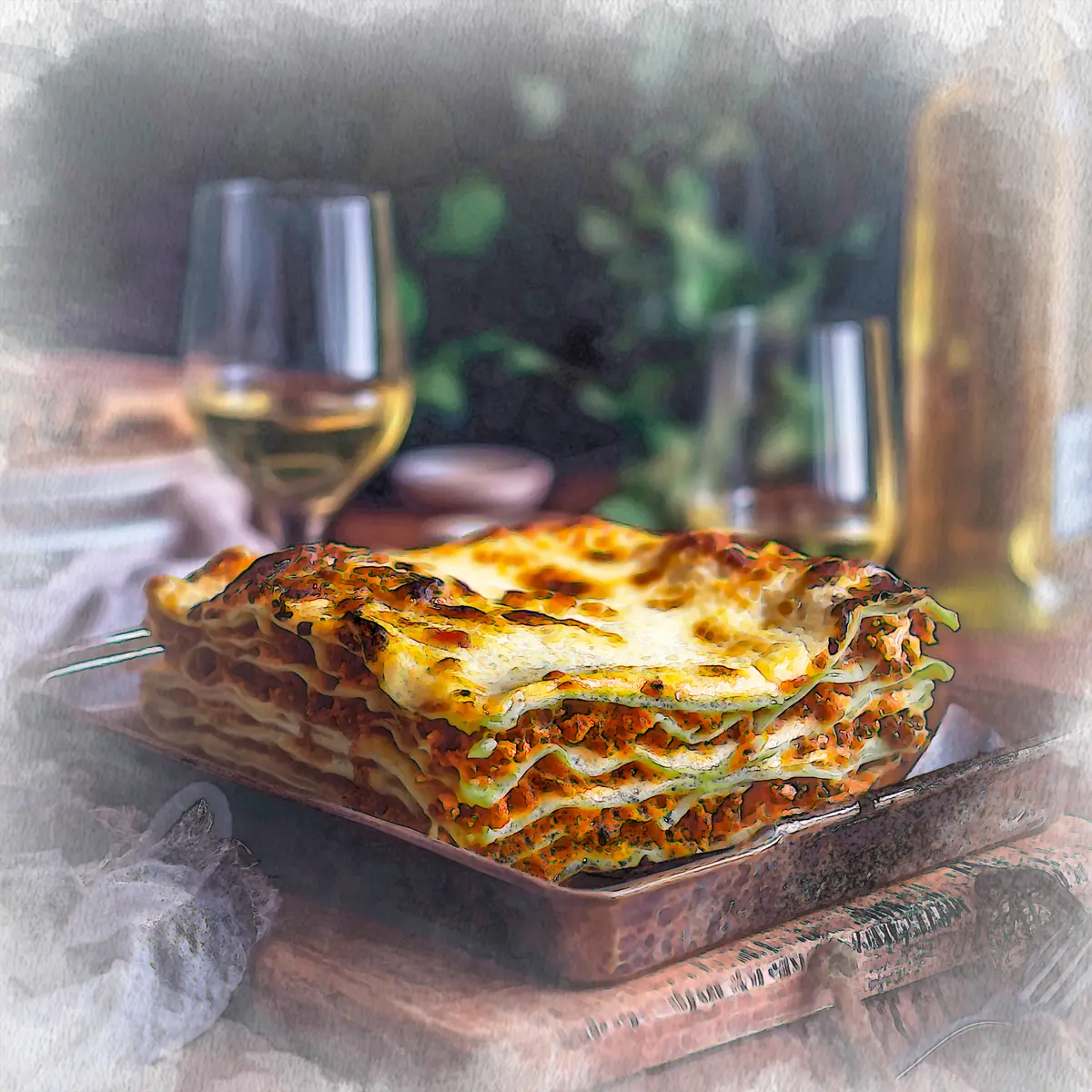
BOLOGNESE LASAGNA
Meat, Pancetta, Tomato purée, Parmigiano Reggiano, Milk, Butter, Flour, Eggs.
A demanding pursuit
Emilia-Romagna
240 minutes
800 Calories
BOLOGNESE LASAGNA
Meat, Pancetta, Tomato purée, Parmigiano Reggiano, Milk, Butter, Flour, Eggs.
A demanding pursuit
Emilia-Romagna
240 minutes
800 Calories
BOLOGNESE LASAGNA
Meat, Pancetta, Tomato purée, Parmigiano Reggiano, Milk, Butter, Flour, Eggs.
A demanding pursuit
Emilia-Romagna
240 minutes
800 Calories
GENESIS
Lasagne alla Bolognese stands as an timeless icon of Emilian and Italian gastronomy upon the global stage. Its lineage traces its roots back to an antiquity long past, with evidence of kindred culinary creations already present in ancient Rome, where the "laganum" was a sheet of pasta ribboned and cut. Nonetheless, the masterpiece we cherish and revere today is indissolubilmente bound to the city of Bologna and its opulent culinary heritage, most notably in its devotion to fresh egg pasta and the sumptuous ragu00f9.
The marriage of the golden, porous pasta sheet, rolled delicately by hand, with the robust, savory ragu00f9 that simmers gently for hours, and the velvety embrace of the bu00e9chamel, composes a dish of unparalleled richness and sublime complexity. Though countless regional iterations of lasagna grace the Italian peninsula, the Bolognese rendition distinguishes itself through a profound balance and depth of flavor, codified by the Italian Academy of Cuisine, which enshrined its official recipe at the Bologna Chamber of Commerce in 2003 to safeguard its sacred authenticity.
Its preparation is a sacred ritual demanding time and devotionu2014an act of love bestowed upon the culinary arts and those we cherish. From the slow-sweating of the mirepoix and the languid simmering of the ragu00f9, to the creation of a smooth, silken bu00e9chamel, unto the stretching of the delicate pasta sheets and the assembly, layer by layer, each gesture conspires to forge a culinary masterpiece. This work of art achieves its zenith in the oven, where flavors melt into perfect symphony and the surface gratinates to golden perfection. Lasagne alla Bolognese is not merely a dish, but a sensory odyssey that sings of conviviality, heritage, and the warmth of the domestic hearth. Perfect for grand occasions or the sacred family gathering of a Sunday feast, it is a comforting embrace, destined to captivate the soul at the very first taste.
PORTIONS (FOR 4 PERSONS)
FOR THE PASTA
Flour 00
Medium eggs
Spinach
400 g
3
150 g
FOR THE EMBELLISHMENT
Minced beef of noble lineage
Fresh pork belly, rich and sweet
Golden carrot of the earth
Celery, crisp and green
Saffron-hued onion
Sieved sun-ripened tomatoes
Concentrated tomato extract
Robust dry red wine
Nourishing broth of meat or herbage
Extra virgin olive oil, liquid gold
Pure salt
Freshly cracked black pepper
300 g
150 g
50 g
50 g
50 g
300 g
1 tablespoon
150 ml
100 ml
to taste
to taste
to taste
FOR THE VELVET BECHAMEL
Whole milk
Butter
Flour 00
Salt
Nutmeg
1 Liter
80 g
80 g
to taste
to taste
FOR THE COMPOSITION
Grated Parmigiano Reggiano
Butter
150 g
to taste
CURATION
For the Bolognese Ragù:
Begin by composing the ragù, for it demands the longest, most patient simmer to reach perfection. Finely mince the carrot, celery, and onion to fashion a classic mirepoix, the aromatic foundation of Italian heritage. Dice the pancetta into exquisite, minute cubes, or mince it finely with a knife. In a spacious casserole dish (ideally crafted of terracotta or cast iron), warm a generous swirl of extra virgin olive oil. Introduce the pancetta, allowing it to render gently and release its rich virtues until lightly gilded and crisp. Add the minced aromatics and sweat over a gentle heat for 10-15 minutes, stirring reverently, until they are tender and translucent.
Now, introduce the minced meats. Sear them over a more spirited flame, breaking the crown of the meat apart with a wooden spoon, until it has assumed a rich, sealed color of roasted perfection. Deglaze the pan with red wine, allowing the spirited alcools to evaporate entirely into the ether. Strew in the double-concentrated tomato paste, stirring to dissolve its deep essence. Pour in the pureed tomatoes and warm, nurturing broth (or hot water). Season with salt and pepper to taste. Bring the ragù to an elegant simmer, then reduce the flame to its absolute minimum; cover, and allow the alchemy to unfold slowly for at least 2-3 hours (ideally 3-4 hours), stirring occasionally. The ragù must emerge thick and majestic. Should it dry during its long slumber, revive it with a touch more warm broth or water. Taste, and adjust the seasoning with salt and pepper before lifting it from the flame.For the Béchamel:
While the ragù is deep in its slow reverie, turn your spirit to the creation of the béchamel. In a small saucepan, melt the butter over gentle heat. Withdraw the pan from the flame and introduce the flour all at once, whisking vigorously to forge a smooth, flawless paste known as a "roux". Return the pan to a low heat and toast the roux for a few moments, stirring continuously, without allowing it to take on color. Meanwhile, warm the milk in a separate vessel, stopping just short of a boil.
Pour the warm milk onto the roux in several stages, whisking with persistent vigor to banish any potential lumps. Bring the béchamel to a slow boil over gentle heat, stirring constantly, as it ascends to its velvet potential. As it begins to thicken, whisper the heat even lower and cook for 2-3 minutes until it attains the perfect density (it must be silky and enrobing, never watery). Season with salt and a generous rasp of freshly grated nutmeg. Remove from the fire and press plastic film directly onto the surface to prevent a skin from forming upon its smooth face.For the Fresh Pasta:
Boil the spinach, squeeze out every drop of moisture with absolute care, and purée it in a mixer until perfectly smooth. Upon a wooden work surface, shape the flour into a majestic mound, creating a well at its heart. Crack the eggs into the center and add the vibrant spinach purée. With a fork, gently whisk the eggs and spinach, gradually carrying down the flour from the inner walls. As the mass gains body, begin to knead with your hands, working with vigor for about 10-15 minutes, until you obtain a smooth, elastic, and harmonious dough. Envelop the dough in plastic wrap and leave it to rest at room temperature for at least 30 minutes to ease its gluten tension.
Once rested, divide the dough into smaller portions. Lightly dust the board and each portion with flour. Sheet each portion with a rolling pin or a pasta machine, drawing out thin, delicate veils of pasta (about 1 mm thick). Cut these sheets into rectangles aligned with the dimensions of your baking dish. Bring a pot of lightly salted water to a boil; immerse the sheets one by one for 30-40 seconds, lift them with a skimmer, and transfer them to a dry cloth to gently blot away the water and lay them side by side.For the Assembly and Baking:
Preheat the oven to 180°C (static). Generously butter the bottom and sides of an artisanal baking dish. Spread a thin, guiding layer of veloute-besciamella over the base. Lay down a sheet of fresh pasta (trimming it with care to fit the dish, if necessary). Drape the pasta in a luxurious layer of Bolognese ragù, followed by a ribbon of béchamel and a lavish snowfall of grated Parmigiano Reggiano.
Continue this ritual, alternating the layers with intent: pasta, ragù, béchamel, and Parmigiano. Carry on until all components have yielded their essence, crowning the final layer with béchamel and a magnificent dusting of Parmigiano Reggiano. You may dot the crown with a few pearls of butter to encourage a perfect, gilded gratin.
Bake the lasagne in the preheated oven for 30-40 minutes, until the top is beautifully gratinéed and the juices bubble merrily at the edges, singing of comfort. If the crust begins to color too quickly, gently shield it with foil during the final moments of baking.
Once fully realized, withdraw the lasagne from the oven and let it rest for at least 10-15 minutes before carving and presenting. This brief repose allows the flavors to settle into a harmonious whole and makes portioning an act of elegance.
aspiration
For an even more deeply flavorful ragù, you may introduce a small treasury of finely minced chicken livers into the sofrito at the very inception of the cooking.
You may prepare both the ragù and the béchamel in advance, letting them rest in the cold depths of the refrigerator. In this manner, the final assembly of the lasagna becomes a swift, seamless choreography.
Do not be sparing with the Parmigiano Reggiano; it is the vital essence for both the depth of flavor and the golden, transcendent crust.
Tradition dictates that the layers must number exactly seven.


GENESIS
Lasagne alla Bolognese stands as an timeless icon of Emilian and Italian gastronomy upon the global stage. Its lineage traces its roots back to an antiquity long past, with evidence of kindred culinary creations already present in ancient Rome, where the "laganum" was a sheet of pasta ribboned and cut. Nonetheless, the masterpiece we cherish and revere today is indissolubilmente bound to the city of Bologna and its opulent culinary heritage, most notably in its devotion to fresh egg pasta and the sumptuous ragu00f9.
The marriage of the golden, porous pasta sheet, rolled delicately by hand, with the robust, savory ragu00f9 that simmers gently for hours, and the velvety embrace of the bu00e9chamel, composes a dish of unparalleled richness and sublime complexity. Though countless regional iterations of lasagna grace the Italian peninsula, the Bolognese rendition distinguishes itself through a profound balance and depth of flavor, codified by the Italian Academy of Cuisine, which enshrined its official recipe at the Bologna Chamber of Commerce in 2003 to safeguard its sacred authenticity.
Its preparation is a sacred ritual demanding time and devotionu2014an act of love bestowed upon the culinary arts and those we cherish. From the slow-sweating of the mirepoix and the languid simmering of the ragu00f9, to the creation of a smooth, silken bu00e9chamel, unto the stretching of the delicate pasta sheets and the assembly, layer by layer, each gesture conspires to forge a culinary masterpiece. This work of art achieves its zenith in the oven, where flavors melt into perfect symphony and the surface gratinates to golden perfection. Lasagne alla Bolognese is not merely a dish, but a sensory odyssey that sings of conviviality, heritage, and the warmth of the domestic hearth. Perfect for grand occasions or the sacred family gathering of a Sunday feast, it is a comforting embrace, destined to captivate the soul at the very first taste.
PORTIONS (FOR 4 PERSONS)
FOR THE PASTA
Flour 00
Medium eggs
Spinach
400 g
3
150 g
FOR THE EMBELLISHMENT
Minced beef of noble lineage
Fresh pork belly, rich and sweet
Golden carrot of the earth
Celery, crisp and green
Saffron-hued onion
Sieved sun-ripened tomatoes
Concentrated tomato extract
Robust dry red wine
Nourishing broth of meat or herbage
Extra virgin olive oil, liquid gold
Pure salt
Freshly cracked black pepper
300 g
150 g
50 g
50 g
50 g
300 g
1 tablespoon
150 ml
100 ml
to taste
to taste
to taste
FOR THE VELVET BECHAMEL
Whole milk
Butter
Flour 00
Salt
Nutmeg
1 Liter
80 g
80 g
to taste
to taste
FOR THE COMPOSITION
Grated Parmigiano Reggiano
Butter
150 g
to taste
CURATION
For the Bolognese Ragù:
Begin by composing the ragù, for it demands the longest, most patient simmer to reach perfection. Finely mince the carrot, celery, and onion to fashion a classic mirepoix, the aromatic foundation of Italian heritage. Dice the pancetta into exquisite, minute cubes, or mince it finely with a knife. In a spacious casserole dish (ideally crafted of terracotta or cast iron), warm a generous swirl of extra virgin olive oil. Introduce the pancetta, allowing it to render gently and release its rich virtues until lightly gilded and crisp. Add the minced aromatics and sweat over a gentle heat for 10-15 minutes, stirring reverently, until they are tender and translucent.
Now, introduce the minced meats. Sear them over a more spirited flame, breaking the crown of the meat apart with a wooden spoon, until it has assumed a rich, sealed color of roasted perfection. Deglaze the pan with red wine, allowing the spirited alcools to evaporate entirely into the ether. Strew in the double-concentrated tomato paste, stirring to dissolve its deep essence. Pour in the pureed tomatoes and warm, nurturing broth (or hot water). Season with salt and pepper to taste. Bring the ragù to an elegant simmer, then reduce the flame to its absolute minimum; cover, and allow the alchemy to unfold slowly for at least 2-3 hours (ideally 3-4 hours), stirring occasionally. The ragù must emerge thick and majestic. Should it dry during its long slumber, revive it with a touch more warm broth or water. Taste, and adjust the seasoning with salt and pepper before lifting it from the flame.For the Béchamel:
While the ragù is deep in its slow reverie, turn your spirit to the creation of the béchamel. In a small saucepan, melt the butter over gentle heat. Withdraw the pan from the flame and introduce the flour all at once, whisking vigorously to forge a smooth, flawless paste known as a "roux". Return the pan to a low heat and toast the roux for a few moments, stirring continuously, without allowing it to take on color. Meanwhile, warm the milk in a separate vessel, stopping just short of a boil.
Pour the warm milk onto the roux in several stages, whisking with persistent vigor to banish any potential lumps. Bring the béchamel to a slow boil over gentle heat, stirring constantly, as it ascends to its velvet potential. As it begins to thicken, whisper the heat even lower and cook for 2-3 minutes until it attains the perfect density (it must be silky and enrobing, never watery). Season with salt and a generous rasp of freshly grated nutmeg. Remove from the fire and press plastic film directly onto the surface to prevent a skin from forming upon its smooth face.For the Fresh Pasta:
Boil the spinach, squeeze out every drop of moisture with absolute care, and purée it in a mixer until perfectly smooth. Upon a wooden work surface, shape the flour into a majestic mound, creating a well at its heart. Crack the eggs into the center and add the vibrant spinach purée. With a fork, gently whisk the eggs and spinach, gradually carrying down the flour from the inner walls. As the mass gains body, begin to knead with your hands, working with vigor for about 10-15 minutes, until you obtain a smooth, elastic, and harmonious dough. Envelop the dough in plastic wrap and leave it to rest at room temperature for at least 30 minutes to ease its gluten tension.
Once rested, divide the dough into smaller portions. Lightly dust the board and each portion with flour. Sheet each portion with a rolling pin or a pasta machine, drawing out thin, delicate veils of pasta (about 1 mm thick). Cut these sheets into rectangles aligned with the dimensions of your baking dish. Bring a pot of lightly salted water to a boil; immerse the sheets one by one for 30-40 seconds, lift them with a skimmer, and transfer them to a dry cloth to gently blot away the water and lay them side by side.For the Assembly and Baking:
Preheat the oven to 180°C (static). Generously butter the bottom and sides of an artisanal baking dish. Spread a thin, guiding layer of veloute-besciamella over the base. Lay down a sheet of fresh pasta (trimming it with care to fit the dish, if necessary). Drape the pasta in a luxurious layer of Bolognese ragù, followed by a ribbon of béchamel and a lavish snowfall of grated Parmigiano Reggiano.
Continue this ritual, alternating the layers with intent: pasta, ragù, béchamel, and Parmigiano. Carry on until all components have yielded their essence, crowning the final layer with béchamel and a magnificent dusting of Parmigiano Reggiano. You may dot the crown with a few pearls of butter to encourage a perfect, gilded gratin.
Bake the lasagne in the preheated oven for 30-40 minutes, until the top is beautifully gratinéed and the juices bubble merrily at the edges, singing of comfort. If the crust begins to color too quickly, gently shield it with foil during the final moments of baking.
Once fully realized, withdraw the lasagne from the oven and let it rest for at least 10-15 minutes before carving and presenting. This brief repose allows the flavors to settle into a harmonious whole and makes portioning an act of elegance.
aspiration
For an even more deeply flavorful ragù, you may introduce a small treasury of finely minced chicken livers into the sofrito at the very inception of the cooking.
You may prepare both the ragù and the béchamel in advance, letting them rest in the cold depths of the refrigerator. In this manner, the final assembly of the lasagna becomes a swift, seamless choreography.
Do not be sparing with the Parmigiano Reggiano; it is the vital essence for both the depth of flavor and the golden, transcendent crust.
Tradition dictates that the layers must number exactly seven.
latest culinary creations
GENESIS
Lasagne alla Bolognese stands as an timeless icon of Emilian and Italian gastronomy upon the global stage. Its lineage traces its roots back to an antiquity long past, with evidence of kindred culinary creations already present in ancient Rome, where the "laganum" was a sheet of pasta ribboned and cut. Nonetheless, the masterpiece we cherish and revere today is indissolubilmente bound to the city of Bologna and its opulent culinary heritage, most notably in its devotion to fresh egg pasta and the sumptuous ragu00f9.
The marriage of the golden, porous pasta sheet, rolled delicately by hand, with the robust, savory ragu00f9 that simmers gently for hours, and the velvety embrace of the bu00e9chamel, composes a dish of unparalleled richness and sublime complexity. Though countless regional iterations of lasagna grace the Italian peninsula, the Bolognese rendition distinguishes itself through a profound balance and depth of flavor, codified by the Italian Academy of Cuisine, which enshrined its official recipe at the Bologna Chamber of Commerce in 2003 to safeguard its sacred authenticity.
Its preparation is a sacred ritual demanding time and devotionu2014an act of love bestowed upon the culinary arts and those we cherish. From the slow-sweating of the mirepoix and the languid simmering of the ragu00f9, to the creation of a smooth, silken bu00e9chamel, unto the stretching of the delicate pasta sheets and the assembly, layer by layer, each gesture conspires to forge a culinary masterpiece. This work of art achieves its zenith in the oven, where flavors melt into perfect symphony and the surface gratinates to golden perfection. Lasagne alla Bolognese is not merely a dish, but a sensory odyssey that sings of conviviality, heritage, and the warmth of the domestic hearth. Perfect for grand occasions or the sacred family gathering of a Sunday feast, it is a comforting embrace, destined to captivate the soul at the very first taste.
PORTIONS (FOR 4 PERSONS)
FOR THE PASTA
Flour 00
Medium eggs
Spinach
400 g
3
150 g
FOR THE EMBELLISHMENT
Minced beef of noble lineage
Fresh pork belly, rich and sweet
Golden carrot of the earth
Celery, crisp and green
Saffron-hued onion
Sieved sun-ripened tomatoes
Concentrated tomato extract
Robust dry red wine
Nourishing broth of meat or herbage
Extra virgin olive oil, liquid gold
Pure salt
Freshly cracked black pepper
300 g
150 g
50 g
50 g
50 g
300 g
1 tablespoon
150 ml
100 ml
to taste
to taste
to taste
FOR THE VELVET BECHAMEL
Whole milk
Butter
Flour 00
Salt
Nutmeg
1 Liter
80 g
80 g
to taste
to taste
FOR THE COMPOSITION
Grated Parmigiano Reggiano
Butter
150 g
to taste
CURATION
For the Bolognese Ragù:
Begin by composing the ragù, for it demands the longest, most patient simmer to reach perfection. Finely mince the carrot, celery, and onion to fashion a classic mirepoix, the aromatic foundation of Italian heritage. Dice the pancetta into exquisite, minute cubes, or mince it finely with a knife. In a spacious casserole dish (ideally crafted of terracotta or cast iron), warm a generous swirl of extra virgin olive oil. Introduce the pancetta, allowing it to render gently and release its rich virtues until lightly gilded and crisp. Add the minced aromatics and sweat over a gentle heat for 10-15 minutes, stirring reverently, until they are tender and translucent.
Now, introduce the minced meats. Sear them over a more spirited flame, breaking the crown of the meat apart with a wooden spoon, until it has assumed a rich, sealed color of roasted perfection. Deglaze the pan with red wine, allowing the spirited alcools to evaporate entirely into the ether. Strew in the double-concentrated tomato paste, stirring to dissolve its deep essence. Pour in the pureed tomatoes and warm, nurturing broth (or hot water). Season with salt and pepper to taste. Bring the ragù to an elegant simmer, then reduce the flame to its absolute minimum; cover, and allow the alchemy to unfold slowly for at least 2-3 hours (ideally 3-4 hours), stirring occasionally. The ragù must emerge thick and majestic. Should it dry during its long slumber, revive it with a touch more warm broth or water. Taste, and adjust the seasoning with salt and pepper before lifting it from the flame.For the Béchamel:
While the ragù is deep in its slow reverie, turn your spirit to the creation of the béchamel. In a small saucepan, melt the butter over gentle heat. Withdraw the pan from the flame and introduce the flour all at once, whisking vigorously to forge a smooth, flawless paste known as a "roux". Return the pan to a low heat and toast the roux for a few moments, stirring continuously, without allowing it to take on color. Meanwhile, warm the milk in a separate vessel, stopping just short of a boil.
Pour the warm milk onto the roux in several stages, whisking with persistent vigor to banish any potential lumps. Bring the béchamel to a slow boil over gentle heat, stirring constantly, as it ascends to its velvet potential. As it begins to thicken, whisper the heat even lower and cook for 2-3 minutes until it attains the perfect density (it must be silky and enrobing, never watery). Season with salt and a generous rasp of freshly grated nutmeg. Remove from the fire and press plastic film directly onto the surface to prevent a skin from forming upon its smooth face.For the Fresh Pasta:
Boil the spinach, squeeze out every drop of moisture with absolute care, and purée it in a mixer until perfectly smooth. Upon a wooden work surface, shape the flour into a majestic mound, creating a well at its heart. Crack the eggs into the center and add the vibrant spinach purée. With a fork, gently whisk the eggs and spinach, gradually carrying down the flour from the inner walls. As the mass gains body, begin to knead with your hands, working with vigor for about 10-15 minutes, until you obtain a smooth, elastic, and harmonious dough. Envelop the dough in plastic wrap and leave it to rest at room temperature for at least 30 minutes to ease its gluten tension.
Once rested, divide the dough into smaller portions. Lightly dust the board and each portion with flour. Sheet each portion with a rolling pin or a pasta machine, drawing out thin, delicate veils of pasta (about 1 mm thick). Cut these sheets into rectangles aligned with the dimensions of your baking dish. Bring a pot of lightly salted water to a boil; immerse the sheets one by one for 30-40 seconds, lift them with a skimmer, and transfer them to a dry cloth to gently blot away the water and lay them side by side.For the Assembly and Baking:
Preheat the oven to 180°C (static). Generously butter the bottom and sides of an artisanal baking dish. Spread a thin, guiding layer of veloute-besciamella over the base. Lay down a sheet of fresh pasta (trimming it with care to fit the dish, if necessary). Drape the pasta in a luxurious layer of Bolognese ragù, followed by a ribbon of béchamel and a lavish snowfall of grated Parmigiano Reggiano.
Continue this ritual, alternating the layers with intent: pasta, ragù, béchamel, and Parmigiano. Carry on until all components have yielded their essence, crowning the final layer with béchamel and a magnificent dusting of Parmigiano Reggiano. You may dot the crown with a few pearls of butter to encourage a perfect, gilded gratin.
Bake the lasagne in the preheated oven for 30-40 minutes, until the top is beautifully gratinéed and the juices bubble merrily at the edges, singing of comfort. If the crust begins to color too quickly, gently shield it with foil during the final moments of baking.
Once fully realized, withdraw the lasagne from the oven and let it rest for at least 10-15 minutes before carving and presenting. This brief repose allows the flavors to settle into a harmonious whole and makes portioning an act of elegance.
aspiration
For an even more deeply flavorful ragù, you may introduce a small treasury of finely minced chicken livers into the sofrito at the very inception of the cooking.
You may prepare both the ragù and the béchamel in advance, letting them rest in the cold depths of the refrigerator. In this manner, the final assembly of the lasagna becomes a swift, seamless choreography.
Do not be sparing with the Parmigiano Reggiano; it is the vital essence for both the depth of flavor and the golden, transcendent crust.
Tradition dictates that the layers must number exactly seven.