READINGS OF PASTA: A LITERARY CHRONICLE
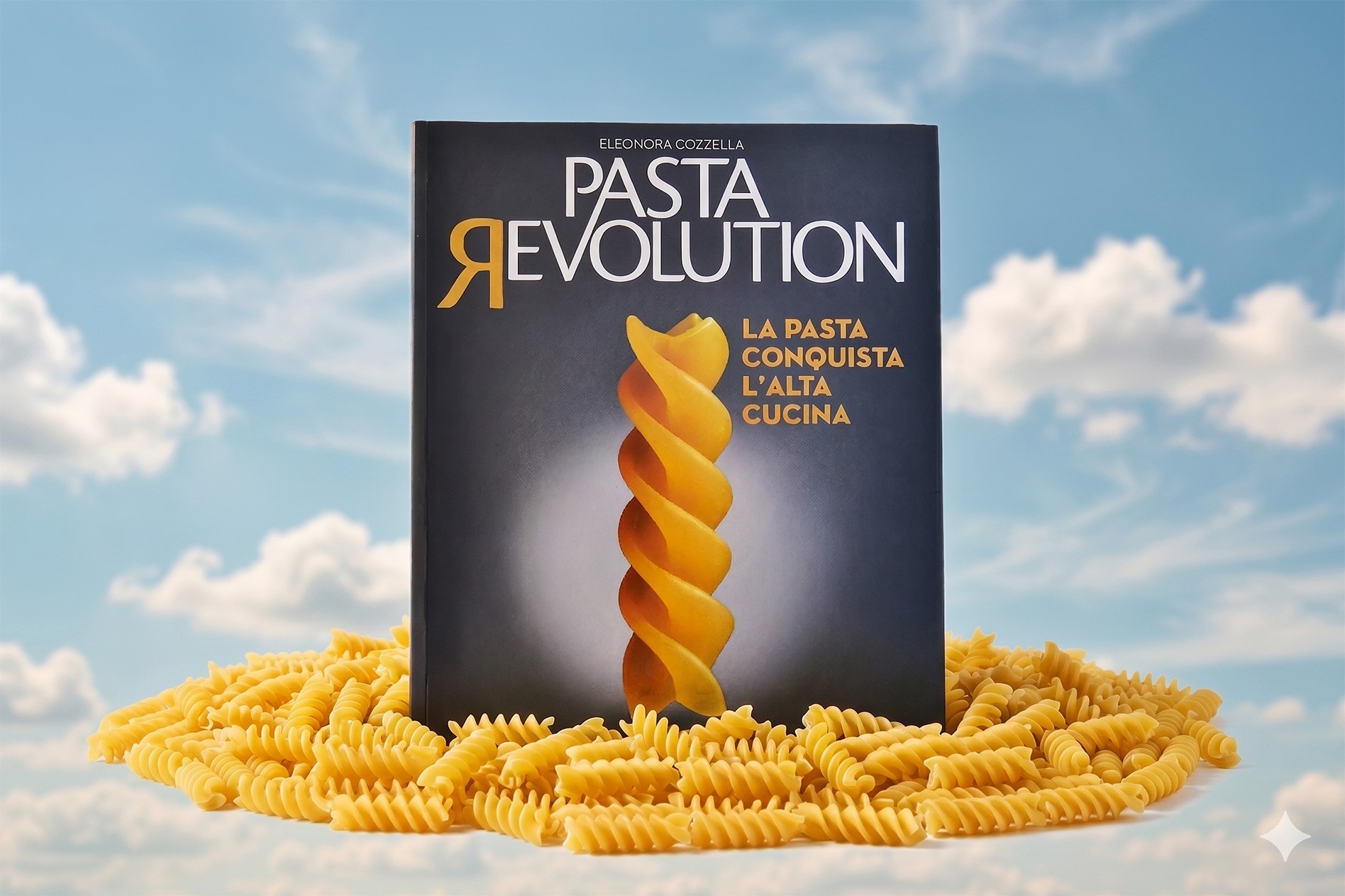
Eleonora Cozzella, Pasta Revolution. Pasta conquers haute cuisine (Giunti Editore, 160 pp)
May 16, 2026
READINGS OF PASTA: A LITERARY CHRONICLE
Eleonora Cozzella, Pasta Revolution. Pasta conquers haute cuisine (Giunti Editore, 160 pp)
May 16, 2026
READINGS OF PASTA: A LITERARY CHRONICLE
Eleonora Cozzella, Pasta Revolution. Pasta conquers haute cuisine (Giunti Editore, 160 pp)
May 16, 2026
Within the vast, and at times overdrawn, repertoire of pasta as domestic geography and an icon of Italian cuisine, there exist texts that choose to observe it from another threshold: that of technique, of gesture, and of the chefu2019s relentless quest.
Pasta Revolution by Eleonora Cozzella inhabits precisely this fertile territory. It perceives pasta at the exact moment it ceases to be merely a first course and becomes the medium of haute cuisine, an authorial elocution, a field of intellectual inquiry.
It is a volume that weaves culinary culture with contemporary vision, demonstrating how an apparently simple foodstuff can reveal itself as a complex form. Shape, cooking, texture, condiment, temperature, and service converge to weave a new and fascinating mantle for pasta, capable of inhabiting both memory and avant-garde experimentation.
The primary merit of the book lies, perhaps, in its very point of observation. The author does not sever the pasta of tradition from that of the master chefs, nor does she oppose the domestic hearth to the restaurant. On the contrary, she reveals how haute cuisine can render legible that which daily life tends to take for granted as routine gesture. Behind a single strand of spaghetti, a raviolo, a die cut, or a cooking method, a precise grammar is revealed: one of care, measure, materiality, and an elevated sense of taste.
Yet Pasta Revolution never reduces pasta to a crystallized, cerebral exercise for its own sake. Its modernity is born not of provocation, but of listening. Pasta is interrogated without being denatured, drawn into the authoru2019s domain without losing its collective belonging.
It is perhaps here, too, that the book finds its strength: in narrating a quiet revolution, not in opposition to tradition, but intricately knotted within tradition itself.
For pasta, when it enters the realm of haute cuisine, does not cease to be memory. Quite simply, it begins "to contemplate itself".


Within the vast, and at times overdrawn, repertoire of pasta as domestic geography and an icon of Italian cuisine, there exist texts that choose to observe it from another threshold: that of technique, of gesture, and of the chefu2019s relentless quest.
Pasta Revolution by Eleonora Cozzella inhabits precisely this fertile territory. It perceives pasta at the exact moment it ceases to be merely a first course and becomes the medium of haute cuisine, an authorial elocution, a field of intellectual inquiry.
It is a volume that weaves culinary culture with contemporary vision, demonstrating how an apparently simple foodstuff can reveal itself as a complex form. Shape, cooking, texture, condiment, temperature, and service converge to weave a new and fascinating mantle for pasta, capable of inhabiting both memory and avant-garde experimentation.
The primary merit of the book lies, perhaps, in its very point of observation. The author does not sever the pasta of tradition from that of the master chefs, nor does she oppose the domestic hearth to the restaurant. On the contrary, she reveals how haute cuisine can render legible that which daily life tends to take for granted as routine gesture. Behind a single strand of spaghetti, a raviolo, a die cut, or a cooking method, a precise grammar is revealed: one of care, measure, materiality, and an elevated sense of taste.
Yet Pasta Revolution never reduces pasta to a crystallized, cerebral exercise for its own sake. Its modernity is born not of provocation, but of listening. Pasta is interrogated without being denatured, drawn into the authoru2019s domain without losing its collective belonging.
It is perhaps here, too, that the book finds its strength: in narrating a quiet revolution, not in opposition to tradition, but intricately knotted within tradition itself.
For pasta, when it enters the realm of haute cuisine, does not cease to be memory. Quite simply, it begins "to contemplate itself".
Within the vast, and at times overdrawn, repertoire of pasta as domestic geography and an icon of Italian cuisine, there exist texts that choose to observe it from another threshold: that of technique, of gesture, and of the chefu2019s relentless quest.
Pasta Revolution by Eleonora Cozzella inhabits precisely this fertile territory. It perceives pasta at the exact moment it ceases to be merely a first course and becomes the medium of haute cuisine, an authorial elocution, a field of intellectual inquiry.
It is a volume that weaves culinary culture with contemporary vision, demonstrating how an apparently simple foodstuff can reveal itself as a complex form. Shape, cooking, texture, condiment, temperature, and service converge to weave a new and fascinating mantle for pasta, capable of inhabiting both memory and avant-garde experimentation.
The primary merit of the book lies, perhaps, in its very point of observation. The author does not sever the pasta of tradition from that of the master chefs, nor does she oppose the domestic hearth to the restaurant. On the contrary, she reveals how haute cuisine can render legible that which daily life tends to take for granted as routine gesture. Behind a single strand of spaghetti, a raviolo, a die cut, or a cooking method, a precise grammar is revealed: one of care, measure, materiality, and an elevated sense of taste.
Yet Pasta Revolution never reduces pasta to a crystallized, cerebral exercise for its own sake. Its modernity is born not of provocation, but of listening. Pasta is interrogated without being denatured, drawn into the authoru2019s domain without losing its collective belonging.
It is perhaps here, too, that the book finds its strength: in narrating a quiet revolution, not in opposition to tradition, but intricately knotted within tradition itself.
For pasta, when it enters the realm of haute cuisine, does not cease to be memory. Quite simply, it begins "to contemplate itself".