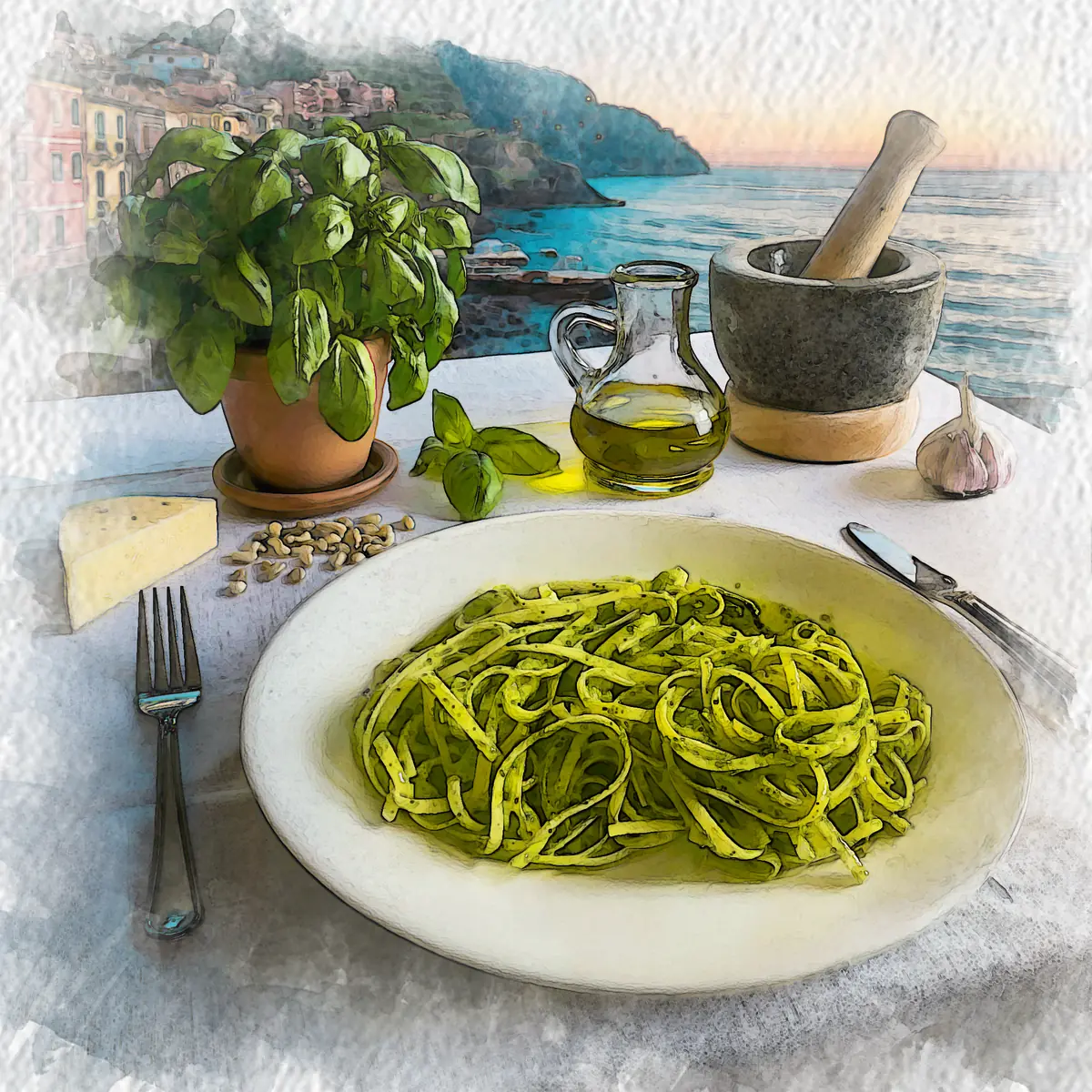
LINGUINE IN THE POETIC EMBRACE OF GENOVESE PESTO
Linguine, Sweet Basil, Pine Nuts, Garlic, Parmigiano Reggiano, Pecorino Sardo.
Moderate
Liguria
A brief span of thirty minutes
600 kcal
LINGUINE IN THE POETIC EMBRACE OF GENOVESE PESTO
Linguine, Sweet Basil, Pine Nuts, Garlic, Parmigiano Reggiano, Pecorino Sardo.
Moderate
Liguria
A brief span of thirty minutes
600 kcal
LINGUINE IN THE POETIC EMBRACE OF GENOVESE PESTO
Linguine, Sweet Basil, Pine Nuts, Garlic, Parmigiano Reggiano, Pecorino Sardo.
Moderate
Liguria
A brief span of thirty minutes
600 kcal
GENESIS
In the Middle Ages, within the rugged lands of Liguria, there spread an garlic-infused elixir known as "aggiadda" (agliata), employed to preserve cooked offerings and bestow robust flavor upon humble dishes; a simple yet potent sauce, crafted to endure long voyages across the high seas.
The advent of basil, the sovereign herb of modern pesto, blossomed much later. Hailing from the distant shores of India, it found its way to Europe and discovered in Liguria, embraced by its mild climes, an ideal sanctuary to grow lush and exquisitely fragrant, most notably in the sun-drenched terraced hills of Pru00e0, near Genoa.
The sacred formula of Pesto alla Genovese as we revere it today began to crystallize between the 18th and 19th centuries. Its first "official" codification is traced back to the gastronomic tome "La Cuciniera Genovese" by Gio Batta Ratto, published in 1863. Within those pages emerged the recipe uniting all the essential elements: basil, garlic, pine nuts, grana cheese (Parmigiano or Ligurian grana), Sardinian sheep's milk cheese (pecorino), extra virgin olive oil, and coarse sea salt, all reverently crushed in a mortar.
The ritual of the marble mortar and the wooden pestle is no mere folkloric gesture, but a precise and ancient art: the rotational grace of the pestle coaxes the essence from the basil leaves without bruising or cutting them (as modern blades would), thereby averting oxidation and preserving their pristine fragrance and brilliant emerald hue. The provenance of the other ingredients is equally vital, from the delicate, whisper-light Ligurian olive oil to the prized Genoese Basil PDO.
Pesto alla Genovese journeyed forth from the shores of Liguria to the rest of Italy and thence to the wider world, establishing itself as one of the most iconic and beloved embassies of Italian gastronomy. Its lineage narrates the evolution of a rustic culinary creation transformed through time into a masterpiece of symmetry and perfume, a living testament to the rich cultural heritage of Ligurian cuisine.
PORTIONS (FOR 4 PERSONS)
THE RECIPE
Linguine
Genoese Basil PDO
30 g of Ligurian pine nuts
Garlic
Parmigiano Reggiano PDO
Fiore Sardo Pecorino PDO
Ligurian Extra Virgin Olive Oil
Coarse sea salt
320 g
100 g of leaves
30 g
1/2 clove
45 g
15 g
approximately 100 ml
to taste
CURATION
Awaken the Pesto:
Should you choose the noble mortar, gently bathe the basil leaves and dry them with utmost care upon a pristine cloth. Place the peeled garlic cloves and a pinch of coarse salt within the mortar. Begin to crush them until they soften into a velvety cream. Introduce the pine nuts and continue your rhythmic bruising. Gradually invite the basil leaves, coaxing them with a circular motion against the marble walls until they yield and surrender their essence. Fold in the grated cheeses and, finally, pour the extra-virgin olive oil in a slender, golden thread, stirring gently with the pestle to orchestrate a harmonious and luscious sauce.
If you employ the modern blender, place the garlic, pine nuts, and coarse salt in the bowl. Pulse for but a few moments. Add the washed, dried basil leaves and the grated cheeses. Operate the machine in brief whispers of movement so as not to warm the delicate herb, drizzling the oil slowly until the desired emulsion is born. It is vital to blend with briefest intent and at low speed, preserving the vibrant green and pristine flavor from the ruin of oxidation.Boil the Pasta:
Now, bring a generous cauldron of salted water to a spirited boil, and cook the linguine according to the sacred timing on the parcel to achieve a perfect al dente bite.
As the pasta dances in the water, transfer your prepared pesto to a spacious vessel. Draw a ladle of the starchy cooking water and whisper it into the pesto, stirring to awaken a fluid splendor. Exercise restraint, lest the sauce lose its robust character in too much water.
Once the linguine have reached their ideal state, drain them thoroughly and nestle them directly into the waiting embrace of the pesto. Toss with gentle hands to envelop the pasta in a green mantle. If the culinary muses demand, add a final droplet of cooking water to attain a sublime, silken texture.
Serve these Linguine al Pesto forthwith, adorned, if you so desire, with a few tender crown leaves of fresh basil and a snowfall of grated Parmigiano or Pecorino.
aspiration
Should you desire a more ethereal pesto, you may gently diminish the presence of the garlic, or omit its pungent essence entirely.
To preserve this emerald elixir, transfer it into a pristine glass vessel, crowning its surface with a protective veil of extra virgin olive oil before sealing the lid tightly. Thus, it shall slumber gracefully in the refrigerator for a few days; alternatively, you may entrust it to the cold embrace of the freezer in delicate, portioned treasures.


GENESIS
In the Middle Ages, within the rugged lands of Liguria, there spread an garlic-infused elixir known as "aggiadda" (agliata), employed to preserve cooked offerings and bestow robust flavor upon humble dishes; a simple yet potent sauce, crafted to endure long voyages across the high seas.
The advent of basil, the sovereign herb of modern pesto, blossomed much later. Hailing from the distant shores of India, it found its way to Europe and discovered in Liguria, embraced by its mild climes, an ideal sanctuary to grow lush and exquisitely fragrant, most notably in the sun-drenched terraced hills of Pru00e0, near Genoa.
The sacred formula of Pesto alla Genovese as we revere it today began to crystallize between the 18th and 19th centuries. Its first "official" codification is traced back to the gastronomic tome "La Cuciniera Genovese" by Gio Batta Ratto, published in 1863. Within those pages emerged the recipe uniting all the essential elements: basil, garlic, pine nuts, grana cheese (Parmigiano or Ligurian grana), Sardinian sheep's milk cheese (pecorino), extra virgin olive oil, and coarse sea salt, all reverently crushed in a mortar.
The ritual of the marble mortar and the wooden pestle is no mere folkloric gesture, but a precise and ancient art: the rotational grace of the pestle coaxes the essence from the basil leaves without bruising or cutting them (as modern blades would), thereby averting oxidation and preserving their pristine fragrance and brilliant emerald hue. The provenance of the other ingredients is equally vital, from the delicate, whisper-light Ligurian olive oil to the prized Genoese Basil PDO.
Pesto alla Genovese journeyed forth from the shores of Liguria to the rest of Italy and thence to the wider world, establishing itself as one of the most iconic and beloved embassies of Italian gastronomy. Its lineage narrates the evolution of a rustic culinary creation transformed through time into a masterpiece of symmetry and perfume, a living testament to the rich cultural heritage of Ligurian cuisine.
PORTIONS (FOR 4 PERSONS)
THE RECIPE
Linguine
Genoese Basil PDO
30 g of Ligurian pine nuts
Garlic
Parmigiano Reggiano PDO
Fiore Sardo Pecorino PDO
Ligurian Extra Virgin Olive Oil
Coarse sea salt
320 g
100 g of leaves
30 g
1/2 clove
45 g
15 g
approximately 100 ml
to taste
CURATION
Awaken the Pesto:
Should you choose the noble mortar, gently bathe the basil leaves and dry them with utmost care upon a pristine cloth. Place the peeled garlic cloves and a pinch of coarse salt within the mortar. Begin to crush them until they soften into a velvety cream. Introduce the pine nuts and continue your rhythmic bruising. Gradually invite the basil leaves, coaxing them with a circular motion against the marble walls until they yield and surrender their essence. Fold in the grated cheeses and, finally, pour the extra-virgin olive oil in a slender, golden thread, stirring gently with the pestle to orchestrate a harmonious and luscious sauce.
If you employ the modern blender, place the garlic, pine nuts, and coarse salt in the bowl. Pulse for but a few moments. Add the washed, dried basil leaves and the grated cheeses. Operate the machine in brief whispers of movement so as not to warm the delicate herb, drizzling the oil slowly until the desired emulsion is born. It is vital to blend with briefest intent and at low speed, preserving the vibrant green and pristine flavor from the ruin of oxidation.Boil the Pasta:
Now, bring a generous cauldron of salted water to a spirited boil, and cook the linguine according to the sacred timing on the parcel to achieve a perfect al dente bite.
As the pasta dances in the water, transfer your prepared pesto to a spacious vessel. Draw a ladle of the starchy cooking water and whisper it into the pesto, stirring to awaken a fluid splendor. Exercise restraint, lest the sauce lose its robust character in too much water.
Once the linguine have reached their ideal state, drain them thoroughly and nestle them directly into the waiting embrace of the pesto. Toss with gentle hands to envelop the pasta in a green mantle. If the culinary muses demand, add a final droplet of cooking water to attain a sublime, silken texture.
Serve these Linguine al Pesto forthwith, adorned, if you so desire, with a few tender crown leaves of fresh basil and a snowfall of grated Parmigiano or Pecorino.
aspiration
Should you desire a more ethereal pesto, you may gently diminish the presence of the garlic, or omit its pungent essence entirely.
To preserve this emerald elixir, transfer it into a pristine glass vessel, crowning its surface with a protective veil of extra virgin olive oil before sealing the lid tightly. Thus, it shall slumber gracefully in the refrigerator for a few days; alternatively, you may entrust it to the cold embrace of the freezer in delicate, portioned treasures.
latest culinary creations
GENESIS
In the Middle Ages, within the rugged lands of Liguria, there spread an garlic-infused elixir known as "aggiadda" (agliata), employed to preserve cooked offerings and bestow robust flavor upon humble dishes; a simple yet potent sauce, crafted to endure long voyages across the high seas.
The advent of basil, the sovereign herb of modern pesto, blossomed much later. Hailing from the distant shores of India, it found its way to Europe and discovered in Liguria, embraced by its mild climes, an ideal sanctuary to grow lush and exquisitely fragrant, most notably in the sun-drenched terraced hills of Pru00e0, near Genoa.
The sacred formula of Pesto alla Genovese as we revere it today began to crystallize between the 18th and 19th centuries. Its first "official" codification is traced back to the gastronomic tome "La Cuciniera Genovese" by Gio Batta Ratto, published in 1863. Within those pages emerged the recipe uniting all the essential elements: basil, garlic, pine nuts, grana cheese (Parmigiano or Ligurian grana), Sardinian sheep's milk cheese (pecorino), extra virgin olive oil, and coarse sea salt, all reverently crushed in a mortar.
The ritual of the marble mortar and the wooden pestle is no mere folkloric gesture, but a precise and ancient art: the rotational grace of the pestle coaxes the essence from the basil leaves without bruising or cutting them (as modern blades would), thereby averting oxidation and preserving their pristine fragrance and brilliant emerald hue. The provenance of the other ingredients is equally vital, from the delicate, whisper-light Ligurian olive oil to the prized Genoese Basil PDO.
Pesto alla Genovese journeyed forth from the shores of Liguria to the rest of Italy and thence to the wider world, establishing itself as one of the most iconic and beloved embassies of Italian gastronomy. Its lineage narrates the evolution of a rustic culinary creation transformed through time into a masterpiece of symmetry and perfume, a living testament to the rich cultural heritage of Ligurian cuisine.
PORTIONS (FOR 4 PERSONS)
THE RECIPE
Linguine
Genoese Basil PDO
30 g of Ligurian pine nuts
Garlic
Parmigiano Reggiano PDO
Fiore Sardo Pecorino PDO
Ligurian Extra Virgin Olive Oil
Coarse sea salt
320 g
100 g of leaves
30 g
1/2 clove
45 g
15 g
approximately 100 ml
to taste
CURATION
Awaken the Pesto:
Should you choose the noble mortar, gently bathe the basil leaves and dry them with utmost care upon a pristine cloth. Place the peeled garlic cloves and a pinch of coarse salt within the mortar. Begin to crush them until they soften into a velvety cream. Introduce the pine nuts and continue your rhythmic bruising. Gradually invite the basil leaves, coaxing them with a circular motion against the marble walls until they yield and surrender their essence. Fold in the grated cheeses and, finally, pour the extra-virgin olive oil in a slender, golden thread, stirring gently with the pestle to orchestrate a harmonious and luscious sauce.
If you employ the modern blender, place the garlic, pine nuts, and coarse salt in the bowl. Pulse for but a few moments. Add the washed, dried basil leaves and the grated cheeses. Operate the machine in brief whispers of movement so as not to warm the delicate herb, drizzling the oil slowly until the desired emulsion is born. It is vital to blend with briefest intent and at low speed, preserving the vibrant green and pristine flavor from the ruin of oxidation.Boil the Pasta:
Now, bring a generous cauldron of salted water to a spirited boil, and cook the linguine according to the sacred timing on the parcel to achieve a perfect al dente bite.
As the pasta dances in the water, transfer your prepared pesto to a spacious vessel. Draw a ladle of the starchy cooking water and whisper it into the pesto, stirring to awaken a fluid splendor. Exercise restraint, lest the sauce lose its robust character in too much water.
Once the linguine have reached their ideal state, drain them thoroughly and nestle them directly into the waiting embrace of the pesto. Toss with gentle hands to envelop the pasta in a green mantle. If the culinary muses demand, add a final droplet of cooking water to attain a sublime, silken texture.
Serve these Linguine al Pesto forthwith, adorned, if you so desire, with a few tender crown leaves of fresh basil and a snowfall of grated Parmigiano or Pecorino.
aspiration
Should you desire a more ethereal pesto, you may gently diminish the presence of the garlic, or omit its pungent essence entirely.
To preserve this emerald elixir, transfer it into a pristine glass vessel, crowning its surface with a protective veil of extra virgin olive oil before sealing the lid tightly. Thus, it shall slumber gracefully in the refrigerator for a few days; alternatively, you may entrust it to the cold embrace of the freezer in delicate, portioned treasures.