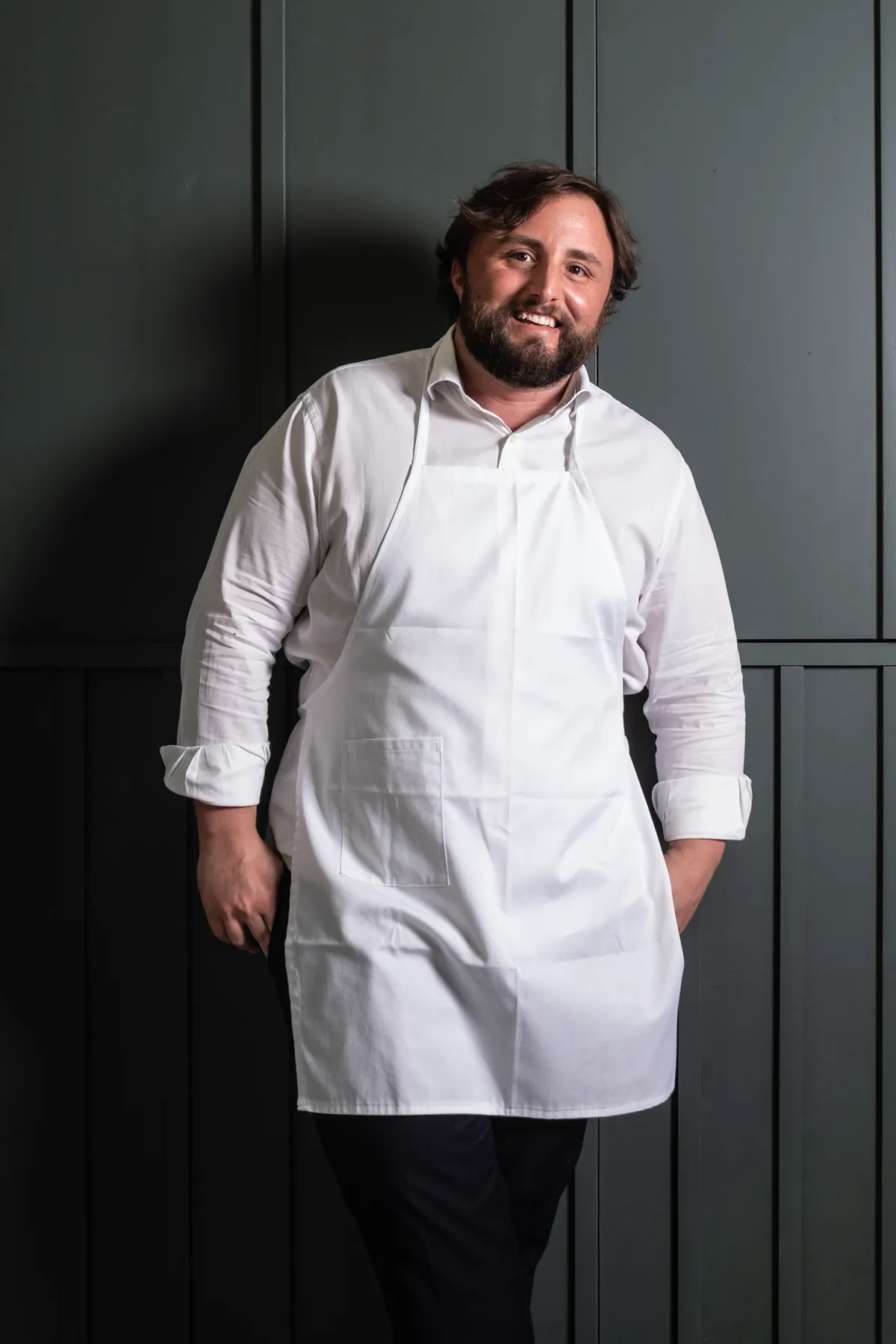
LUCA NATALINI
The Cuisine in One's Blood: Luca's Journey
1989
Pescia
Traditional - Evolutional
LUCA NATALINI
The Cuisine in One's Blood: Luca's Journey
1989
Pescia
Traditional - Evolutional
LUCA NATALINI
The Cuisine in One's Blood: Luca's Journey
1989
Pescia
Traditional - Evolutional
CURRICULUM VITAE
Born in the picturesque town of Pescia, nestled in the province of Pistoia, on May 30, 1989, Luca manifested from an early age an innate predisposition for the arts—a talent inherited from his grandfather Carlo Maria Mariani, a prominent figure in the Italian artistic and pictorial landscape. In parallel, his love for authentic and genuine flavors traced its roots to the teachings of his great-grandmother Valda, guardian of ancient culinary traditions.
Already in his youth, Luca understood that the kitchen represented for him the privileged medium of expression, allowing him to wed his artistic sensibility with a refined sense of taste. His precocious and ambitious career commenced at the tender age of fourteen when, animated by the desire to fathom the secrets of haute cuisine, he undertook a significant journey to Paris, the very crucible of world gastronomy, with the fervent dream of mastering the elaborate and sophisticated techniques of the French culinary tradition.
Following this stimulating Parisian chapter, his professional path beheld further milestones of growth and learning. He continued his education and honed his culinary arts in the prestigious cities of Prague and Vienna, crossroads of diverse cultures and savors. Subsequently, he spent a significant period of five years in Russia, an intense professional epoch during which he served as general supervisor for an illustrious restaurant company with a vast presence across the Russian territory. This experience allowed him to acquire a global vision of the industry and to develop remarkable managerial and organizational acumen.
In 2012, a major academic milestone marked his educational journey: he graduated from Alma, the renowned International School of Italian Cuisine situated in Colorno, in the heart of Parma's Food Valley—an institution of absolute excellence for the formation of fine dining chefs. The year 2016 represented a time of significant professional triumphs. He participated with distinction in the culinary competition organized by Barilla, setting himself apart through his creativity and mastery, and ranking among the top ten talented chefs in competition. Concurrently, in Russia, his emerging talent was officially recognized with the coveted title of Young Chef bestowed upon him by S. Pellegrino, a prestigious accolade in the arena of international gastronomy.
The year 2017 cast him as a protagonist on the small screen with his participation in the popular television program "Top Chef," an intense and formative experience that culminated in his capturing the bronze medal—a testament to his skill and determination. From 2019, his presence in the television world solidified with a regular involvement in the long-running and cherished program "La Prova del Cuoco," which made him a familiar face to the Italian public. Throughout 2022, his versatility and competence led him to participate in other highly successful broadcasts, such as "Detto Fatto" and "Vorrei dirti che," both broadcast on Rai 2, further widening his visibility and renown.
After concluding the entrepreneurial adventure associated with his restaurant "Autem," situated in Langhirano—a locality celebrated for the production of prosciutto—in the summer of 2020 he embarked upon a new and stimulating professional challenge, arriving at the prestigious Milanese restaurant "El Pont De Ferr," an historic and iconic landmark of Milan’s gastronomic scene, wisely guided by chef Maida Mercuri.
Finally, crowning a path rich in experience and success, May 5, 2023, marked a new chapter in his career with the eagerly anticipated reopening of his restaurant "Autem" in the beating heart of Milan, precisely at via Serviliano Lattuada, number 2. This is a sanctuary where he can fully express his culinary vision and welcome guests with his signature gastronomic offerings.
dialogues
What is your earliest, most deeply moving memory of the world of pasta? Can you share it with us?
Surely my most vivid recollection is bound to the sheer bounty of Parmigiano that I, as a child, would bestow upon my plate. It was nearly more Parmigiano than pasta—a true, enveloping festival of dairy essence draping the spaghetti. I recall with clarity the almost "resolute" texture of the pasta upon the palate, a sensation that lingered during mastication, though the flavor was entirely governed by the intense, subtly granular savor of the aged cheese. To this day, I remain enchanted by this primal sensation, a union simple yet profoundly gratifying.
In the journey of your career, which pasta creation has left an indelible imprint, shaping your professional path? Describe this dish and how it molded your culinary philosophy.
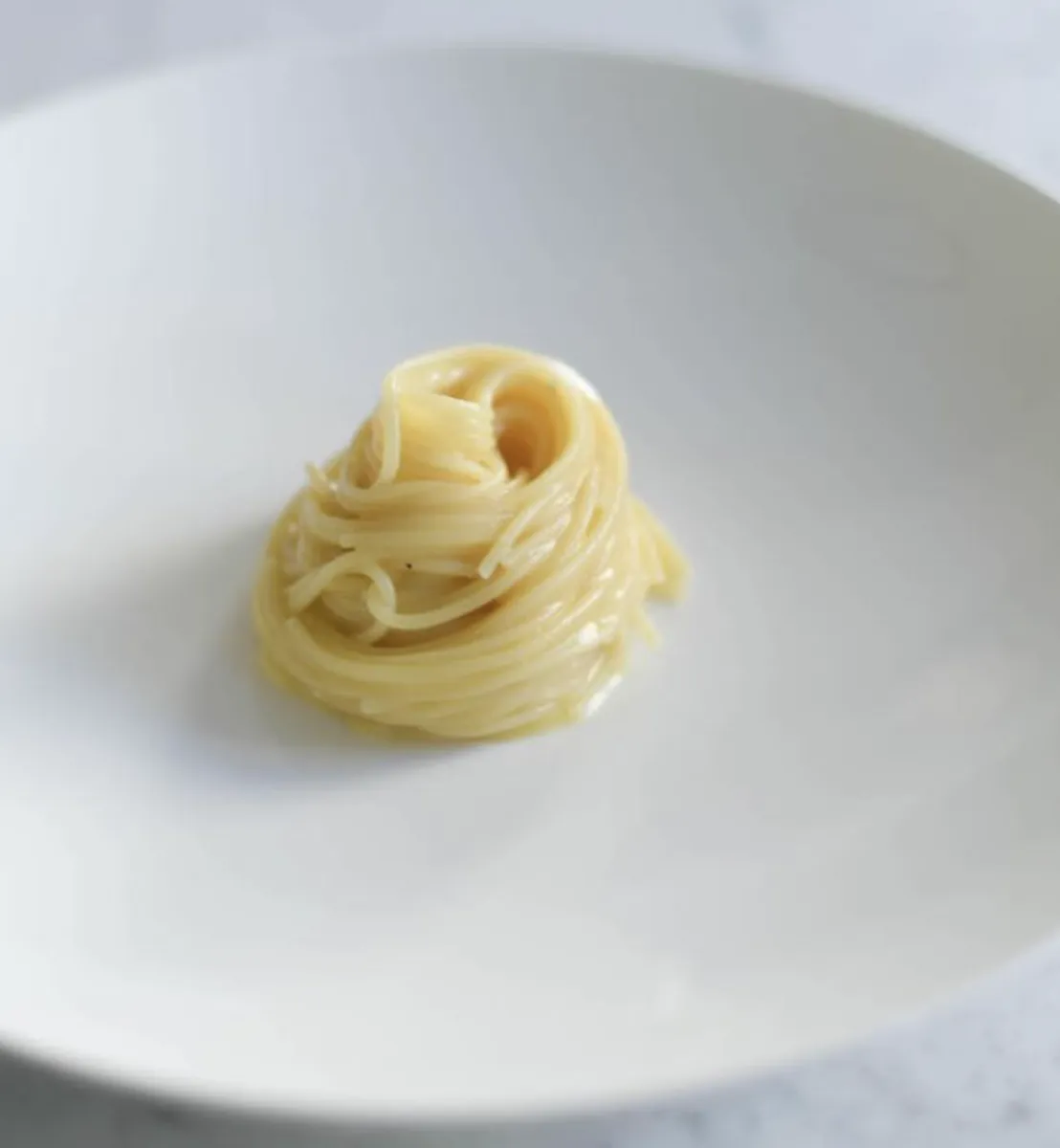
Without doubt, the dish that marked a watershed moment in my professional odyssey—redefining the very concept of cooking time, temperature, and texture—was Gualtiero Marchesi’s cold Spaghettino with lemon and chives. It was, to me, a revelation: a paradigm of elegance and intellect applied to the simplicity of a pasta dish. Thus was Marchesi: profoundly intellectual, conceptual, capable of elevating a humble strand of spaghetti to a complex and unforgettable sensory experience. This dish taught me to peer beyond the superficial, to seek the very soul of the ingredients, and to regard every nuance, from temperature to presentation, as an essential note in the symphony of taste.
Among the myriad shapes of pasta, which do you treasure most? How do you creatively pair the diverse forms with their sauces, and what techniques do you employ to exalt their flavors?
I adore all pasta; indeed, I may call myself a true citizen of "MondoPasta," yet my singular, unconditional passion lives in the spaghettino. For me, the spaghettino possess a captivating versatility: it can be exalted in its pure simplicity with garlic, olive oil, and chili pepper, which celebrate its resilient bite, enriched by the creaminess of butter, enveloped by the sweetness of tomato, or enlivened by the vibrancy of fresh cherry tomatoes, or indeed crowned by the fragrance of pesto. It harmonizes with a surprising variety of sauces and condiments, never losing its unique identity. Its slender, elongated form allows for an exquisite mantecatura, ensuring a seamless and uniform glaze of flavor.
How do you perceive the evolution of pasta within the realm of fine dining? Are there innovative techniques or trends that particularly captivate your curiosity?
The evolution of pasta in fine dining is increasingly anchored in an intimate, mindful understanding of the grains, their precise milling, and the meticulous cooking techniques that honor their unique attributes. We are Rediscovering the nobility of pasta not merely as a "vessel" for a sauce, but as a source of complexity in flavor and texture in its own right. Yet this must always remain true: beyond all technique and innovation, a steadfast foundation of authentic and recognizable flavor is paramount. A dish may be born of the most fascinating conceptual thought, but in the end, it must always satisfy the palate.
Which pasta dish transports you back to the hearth of your home, offering comfort? And what recipes do you prepare most frequently within your own domestic walls?
Ah, within my own home, the spaghettino with garlic, oil, chili pepper, and a generous snowfall of Parmigiano reigns supreme. It is a simple preparation yet deeply rooted in my sensory memory—a true comfort food. The most wondrous element of this dish, its genuine alchemy, is the starchy soul of the spaghetti, married to the sharpness of garlic, the lively kick of chili, the enveloping savor of grated Parmigiano, and the golden oil, forming a flawless emulsion that caresses the palate.
How do you interpret the resurgence of pasta asciutta, a beloved symbol of Italian tradition? What is the significance of this phenomenon within the current gastronomic landscape?
Regarding "pasta asciutta," I must summon one of my own historic signatures: the "pasta in bianco" (white pasta). I was, in a sense, a pioneer in bringing it back to the fore of fine gastronomy—partly as a challenge, partly in play, which is ever the most stimulating pursuit: taking an element apparently mundane and transforming it into something wondrous. Visually, it presents a purely minimalist, almost austere aesthetic—that of a simple dry pasta. Yet, upon tasting, there is an unexpected explosion of flavor, born, for instance, of a masterful simmer in a decoction of bay leaves (a concentrated, aromatic broth) later bound with a plum Vermouth, which imparts a striking acidity and an intoxicating, enveloping aroma.
Do you view pasta as a "blank canvas" for other ingredients, or as the undisputed protagonist of the plate?
To answer your question, "a blank canvas" beautifully captures my perspective. I cherish the wonder of surprise when a simple, almost unassuming presentation conceals an extraordinarily complex labor of culinary craft and flavor research. Beyond this game of contrasts, I consider pasta a highly versatile ingredient, serving beautifully both as protagonist or as accompaniment, ever offering fresh paths of creative expression.
In a tasting menu, where would you ideally place a pasta dish? Do you envision it as an antipasto, a main courses, or perhaps even as a dessert? And if so, in what manner?
As an Italian, I view pasta primarily as a first course, yet I recognize its remarkable adaptability, such that I can readily conceive it as an antipasto—one thinks of Marchesi’s celebrated cold Spaghettino with caviar—or as a primary course, be it a simple spaghetti al pomodoro or any other legacy recipe. This bond with pasta is woven into our culinary DNA, and for us, taste is the absolute priority. Yet its eclectic nature allows it to cross the threshold into the sweet realm, through preparations and ingredients that shift its savor. For this reason, I believe in free will in the kitchen, whilst remaining forever anchored to the fundamental sovereignty of taste.
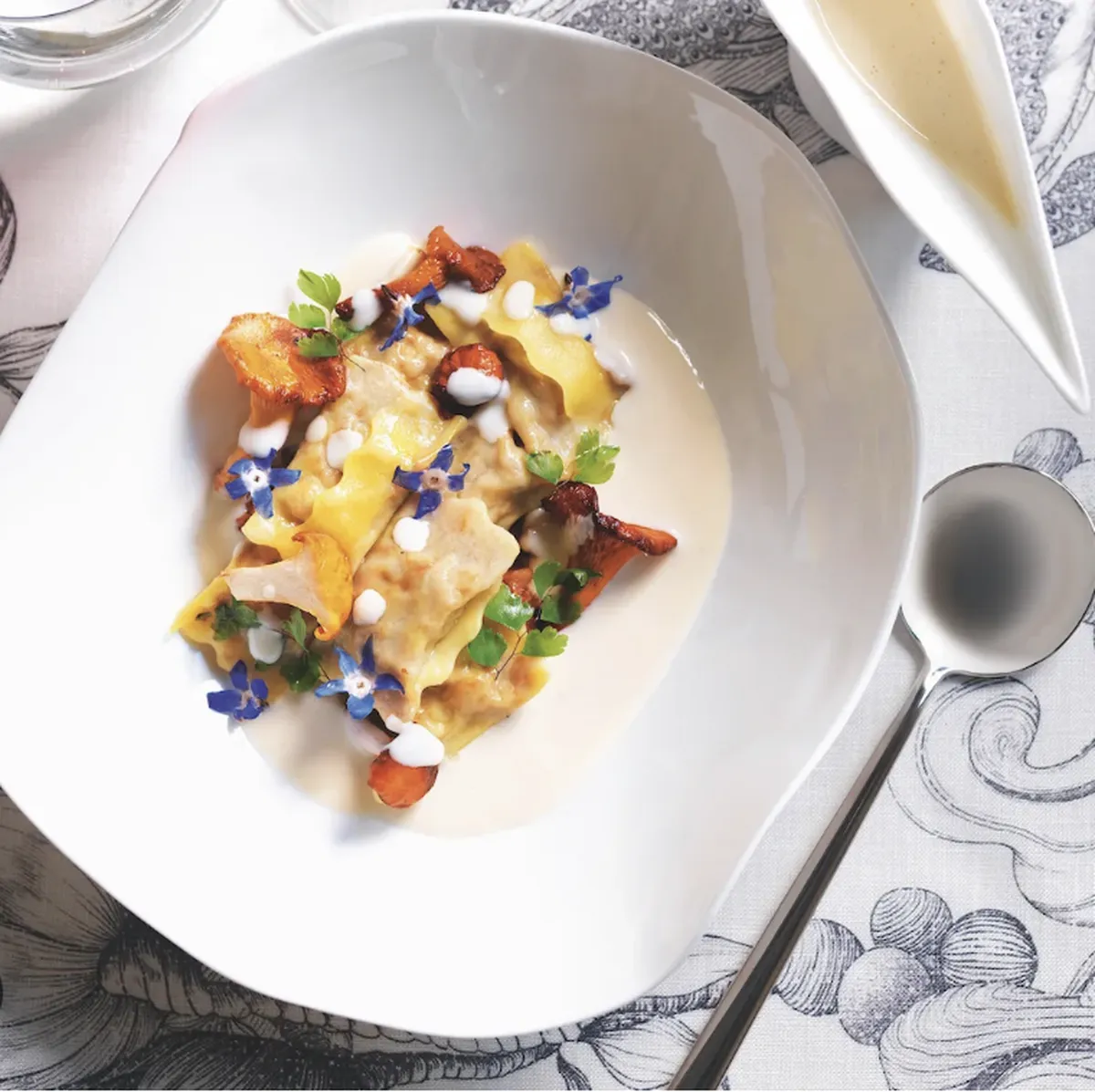
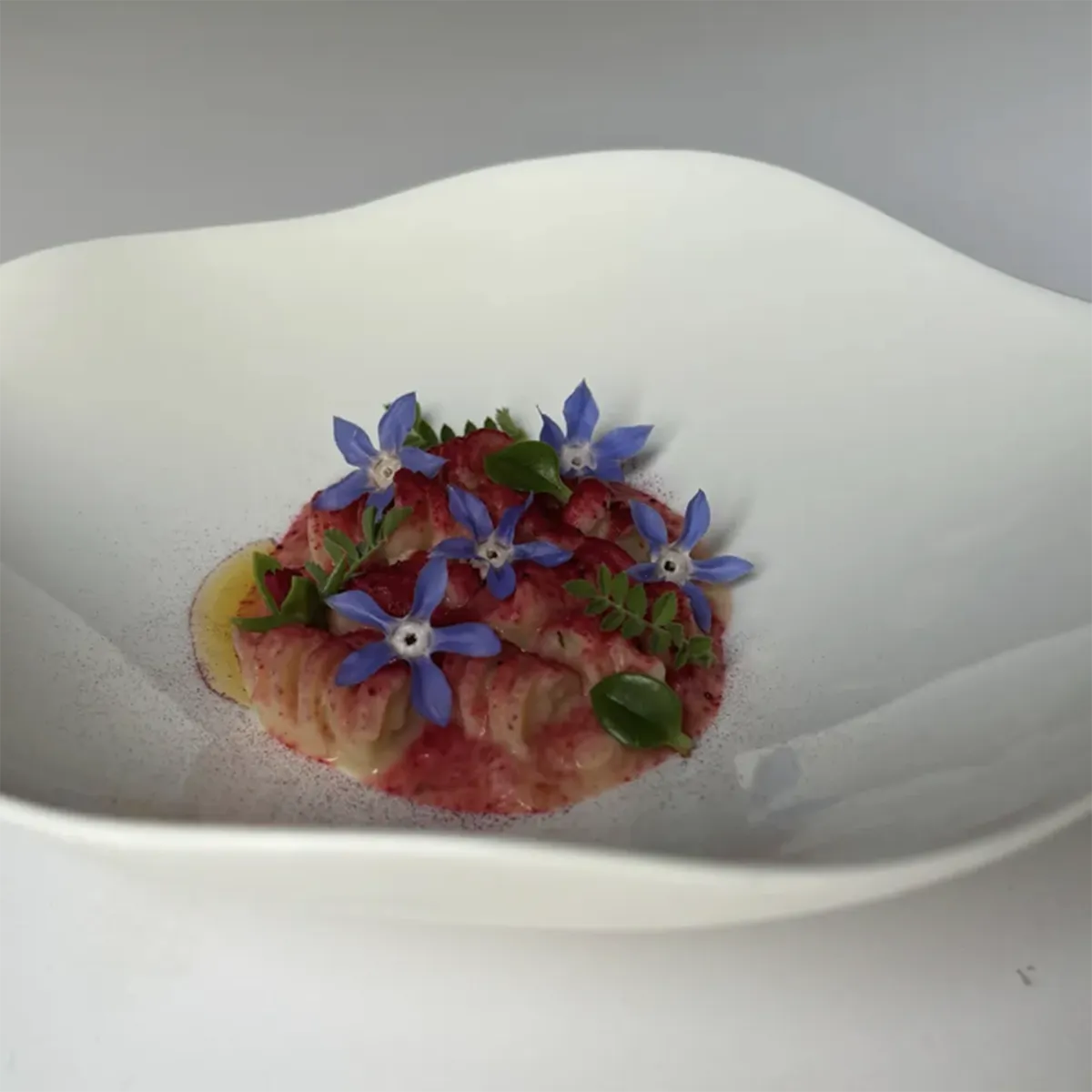
CURRICULUM VITAE
Born in the picturesque town of Pescia, nestled in the province of Pistoia, on May 30, 1989, Luca manifested from an early age an innate predisposition for the arts—a talent inherited from his grandfather Carlo Maria Mariani, a prominent figure in the Italian artistic and pictorial landscape. In parallel, his love for authentic and genuine flavors traced its roots to the teachings of his great-grandmother Valda, guardian of ancient culinary traditions.
Already in his youth, Luca understood that the kitchen represented for him the privileged medium of expression, allowing him to wed his artistic sensibility with a refined sense of taste. His precocious and ambitious career commenced at the tender age of fourteen when, animated by the desire to fathom the secrets of haute cuisine, he undertook a significant journey to Paris, the very crucible of world gastronomy, with the fervent dream of mastering the elaborate and sophisticated techniques of the French culinary tradition.
Following this stimulating Parisian chapter, his professional path beheld further milestones of growth and learning. He continued his education and honed his culinary arts in the prestigious cities of Prague and Vienna, crossroads of diverse cultures and savors. Subsequently, he spent a significant period of five years in Russia, an intense professional epoch during which he served as general supervisor for an illustrious restaurant company with a vast presence across the Russian territory. This experience allowed him to acquire a global vision of the industry and to develop remarkable managerial and organizational acumen.
In 2012, a major academic milestone marked his educational journey: he graduated from Alma, the renowned International School of Italian Cuisine situated in Colorno, in the heart of Parma's Food Valley—an institution of absolute excellence for the formation of fine dining chefs. The year 2016 represented a time of significant professional triumphs. He participated with distinction in the culinary competition organized by Barilla, setting himself apart through his creativity and mastery, and ranking among the top ten talented chefs in competition. Concurrently, in Russia, his emerging talent was officially recognized with the coveted title of Young Chef bestowed upon him by S. Pellegrino, a prestigious accolade in the arena of international gastronomy.
The year 2017 cast him as a protagonist on the small screen with his participation in the popular television program "Top Chef," an intense and formative experience that culminated in his capturing the bronze medal—a testament to his skill and determination. From 2019, his presence in the television world solidified with a regular involvement in the long-running and cherished program "La Prova del Cuoco," which made him a familiar face to the Italian public. Throughout 2022, his versatility and competence led him to participate in other highly successful broadcasts, such as "Detto Fatto" and "Vorrei dirti che," both broadcast on Rai 2, further widening his visibility and renown.
After concluding the entrepreneurial adventure associated with his restaurant "Autem," situated in Langhirano—a locality celebrated for the production of prosciutto—in the summer of 2020 he embarked upon a new and stimulating professional challenge, arriving at the prestigious Milanese restaurant "El Pont De Ferr," an historic and iconic landmark of Milan’s gastronomic scene, wisely guided by chef Maida Mercuri.
Finally, crowning a path rich in experience and success, May 5, 2023, marked a new chapter in his career with the eagerly anticipated reopening of his restaurant "Autem" in the beating heart of Milan, precisely at via Serviliano Lattuada, number 2. This is a sanctuary where he can fully express his culinary vision and welcome guests with his signature gastronomic offerings.
dialogues
What is your earliest, most deeply moving memory of the world of pasta? Can you share it with us?
Surely my most vivid recollection is bound to the sheer bounty of Parmigiano that I, as a child, would bestow upon my plate. It was nearly more Parmigiano than pasta—a true, enveloping festival of dairy essence draping the spaghetti. I recall with clarity the almost "resolute" texture of the pasta upon the palate, a sensation that lingered during mastication, though the flavor was entirely governed by the intense, subtly granular savor of the aged cheese. To this day, I remain enchanted by this primal sensation, a union simple yet profoundly gratifying.
In the journey of your career, which pasta creation has left an indelible imprint, shaping your professional path? Describe this dish and how it molded your culinary philosophy.
Without doubt, the dish that marked a watershed moment in my professional odyssey—redefining the very concept of cooking time, temperature, and texture—was Gualtiero Marchesi’s cold Spaghettino with lemon and chives. It was, to me, a revelation: a paradigm of elegance and intellect applied to the simplicity of a pasta dish. Thus was Marchesi: profoundly intellectual, conceptual, capable of elevating a humble strand of spaghetti to a complex and unforgettable sensory experience. This dish taught me to peer beyond the superficial, to seek the very soul of the ingredients, and to regard every nuance, from temperature to presentation, as an essential note in the symphony of taste.
Among the myriad shapes of pasta, which do you treasure most? How do you creatively pair the diverse forms with their sauces, and what techniques do you employ to exalt their flavors?
I adore all pasta; indeed, I may call myself a true citizen of "MondoPasta," yet my singular, unconditional passion lives in the spaghettino. For me, the spaghettino possess a captivating versatility: it can be exalted in its pure simplicity with garlic, olive oil, and chili pepper, which celebrate its resilient bite, enriched by the creaminess of butter, enveloped by the sweetness of tomato, or enlivened by the vibrancy of fresh cherry tomatoes, or indeed crowned by the fragrance of pesto. It harmonizes with a surprising variety of sauces and condiments, never losing its unique identity. Its slender, elongated form allows for an exquisite mantecatura, ensuring a seamless and uniform glaze of flavor.
How do you perceive the evolution of pasta within the realm of fine dining? Are there innovative techniques or trends that particularly captivate your curiosity?
The evolution of pasta in fine dining is increasingly anchored in an intimate, mindful understanding of the grains, their precise milling, and the meticulous cooking techniques that honor their unique attributes. We are Rediscovering the nobility of pasta not merely as a "vessel" for a sauce, but as a source of complexity in flavor and texture in its own right. Yet this must always remain true: beyond all technique and innovation, a steadfast foundation of authentic and recognizable flavor is paramount. A dish may be born of the most fascinating conceptual thought, but in the end, it must always satisfy the palate.
Which pasta dish transports you back to the hearth of your home, offering comfort? And what recipes do you prepare most frequently within your own domestic walls?
Ah, within my own home, the spaghettino with garlic, oil, chili pepper, and a generous snowfall of Parmigiano reigns supreme. It is a simple preparation yet deeply rooted in my sensory memory—a true comfort food. The most wondrous element of this dish, its genuine alchemy, is the starchy soul of the spaghetti, married to the sharpness of garlic, the lively kick of chili, the enveloping savor of grated Parmigiano, and the golden oil, forming a flawless emulsion that caresses the palate.
How do you interpret the resurgence of pasta asciutta, a beloved symbol of Italian tradition? What is the significance of this phenomenon within the current gastronomic landscape?
Regarding "pasta asciutta," I must summon one of my own historic signatures: the "pasta in bianco" (white pasta). I was, in a sense, a pioneer in bringing it back to the fore of fine gastronomy—partly as a challenge, partly in play, which is ever the most stimulating pursuit: taking an element apparently mundane and transforming it into something wondrous. Visually, it presents a purely minimalist, almost austere aesthetic—that of a simple dry pasta. Yet, upon tasting, there is an unexpected explosion of flavor, born, for instance, of a masterful simmer in a decoction of bay leaves (a concentrated, aromatic broth) later bound with a plum Vermouth, which imparts a striking acidity and an intoxicating, enveloping aroma.
Do you view pasta as a "blank canvas" for other ingredients, or as the undisputed protagonist of the plate?
To answer your question, "a blank canvas" beautifully captures my perspective. I cherish the wonder of surprise when a simple, almost unassuming presentation conceals an extraordinarily complex labor of culinary craft and flavor research. Beyond this game of contrasts, I consider pasta a highly versatile ingredient, serving beautifully both as protagonist or as accompaniment, ever offering fresh paths of creative expression.
In a tasting menu, where would you ideally place a pasta dish? Do you envision it as an antipasto, a main courses, or perhaps even as a dessert? And if so, in what manner?
As an Italian, I view pasta primarily as a first course, yet I recognize its remarkable adaptability, such that I can readily conceive it as an antipasto—one thinks of Marchesi’s celebrated cold Spaghettino with caviar—or as a primary course, be it a simple spaghetti al pomodoro or any other legacy recipe. This bond with pasta is woven into our culinary DNA, and for us, taste is the absolute priority. Yet its eclectic nature allows it to cross the threshold into the sweet realm, through preparations and ingredients that shift its savor. For this reason, I believe in free will in the kitchen, whilst remaining forever anchored to the fundamental sovereignty of taste.
CURRICULUM VITAE
Born in the picturesque town of Pescia, nestled in the province of Pistoia, on May 30, 1989, Luca manifested from an early age an innate predisposition for the arts—a talent inherited from his grandfather Carlo Maria Mariani, a prominent figure in the Italian artistic and pictorial landscape. In parallel, his love for authentic and genuine flavors traced its roots to the teachings of his great-grandmother Valda, guardian of ancient culinary traditions.
Already in his youth, Luca understood that the kitchen represented for him the privileged medium of expression, allowing him to wed his artistic sensibility with a refined sense of taste. His precocious and ambitious career commenced at the tender age of fourteen when, animated by the desire to fathom the secrets of haute cuisine, he undertook a significant journey to Paris, the very crucible of world gastronomy, with the fervent dream of mastering the elaborate and sophisticated techniques of the French culinary tradition.
Following this stimulating Parisian chapter, his professional path beheld further milestones of growth and learning. He continued his education and honed his culinary arts in the prestigious cities of Prague and Vienna, crossroads of diverse cultures and savors. Subsequently, he spent a significant period of five years in Russia, an intense professional epoch during which he served as general supervisor for an illustrious restaurant company with a vast presence across the Russian territory. This experience allowed him to acquire a global vision of the industry and to develop remarkable managerial and organizational acumen.
In 2012, a major academic milestone marked his educational journey: he graduated from Alma, the renowned International School of Italian Cuisine situated in Colorno, in the heart of Parma's Food Valley—an institution of absolute excellence for the formation of fine dining chefs. The year 2016 represented a time of significant professional triumphs. He participated with distinction in the culinary competition organized by Barilla, setting himself apart through his creativity and mastery, and ranking among the top ten talented chefs in competition. Concurrently, in Russia, his emerging talent was officially recognized with the coveted title of Young Chef bestowed upon him by S. Pellegrino, a prestigious accolade in the arena of international gastronomy.
The year 2017 cast him as a protagonist on the small screen with his participation in the popular television program "Top Chef," an intense and formative experience that culminated in his capturing the bronze medal—a testament to his skill and determination. From 2019, his presence in the television world solidified with a regular involvement in the long-running and cherished program "La Prova del Cuoco," which made him a familiar face to the Italian public. Throughout 2022, his versatility and competence led him to participate in other highly successful broadcasts, such as "Detto Fatto" and "Vorrei dirti che," both broadcast on Rai 2, further widening his visibility and renown.
After concluding the entrepreneurial adventure associated with his restaurant "Autem," situated in Langhirano—a locality celebrated for the production of prosciutto—in the summer of 2020 he embarked upon a new and stimulating professional challenge, arriving at the prestigious Milanese restaurant "El Pont De Ferr," an historic and iconic landmark of Milan’s gastronomic scene, wisely guided by chef Maida Mercuri.
Finally, crowning a path rich in experience and success, May 5, 2023, marked a new chapter in his career with the eagerly anticipated reopening of his restaurant "Autem" in the beating heart of Milan, precisely at via Serviliano Lattuada, number 2. This is a sanctuary where he can fully express his culinary vision and welcome guests with his signature gastronomic offerings.
dialogues
What is your earliest, most deeply moving memory of the world of pasta? Can you share it with us?
Surely my most vivid recollection is bound to the sheer bounty of Parmigiano that I, as a child, would bestow upon my plate. It was nearly more Parmigiano than pasta—a true, enveloping festival of dairy essence draping the spaghetti. I recall with clarity the almost "resolute" texture of the pasta upon the palate, a sensation that lingered during mastication, though the flavor was entirely governed by the intense, subtly granular savor of the aged cheese. To this day, I remain enchanted by this primal sensation, a union simple yet profoundly gratifying.
In the journey of your career, which pasta creation has left an indelible imprint, shaping your professional path? Describe this dish and how it molded your culinary philosophy.
Without doubt, the dish that marked a watershed moment in my professional odyssey—redefining the very concept of cooking time, temperature, and texture—was Gualtiero Marchesi’s cold Spaghettino with lemon and chives. It was, to me, a revelation: a paradigm of elegance and intellect applied to the simplicity of a pasta dish. Thus was Marchesi: profoundly intellectual, conceptual, capable of elevating a humble strand of spaghetti to a complex and unforgettable sensory experience. This dish taught me to peer beyond the superficial, to seek the very soul of the ingredients, and to regard every nuance, from temperature to presentation, as an essential note in the symphony of taste.
Among the myriad shapes of pasta, which do you treasure most? How do you creatively pair the diverse forms with their sauces, and what techniques do you employ to exalt their flavors?
I adore all pasta; indeed, I may call myself a true citizen of "MondoPasta," yet my singular, unconditional passion lives in the spaghettino. For me, the spaghettino possess a captivating versatility: it can be exalted in its pure simplicity with garlic, olive oil, and chili pepper, which celebrate its resilient bite, enriched by the creaminess of butter, enveloped by the sweetness of tomato, or enlivened by the vibrancy of fresh cherry tomatoes, or indeed crowned by the fragrance of pesto. It harmonizes with a surprising variety of sauces and condiments, never losing its unique identity. Its slender, elongated form allows for an exquisite mantecatura, ensuring a seamless and uniform glaze of flavor.
How do you perceive the evolution of pasta within the realm of fine dining? Are there innovative techniques or trends that particularly captivate your curiosity?
The evolution of pasta in fine dining is increasingly anchored in an intimate, mindful understanding of the grains, their precise milling, and the meticulous cooking techniques that honor their unique attributes. We are Rediscovering the nobility of pasta not merely as a "vessel" for a sauce, but as a source of complexity in flavor and texture in its own right. Yet this must always remain true: beyond all technique and innovation, a steadfast foundation of authentic and recognizable flavor is paramount. A dish may be born of the most fascinating conceptual thought, but in the end, it must always satisfy the palate.
Which pasta dish transports you back to the hearth of your home, offering comfort? And what recipes do you prepare most frequently within your own domestic walls?
Ah, within my own home, the spaghettino with garlic, oil, chili pepper, and a generous snowfall of Parmigiano reigns supreme. It is a simple preparation yet deeply rooted in my sensory memory—a true comfort food. The most wondrous element of this dish, its genuine alchemy, is the starchy soul of the spaghetti, married to the sharpness of garlic, the lively kick of chili, the enveloping savor of grated Parmigiano, and the golden oil, forming a flawless emulsion that caresses the palate.
How do you interpret the resurgence of pasta asciutta, a beloved symbol of Italian tradition? What is the significance of this phenomenon within the current gastronomic landscape?
Regarding "pasta asciutta," I must summon one of my own historic signatures: the "pasta in bianco" (white pasta). I was, in a sense, a pioneer in bringing it back to the fore of fine gastronomy—partly as a challenge, partly in play, which is ever the most stimulating pursuit: taking an element apparently mundane and transforming it into something wondrous. Visually, it presents a purely minimalist, almost austere aesthetic—that of a simple dry pasta. Yet, upon tasting, there is an unexpected explosion of flavor, born, for instance, of a masterful simmer in a decoction of bay leaves (a concentrated, aromatic broth) later bound with a plum Vermouth, which imparts a striking acidity and an intoxicating, enveloping aroma.
Do you view pasta as a "blank canvas" for other ingredients, or as the undisputed protagonist of the plate?
To answer your question, "a blank canvas" beautifully captures my perspective. I cherish the wonder of surprise when a simple, almost unassuming presentation conceals an extraordinarily complex labor of culinary craft and flavor research. Beyond this game of contrasts, I consider pasta a highly versatile ingredient, serving beautifully both as protagonist or as accompaniment, ever offering fresh paths of creative expression.
In a tasting menu, where would you ideally place a pasta dish? Do you envision it as an antipasto, a main courses, or perhaps even as a dessert? And if so, in what manner?
As an Italian, I view pasta primarily as a first course, yet I recognize its remarkable adaptability, such that I can readily conceive it as an antipasto—one thinks of Marchesi’s celebrated cold Spaghettino with caviar—or as a primary course, be it a simple spaghetti al pomodoro or any other legacy recipe. This bond with pasta is woven into our culinary DNA, and for us, taste is the absolute priority. Yet its eclectic nature allows it to cross the threshold into the sweet realm, through preparations and ingredients that shift its savor. For this reason, I believe in free will in the kitchen, whilst remaining forever anchored to the fundamental sovereignty of taste.