genesis
There is a noun that, in its singular grace, encapsulates an entire poetic destiny: LÜF. It descends from the vernacular of the Valtellina, a word uniting two opposing forces virtually indistinguishable in their utterance: the egg and the wolf. Primary matter and untamed instinct; thus, domestic nurturing and a "visceral, wolf-like hunger." It is more than a mere sign: it is a yearning, a declaration that pasta—in this domain—shall never be a fleeting caprice, but an art of absolute necessity, executed with devotion.
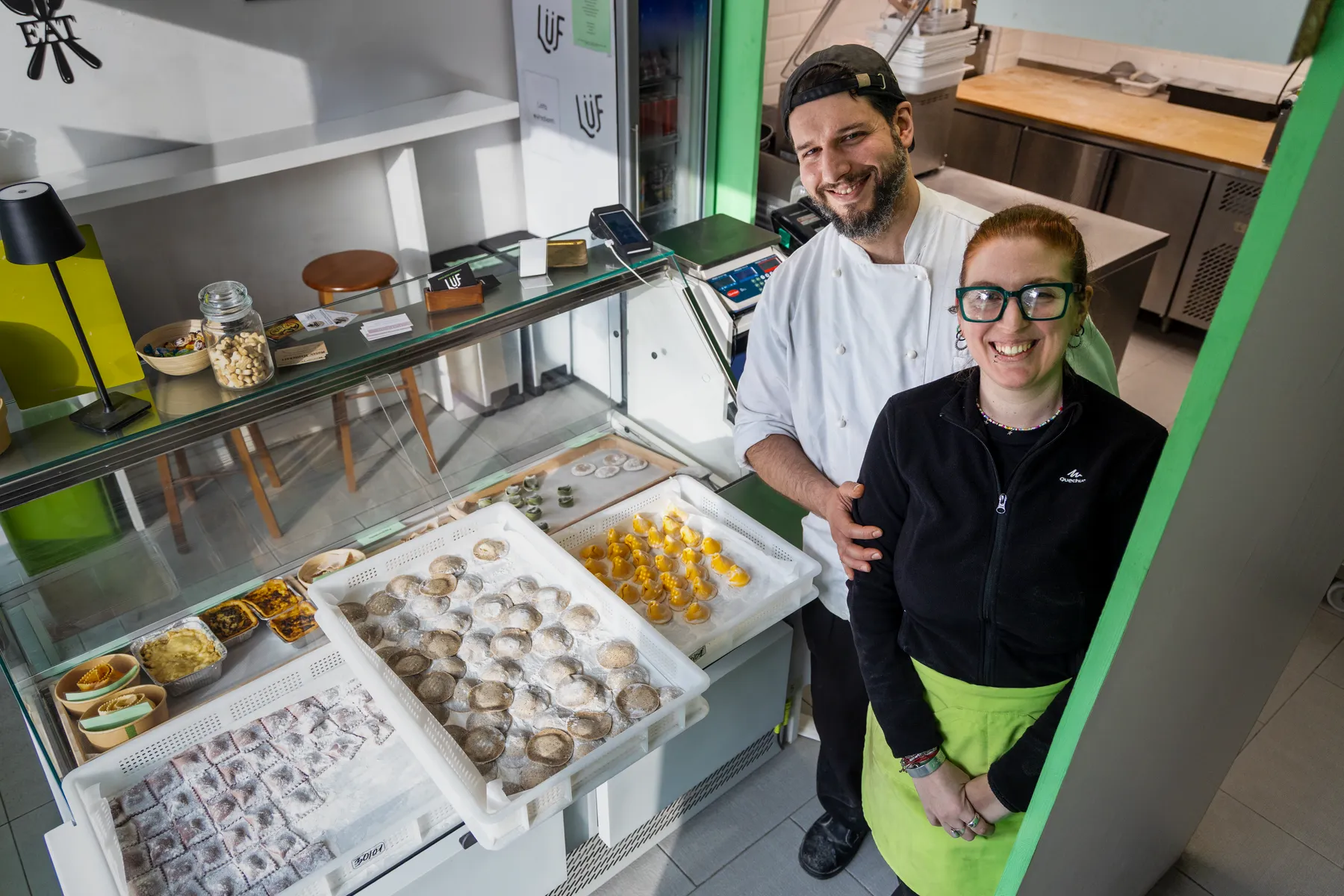
Its debut in Milan is marked by a precise date: August 31st, 2023. It is signed by Marco Poncia and Arianna Morini, companions of ten years: not a temporary alliance, but a shared existence that mirrors itself in their labor with the gravity of those who understand that each day is a solemn testament.
Marco comes from a path defined by architectural rigor rather than vanity: Trussardi alla Scala, Mudec with Enrico Bartolini, experiences alongside Andrea Ribaldone, the stewardship of Simone Rugiati’s Food Loft, the birth of Osteria del Malnat, and his collaboration with Cesare Battisti at Ratanà. This is no mere ornamental list: it is the technical lexicon required when one chooses to dedicate life to stuffed pasta, which is to say, to absolute precision.
Arianna, conversely, arrives from a different realm: a former canine educator, she transformed her path after the pandemic to become the vital heart of the house—the "official taster," possessing that gentle irony which so often graces earnest endeavors. Together, they sustain LÜF in a quiet suburban enclave with little footfall: a sanctuary where nothing is guaranteed and everything must be earned. Thus, the establishment flourishes upon a dual devotion: a modern narrative woven through digital tapestries, and a loyal neighborhood clientele who return because they have truly understood.
Beneath it all, almost unseen, lies the rarest virtue to which the creators passionately adhere: the silent discipline of culinary sustainability.
alchemy
Magic, here, is no illusion: it is the repeated gesture, refined until it becomes truth. The absolute signature of LÜF is artisanal stuffed pasta, approached with a luminous philosophy: cooked to order—or ready to cross the threshold of your home without losing its soul.
The pasta may be savored on-site, purchased fresh, or blast-frozen with a six-month shelf-life: conceived to be plunged directly from its frozen state into boiling water, a small domestic shortcut that does not betray the devotion of the workshop. This is a contemporary way to protect craftsmanship: not to embalm it, but to weave it into the fabric of daily life.
Among the signature creations lie two opposing poles—much like the name itself.
The Pizzocchero Ravioli are seasonal, hailing from the winter, carrying within them the mountain as a larder: savory, clean, and carrying a distinct identity. An homage to origins that does not dissolve into nostalgia, but deepens into substance.
The Cacio e Pepe Ravioli, conversely, have become the most iconic offering, almost in spite of themselves: demanded by patrons year-round, transformed by collective desire into a true classic. And there is something poetic in this dynamic: an establishment that listens, consenting to be defined by those who frequent it.
The raw ingredients follow a path of vigilant, almost moral provenance: the meat arrives exclusively from the Ostinelli Butchery in Alta Brianza; the flours are sourced from Molino dalla Giovanna and La Molisana, with a specific 100% whole-wheat selection from Mulino Caputo. The chef eschews mass distribution as much as possible: not out of vanity, but for sensory and technical mastery, to always know where flavor is born.
Thus, LÜF becomes a small, living heritage: not a mere "concept," nor a theatrical stage, but an atelier defending the simplest yet most arduous act—to feed others beautifully, with coherence. The egg and the wolf: the delicacy of the pasta sheet and the hunger that demands honesty. In between, the raviolo stands as the threshold. And Milan, when it awakens to this, returns.
provenance
final heritages


genesis
There is a noun that, in its singular grace, encapsulates an entire poetic destiny: LÜF. It descends from the vernacular of the Valtellina, a word uniting two opposing forces virtually indistinguishable in their utterance: the egg and the wolf. Primary matter and untamed instinct; thus, domestic nurturing and a "visceral, wolf-like hunger." It is more than a mere sign: it is a yearning, a declaration that pasta—in this domain—shall never be a fleeting caprice, but an art of absolute necessity, executed with devotion.
Its debut in Milan is marked by a precise date: August 31st, 2023. It is signed by Marco Poncia and Arianna Morini, companions of ten years: not a temporary alliance, but a shared existence that mirrors itself in their labor with the gravity of those who understand that each day is a solemn testament.
Marco comes from a path defined by architectural rigor rather than vanity: Trussardi alla Scala, Mudec with Enrico Bartolini, experiences alongside Andrea Ribaldone, the stewardship of Simone Rugiati’s Food Loft, the birth of Osteria del Malnat, and his collaboration with Cesare Battisti at Ratanà. This is no mere ornamental list: it is the technical lexicon required when one chooses to dedicate life to stuffed pasta, which is to say, to absolute precision.
Arianna, conversely, arrives from a different realm: a former canine educator, she transformed her path after the pandemic to become the vital heart of the house—the "official taster," possessing that gentle irony which so often graces earnest endeavors. Together, they sustain LÜF in a quiet suburban enclave with little footfall: a sanctuary where nothing is guaranteed and everything must be earned. Thus, the establishment flourishes upon a dual devotion: a modern narrative woven through digital tapestries, and a loyal neighborhood clientele who return because they have truly understood.
Beneath it all, almost unseen, lies the rarest virtue to which the creators passionately adhere: the silent discipline of culinary sustainability.
alchemy
Magic, here, is no illusion: it is the repeated gesture, refined until it becomes truth. The absolute signature of LÜF is artisanal stuffed pasta, approached with a luminous philosophy: cooked to order—or ready to cross the threshold of your home without losing its soul.
The pasta may be savored on-site, purchased fresh, or blast-frozen with a six-month shelf-life: conceived to be plunged directly from its frozen state into boiling water, a small domestic shortcut that does not betray the devotion of the workshop. This is a contemporary way to protect craftsmanship: not to embalm it, but to weave it into the fabric of daily life.
Among the signature creations lie two opposing poles—much like the name itself.
The Pizzocchero Ravioli are seasonal, hailing from the winter, carrying within them the mountain as a larder: savory, clean, and carrying a distinct identity. An homage to origins that does not dissolve into nostalgia, but deepens into substance.
The Cacio e Pepe Ravioli, conversely, have become the most iconic offering, almost in spite of themselves: demanded by patrons year-round, transformed by collective desire into a true classic. And there is something poetic in this dynamic: an establishment that listens, consenting to be defined by those who frequent it.
The raw ingredients follow a path of vigilant, almost moral provenance: the meat arrives exclusively from the Ostinelli Butchery in Alta Brianza; the flours are sourced from Molino dalla Giovanna and La Molisana, with a specific 100% whole-wheat selection from Mulino Caputo. The chef eschews mass distribution as much as possible: not out of vanity, but for sensory and technical mastery, to always know where flavor is born.
Thus, LÜF becomes a small, living heritage: not a mere "concept," nor a theatrical stage, but an atelier defending the simplest yet most arduous act—to feed others beautifully, with coherence. The egg and the wolf: the delicacy of the pasta sheet and the hunger that demands honesty. In between, the raviolo stands as the threshold. And Milan, when it awakens to this, returns.
provenance
final heritages
genesis
There is a noun that, in its singular grace, encapsulates an entire poetic destiny: LÜF. It descends from the vernacular of the Valtellina, a word uniting two opposing forces virtually indistinguishable in their utterance: the egg and the wolf. Primary matter and untamed instinct; thus, domestic nurturing and a "visceral, wolf-like hunger." It is more than a mere sign: it is a yearning, a declaration that pasta—in this domain—shall never be a fleeting caprice, but an art of absolute necessity, executed with devotion.
Its debut in Milan is marked by a precise date: August 31st, 2023. It is signed by Marco Poncia and Arianna Morini, companions of ten years: not a temporary alliance, but a shared existence that mirrors itself in their labor with the gravity of those who understand that each day is a solemn testament.
Marco comes from a path defined by architectural rigor rather than vanity: Trussardi alla Scala, Mudec with Enrico Bartolini, experiences alongside Andrea Ribaldone, the stewardship of Simone Rugiati’s Food Loft, the birth of Osteria del Malnat, and his collaboration with Cesare Battisti at Ratanà. This is no mere ornamental list: it is the technical lexicon required when one chooses to dedicate life to stuffed pasta, which is to say, to absolute precision.
Arianna, conversely, arrives from a different realm: a former canine educator, she transformed her path after the pandemic to become the vital heart of the house—the "official taster," possessing that gentle irony which so often graces earnest endeavors. Together, they sustain LÜF in a quiet suburban enclave with little footfall: a sanctuary where nothing is guaranteed and everything must be earned. Thus, the establishment flourishes upon a dual devotion: a modern narrative woven through digital tapestries, and a loyal neighborhood clientele who return because they have truly understood.
Beneath it all, almost unseen, lies the rarest virtue to which the creators passionately adhere: the silent discipline of culinary sustainability.
alchemy
Magic, here, is no illusion: it is the repeated gesture, refined until it becomes truth. The absolute signature of LÜF is artisanal stuffed pasta, approached with a luminous philosophy: cooked to order—or ready to cross the threshold of your home without losing its soul.
The pasta may be savored on-site, purchased fresh, or blast-frozen with a six-month shelf-life: conceived to be plunged directly from its frozen state into boiling water, a small domestic shortcut that does not betray the devotion of the workshop. This is a contemporary way to protect craftsmanship: not to embalm it, but to weave it into the fabric of daily life.
Among the signature creations lie two opposing poles—much like the name itself.
The Pizzocchero Ravioli are seasonal, hailing from the winter, carrying within them the mountain as a larder: savory, clean, and carrying a distinct identity. An homage to origins that does not dissolve into nostalgia, but deepens into substance.
The Cacio e Pepe Ravioli, conversely, have become the most iconic offering, almost in spite of themselves: demanded by patrons year-round, transformed by collective desire into a true classic. And there is something poetic in this dynamic: an establishment that listens, consenting to be defined by those who frequent it.
The raw ingredients follow a path of vigilant, almost moral provenance: the meat arrives exclusively from the Ostinelli Butchery in Alta Brianza; the flours are sourced from Molino dalla Giovanna and La Molisana, with a specific 100% whole-wheat selection from Mulino Caputo. The chef eschews mass distribution as much as possible: not out of vanity, but for sensory and technical mastery, to always know where flavor is born.
Thus, LÜF becomes a small, living heritage: not a mere "concept," nor a theatrical stage, but an atelier defending the simplest yet most arduous act—to feed others beautifully, with coherence. The egg and the wolf: the delicacy of the pasta sheet and the hunger that demands honesty. In between, the raviolo stands as the threshold. And Milan, when it awakens to this, returns.