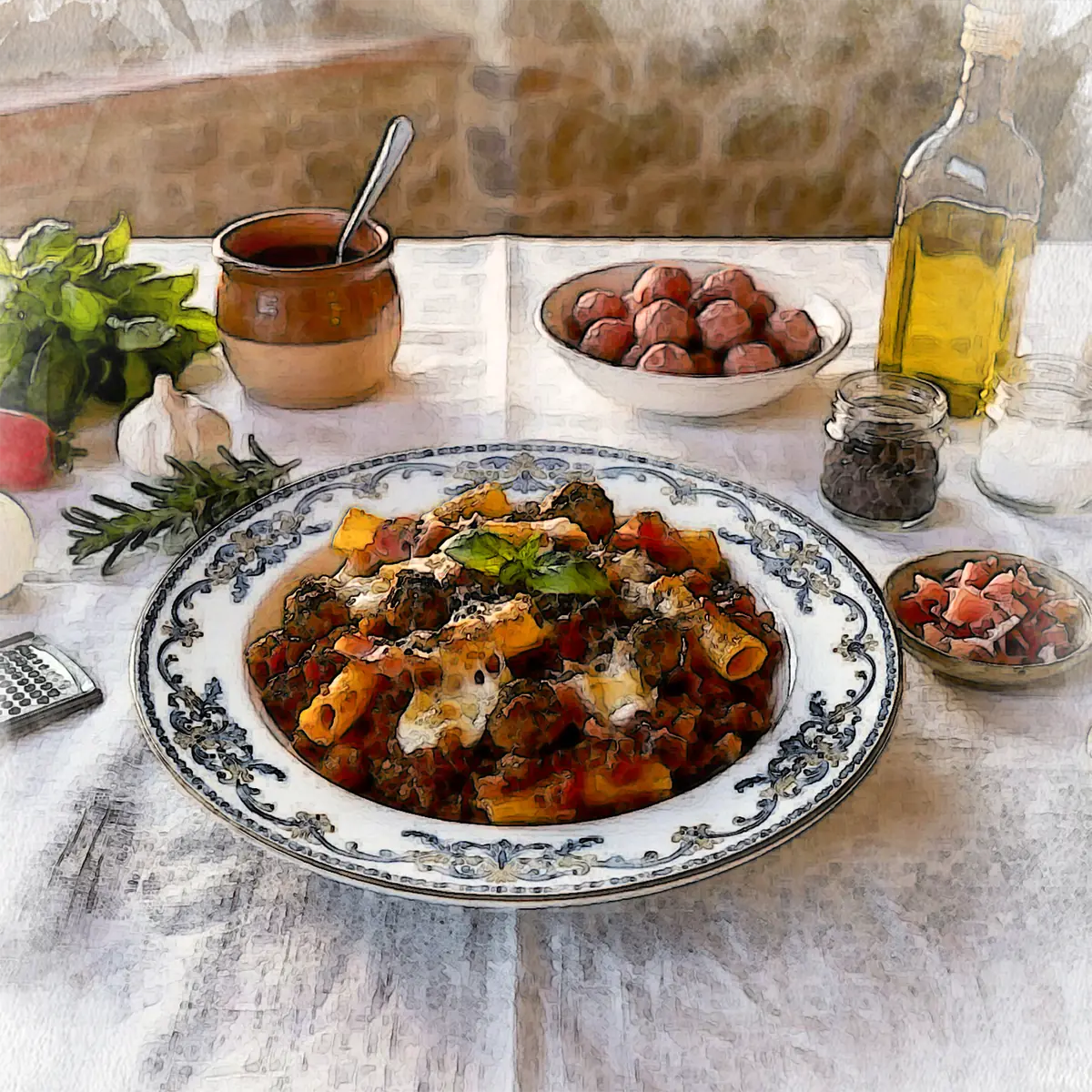
Ferdinand II's Hand-Crafted Maccheroncelli
Maccheroncelli, tender beef, rich pork, savory sausage, cured prosciutto, buffalo mozzarella, Parmigiano Reggiano, fresh tomatoes, and aromatic basil
A demanding pursuit
Campania
240 minutes
780 Kcal
Ferdinand II's Hand-Crafted Maccheroncelli
Maccheroncelli, tender beef, rich pork, savory sausage, cured prosciutto, buffalo mozzarella, Parmigiano Reggiano, fresh tomatoes, and aromatic basil
A demanding pursuit
Campania
240 minutes
780 Kcal
Ferdinand II's Hand-Crafted Maccheroncelli
Maccheroncelli, tender beef, rich pork, savory sausage, cured prosciutto, buffalo mozzarella, Parmigiano Reggiano, fresh tomatoes, and aromatic basil
A demanding pursuit
Campania
240 minutes
780 Kcal
GENESIS
The history of Maccheroncelli alla Ferdinando II represents a seminal crossroads in understanding the culinary identity of Southern Italy, arising as a synthesis between popular ingenuity and the splendor of the Bourbon court. This preparation is a complex cultural masterpiece in which technical innovations and the evolution of courtly etiquette intertwine. Ferdinand II, who ascended the throne in 1830, was a sovereign of profoundly Neapolitan character, known as "King Bomba" for his immoderate passion for hearty dishes such as pasta with ragu00f9. He delighted in speaking in dialect with fishermen and commoners, an affinity reflected in a court kitchen capable of elevating humble ingredients like mozzarella and macaroni to the heights of nobility.
An indispensable chapter in the consecration of this dish was the innovation of the four-tined fork, introduced by the chamberlain Gennaro Spadaccini. Prior to this invention, pasta was consumed with the bare hands, a practice deemed ungainly for the aristocracy. The new fork allowed the pasta to be rolled with ease, rendering macaroni fitting for official banquets. The specific format of the maccheroncelli, however, is attributed to the cook Gennaro Gattuccio, who drew inspiration from the gold coins of the realm to fashion grand tubes of pasta, designed to symbolize opulence and to cradle intricate fillings.
The formalization of the recipe owes a magnificent debt to Ippolito Cavalcanti, Duke of Buonvicino, who in 1837 published his treatise "Cucina Teorico-Pratica", enshrining the systematic use of the tomato and pasta in writing. His tomato sauce, born from the slow concentration of fresh summer fruits and basil, remains the aromatic pillar necessary to balance the richness of the meats and mozzarella within this dish.
PORTIONS (FOR 4 PERSONS)
FOR THE PASTA
Maccheroncelli (or Paccherini)
Beef pulp (veal)
Prime pork pulp
Artisanal sausages
Sinfonia of cured ham in julienne strips
Fresh San Marzano tomatoes
Buffalo mozzarella
Parmigiano Reggiano
Sweet onion
Aromatic garlic
Dry white wine
Velvety butter
Extra virgin olive oil
Fine salt
Freshly cracked pepper
Freshly picked basil
400 g
300 g
200 g
2
100 g
1 kg
250 g
80 g
1
1 clove
1 glass
To taste
To taste
To taste
To taste
To taste
FOR THE PETITE METEORS OF FORCEMEAT
Ground beef and pork
Egg
Stale bread crumb
Grated pecorino
Seed oil for frying
200 g
1
To taste
To taste
To taste
CURATION
For the ragù:
Begin by preparing the sacred foundation of the sauce. In a generous, deep pot, warm a ribbon of extra virgin olive oil with a nub of butter, gently whispering the minced onion and garlic clove into a soft, fragrant sweat. Introduce the beef and pork, along with the crumbled sausage, allowing them to sear and brown over an ardent flame. Add the cured prosciutto, sliced into delicate ribbons, to impart the savory heritage of this time-honored recipe. Deglaze with white wine, allowing the alcohol to rise and vanish into the air. Now, invite the fresh tomatoes—scalded, peeled, and passed through a sieve—to join the pot. Season with salt and pepper, scatter hand-torn basil leaves, and surrender the sauce to an incredibly slow, meditative simmer for several hours, cradling it with water or broth as needed, until it transforms into a dense, velvety masterpiece.For the tiny meatballs (polpettine):
While the ragù murmurs on the hearth, compose the meatballs. In a vessel, gently bind the minced meat with the egg, the softened and wrung breadcrumb, and the grated pecorino. Shape them with care into minuscule spheres, no larger than a summer cherry, and fry them in abundant oil until they achieve a glorious golden hue. Once ready, set them aside to rest upon absorbent paper.For the pasta and the assembly:
Boil the maccheroncelli in generously salted water, draining them while they still hold a firm, proud bite (very al dente). In a large bowl, marry the pasta with a portion of the ragù, the cubes of rich buffalo mozzarella, the fried meatballs, and an abundant dusting of Parmigiano Reggiano. The mozzarella must begin to spin its delicate, silken threads, weaving a harmonious bond between the ingredients.For the final baking (stufatura):
Take a baking dish or earthenware vessel, butter it generously, and arrange the dressed maccheroncelli within. Crown the creation with the remaining ragù and a final snowfall of grated cheese. Transfer the dish to the oven for its final "stufatura," allowing the flavors to fuse in culinary matrimony. Serve this masterpiece warm, letting the sublime contrast between the pasta and the decadent, molten heart reveal itself in all its fragrant glory. Present the portions in individual dishes.
aspiration
For a taste of supreme authenticity, utilize solely fresh, exquisitely ripe San Marzano tomatoes.
Ensure the buffalo mozzarella is thoroughly drained before slicing, lest it release an excess of moisture during the gentle stewing.
Should you wish to follow the legendary path of Gattuccio, seek a pasta shape of exceptional width and porosity, destined to cradle the rich sauce and delicate meatballs.
You may prepare the ragù a day in advance: a night of repose serves to heighten its aromatic depth and elevate the sublime flavors of the meat.


GENESIS
The history of Maccheroncelli alla Ferdinando II represents a seminal crossroads in understanding the culinary identity of Southern Italy, arising as a synthesis between popular ingenuity and the splendor of the Bourbon court. This preparation is a complex cultural masterpiece in which technical innovations and the evolution of courtly etiquette intertwine. Ferdinand II, who ascended the throne in 1830, was a sovereign of profoundly Neapolitan character, known as "King Bomba" for his immoderate passion for hearty dishes such as pasta with ragu00f9. He delighted in speaking in dialect with fishermen and commoners, an affinity reflected in a court kitchen capable of elevating humble ingredients like mozzarella and macaroni to the heights of nobility.
An indispensable chapter in the consecration of this dish was the innovation of the four-tined fork, introduced by the chamberlain Gennaro Spadaccini. Prior to this invention, pasta was consumed with the bare hands, a practice deemed ungainly for the aristocracy. The new fork allowed the pasta to be rolled with ease, rendering macaroni fitting for official banquets. The specific format of the maccheroncelli, however, is attributed to the cook Gennaro Gattuccio, who drew inspiration from the gold coins of the realm to fashion grand tubes of pasta, designed to symbolize opulence and to cradle intricate fillings.
The formalization of the recipe owes a magnificent debt to Ippolito Cavalcanti, Duke of Buonvicino, who in 1837 published his treatise "Cucina Teorico-Pratica", enshrining the systematic use of the tomato and pasta in writing. His tomato sauce, born from the slow concentration of fresh summer fruits and basil, remains the aromatic pillar necessary to balance the richness of the meats and mozzarella within this dish.
PORTIONS (FOR 4 PERSONS)
FOR THE PASTA
Maccheroncelli (or Paccherini)
Beef pulp (veal)
Prime pork pulp
Artisanal sausages
Sinfonia of cured ham in julienne strips
Fresh San Marzano tomatoes
Buffalo mozzarella
Parmigiano Reggiano
Sweet onion
Aromatic garlic
Dry white wine
Velvety butter
Extra virgin olive oil
Fine salt
Freshly cracked pepper
Freshly picked basil
400 g
300 g
200 g
2
100 g
1 kg
250 g
80 g
1
1 clove
1 glass
To taste
To taste
To taste
To taste
To taste
FOR THE PETITE METEORS OF FORCEMEAT
Ground beef and pork
Egg
Stale bread crumb
Grated pecorino
Seed oil for frying
200 g
1
To taste
To taste
To taste
CURATION
For the ragù:
Begin by preparing the sacred foundation of the sauce. In a generous, deep pot, warm a ribbon of extra virgin olive oil with a nub of butter, gently whispering the minced onion and garlic clove into a soft, fragrant sweat. Introduce the beef and pork, along with the crumbled sausage, allowing them to sear and brown over an ardent flame. Add the cured prosciutto, sliced into delicate ribbons, to impart the savory heritage of this time-honored recipe. Deglaze with white wine, allowing the alcohol to rise and vanish into the air. Now, invite the fresh tomatoes—scalded, peeled, and passed through a sieve—to join the pot. Season with salt and pepper, scatter hand-torn basil leaves, and surrender the sauce to an incredibly slow, meditative simmer for several hours, cradling it with water or broth as needed, until it transforms into a dense, velvety masterpiece.For the tiny meatballs (polpettine):
While the ragù murmurs on the hearth, compose the meatballs. In a vessel, gently bind the minced meat with the egg, the softened and wrung breadcrumb, and the grated pecorino. Shape them with care into minuscule spheres, no larger than a summer cherry, and fry them in abundant oil until they achieve a glorious golden hue. Once ready, set them aside to rest upon absorbent paper.For the pasta and the assembly:
Boil the maccheroncelli in generously salted water, draining them while they still hold a firm, proud bite (very al dente). In a large bowl, marry the pasta with a portion of the ragù, the cubes of rich buffalo mozzarella, the fried meatballs, and an abundant dusting of Parmigiano Reggiano. The mozzarella must begin to spin its delicate, silken threads, weaving a harmonious bond between the ingredients.For the final baking (stufatura):
Take a baking dish or earthenware vessel, butter it generously, and arrange the dressed maccheroncelli within. Crown the creation with the remaining ragù and a final snowfall of grated cheese. Transfer the dish to the oven for its final "stufatura," allowing the flavors to fuse in culinary matrimony. Serve this masterpiece warm, letting the sublime contrast between the pasta and the decadent, molten heart reveal itself in all its fragrant glory. Present the portions in individual dishes.
aspiration
For a taste of supreme authenticity, utilize solely fresh, exquisitely ripe San Marzano tomatoes.
Ensure the buffalo mozzarella is thoroughly drained before slicing, lest it release an excess of moisture during the gentle stewing.
Should you wish to follow the legendary path of Gattuccio, seek a pasta shape of exceptional width and porosity, destined to cradle the rich sauce and delicate meatballs.
You may prepare the ragù a day in advance: a night of repose serves to heighten its aromatic depth and elevate the sublime flavors of the meat.
latest culinary creations
GENESIS
The history of Maccheroncelli alla Ferdinando II represents a seminal crossroads in understanding the culinary identity of Southern Italy, arising as a synthesis between popular ingenuity and the splendor of the Bourbon court. This preparation is a complex cultural masterpiece in which technical innovations and the evolution of courtly etiquette intertwine. Ferdinand II, who ascended the throne in 1830, was a sovereign of profoundly Neapolitan character, known as "King Bomba" for his immoderate passion for hearty dishes such as pasta with ragu00f9. He delighted in speaking in dialect with fishermen and commoners, an affinity reflected in a court kitchen capable of elevating humble ingredients like mozzarella and macaroni to the heights of nobility.
An indispensable chapter in the consecration of this dish was the innovation of the four-tined fork, introduced by the chamberlain Gennaro Spadaccini. Prior to this invention, pasta was consumed with the bare hands, a practice deemed ungainly for the aristocracy. The new fork allowed the pasta to be rolled with ease, rendering macaroni fitting for official banquets. The specific format of the maccheroncelli, however, is attributed to the cook Gennaro Gattuccio, who drew inspiration from the gold coins of the realm to fashion grand tubes of pasta, designed to symbolize opulence and to cradle intricate fillings.
The formalization of the recipe owes a magnificent debt to Ippolito Cavalcanti, Duke of Buonvicino, who in 1837 published his treatise "Cucina Teorico-Pratica", enshrining the systematic use of the tomato and pasta in writing. His tomato sauce, born from the slow concentration of fresh summer fruits and basil, remains the aromatic pillar necessary to balance the richness of the meats and mozzarella within this dish.
PORTIONS (FOR 4 PERSONS)
FOR THE PASTA
Maccheroncelli (or Paccherini)
Beef pulp (veal)
Prime pork pulp
Artisanal sausages
Sinfonia of cured ham in julienne strips
Fresh San Marzano tomatoes
Buffalo mozzarella
Parmigiano Reggiano
Sweet onion
Aromatic garlic
Dry white wine
Velvety butter
Extra virgin olive oil
Fine salt
Freshly cracked pepper
Freshly picked basil
400 g
300 g
200 g
2
100 g
1 kg
250 g
80 g
1
1 clove
1 glass
To taste
To taste
To taste
To taste
To taste
FOR THE PETITE METEORS OF FORCEMEAT
Ground beef and pork
Egg
Stale bread crumb
Grated pecorino
Seed oil for frying
200 g
1
To taste
To taste
To taste
CURATION
For the ragù:
Begin by preparing the sacred foundation of the sauce. In a generous, deep pot, warm a ribbon of extra virgin olive oil with a nub of butter, gently whispering the minced onion and garlic clove into a soft, fragrant sweat. Introduce the beef and pork, along with the crumbled sausage, allowing them to sear and brown over an ardent flame. Add the cured prosciutto, sliced into delicate ribbons, to impart the savory heritage of this time-honored recipe. Deglaze with white wine, allowing the alcohol to rise and vanish into the air. Now, invite the fresh tomatoes—scalded, peeled, and passed through a sieve—to join the pot. Season with salt and pepper, scatter hand-torn basil leaves, and surrender the sauce to an incredibly slow, meditative simmer for several hours, cradling it with water or broth as needed, until it transforms into a dense, velvety masterpiece.For the tiny meatballs (polpettine):
While the ragù murmurs on the hearth, compose the meatballs. In a vessel, gently bind the minced meat with the egg, the softened and wrung breadcrumb, and the grated pecorino. Shape them with care into minuscule spheres, no larger than a summer cherry, and fry them in abundant oil until they achieve a glorious golden hue. Once ready, set them aside to rest upon absorbent paper.For the pasta and the assembly:
Boil the maccheroncelli in generously salted water, draining them while they still hold a firm, proud bite (very al dente). In a large bowl, marry the pasta with a portion of the ragù, the cubes of rich buffalo mozzarella, the fried meatballs, and an abundant dusting of Parmigiano Reggiano. The mozzarella must begin to spin its delicate, silken threads, weaving a harmonious bond between the ingredients.For the final baking (stufatura):
Take a baking dish or earthenware vessel, butter it generously, and arrange the dressed maccheroncelli within. Crown the creation with the remaining ragù and a final snowfall of grated cheese. Transfer the dish to the oven for its final "stufatura," allowing the flavors to fuse in culinary matrimony. Serve this masterpiece warm, letting the sublime contrast between the pasta and the decadent, molten heart reveal itself in all its fragrant glory. Present the portions in individual dishes.
aspiration
For a taste of supreme authenticity, utilize solely fresh, exquisitely ripe San Marzano tomatoes.
Ensure the buffalo mozzarella is thoroughly drained before slicing, lest it release an excess of moisture during the gentle stewing.
Should you wish to follow the legendary path of Gattuccio, seek a pasta shape of exceptional width and porosity, destined to cradle the rich sauce and delicate meatballs.
You may prepare the ragù a day in advance: a night of repose serves to heighten its aromatic depth and elevate the sublime flavors of the meat.