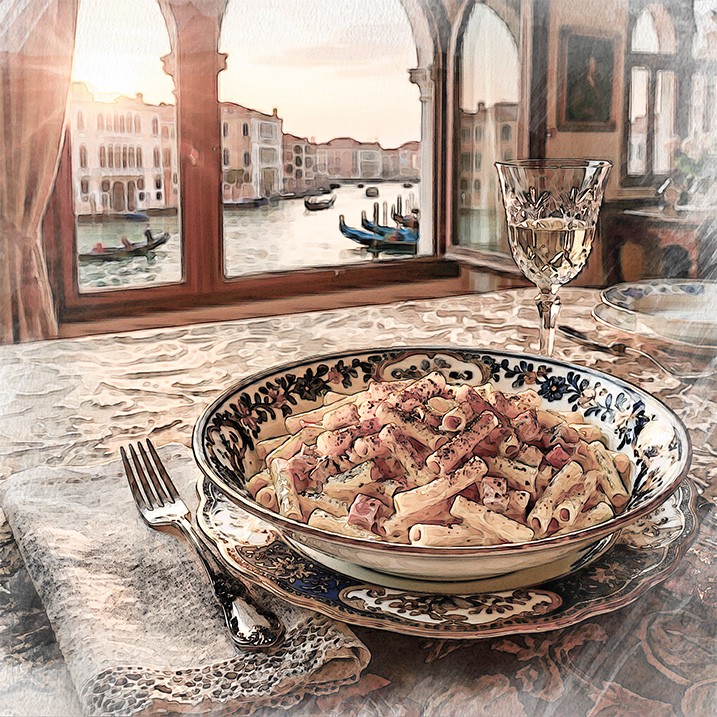
CASANOVA'S MACCHERONI
Maccheroni, breast of capon, loin of pork, cured ham, fresh cream, egg yolks, and sweet cinnamon
Moderate
Veneto
A prelude of forty minutes
710 Kcal
CASANOVA'S MACCHERONI
Maccheroni, breast of capon, loin of pork, cured ham, fresh cream, egg yolks, and sweet cinnamon
Moderate
Veneto
A prelude of forty minutes
710 Kcal
CASANOVA'S MACCHERONI
Maccheroni, breast of capon, loin of pork, cured ham, fresh cream, egg yolks, and sweet cinnamon
Moderate
Veneto
A prelude of forty minutes
710 Kcal
GENESIS
Giacomo Casanova, an emblematic figure of the Venetian eighteenth century, is remembered by history not only as an untiring seducer, but also as a refined intellectual, adventurer, and profound connoisseur of life's pleasures, among which gastronomy held a place of honor. In his celebrated memoirs, entitled "Histoire de ma vie," it emerges clearly how food was, for him, a necessary prelude to love and an art capable of elevating the spirit. He lived in an epoch when the aristocratic cuisine of the Republic of Venice absorbed the influences of Eastern spices and rich European preparations, weaving a unique union of complex flavors. The recipe for macaroni dedicated to him perfectly reflects this eighteenth-century opulence and the penchant for refined combinations.
The use of delicate white meats such as capon breast, bound with the texture of pork loin and the savouriness of cooked ham, directly evokes the lavishly laid tables of the palaces overlooking the Grand Canal. In that historical period, pasta was beginning to consolidate its standing even among the noble classes, often served enriched with noble fats such as butter and perfumed with intense aromas. The presence of cinnamon in the dish is by no means accidental: this spice was considered not only an ingredient of prestige and social distinction, but also a potent natural invigorator, ideal for a man of such a frenetic and adventurous life as Giacomo.
The marriage of cream with egg yolks creates a velvety emulsion that envelops the pasta, transforming each morsel into a multisensory experience that balances the richness with the herbaceous notes of fried sage. To prepare this dish today is to conjure the atmosphere of gallant suppers in the Venice of the Doges, amidst masquerade balls and erudite conversations. The choice of macaroni is functional to cradling the rich sauce flecked with tender meats, ensuring that every taste is harmonious and fulfilling, exactly as the celebrated Venetian would have demanded.
Although the dish draws inspiration from the flavors and social prestige of the 18th century (such as the use of cinnamon or noble fats), the version presented is a modern gastronomic reconstruction. It translates Casanova's adventurous spirit into a precise technical process, conceived to be successfully recreated today.
PORTIONS (FOR 4 PERSONS)
THE RECIPE
Maccheroni
Breast of capon
Pork loin
Diced cured ham
Cream
Butter
Egg yolks
Shallot
Beef broth
Sage
Rosemary
Powdered cinnamon
Peanut oil
Salt
Pepper
320 g
250 g
140 g
80 g
150 g
40 g
3
1
1.5 l
To taste
To taste
To taste
To taste
To taste
To taste
CURATION
For the seasoning:
Begin by finely mincing the shallot, letting it gently wilt in a spacious pan together with the butter. Finely hand-mince the capon breast and the pork loin, reducing them to delicate morsels. Once the shallot has softened into transparency, introduce the minced meats to the pan, along with the diced prosciutto cotto. Infuse this culinary canvas with selected sage leaves and a sprig of rosemary. Allow it to brown for approximately 10 minutes, mindful to stir the meats frequently so they cook uniformly and deeply absorb the aromatics.
In a grand vessel, wed the beef broth with a litre and a half of water. Season lightly with salt, bring to a rolling boil, and drop in the maccheroni. Meanwhile, in a generous bowl, whisk the cream with the egg yolks. Introduce a pinch of salt, a fresh grind of pepper, and a generous dusting of cinnamon. Blend the mixture thoroughly with a whisk or by hand, and set it aside to await its moment. In a separate pan, heat the peanut oil. When the oil is shimmering and hot, flash-fry a handful of sage leaves for a few fleeting moments until they achieve a delicate crispness, then drain them upon absorbent paper.For the finish:
Drain the maccheroni al dente and introduce them directly into the pan holding the meats. Immediately pour in the mixture of cream and egg yolks, tossing the ingredients together over a lively flame for a single minute to bind the rich cream and bring the flavours into perfect harmony. Plate the maccheroni with grace, crowning each serving with the crispy fried sage leaves and a final, poetic dusting of cinnamon.
aspiration
For a more deeply flavored rendition, one might deglaze the meat with a gentle splash of dry Marsala wine before introducing the cream.
Ensure that the delicate liaison of egg and cream does not linger too long over the flame, lest it break and curdle; it must remain fluid, velvety, and sublime.
Should the sauce prove overly dense, you may grace it with a spoonful of warm broth prior to serving.


GENESIS
Giacomo Casanova, an emblematic figure of the Venetian eighteenth century, is remembered by history not only as an untiring seducer, but also as a refined intellectual, adventurer, and profound connoisseur of life's pleasures, among which gastronomy held a place of honor. In his celebrated memoirs, entitled "Histoire de ma vie," it emerges clearly how food was, for him, a necessary prelude to love and an art capable of elevating the spirit. He lived in an epoch when the aristocratic cuisine of the Republic of Venice absorbed the influences of Eastern spices and rich European preparations, weaving a unique union of complex flavors. The recipe for macaroni dedicated to him perfectly reflects this eighteenth-century opulence and the penchant for refined combinations.
The use of delicate white meats such as capon breast, bound with the texture of pork loin and the savouriness of cooked ham, directly evokes the lavishly laid tables of the palaces overlooking the Grand Canal. In that historical period, pasta was beginning to consolidate its standing even among the noble classes, often served enriched with noble fats such as butter and perfumed with intense aromas. The presence of cinnamon in the dish is by no means accidental: this spice was considered not only an ingredient of prestige and social distinction, but also a potent natural invigorator, ideal for a man of such a frenetic and adventurous life as Giacomo.
The marriage of cream with egg yolks creates a velvety emulsion that envelops the pasta, transforming each morsel into a multisensory experience that balances the richness with the herbaceous notes of fried sage. To prepare this dish today is to conjure the atmosphere of gallant suppers in the Venice of the Doges, amidst masquerade balls and erudite conversations. The choice of macaroni is functional to cradling the rich sauce flecked with tender meats, ensuring that every taste is harmonious and fulfilling, exactly as the celebrated Venetian would have demanded.
Although the dish draws inspiration from the flavors and social prestige of the 18th century (such as the use of cinnamon or noble fats), the version presented is a modern gastronomic reconstruction. It translates Casanova's adventurous spirit into a precise technical process, conceived to be successfully recreated today.
PORTIONS (FOR 4 PERSONS)
THE RECIPE
Maccheroni
Breast of capon
Pork loin
Diced cured ham
Cream
Butter
Egg yolks
Shallot
Beef broth
Sage
Rosemary
Powdered cinnamon
Peanut oil
Salt
Pepper
320 g
250 g
140 g
80 g
150 g
40 g
3
1
1.5 l
To taste
To taste
To taste
To taste
To taste
To taste
CURATION
For the seasoning:
Begin by finely mincing the shallot, letting it gently wilt in a spacious pan together with the butter. Finely hand-mince the capon breast and the pork loin, reducing them to delicate morsels. Once the shallot has softened into transparency, introduce the minced meats to the pan, along with the diced prosciutto cotto. Infuse this culinary canvas with selected sage leaves and a sprig of rosemary. Allow it to brown for approximately 10 minutes, mindful to stir the meats frequently so they cook uniformly and deeply absorb the aromatics.
In a grand vessel, wed the beef broth with a litre and a half of water. Season lightly with salt, bring to a rolling boil, and drop in the maccheroni. Meanwhile, in a generous bowl, whisk the cream with the egg yolks. Introduce a pinch of salt, a fresh grind of pepper, and a generous dusting of cinnamon. Blend the mixture thoroughly with a whisk or by hand, and set it aside to await its moment. In a separate pan, heat the peanut oil. When the oil is shimmering and hot, flash-fry a handful of sage leaves for a few fleeting moments until they achieve a delicate crispness, then drain them upon absorbent paper.For the finish:
Drain the maccheroni al dente and introduce them directly into the pan holding the meats. Immediately pour in the mixture of cream and egg yolks, tossing the ingredients together over a lively flame for a single minute to bind the rich cream and bring the flavours into perfect harmony. Plate the maccheroni with grace, crowning each serving with the crispy fried sage leaves and a final, poetic dusting of cinnamon.
aspiration
For a more deeply flavored rendition, one might deglaze the meat with a gentle splash of dry Marsala wine before introducing the cream.
Ensure that the delicate liaison of egg and cream does not linger too long over the flame, lest it break and curdle; it must remain fluid, velvety, and sublime.
Should the sauce prove overly dense, you may grace it with a spoonful of warm broth prior to serving.
latest culinary creations
GENESIS
Giacomo Casanova, an emblematic figure of the Venetian eighteenth century, is remembered by history not only as an untiring seducer, but also as a refined intellectual, adventurer, and profound connoisseur of life's pleasures, among which gastronomy held a place of honor. In his celebrated memoirs, entitled "Histoire de ma vie," it emerges clearly how food was, for him, a necessary prelude to love and an art capable of elevating the spirit. He lived in an epoch when the aristocratic cuisine of the Republic of Venice absorbed the influences of Eastern spices and rich European preparations, weaving a unique union of complex flavors. The recipe for macaroni dedicated to him perfectly reflects this eighteenth-century opulence and the penchant for refined combinations.
The use of delicate white meats such as capon breast, bound with the texture of pork loin and the savouriness of cooked ham, directly evokes the lavishly laid tables of the palaces overlooking the Grand Canal. In that historical period, pasta was beginning to consolidate its standing even among the noble classes, often served enriched with noble fats such as butter and perfumed with intense aromas. The presence of cinnamon in the dish is by no means accidental: this spice was considered not only an ingredient of prestige and social distinction, but also a potent natural invigorator, ideal for a man of such a frenetic and adventurous life as Giacomo.
The marriage of cream with egg yolks creates a velvety emulsion that envelops the pasta, transforming each morsel into a multisensory experience that balances the richness with the herbaceous notes of fried sage. To prepare this dish today is to conjure the atmosphere of gallant suppers in the Venice of the Doges, amidst masquerade balls and erudite conversations. The choice of macaroni is functional to cradling the rich sauce flecked with tender meats, ensuring that every taste is harmonious and fulfilling, exactly as the celebrated Venetian would have demanded.
Although the dish draws inspiration from the flavors and social prestige of the 18th century (such as the use of cinnamon or noble fats), the version presented is a modern gastronomic reconstruction. It translates Casanova's adventurous spirit into a precise technical process, conceived to be successfully recreated today.
PORTIONS (FOR 4 PERSONS)
THE RECIPE
Maccheroni
Breast of capon
Pork loin
Diced cured ham
Cream
Butter
Egg yolks
Shallot
Beef broth
Sage
Rosemary
Powdered cinnamon
Peanut oil
Salt
Pepper
320 g
250 g
140 g
80 g
150 g
40 g
3
1
1.5 l
To taste
To taste
To taste
To taste
To taste
To taste
CURATION
For the seasoning:
Begin by finely mincing the shallot, letting it gently wilt in a spacious pan together with the butter. Finely hand-mince the capon breast and the pork loin, reducing them to delicate morsels. Once the shallot has softened into transparency, introduce the minced meats to the pan, along with the diced prosciutto cotto. Infuse this culinary canvas with selected sage leaves and a sprig of rosemary. Allow it to brown for approximately 10 minutes, mindful to stir the meats frequently so they cook uniformly and deeply absorb the aromatics.
In a grand vessel, wed the beef broth with a litre and a half of water. Season lightly with salt, bring to a rolling boil, and drop in the maccheroni. Meanwhile, in a generous bowl, whisk the cream with the egg yolks. Introduce a pinch of salt, a fresh grind of pepper, and a generous dusting of cinnamon. Blend the mixture thoroughly with a whisk or by hand, and set it aside to await its moment. In a separate pan, heat the peanut oil. When the oil is shimmering and hot, flash-fry a handful of sage leaves for a few fleeting moments until they achieve a delicate crispness, then drain them upon absorbent paper.For the finish:
Drain the maccheroni al dente and introduce them directly into the pan holding the meats. Immediately pour in the mixture of cream and egg yolks, tossing the ingredients together over a lively flame for a single minute to bind the rich cream and bring the flavours into perfect harmony. Plate the maccheroni with grace, crowning each serving with the crispy fried sage leaves and a final, poetic dusting of cinnamon.
aspiration
For a more deeply flavored rendition, one might deglaze the meat with a gentle splash of dry Marsala wine before introducing the cream.
Ensure that the delicate liaison of egg and cream does not linger too long over the flame, lest it break and curdle; it must remain fluid, velvety, and sublime.
Should the sauce prove overly dense, you may grace it with a spoonful of warm broth prior to serving.