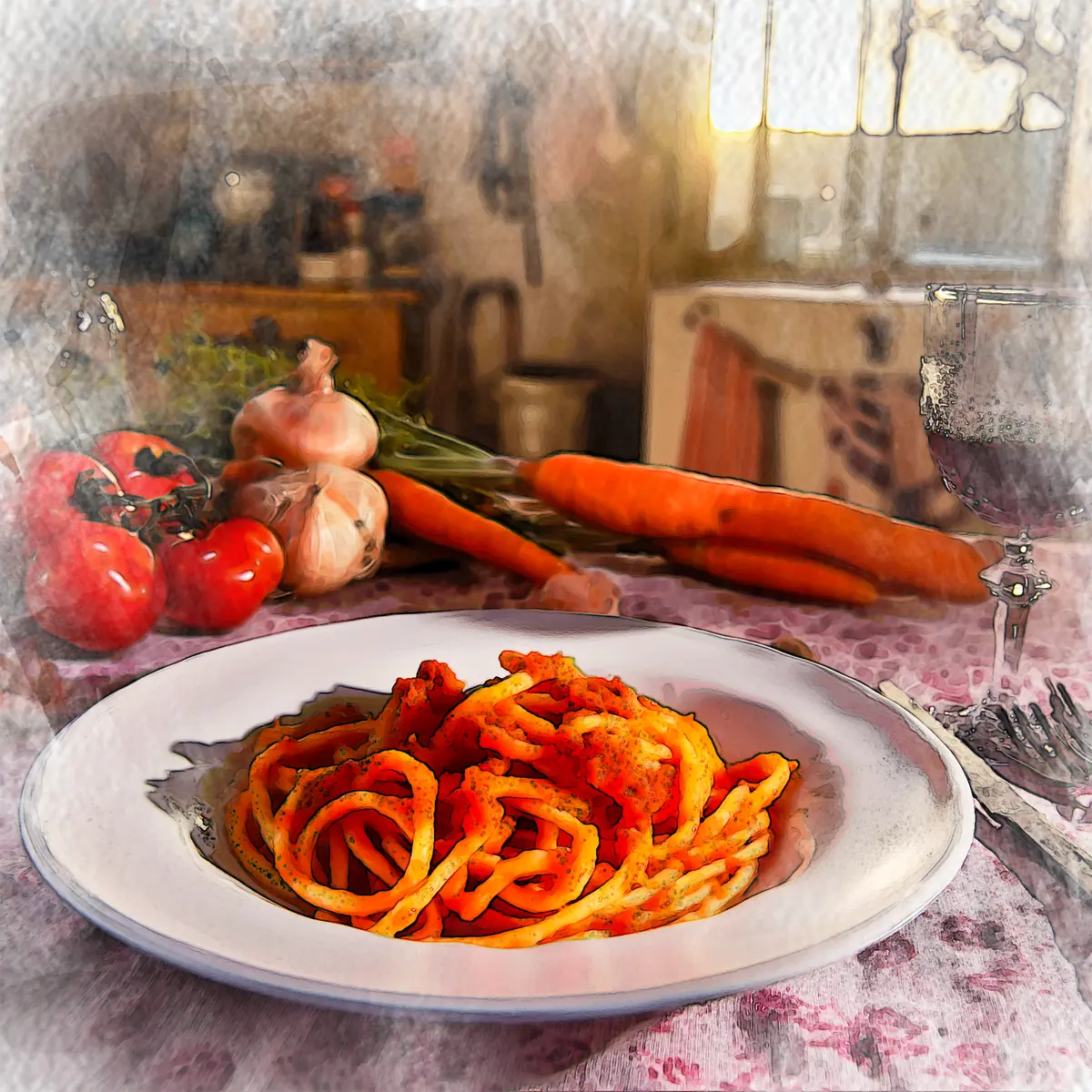
MANATE PASTA GRACED WITH A RUSTIC SAUSAGE RAGÙ
Durum wheat semolina, Artisanal sausage, Peeled plum tomatoes, Pecorino di Filiano
A demanding pursuit
Basilicata
120 minutes
850 Kcal
MANATE PASTA GRACED WITH A RUSTIC SAUSAGE RAGÙ
Durum wheat semolina, Artisanal sausage, Peeled plum tomatoes, Pecorino di Filiano
A demanding pursuit
Basilicata
120 minutes
850 Kcal
MANATE PASTA GRACED WITH A RUSTIC SAUSAGE RAGÙ
Durum wheat semolina, Artisanal sausage, Peeled plum tomatoes, Pecorino di Filiano
A demanding pursuit
Basilicata
120 minutes
850 Kcal
GENESIS
Le Manate, also known by the names Manatelle or Manari, are a form of pasta whose roots are deeply anchored in the rural heritage of Basilicata, particularly within the Potentino region, between the communes of Vaglio and Oppido Lucano.
This culinary creation, so intimately bound to its terroir that it holds the distinction of a Traditional Agri-food Product (PAT), owes its name to the choreography of its creation, entirely manual, or to its final form resembling a skein of wool.
Their singularity resides in an archaic technique of production, which eschews the use of any culinary implement, neither rolling pin nor pasta machine. The dough, composed solely of durum wheat semolina and water, is transformed into an embrace of pasta, a simple ring.
This ring is then coaxed by the hands, slipped within, which with masterful gestures stretch and widen it, refining its form until a long "necklace" is born, wrapped upon itself. The process continues until the desired amplitude is achieved, yielding thick, irregular strands of pasta, reminiscent of hollowless bucatini.
Each manata is a singular masterpiece, testament to an "embodied wisdom"u2014a knowledge not gathered from volumes but handed down through silent observation and practice, from generation to generation.
It is a true artifact of a pre-industrial era, wherein the human hand was the most exquisite instrument in the kitchen. Their robust texture renders them the perfect vessel to receive rich, complex sauces, such as the classic meat ragu00f9.
PORTIONS (FOR 4 PERSONS)
FOR THE PASTA
Durum wheat semolina
Tepid water
Salt
400 g
approximately 200 ml
1 pinch
FOR THE EMBELLISHMENT
Fresh artisanal sausage
Peeled plum tomatoes
Golden sweet onion
Garden-fresh carrot
Stalk of crisp celery
Rich red wine
Pecorino di Filiano DOP
Extra virgin olive oil
Sea salt
Freshly cracked black pepper
Fresh chili pepper
400 g
800 g
1
1
1
1/2 glass
to taste
to taste
to taste
to taste
(optional)
CURATION
For the fresh pasta:
Upon a wooden pastry board, shape the semolina into a noble mound with a well at its center, then gently pour in a pinch of salt and the tepid water, drop by drop. Begin to knead with the tips of your fingers, gradually drawing in the flour until a smooth, firm, and supple dough is born.
Shroud it in a clean linen cloth and let it rest in quiet contemplation for at least thirty minutes. Once its repose is complete, take a portion of the dough and fashion it with your hands into a slender rope. Join the two ends to forge an unbroken ring.
At this moment, the sacred choreography of the Manate begins: slip both hands inside the ring of dough and, with rhythmic, unwavering motions, begin to draw it outward, stretching and refining its form.
Spin the dough between your hands, draping it over itself in successive folds, continuing to pull until you obtain threads of some four to five millimeters in thickness.
Having achieved the desired length, sever the ends of the skein to liberate the individual strands of pasta. Arrange the Manate upon a lightly floured tray.For the condiment:
Prepare a fine mince of onion, carrot, and celery. In a spacious earthenware pot, warm a generous stream of extra virgin olive oil and let the aromatic trilogy sweat over a gentle flame until soft and translucent.
Meanwhile, strip the sausage of its casing and crumble the meat finely with your hands or the tines of a fork. Heighten the flame beneath the soffritto, introduce the sausage, and sear it beautifully, stirring often, until it is deeply golden.
Deglaze with the red wine and allow the spirit of the alcohol to rise and vanish completely. Add the peeled tomatoes, previously crushed by hand, introduce the chili pepper if your palate desires, and season with salt and pepper.
Cover, reduce the flame to its quietest simmer, and let the ragu00f9 simmer deeply for at least an hour and a half, stirring occasionally. The sauce must reduce to become concentrated, dense, and rich with memory.Cooking and Mantecatura:
Bring a generous pot of salted water to a rolling boil and coax the Manate into the water.
Being fresh pasta, they will cook in but a few fleeting minutes; taste them to discern their perfect texture. Drain them directly into the cauldron containing the sausage ragu00f9, reserving a portion of the cooking water. Toss the pasta over a lively flame for a brief moment, stirring to marry the elements in perfect union.
Should it be required, finish with a small ladle of the starchy cooking water. Serve immediately, adorned with a lavish grating of aged Pecorino di Filiano.
aspiration
For an even more authentic flavor, utilize a traditional Lucanian sausage, elegantly perfumed with wild fennel seeds.
As an alternative to the ragù, you may essay a traditional variation that calls for cutting the fresh manate into irregular morsels (akin to quadrucci) and simmering them within a legume soup, most sublimely with chickpeas.
Should the ragù dry excessively during its slow braise, you may gently introduce a ladle of warm water to preserve its perfect, velvety consistency.
Allowing the dough to rest is of paramount importance, ensuring the noble elasticity requisite to facilitate the intricate artistry of hand-stretching.


GENESIS
Le Manate, also known by the names Manatelle or Manari, are a form of pasta whose roots are deeply anchored in the rural heritage of Basilicata, particularly within the Potentino region, between the communes of Vaglio and Oppido Lucano.
This culinary creation, so intimately bound to its terroir that it holds the distinction of a Traditional Agri-food Product (PAT), owes its name to the choreography of its creation, entirely manual, or to its final form resembling a skein of wool.
Their singularity resides in an archaic technique of production, which eschews the use of any culinary implement, neither rolling pin nor pasta machine. The dough, composed solely of durum wheat semolina and water, is transformed into an embrace of pasta, a simple ring.
This ring is then coaxed by the hands, slipped within, which with masterful gestures stretch and widen it, refining its form until a long "necklace" is born, wrapped upon itself. The process continues until the desired amplitude is achieved, yielding thick, irregular strands of pasta, reminiscent of hollowless bucatini.
Each manata is a singular masterpiece, testament to an "embodied wisdom"u2014a knowledge not gathered from volumes but handed down through silent observation and practice, from generation to generation.
It is a true artifact of a pre-industrial era, wherein the human hand was the most exquisite instrument in the kitchen. Their robust texture renders them the perfect vessel to receive rich, complex sauces, such as the classic meat ragu00f9.
PORTIONS (FOR 4 PERSONS)
FOR THE PASTA
Durum wheat semolina
Tepid water
Salt
400 g
approximately 200 ml
1 pinch
FOR THE EMBELLISHMENT
Fresh artisanal sausage
Peeled plum tomatoes
Golden sweet onion
Garden-fresh carrot
Stalk of crisp celery
Rich red wine
Pecorino di Filiano DOP
Extra virgin olive oil
Sea salt
Freshly cracked black pepper
Fresh chili pepper
400 g
800 g
1
1
1
1/2 glass
to taste
to taste
to taste
to taste
(optional)
CURATION
For the fresh pasta:
Upon a wooden pastry board, shape the semolina into a noble mound with a well at its center, then gently pour in a pinch of salt and the tepid water, drop by drop. Begin to knead with the tips of your fingers, gradually drawing in the flour until a smooth, firm, and supple dough is born.
Shroud it in a clean linen cloth and let it rest in quiet contemplation for at least thirty minutes. Once its repose is complete, take a portion of the dough and fashion it with your hands into a slender rope. Join the two ends to forge an unbroken ring.
At this moment, the sacred choreography of the Manate begins: slip both hands inside the ring of dough and, with rhythmic, unwavering motions, begin to draw it outward, stretching and refining its form.
Spin the dough between your hands, draping it over itself in successive folds, continuing to pull until you obtain threads of some four to five millimeters in thickness.
Having achieved the desired length, sever the ends of the skein to liberate the individual strands of pasta. Arrange the Manate upon a lightly floured tray.For the condiment:
Prepare a fine mince of onion, carrot, and celery. In a spacious earthenware pot, warm a generous stream of extra virgin olive oil and let the aromatic trilogy sweat over a gentle flame until soft and translucent.
Meanwhile, strip the sausage of its casing and crumble the meat finely with your hands or the tines of a fork. Heighten the flame beneath the soffritto, introduce the sausage, and sear it beautifully, stirring often, until it is deeply golden.
Deglaze with the red wine and allow the spirit of the alcohol to rise and vanish completely. Add the peeled tomatoes, previously crushed by hand, introduce the chili pepper if your palate desires, and season with salt and pepper.
Cover, reduce the flame to its quietest simmer, and let the ragu00f9 simmer deeply for at least an hour and a half, stirring occasionally. The sauce must reduce to become concentrated, dense, and rich with memory.Cooking and Mantecatura:
Bring a generous pot of salted water to a rolling boil and coax the Manate into the water.
Being fresh pasta, they will cook in but a few fleeting minutes; taste them to discern their perfect texture. Drain them directly into the cauldron containing the sausage ragu00f9, reserving a portion of the cooking water. Toss the pasta over a lively flame for a brief moment, stirring to marry the elements in perfect union.
Should it be required, finish with a small ladle of the starchy cooking water. Serve immediately, adorned with a lavish grating of aged Pecorino di Filiano.
aspiration
For an even more authentic flavor, utilize a traditional Lucanian sausage, elegantly perfumed with wild fennel seeds.
As an alternative to the ragù, you may essay a traditional variation that calls for cutting the fresh manate into irregular morsels (akin to quadrucci) and simmering them within a legume soup, most sublimely with chickpeas.
Should the ragù dry excessively during its slow braise, you may gently introduce a ladle of warm water to preserve its perfect, velvety consistency.
Allowing the dough to rest is of paramount importance, ensuring the noble elasticity requisite to facilitate the intricate artistry of hand-stretching.
latest culinary creations
GENESIS
Le Manate, also known by the names Manatelle or Manari, are a form of pasta whose roots are deeply anchored in the rural heritage of Basilicata, particularly within the Potentino region, between the communes of Vaglio and Oppido Lucano.
This culinary creation, so intimately bound to its terroir that it holds the distinction of a Traditional Agri-food Product (PAT), owes its name to the choreography of its creation, entirely manual, or to its final form resembling a skein of wool.
Their singularity resides in an archaic technique of production, which eschews the use of any culinary implement, neither rolling pin nor pasta machine. The dough, composed solely of durum wheat semolina and water, is transformed into an embrace of pasta, a simple ring.
This ring is then coaxed by the hands, slipped within, which with masterful gestures stretch and widen it, refining its form until a long "necklace" is born, wrapped upon itself. The process continues until the desired amplitude is achieved, yielding thick, irregular strands of pasta, reminiscent of hollowless bucatini.
Each manata is a singular masterpiece, testament to an "embodied wisdom"u2014a knowledge not gathered from volumes but handed down through silent observation and practice, from generation to generation.
It is a true artifact of a pre-industrial era, wherein the human hand was the most exquisite instrument in the kitchen. Their robust texture renders them the perfect vessel to receive rich, complex sauces, such as the classic meat ragu00f9.
PORTIONS (FOR 4 PERSONS)
FOR THE PASTA
Durum wheat semolina
Tepid water
Salt
400 g
approximately 200 ml
1 pinch
FOR THE EMBELLISHMENT
Fresh artisanal sausage
Peeled plum tomatoes
Golden sweet onion
Garden-fresh carrot
Stalk of crisp celery
Rich red wine
Pecorino di Filiano DOP
Extra virgin olive oil
Sea salt
Freshly cracked black pepper
Fresh chili pepper
400 g
800 g
1
1
1
1/2 glass
to taste
to taste
to taste
to taste
(optional)
CURATION
For the fresh pasta:
Upon a wooden pastry board, shape the semolina into a noble mound with a well at its center, then gently pour in a pinch of salt and the tepid water, drop by drop. Begin to knead with the tips of your fingers, gradually drawing in the flour until a smooth, firm, and supple dough is born.
Shroud it in a clean linen cloth and let it rest in quiet contemplation for at least thirty minutes. Once its repose is complete, take a portion of the dough and fashion it with your hands into a slender rope. Join the two ends to forge an unbroken ring.
At this moment, the sacred choreography of the Manate begins: slip both hands inside the ring of dough and, with rhythmic, unwavering motions, begin to draw it outward, stretching and refining its form.
Spin the dough between your hands, draping it over itself in successive folds, continuing to pull until you obtain threads of some four to five millimeters in thickness.
Having achieved the desired length, sever the ends of the skein to liberate the individual strands of pasta. Arrange the Manate upon a lightly floured tray.For the condiment:
Prepare a fine mince of onion, carrot, and celery. In a spacious earthenware pot, warm a generous stream of extra virgin olive oil and let the aromatic trilogy sweat over a gentle flame until soft and translucent.
Meanwhile, strip the sausage of its casing and crumble the meat finely with your hands or the tines of a fork. Heighten the flame beneath the soffritto, introduce the sausage, and sear it beautifully, stirring often, until it is deeply golden.
Deglaze with the red wine and allow the spirit of the alcohol to rise and vanish completely. Add the peeled tomatoes, previously crushed by hand, introduce the chili pepper if your palate desires, and season with salt and pepper.
Cover, reduce the flame to its quietest simmer, and let the ragu00f9 simmer deeply for at least an hour and a half, stirring occasionally. The sauce must reduce to become concentrated, dense, and rich with memory.Cooking and Mantecatura:
Bring a generous pot of salted water to a rolling boil and coax the Manate into the water.
Being fresh pasta, they will cook in but a few fleeting minutes; taste them to discern their perfect texture. Drain them directly into the cauldron containing the sausage ragu00f9, reserving a portion of the cooking water. Toss the pasta over a lively flame for a brief moment, stirring to marry the elements in perfect union.
Should it be required, finish with a small ladle of the starchy cooking water. Serve immediately, adorned with a lavish grating of aged Pecorino di Filiano.
aspiration
For an even more authentic flavor, utilize a traditional Lucanian sausage, elegantly perfumed with wild fennel seeds.
As an alternative to the ragù, you may essay a traditional variation that calls for cutting the fresh manate into irregular morsels (akin to quadrucci) and simmering them within a legume soup, most sublimely with chickpeas.
Should the ragù dry excessively during its slow braise, you may gently introduce a ladle of warm water to preserve its perfect, velvety consistency.
Allowing the dough to rest is of paramount importance, ensuring the noble elasticity requisite to facilitate the intricate artistry of hand-stretching.