genesis
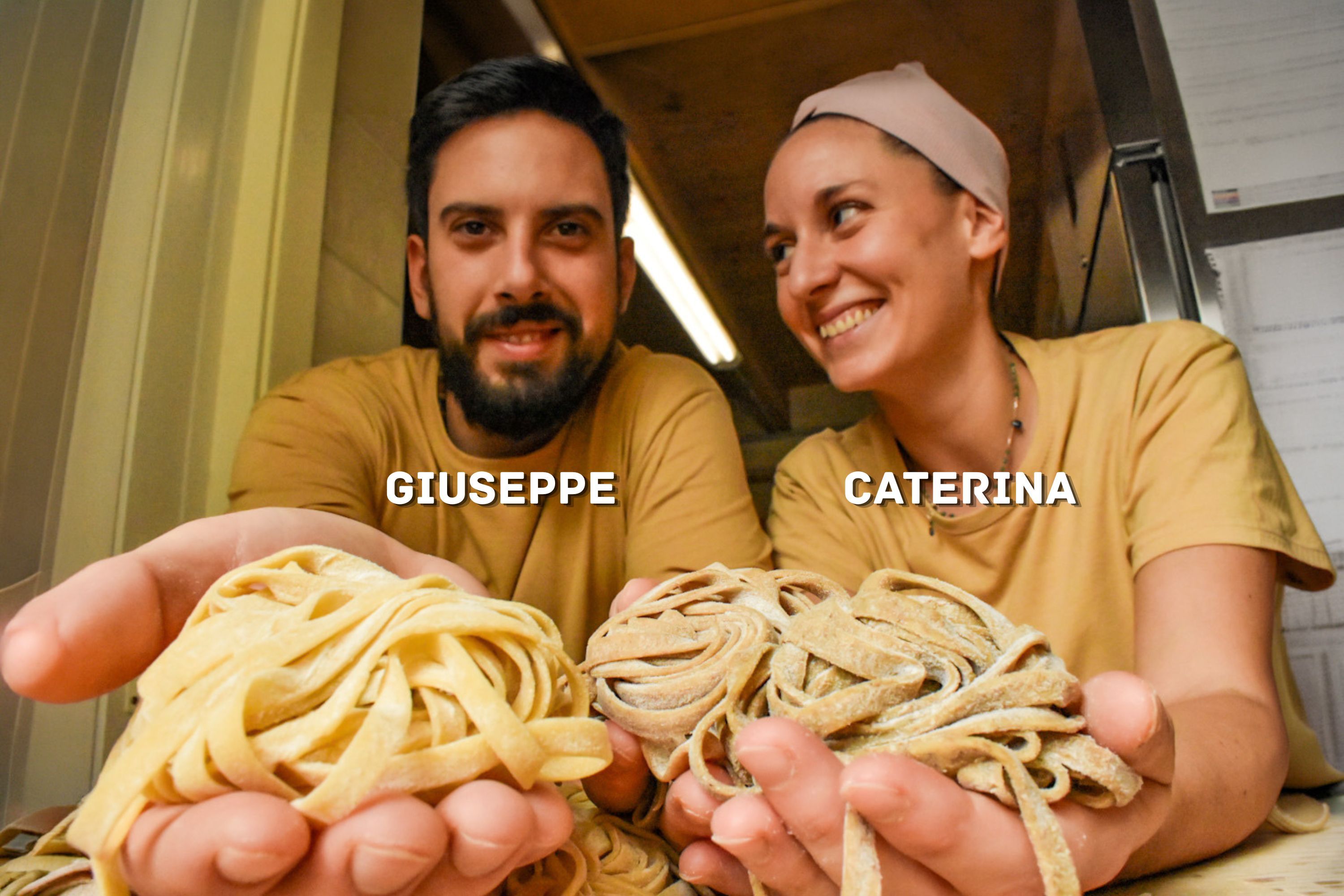
There are establishments that, even before acquiring a name, germinate from an encounter. That between Caterina Galli and Giuseppe Torresin occurred in 2013, within the confines of a London kitchen. She, born and raised in Modena, nourished on a natural intimacy with fresh pasta, was shaped at ALMA; he, hailing from Mestre, emerged from the Giuseppe Maffioli culinary institute of Castelfranco Veneto. They crossed paths while working side by side at Franco’s, subsequently continuing their professional odyssey in Barcelona. From the very beginning, they have been partners in life as they are comrades-in-arms in the kitchen.
Their return to Italy coincided with the 2020 pandemic and that profound suspension which forced many to re-envisage their craft. For them, it became the season in which an intuition began to assume form and substance: to founded a pasta laboratory. They chose Veneto, the native land of Giuseppe, and Spinea—a place where fresh pasta is revered, yet artisanal laboratories remain scarce. In January 2022, Mani in Pasta opened its doors in a rustic venue of timber and raw materials, whispering from the very threshold the poetry of what transpires behind the counter: a daily, tangible labor, entirely wrought on site.
alchemy
The soul of the atelier is deeply Emilian, yet it does not remain static within tradition. Caterina and Giuseppe have mastered its grammar, only to guide it elsewhere, most notably in their stuffed pastas. Alongside the more customary Tortelli, there emerge fillings of red wine-braised beef, ossobuco, or pork ribs: profound stuffings, crafted so that the pasta sheet is no mere vessel, but retains its presence, texture, and bite.
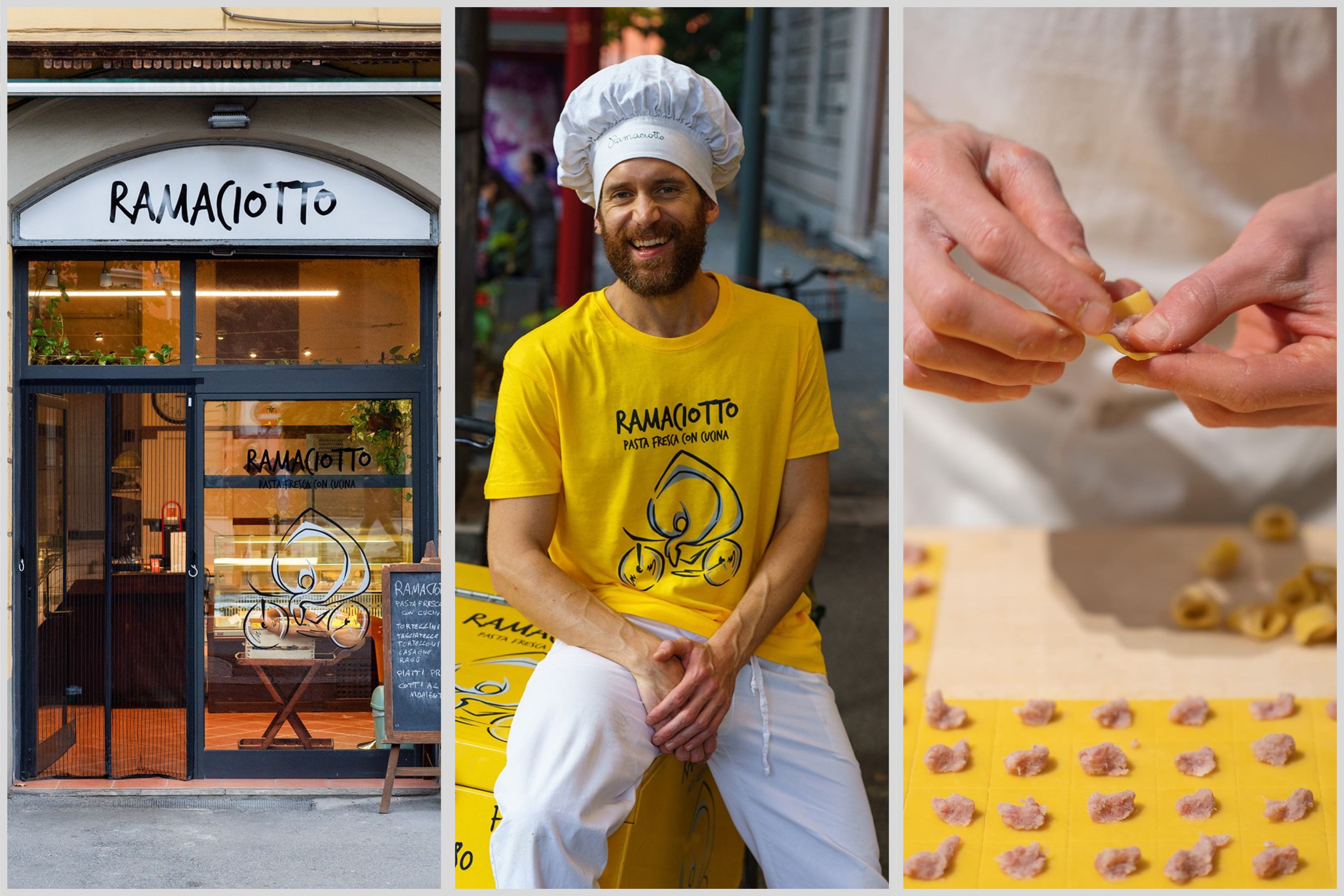
The signature remains the Modenese Tortellino. The egg-rich pasta sheet is delicate yet resilient; the filling honors domestic memory, featuring pork loin, mortadella, prosciutto, Parmigiano Reggiano, and a whisper of nutmeg. In Spinea, where the most familiar point of reference is often the Tortellino of Valeggio or the prosciutto-filled variety, it has become a quiet revelation: the precise point where Caterina's heritage takes root in Giuseppe's homeland.
All around, the counter shifts with the seasons: Bigoli crafted with the traditional press, Tagliatelle (including whole wheat), seven-layer Lasagne, Modenese Rosette, Passatelli, Ravioli, and Tortelli. And furthermore, artisanal compound butters, conceived to accompany the stuffed pasta without eclipsing its character, alongside pestos, sauces, and ragù of duck, poultry, wild boar, or venison.
The alchemy here does not lie in novelty at all costs. It is found in recognizing when a tradition can cross a border without losing its voice. And in allowing two distinct accents, upon the canvas of the pasta sheet, to ultimately find a singular, poetic expression.
provenance



genesis
There are establishments that, even before acquiring a name, germinate from an encounter. That between Caterina Galli and Giuseppe Torresin occurred in 2013, within the confines of a London kitchen. She, born and raised in Modena, nourished on a natural intimacy with fresh pasta, was shaped at ALMA; he, hailing from Mestre, emerged from the Giuseppe Maffioli culinary institute of Castelfranco Veneto. They crossed paths while working side by side at Franco’s, subsequently continuing their professional odyssey in Barcelona. From the very beginning, they have been partners in life as they are comrades-in-arms in the kitchen.
Their return to Italy coincided with the 2020 pandemic and that profound suspension which forced many to re-envisage their craft. For them, it became the season in which an intuition began to assume form and substance: to founded a pasta laboratory. They chose Veneto, the native land of Giuseppe, and Spinea—a place where fresh pasta is revered, yet artisanal laboratories remain scarce. In January 2022, Mani in Pasta opened its doors in a rustic venue of timber and raw materials, whispering from the very threshold the poetry of what transpires behind the counter: a daily, tangible labor, entirely wrought on site.
alchemy
The soul of the atelier is deeply Emilian, yet it does not remain static within tradition. Caterina and Giuseppe have mastered its grammar, only to guide it elsewhere, most notably in their stuffed pastas. Alongside the more customary Tortelli, there emerge fillings of red wine-braised beef, ossobuco, or pork ribs: profound stuffings, crafted so that the pasta sheet is no mere vessel, but retains its presence, texture, and bite.
The signature remains the Modenese Tortellino. The egg-rich pasta sheet is delicate yet resilient; the filling honors domestic memory, featuring pork loin, mortadella, prosciutto, Parmigiano Reggiano, and a whisper of nutmeg. In Spinea, where the most familiar point of reference is often the Tortellino of Valeggio or the prosciutto-filled variety, it has become a quiet revelation: the precise point where Caterina's heritage takes root in Giuseppe's homeland.
All around, the counter shifts with the seasons: Bigoli crafted with the traditional press, Tagliatelle (including whole wheat), seven-layer Lasagne, Modenese Rosette, Passatelli, Ravioli, and Tortelli. And furthermore, artisanal compound butters, conceived to accompany the stuffed pasta without eclipsing its character, alongside pestos, sauces, and ragù of duck, poultry, wild boar, or venison.
The alchemy here does not lie in novelty at all costs. It is found in recognizing when a tradition can cross a border without losing its voice. And in allowing two distinct accents, upon the canvas of the pasta sheet, to ultimately find a singular, poetic expression.
provenance
final heritages
genesis
There are establishments that, even before acquiring a name, germinate from an encounter. That between Caterina Galli and Giuseppe Torresin occurred in 2013, within the confines of a London kitchen. She, born and raised in Modena, nourished on a natural intimacy with fresh pasta, was shaped at ALMA; he, hailing from Mestre, emerged from the Giuseppe Maffioli culinary institute of Castelfranco Veneto. They crossed paths while working side by side at Franco’s, subsequently continuing their professional odyssey in Barcelona. From the very beginning, they have been partners in life as they are comrades-in-arms in the kitchen.
Their return to Italy coincided with the 2020 pandemic and that profound suspension which forced many to re-envisage their craft. For them, it became the season in which an intuition began to assume form and substance: to founded a pasta laboratory. They chose Veneto, the native land of Giuseppe, and Spinea—a place where fresh pasta is revered, yet artisanal laboratories remain scarce. In January 2022, Mani in Pasta opened its doors in a rustic venue of timber and raw materials, whispering from the very threshold the poetry of what transpires behind the counter: a daily, tangible labor, entirely wrought on site.
alchemy
The soul of the atelier is deeply Emilian, yet it does not remain static within tradition. Caterina and Giuseppe have mastered its grammar, only to guide it elsewhere, most notably in their stuffed pastas. Alongside the more customary Tortelli, there emerge fillings of red wine-braised beef, ossobuco, or pork ribs: profound stuffings, crafted so that the pasta sheet is no mere vessel, but retains its presence, texture, and bite.
The signature remains the Modenese Tortellino. The egg-rich pasta sheet is delicate yet resilient; the filling honors domestic memory, featuring pork loin, mortadella, prosciutto, Parmigiano Reggiano, and a whisper of nutmeg. In Spinea, where the most familiar point of reference is often the Tortellino of Valeggio or the prosciutto-filled variety, it has become a quiet revelation: the precise point where Caterina's heritage takes root in Giuseppe's homeland.
All around, the counter shifts with the seasons: Bigoli crafted with the traditional press, Tagliatelle (including whole wheat), seven-layer Lasagne, Modenese Rosette, Passatelli, Ravioli, and Tortelli. And furthermore, artisanal compound butters, conceived to accompany the stuffed pasta without eclipsing its character, alongside pestos, sauces, and ragù of duck, poultry, wild boar, or venison.
The alchemy here does not lie in novelty at all costs. It is found in recognizing when a tradition can cross a border without losing its voice. And in allowing two distinct accents, upon the canvas of the pasta sheet, to ultimately find a singular, poetic expression.