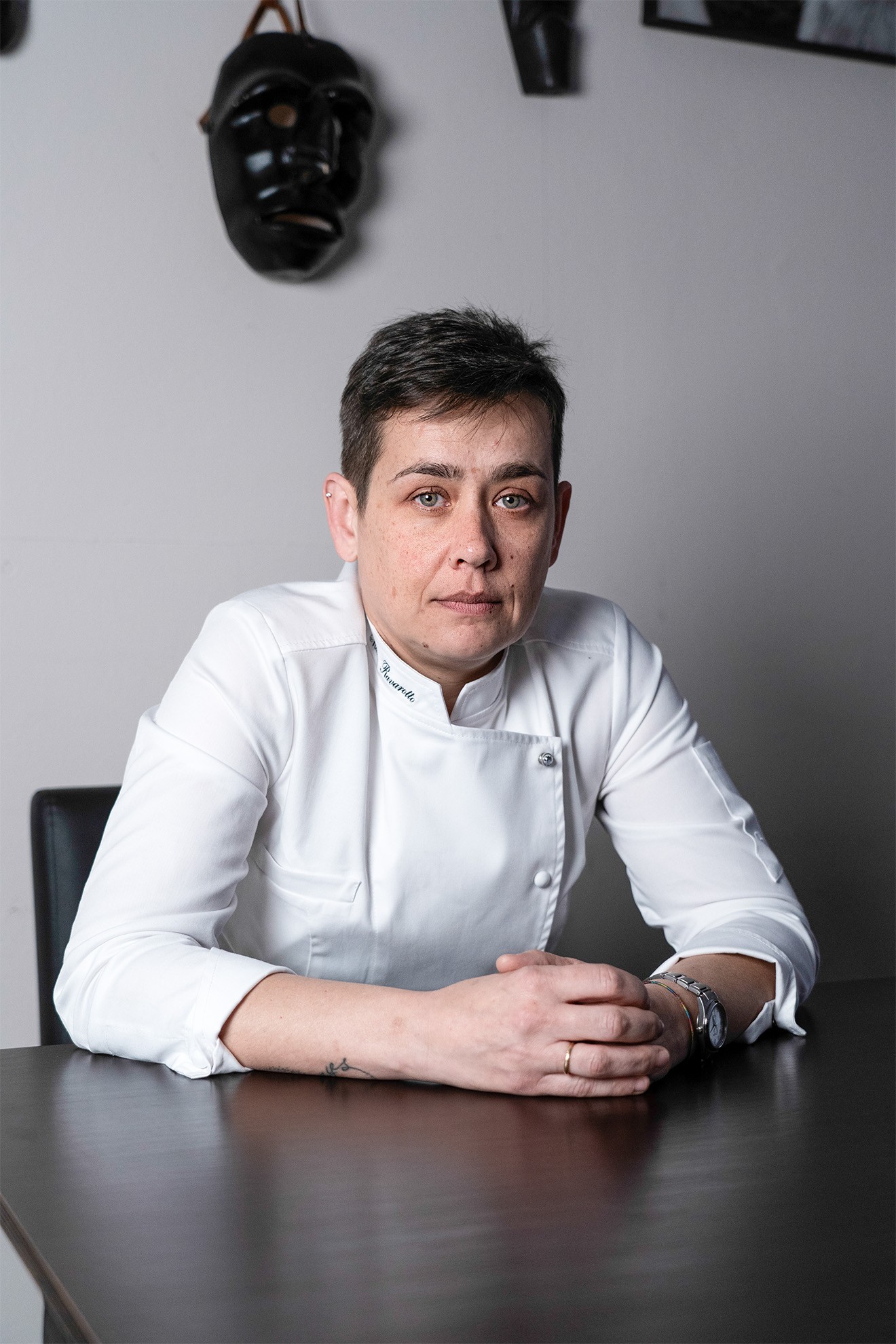
MARINA RAVAROTTO
Roots, fire, contemporary memory
1981
Nuoro
Of Identity - Of Matter
MARINA RAVAROTTO
Roots, fire, contemporary memory
1981
Nuoro
Of Identity - Of Matter
MARINA RAVAROTTO
Roots, fire, contemporary memory
1981
Nuoro
Of Identity - Of Matter
CURRICULUM VITAE
Born in 1981 in Nuoro, the beating heart of Barbagia, Marina Ravarotto has carried within her since childhood a heritage woven of flavors, aromas, and domestic warmth. It was the family feasts, the grandmotherly hands, the extraordinary convergence of two cultures u2014 the Sardinian of Nuoro, where her father Piero's roots run deep, and the South Tyrolean of Bolzano, the homeland of her mother Maria u2014 that forged her gastronomic sensibility.
Upon graduating in 1999 from the ENAP Hotel School of Sardinia, Marina began her journey within the kitchens of her native city, leading to the encounter that would profoundly shape her vision: that with Mario Tirotto, Chef of the Resort Valle dell'Erica in Santa Teresa di Gallura. Under his guidance, she mastered far more than recipes u2014 she absorbed the authentic meaning of devotion, constancy, commitment, and imagination.
Her path continued alongside great protagonists of Sardinian cuisine, such as Stefano Deidda and Roberto Petza, from whom she refined her techniques and plating, solidifying a culinary identity increasingly distinct u2014 rooted in tradition yet receptive to modernity.
In the year 2017, Marina chose to construct her own sanctuary: hence was born the Restaurant ChiaroScuro in Cagliari, freely inspired by the novellas of Grazia Deledda u2014 the Nuorese writer and Nobel Laureate in Literature, with whom she shares not only her native city, but also that narrative vein which transforms every dish into a story.
Through the years, the establishment has flourished, refining its voice and defining its own identity with greater precision. Even the pandemic of 2020, with its shadow of uncertainty, became for Marina an opportunity of discovery: she taught herself the art of weaving 'Su Filindeu' u2014 the "Threads of God" u2014 those ultra-fine tresses of semolina that boast few guardians left in the world, and which demand an almost mystical patience, born of time, devotion, and impassioned study.
Accolades were not long in coming. The crowning achievement arrived in 2023, when Marina Ravarotto entered the Michelin Guide: a milestone reached after years of silent sacrifice, embraced not as a destination, but as a new departure u2014 an inspiration for her, for her brigade, and for all that remains to be written.
dialogues
When did you realize that pasta would become your mother tongue?
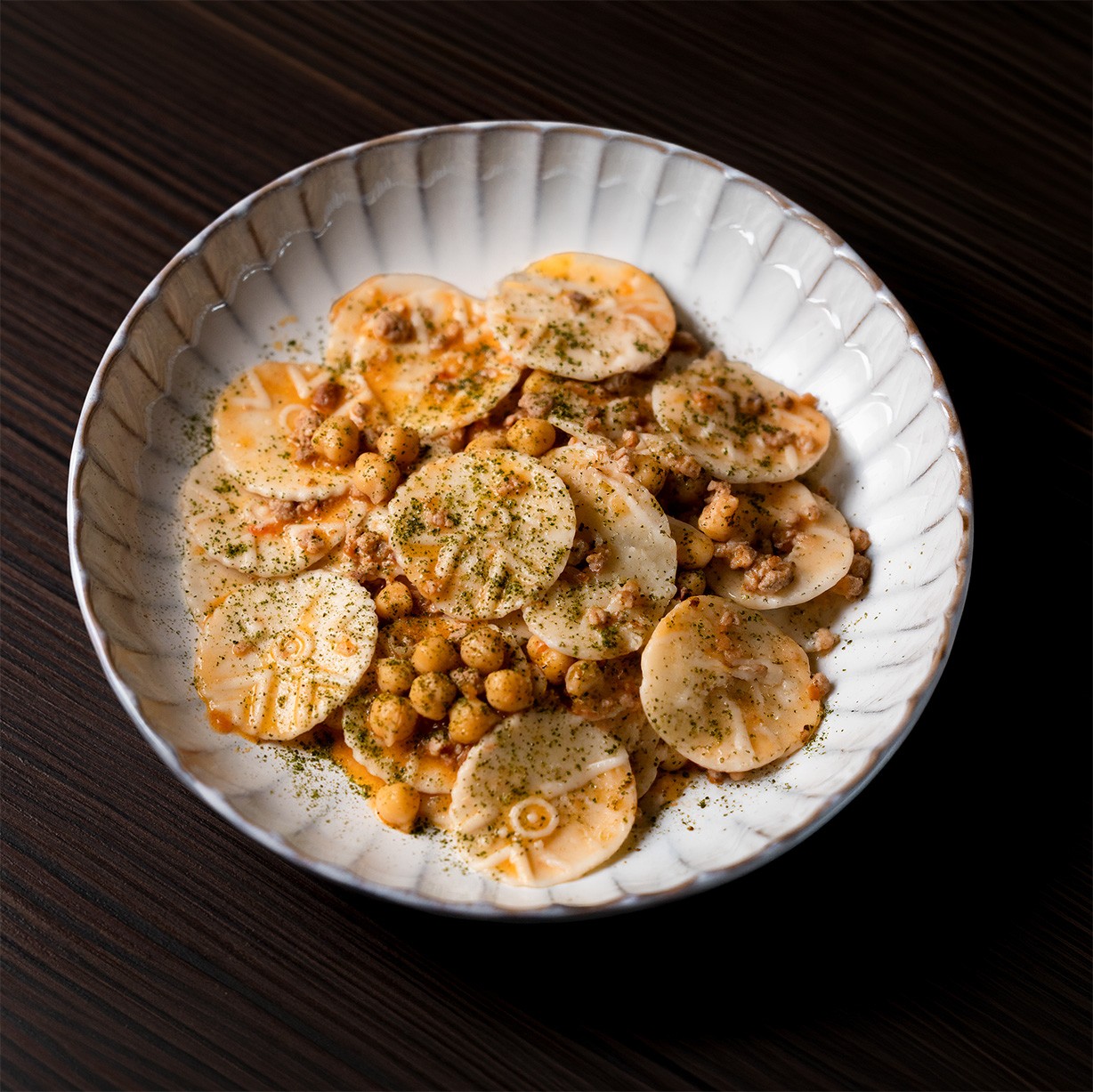
During my time at S'Apposentu with Chef Roberto Petza, I first encountered the 'Tallutzas', a pastoral pasta typical of Marmilla, the region surrounding Siddi, where the restaurant then resided. The Chef explained that in his establishment, this particular shape was reserved solely for children. Yet, it was in working that semolina dough that I felt the call to delve deeper into the sacred world of pasta. From that moment, a quest began—one that was also historical, as the 'Tallutzas' trace their lineage back to the symbolic Sardinian stamp of Sa Pintadera—delving into traditional pastas, while the desire to create and experiment grew ever more fervent within me. Now, whenever I knead, touching the surface with a finger to test its suppleness transports me back to that very day.
If you were to identify with a single pasta shape: what structure, what roughness, and what resilience to the boiling copper would define you?
I am an 'Andarinos': a traditional Sardinian pasta, as textured as the ridges that furrow my brow when I am troubled—restless, and beautifully receptive to everything that surrounds it.
'Su Filindeu' is a votive pasta, a culinary rite of passage, an ancient and exceedingly rare gesture. You acquired this mastery as a self-taught artisan. What is lost, and what is gained, when one learns a sacred pasta without a matriarch?
One forfeits the privilege of absorbing the secrets, the physical intuition, and the ancestral gestures that only a mistress of the craft can bestow. In the case of 'Filindeu', one also misses that ritual sanctity bound to the Feast of San Francesco, which belongs exclusively to the Nuorese matriarchs and cannot be transmitted otherwise. In return, however, one garners boundless patience, absolute devotion, and relentless experimentation—for the fundamental ingredient of this pasta is its profound comprehension. As for myself, I have also gained a sense of inner peace, a stillness that I feel only when my hands fashion this sacred weave.
What do you fiercely defend within the culinary heritage of Barbagia, and what did you struggle, yet manage, to translate into a contemporary lexicon?
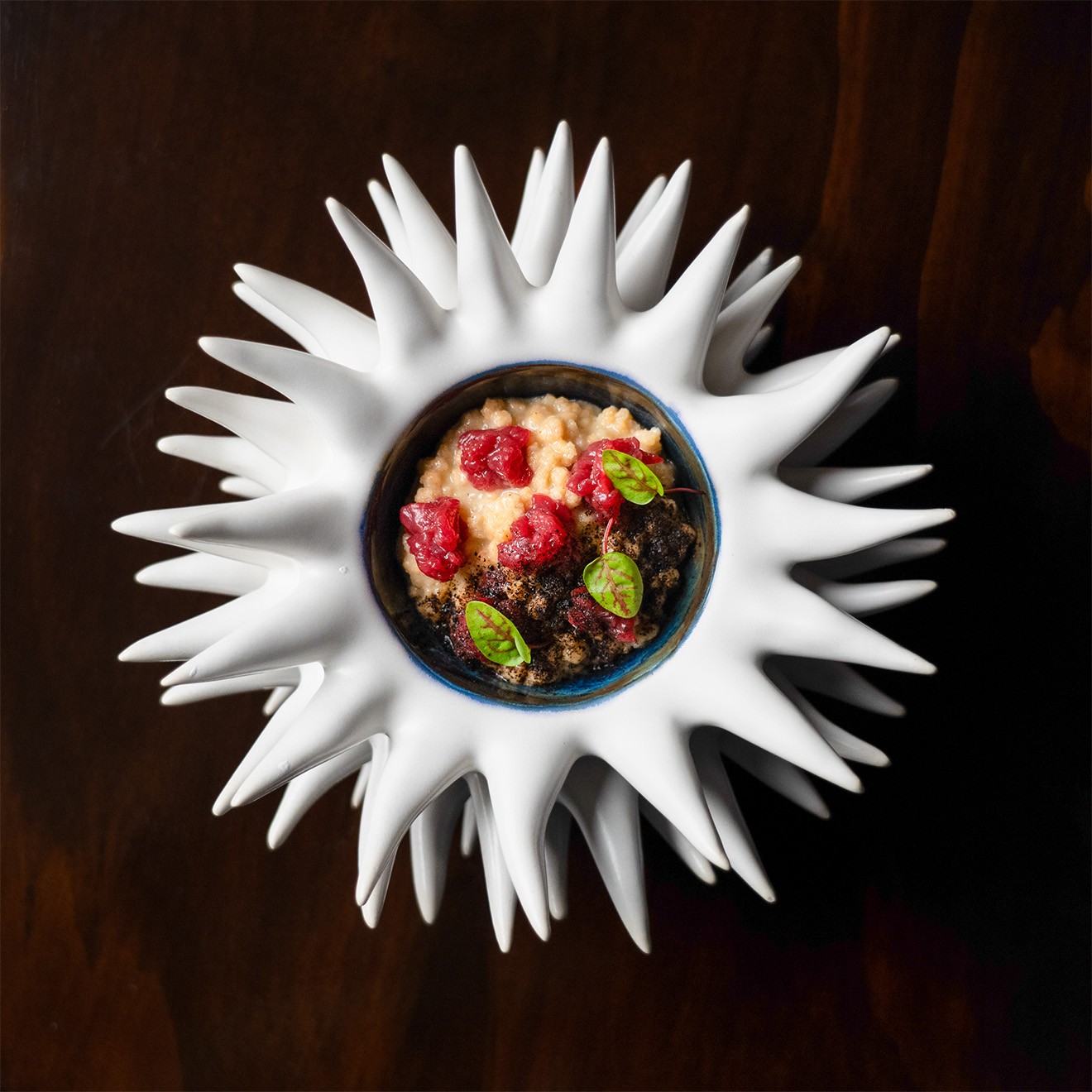
With fierce devotion, I champion Su Pane Frattau, a relic of my childhood and of the city of Nuoro. In a modern key, I have reinterpreted the Filindeu, refining its broth through clarification to further elevate the majesty of this rare pasta.
From Su Filindeu to Is Gravellus, and Maccarrones de busa: when you choose to place them on your menu, what is your quest—fidelity, narrative necessity, technical virtuosity, or personal emotion?
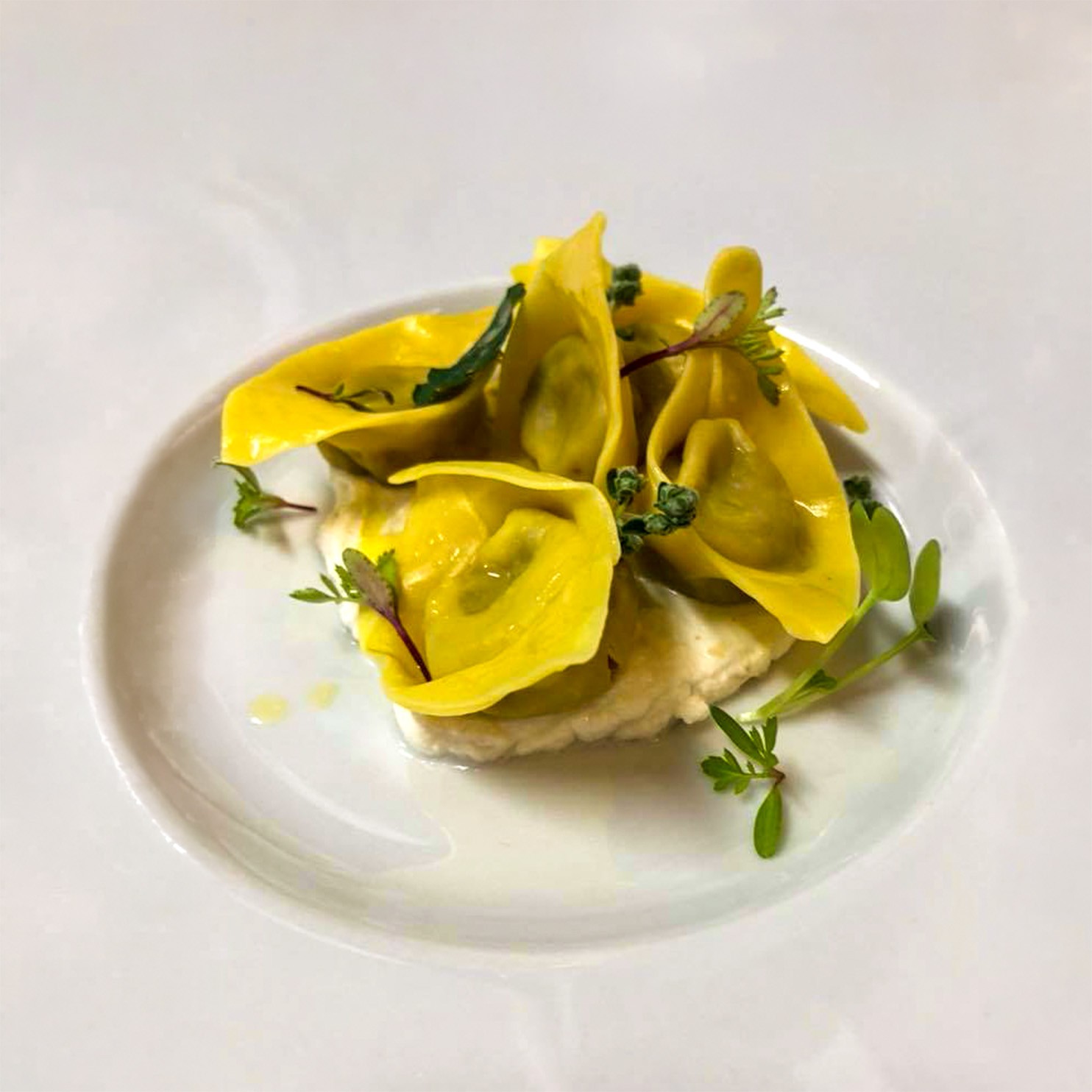
My quest is to narrate the entirety of Sardinian pastas in their diverse geometry. The 'Filindeu' graces the menu all year round; with each changing season, we introduce a new shape, selecting the one that best harmonizes with the earth's cycle. There are still shapes I have yet to introduce: among these are 'Sappuedus', native to Sulcis Iglesiente—revealed to us by our Maître d' Barbara—and 'Su Pitzudu' of Ovodda.
Water, semolina, salt, and hands: the dough of 'Filindeu' is of an absolute, monastic simplicity. How does one work with the absolute minimum without falling into austerity?
The secret lies in that very purity. The Filindeu demands discipline and an unyielding reverence for each step: that is the essence. It is not a matter of adding, but of subtracting nothing from what is already whole.
The elixir of the broth requires more time than the pasta itself. How heavy is the weight of this unseen element compared to the form that ultimately graces the table?
Every element is sacred in the architecture of the dish. In the case of 'Filindeu', the broth must be a master of balance, subtly spiced, meticulously calibrated in every ingredient: from the herbs to the wild mutton. The ultimate aim is to forge an equilibrium that simultaneously crowns the pasta—the true sovereign of the plate.
You inhabit two roles: chef and entrepreneur. When these two identities clash, which one triumphs—and at what cost?
The chef always reigns supreme. The cost is that decisions are not always dictated by mercantile gain, but by the relentless thirst to experiment and to offer a voice to my native land.
ChiaroScuro is a restaurant born of a definitive stance: to remain in Sardinia, defining the spirit of Barbagia from the shores of Cagliari. How heavy is the distance between the land you conjure and the kitchen in which you cook?
The distance between Nuoro and Cagliari is deeply felt, but over time I have uncovered a harmonious balance. Establishing a meat-centric restaurant in Cagliari eight years ago was a daring venture; time has vindicated my resolve. Patrons are curious, they return, and this brings immense fulfillment. One ingredient I have not yet managed to bring to the menu is trout. Nuoro is far from the sea, and river trout has always been the definitive fish of those highlands. The seafood dishes on our current menu pay homage to the Gulf of Angels that embraces us: this is why, for now, the trout has not yet found its place.
If you were to bestow a future upon pasta, what shape would it take?
I would simply hand down the ancestral shapes that already belong to our heritage, for tradition is ever the foundation upon which we must sculpt the future.
CURRICULUM VITAE
Born in 1981 in Nuoro, the beating heart of Barbagia, Marina Ravarotto has carried within her since childhood a heritage woven of flavors, aromas, and domestic warmth. It was the family feasts, the grandmotherly hands, the extraordinary convergence of two cultures u2014 the Sardinian of Nuoro, where her father Piero's roots run deep, and the South Tyrolean of Bolzano, the homeland of her mother Maria u2014 that forged her gastronomic sensibility.
Upon graduating in 1999 from the ENAP Hotel School of Sardinia, Marina began her journey within the kitchens of her native city, leading to the encounter that would profoundly shape her vision: that with Mario Tirotto, Chef of the Resort Valle dell'Erica in Santa Teresa di Gallura. Under his guidance, she mastered far more than recipes u2014 she absorbed the authentic meaning of devotion, constancy, commitment, and imagination.
Her path continued alongside great protagonists of Sardinian cuisine, such as Stefano Deidda and Roberto Petza, from whom she refined her techniques and plating, solidifying a culinary identity increasingly distinct u2014 rooted in tradition yet receptive to modernity.
In the year 2017, Marina chose to construct her own sanctuary: hence was born the Restaurant ChiaroScuro in Cagliari, freely inspired by the novellas of Grazia Deledda u2014 the Nuorese writer and Nobel Laureate in Literature, with whom she shares not only her native city, but also that narrative vein which transforms every dish into a story.
Through the years, the establishment has flourished, refining its voice and defining its own identity with greater precision. Even the pandemic of 2020, with its shadow of uncertainty, became for Marina an opportunity of discovery: she taught herself the art of weaving 'Su Filindeu' u2014 the "Threads of God" u2014 those ultra-fine tresses of semolina that boast few guardians left in the world, and which demand an almost mystical patience, born of time, devotion, and impassioned study.
Accolades were not long in coming. The crowning achievement arrived in 2023, when Marina Ravarotto entered the Michelin Guide: a milestone reached after years of silent sacrifice, embraced not as a destination, but as a new departure u2014 an inspiration for her, for her brigade, and for all that remains to be written.
dialogues
When did you realize that pasta would become your mother tongue?
During my time at S'Apposentu with Chef Roberto Petza, I first encountered the 'Tallutzas', a pastoral pasta typical of Marmilla, the region surrounding Siddi, where the restaurant then resided. The Chef explained that in his establishment, this particular shape was reserved solely for children. Yet, it was in working that semolina dough that I felt the call to delve deeper into the sacred world of pasta. From that moment, a quest began—one that was also historical, as the 'Tallutzas' trace their lineage back to the symbolic Sardinian stamp of Sa Pintadera—delving into traditional pastas, while the desire to create and experiment grew ever more fervent within me. Now, whenever I knead, touching the surface with a finger to test its suppleness transports me back to that very day.
If you were to identify with a single pasta shape: what structure, what roughness, and what resilience to the boiling copper would define you?
I am an 'Andarinos': a traditional Sardinian pasta, as textured as the ridges that furrow my brow when I am troubled—restless, and beautifully receptive to everything that surrounds it.
'Su Filindeu' is a votive pasta, a culinary rite of passage, an ancient and exceedingly rare gesture. You acquired this mastery as a self-taught artisan. What is lost, and what is gained, when one learns a sacred pasta without a matriarch?
One forfeits the privilege of absorbing the secrets, the physical intuition, and the ancestral gestures that only a mistress of the craft can bestow. In the case of 'Filindeu', one also misses that ritual sanctity bound to the Feast of San Francesco, which belongs exclusively to the Nuorese matriarchs and cannot be transmitted otherwise. In return, however, one garners boundless patience, absolute devotion, and relentless experimentation—for the fundamental ingredient of this pasta is its profound comprehension. As for myself, I have also gained a sense of inner peace, a stillness that I feel only when my hands fashion this sacred weave.
What do you fiercely defend within the culinary heritage of Barbagia, and what did you struggle, yet manage, to translate into a contemporary lexicon?
With fierce devotion, I champion Su Pane Frattau, a relic of my childhood and of the city of Nuoro. In a modern key, I have reinterpreted the Filindeu, refining its broth through clarification to further elevate the majesty of this rare pasta.
From Su Filindeu to Is Gravellus, and Maccarrones de busa: when you choose to place them on your menu, what is your quest—fidelity, narrative necessity, technical virtuosity, or personal emotion?
My quest is to narrate the entirety of Sardinian pastas in their diverse geometry. The 'Filindeu' graces the menu all year round; with each changing season, we introduce a new shape, selecting the one that best harmonizes with the earth's cycle. There are still shapes I have yet to introduce: among these are 'Sappuedus', native to Sulcis Iglesiente—revealed to us by our Maître d' Barbara—and 'Su Pitzudu' of Ovodda.
Water, semolina, salt, and hands: the dough of 'Filindeu' is of an absolute, monastic simplicity. How does one work with the absolute minimum without falling into austerity?
The secret lies in that very purity. The Filindeu demands discipline and an unyielding reverence for each step: that is the essence. It is not a matter of adding, but of subtracting nothing from what is already whole.
The elixir of the broth requires more time than the pasta itself. How heavy is the weight of this unseen element compared to the form that ultimately graces the table?
Every element is sacred in the architecture of the dish. In the case of 'Filindeu', the broth must be a master of balance, subtly spiced, meticulously calibrated in every ingredient: from the herbs to the wild mutton. The ultimate aim is to forge an equilibrium that simultaneously crowns the pasta—the true sovereign of the plate.
You inhabit two roles: chef and entrepreneur. When these two identities clash, which one triumphs—and at what cost?
The chef always reigns supreme. The cost is that decisions are not always dictated by mercantile gain, but by the relentless thirst to experiment and to offer a voice to my native land.
ChiaroScuro is a restaurant born of a definitive stance: to remain in Sardinia, defining the spirit of Barbagia from the shores of Cagliari. How heavy is the distance between the land you conjure and the kitchen in which you cook?
The distance between Nuoro and Cagliari is deeply felt, but over time I have uncovered a harmonious balance. Establishing a meat-centric restaurant in Cagliari eight years ago was a daring venture; time has vindicated my resolve. Patrons are curious, they return, and this brings immense fulfillment. One ingredient I have not yet managed to bring to the menu is trout. Nuoro is far from the sea, and river trout has always been the definitive fish of those highlands. The seafood dishes on our current menu pay homage to the Gulf of Angels that embraces us: this is why, for now, the trout has not yet found its place.
If you were to bestow a future upon pasta, what shape would it take?
I would simply hand down the ancestral shapes that already belong to our heritage, for tradition is ever the foundation upon which we must sculpt the future.
CURRICULUM VITAE
Born in 1981 in Nuoro, the beating heart of Barbagia, Marina Ravarotto has carried within her since childhood a heritage woven of flavors, aromas, and domestic warmth. It was the family feasts, the grandmotherly hands, the extraordinary convergence of two cultures u2014 the Sardinian of Nuoro, where her father Piero's roots run deep, and the South Tyrolean of Bolzano, the homeland of her mother Maria u2014 that forged her gastronomic sensibility.
Upon graduating in 1999 from the ENAP Hotel School of Sardinia, Marina began her journey within the kitchens of her native city, leading to the encounter that would profoundly shape her vision: that with Mario Tirotto, Chef of the Resort Valle dell'Erica in Santa Teresa di Gallura. Under his guidance, she mastered far more than recipes u2014 she absorbed the authentic meaning of devotion, constancy, commitment, and imagination.
Her path continued alongside great protagonists of Sardinian cuisine, such as Stefano Deidda and Roberto Petza, from whom she refined her techniques and plating, solidifying a culinary identity increasingly distinct u2014 rooted in tradition yet receptive to modernity.
In the year 2017, Marina chose to construct her own sanctuary: hence was born the Restaurant ChiaroScuro in Cagliari, freely inspired by the novellas of Grazia Deledda u2014 the Nuorese writer and Nobel Laureate in Literature, with whom she shares not only her native city, but also that narrative vein which transforms every dish into a story.
Through the years, the establishment has flourished, refining its voice and defining its own identity with greater precision. Even the pandemic of 2020, with its shadow of uncertainty, became for Marina an opportunity of discovery: she taught herself the art of weaving 'Su Filindeu' u2014 the "Threads of God" u2014 those ultra-fine tresses of semolina that boast few guardians left in the world, and which demand an almost mystical patience, born of time, devotion, and impassioned study.
Accolades were not long in coming. The crowning achievement arrived in 2023, when Marina Ravarotto entered the Michelin Guide: a milestone reached after years of silent sacrifice, embraced not as a destination, but as a new departure u2014 an inspiration for her, for her brigade, and for all that remains to be written.
dialogues
When did you realize that pasta would become your mother tongue?
During my time at S'Apposentu with Chef Roberto Petza, I first encountered the 'Tallutzas', a pastoral pasta typical of Marmilla, the region surrounding Siddi, where the restaurant then resided. The Chef explained that in his establishment, this particular shape was reserved solely for children. Yet, it was in working that semolina dough that I felt the call to delve deeper into the sacred world of pasta. From that moment, a quest began—one that was also historical, as the 'Tallutzas' trace their lineage back to the symbolic Sardinian stamp of Sa Pintadera—delving into traditional pastas, while the desire to create and experiment grew ever more fervent within me. Now, whenever I knead, touching the surface with a finger to test its suppleness transports me back to that very day.
If you were to identify with a single pasta shape: what structure, what roughness, and what resilience to the boiling copper would define you?
I am an 'Andarinos': a traditional Sardinian pasta, as textured as the ridges that furrow my brow when I am troubled—restless, and beautifully receptive to everything that surrounds it.
'Su Filindeu' is a votive pasta, a culinary rite of passage, an ancient and exceedingly rare gesture. You acquired this mastery as a self-taught artisan. What is lost, and what is gained, when one learns a sacred pasta without a matriarch?
One forfeits the privilege of absorbing the secrets, the physical intuition, and the ancestral gestures that only a mistress of the craft can bestow. In the case of 'Filindeu', one also misses that ritual sanctity bound to the Feast of San Francesco, which belongs exclusively to the Nuorese matriarchs and cannot be transmitted otherwise. In return, however, one garners boundless patience, absolute devotion, and relentless experimentation—for the fundamental ingredient of this pasta is its profound comprehension. As for myself, I have also gained a sense of inner peace, a stillness that I feel only when my hands fashion this sacred weave.
What do you fiercely defend within the culinary heritage of Barbagia, and what did you struggle, yet manage, to translate into a contemporary lexicon?
With fierce devotion, I champion Su Pane Frattau, a relic of my childhood and of the city of Nuoro. In a modern key, I have reinterpreted the Filindeu, refining its broth through clarification to further elevate the majesty of this rare pasta.
From Su Filindeu to Is Gravellus, and Maccarrones de busa: when you choose to place them on your menu, what is your quest—fidelity, narrative necessity, technical virtuosity, or personal emotion?
My quest is to narrate the entirety of Sardinian pastas in their diverse geometry. The 'Filindeu' graces the menu all year round; with each changing season, we introduce a new shape, selecting the one that best harmonizes with the earth's cycle. There are still shapes I have yet to introduce: among these are 'Sappuedus', native to Sulcis Iglesiente—revealed to us by our Maître d' Barbara—and 'Su Pitzudu' of Ovodda.
Water, semolina, salt, and hands: the dough of 'Filindeu' is of an absolute, monastic simplicity. How does one work with the absolute minimum without falling into austerity?
The secret lies in that very purity. The Filindeu demands discipline and an unyielding reverence for each step: that is the essence. It is not a matter of adding, but of subtracting nothing from what is already whole.
The elixir of the broth requires more time than the pasta itself. How heavy is the weight of this unseen element compared to the form that ultimately graces the table?
Every element is sacred in the architecture of the dish. In the case of 'Filindeu', the broth must be a master of balance, subtly spiced, meticulously calibrated in every ingredient: from the herbs to the wild mutton. The ultimate aim is to forge an equilibrium that simultaneously crowns the pasta—the true sovereign of the plate.
You inhabit two roles: chef and entrepreneur. When these two identities clash, which one triumphs—and at what cost?
The chef always reigns supreme. The cost is that decisions are not always dictated by mercantile gain, but by the relentless thirst to experiment and to offer a voice to my native land.
ChiaroScuro is a restaurant born of a definitive stance: to remain in Sardinia, defining the spirit of Barbagia from the shores of Cagliari. How heavy is the distance between the land you conjure and the kitchen in which you cook?
The distance between Nuoro and Cagliari is deeply felt, but over time I have uncovered a harmonious balance. Establishing a meat-centric restaurant in Cagliari eight years ago was a daring venture; time has vindicated my resolve. Patrons are curious, they return, and this brings immense fulfillment. One ingredient I have not yet managed to bring to the menu is trout. Nuoro is far from the sea, and river trout has always been the definitive fish of those highlands. The seafood dishes on our current menu pay homage to the Gulf of Angels that embraces us: this is why, for now, the trout has not yet found its place.
If you were to bestow a future upon pasta, what shape would it take?
I would simply hand down the ancestral shapes that already belong to our heritage, for tradition is ever the foundation upon which we must sculpt the future.