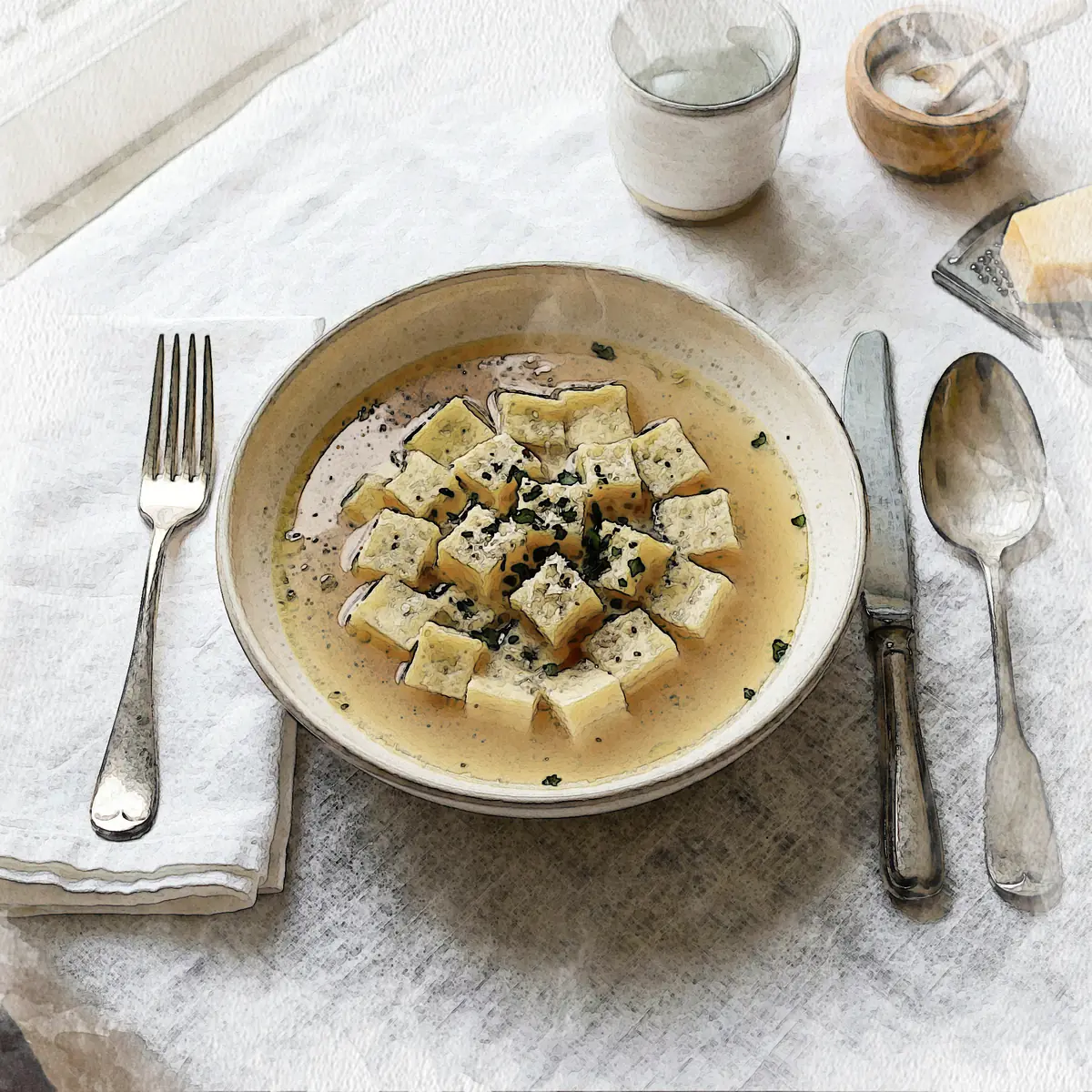
SOUP IN A SATCHEL
Eggs, Parmigiano Reggiano, grated breadcrumbs, flour, a whisper of nutmeg, and a rich meat broth
Effortless
Emilia-Romagna
A journey of ninety minutes
540 Kcal
SOUP IN A SATCHEL
Eggs, Parmigiano Reggiano, grated breadcrumbs, flour, a whisper of nutmeg, and a rich meat broth
Effortless
Emilia-Romagna
A journey of ninety minutes
540 Kcal
SOUP IN A SATCHEL
Eggs, Parmigiano Reggiano, grated breadcrumbs, flour, a whisper of nutmeg, and a rich meat broth
Effortless
Emilia-Romagna
A journey of ninety minutes
540 Kcal
GENESIS
Minestra nel sacchetto (soup in a bag) is an ancient preparation belonging to the rural heritage of Romagna, most notably in the borderlands reaching towards Montefeltro. This dish embodies the profound ingenuity of peasant families who, possessing only a few elemental ingredients, succeeded in fashioning nourishing and celebratory feasts for holy days. Historically, the recipe was born of the need to craft a soup sharing the density and flavor of passatelli, yet employing a distinct cooking method to preserve its structural integrity. The foundational ingredients are those classic to the Romagnolo larder: fresh eggs, aged cheese, grated stale bread, and a whisper of flour, incorporated to bestow greater structure to the dough. Its name derives from the use of a white canvas sack, typically of linen or cotton, within whose embrace the dough is enclosed before being submerged into the simmering broth. This technique permitted the housewives of old to cook the soup alongside the meats of the broth without the two elements mingling excessively, thereby keeping the liquid pristine. Through the course of a long boil, the dough cradled in the sack undergoes a translation of steaming and absorption, transforming into a solid mass perfumed with nutmeg and lemon zest. Once retrieved and sliced, the "saccottino" reveals a singular texture, slightly firmer than traditional passatelli. In epochs past, this soup was presented at Sunday winter feasts or during sacred solemnities, bathed in a rich, golden meat broth born of the slow simmering of beef cuts and free-range hen. Today, the recipe is jealousy guarded by maternal matriarchs, who pass down the vital importance of utilizing natural, untainted textiles, free from any chemical scent, so as not to compromise the pure, sacred flavors of the cheese and eggs.
PORTIONS (FOR 4 PERSONS)
FOR THE SACRED ART OF FRESH PASTA
Eggs
Parmigiano Reggiano
Finely grated breadcrumbs
Flour
Nutmeg
Grated lemon zest
Salt
3
100 gr
100 gr
50 gr
To taste
To taste
To taste
FOR THE EMBELLISHMENT
Consommé of fine meats
1.5 l
CURATION
For the fresh pasta:
In a vessel, release the eggs and whisk them gently with a fork. Combine the grated Parmigiano Reggiano, the breadcrumbs, and the flour. Introduce the salt, the nutmeg, and the grated lemon zest. Knead the mixture with your hands until it coalesces into a homogeneous and compact dough. Take a sack of tightly woven linen or cotton canvas, ensuring it is meticulously clean and odorless, and place the dough within. Secure the sack with kitchen twine, taking care to leave generous space above the mass, as its volume will expand slightly during the sacred act of cooking.For the condiment:
Prepare a classic meat broth utilizing beef and capon, filter it with utmost care, and bring it to a boil in a spacious cauldron. When the broth sings its boiling song, submerge the sack containing the dough and lower the flame. Allow it to simmer gently for approximately 60 minutes. Once the cooking is complete, retrieve the sack from the broth and rest it upon a wooden board. Let it repose for a few moments, allowing the pasta to settle and firm. Untie the twine, extract the block, and carve it into thick slices or small, uniform cubes. Re-immerse these pieces of pasta into the boiling broth for a single minute, and serve the soup piping hot.
aspiration
For a more intense aromatic note, grate the nutmeg afresh at the very moment of preparation.
Ensure the muslin bag has not been laundered with scented softeners, which could compromise the delicate harmony of the recipe's flavors.
Should the mixture prove too yielding, introduce an additional spoonful of breadcrumbs to restore perfect equilibrium to the texture.
You may elevate the presentation of the soup by dusting it with a final whisper of Parmigiano Reggiano directly in the bowl.


GENESIS
Minestra nel sacchetto (soup in a bag) is an ancient preparation belonging to the rural heritage of Romagna, most notably in the borderlands reaching towards Montefeltro. This dish embodies the profound ingenuity of peasant families who, possessing only a few elemental ingredients, succeeded in fashioning nourishing and celebratory feasts for holy days. Historically, the recipe was born of the need to craft a soup sharing the density and flavor of passatelli, yet employing a distinct cooking method to preserve its structural integrity. The foundational ingredients are those classic to the Romagnolo larder: fresh eggs, aged cheese, grated stale bread, and a whisper of flour, incorporated to bestow greater structure to the dough. Its name derives from the use of a white canvas sack, typically of linen or cotton, within whose embrace the dough is enclosed before being submerged into the simmering broth. This technique permitted the housewives of old to cook the soup alongside the meats of the broth without the two elements mingling excessively, thereby keeping the liquid pristine. Through the course of a long boil, the dough cradled in the sack undergoes a translation of steaming and absorption, transforming into a solid mass perfumed with nutmeg and lemon zest. Once retrieved and sliced, the "saccottino" reveals a singular texture, slightly firmer than traditional passatelli. In epochs past, this soup was presented at Sunday winter feasts or during sacred solemnities, bathed in a rich, golden meat broth born of the slow simmering of beef cuts and free-range hen. Today, the recipe is jealousy guarded by maternal matriarchs, who pass down the vital importance of utilizing natural, untainted textiles, free from any chemical scent, so as not to compromise the pure, sacred flavors of the cheese and eggs.
PORTIONS (FOR 4 PERSONS)
FOR THE SACRED ART OF FRESH PASTA
Eggs
Parmigiano Reggiano
Finely grated breadcrumbs
Flour
Nutmeg
Grated lemon zest
Salt
3
100 gr
100 gr
50 gr
To taste
To taste
To taste
FOR THE EMBELLISHMENT
Consommé of fine meats
1.5 l
CURATION
For the fresh pasta:
In a vessel, release the eggs and whisk them gently with a fork. Combine the grated Parmigiano Reggiano, the breadcrumbs, and the flour. Introduce the salt, the nutmeg, and the grated lemon zest. Knead the mixture with your hands until it coalesces into a homogeneous and compact dough. Take a sack of tightly woven linen or cotton canvas, ensuring it is meticulously clean and odorless, and place the dough within. Secure the sack with kitchen twine, taking care to leave generous space above the mass, as its volume will expand slightly during the sacred act of cooking.For the condiment:
Prepare a classic meat broth utilizing beef and capon, filter it with utmost care, and bring it to a boil in a spacious cauldron. When the broth sings its boiling song, submerge the sack containing the dough and lower the flame. Allow it to simmer gently for approximately 60 minutes. Once the cooking is complete, retrieve the sack from the broth and rest it upon a wooden board. Let it repose for a few moments, allowing the pasta to settle and firm. Untie the twine, extract the block, and carve it into thick slices or small, uniform cubes. Re-immerse these pieces of pasta into the boiling broth for a single minute, and serve the soup piping hot.
aspiration
For a more intense aromatic note, grate the nutmeg afresh at the very moment of preparation.
Ensure the muslin bag has not been laundered with scented softeners, which could compromise the delicate harmony of the recipe's flavors.
Should the mixture prove too yielding, introduce an additional spoonful of breadcrumbs to restore perfect equilibrium to the texture.
You may elevate the presentation of the soup by dusting it with a final whisper of Parmigiano Reggiano directly in the bowl.
latest culinary creations
GENESIS
Minestra nel sacchetto (soup in a bag) is an ancient preparation belonging to the rural heritage of Romagna, most notably in the borderlands reaching towards Montefeltro. This dish embodies the profound ingenuity of peasant families who, possessing only a few elemental ingredients, succeeded in fashioning nourishing and celebratory feasts for holy days. Historically, the recipe was born of the need to craft a soup sharing the density and flavor of passatelli, yet employing a distinct cooking method to preserve its structural integrity. The foundational ingredients are those classic to the Romagnolo larder: fresh eggs, aged cheese, grated stale bread, and a whisper of flour, incorporated to bestow greater structure to the dough. Its name derives from the use of a white canvas sack, typically of linen or cotton, within whose embrace the dough is enclosed before being submerged into the simmering broth. This technique permitted the housewives of old to cook the soup alongside the meats of the broth without the two elements mingling excessively, thereby keeping the liquid pristine. Through the course of a long boil, the dough cradled in the sack undergoes a translation of steaming and absorption, transforming into a solid mass perfumed with nutmeg and lemon zest. Once retrieved and sliced, the "saccottino" reveals a singular texture, slightly firmer than traditional passatelli. In epochs past, this soup was presented at Sunday winter feasts or during sacred solemnities, bathed in a rich, golden meat broth born of the slow simmering of beef cuts and free-range hen. Today, the recipe is jealousy guarded by maternal matriarchs, who pass down the vital importance of utilizing natural, untainted textiles, free from any chemical scent, so as not to compromise the pure, sacred flavors of the cheese and eggs.
PORTIONS (FOR 4 PERSONS)
FOR THE SACRED ART OF FRESH PASTA
Eggs
Parmigiano Reggiano
Finely grated breadcrumbs
Flour
Nutmeg
Grated lemon zest
Salt
3
100 gr
100 gr
50 gr
To taste
To taste
To taste
FOR THE EMBELLISHMENT
Consommé of fine meats
1.5 l
CURATION
For the fresh pasta:
In a vessel, release the eggs and whisk them gently with a fork. Combine the grated Parmigiano Reggiano, the breadcrumbs, and the flour. Introduce the salt, the nutmeg, and the grated lemon zest. Knead the mixture with your hands until it coalesces into a homogeneous and compact dough. Take a sack of tightly woven linen or cotton canvas, ensuring it is meticulously clean and odorless, and place the dough within. Secure the sack with kitchen twine, taking care to leave generous space above the mass, as its volume will expand slightly during the sacred act of cooking.For the condiment:
Prepare a classic meat broth utilizing beef and capon, filter it with utmost care, and bring it to a boil in a spacious cauldron. When the broth sings its boiling song, submerge the sack containing the dough and lower the flame. Allow it to simmer gently for approximately 60 minutes. Once the cooking is complete, retrieve the sack from the broth and rest it upon a wooden board. Let it repose for a few moments, allowing the pasta to settle and firm. Untie the twine, extract the block, and carve it into thick slices or small, uniform cubes. Re-immerse these pieces of pasta into the boiling broth for a single minute, and serve the soup piping hot.
aspiration
For a more intense aromatic note, grate the nutmeg afresh at the very moment of preparation.
Ensure the muslin bag has not been laundered with scented softeners, which could compromise the delicate harmony of the recipe's flavors.
Should the mixture prove too yielding, introduce an additional spoonful of breadcrumbs to restore perfect equilibrium to the texture.
You may elevate the presentation of the soup by dusting it with a final whisper of Parmigiano Reggiano directly in the bowl.