CURRICULUM VITAE
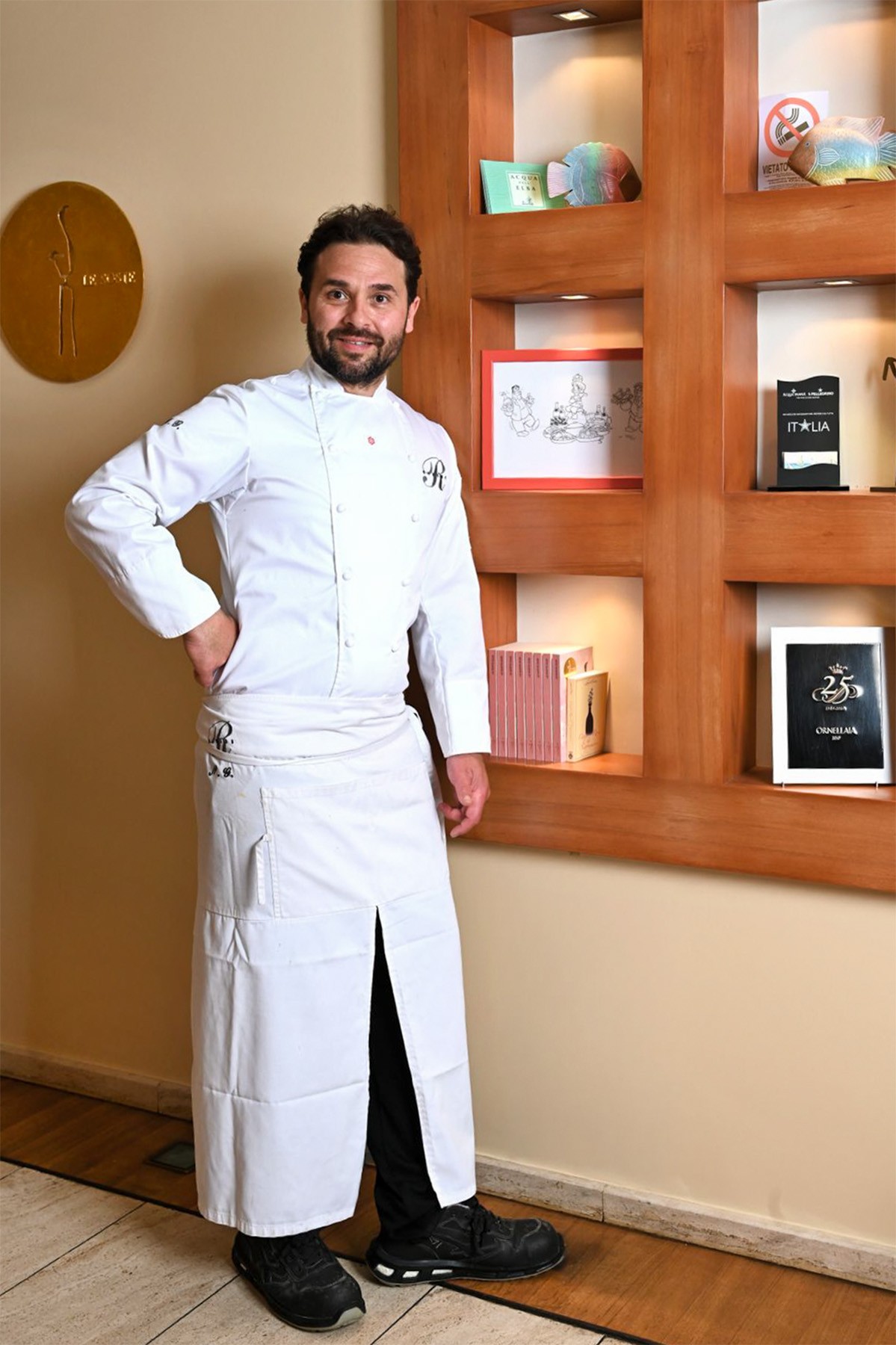
Nicola Gronchi, born in 1984 in Carrara, belongs to that generation of culinary creators for whom technique is never mere virtuosity, but an instrument of absolute precision. His cuisine germinates from a tangible, tactile, almost physical relationship with the raw ingredient: even before the hearth, there were the counters of his family's butchery, where he learned to comprehend the product, reading its fibers, its textures, and its latent possibilities.
His professional odyssey debutes early in Versilia at Villa La Bianca, an experience that marked the dawn of a vocation destined to mature through illustrious kitchens, Michelin-starred sanctuaries, and essential formative passages alongside masters such as Enrico Crippa and Enrico Bartolini. Following his tenure at the Bistrot in Forte dei Marmi, where he guided a kitchen already highly acclaimed, Gronchi embraced the vision of the Boutique Hotel Villa Grey, conquering the Michelin star within mere months of opening.
Since 2020, he has been at the helm of the kitchen at Romano in Viareggio, a glorious institution in the realm of Italian maritime gastronomy. Here, his artistry intertwines with that of the Franceschini family, custodians of a tradition that has for decades rendered the establishment a legendary landmark of culinary Versilia, working in close harmony with Roberto, the face of the new generation, in a bond forged upon continuity, trust, and shared elevation.
Here, Gronchi infuses a contemporary sensitivity without ever severing the thread of memory. His culinary philosophy proceeds through subtraction, equilibrium, and clarity of vision: allowing the aquatic harvest, the terroir, the profound depth of reductions, and the precision of heat to reveal themselves. He seeks not performance, but a luminous clarity. Tuscany remains a living root, not a mere repertoire of practices to cite; the sea, more than a culinary theme, becomes a grammar of flavors.
In a sanctuary like Romano, where family heritage converges with haute cuisine, Nicola Gronchi moves with a rare elegance and measure: guarding the legacy without letting it crystallize, modernizing without betrayal, transforming the raw ingredient into a poetic narrative without ever divesting it of its truth.
dialogues
In a historic temple of seafood gastronomy such as Romano, is pasta more a sacred memory to preserve or a substance to be reimagined?
To my mind, pasta must never be distorted: it must be elevated. Reinterpretation lies in rendering a traditional dish crisper, more incisive, and more contemporary in its command of acidity and salinity. It must unveil itself to the modern palate, the palate of 2026, without severing its ties to what has been.
Viareggio shares a profound affinity with the sea, with the marketplace, and with a certain refined Tuscan culinary elegance. How does all of this manifest within a first course?
It is not merely a matter of “placing the sea upon the plate.” Rather, it is about allowing the dish to become the vessel for the voice of the marketplace. Our fishermen perform a daily, arduous, and noble labor: through my cuisine, I strive to restore value to their sacrifices, transforming that raw substance into a narrative of the utmost authenticity.
Your cooking appears to seek a delicate equilibrium between contemporary technique and reverence for the raw ingredient. In seafood pasta, where does technical gesture end and the listening to the product begin?
The listening begins immediately. When a crate of live mantis shrimp arrives, still leaping, one already senses the perfume of the sea: it is in that very moment that the dish is born. Then comes technique, which serves to make it contemporary, precise, and original in its nuances. But the initial gesture, as I have just said, is always that of listening.
Pasta possesses a dual nature: both domestic and gastronomic. In a restaurant like Romano, how does one prevent it from losing its immediacy, even when integrated into a signature menu?
I believe that signature cuisine is not a mere assemblage of ingredients. True signature cuisine, for me, must remain immediate. Mine is a direct cuisine: it seeks flavor, clarity, and the understanding of the dish. Even where there is rigorous research, the guest must effortlessly reach my concept and thus immediately comprehend it.
In a seafood pasta dish, the decisive element is often invisible: the stock, the extraction, the iodine, the concentration. How crucial is the work devoted to that which binds, envelops, and lends depth to the dish?
In pasta, it is fundamental that every course possesses its own sensory identity. For this reason, our work on the fish trimmings is obsessive: we prepare diverse stocks, pairing them with aromatic herbs and spices, and we seek to diminish the use of salt as much as possible. Depth radiates from here: from that which often does not appear, yet sustains the entire creation.
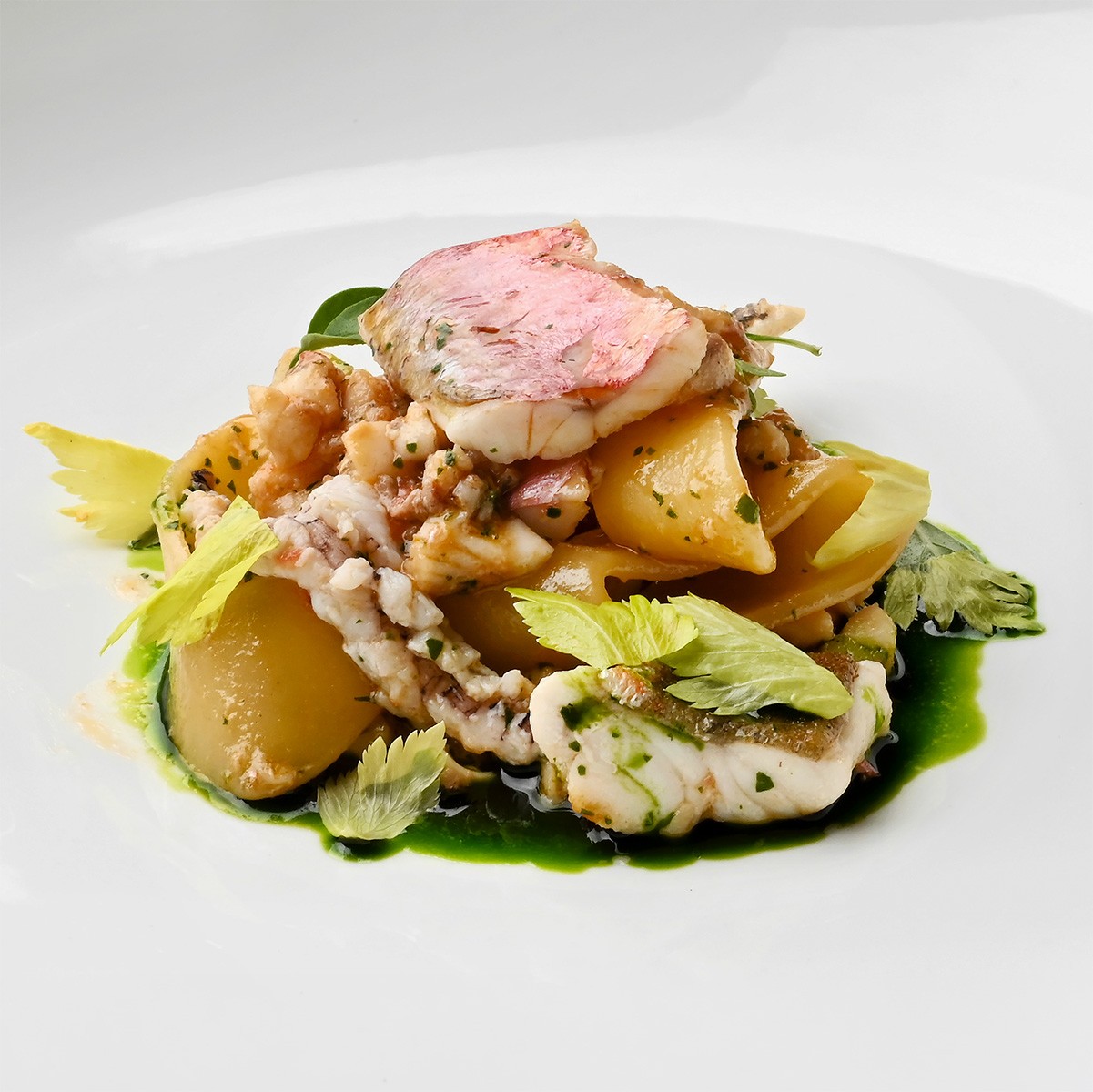
The Calle di Gragnano with mixed fish, mantis shrimp and parsley are also featured on the tasting journey dedicated to the house’s grand classics. What makes this dish so remarkably representative of Romano’s culinary language: the shape, the sea, familial memory, or the manner in which all these elements are bound together?
It is a creation that binds together many elements: form, taste, mastication, and memory. The Calle di Gragnano evoke the shape of a flower and hold beautifully the sauce of the fish caught by the ‘trabaccolari’ — fishermen from San Benedetto who emigrated to Viareggio in the early twentieth century aboard their ‘trabaccoli’ transport boats.
The mastication recalls that of pacchero, yet the shape allows them to be enjoyed whole, rendering the mouthful more complete. Lastly, there is the desire to reclaim family memory: the Paccheri alla viareggina, our poetic reinterpretation of a grand classic from the kitchen of Romano.When choosing a pasta shape, do you begin with the form, the chewing texture, the sauce, or the overall vision of the dish?
The centrality resides first and foremost in the flavor of the pasta itself, which shifts according to its shape. Then arrives the sauce, and finally the mastication. The shape is no mere detail: it determines the way the dish is perceived, the rhythm of the bite, and the relationship between the pasta and the sauce.
Pasta, more than other elements, forces the chef to measure themselves against time: cooking, emulsifying, serving, the precision of the pass. How delicate is this equilibrium in a gourmet kitchen?
In our kitchen, the first courses dictate the service and condition the timing of the other stations. In a culinary world of great attentiveness, one must be precise, focused, and above all, poised. Pasta forgives no distraction: it requires a presence and a totalizing commitment.
Romano is an establishment with a powerful family history and a long-standing identity in Italian seafood cuisine. What responsibility do you feel when working with such a recognizable language as pasta?
Pasta always carries a collective memory within itself. When a guest savors a dish, they unconsciously seek a sense of belonging. At Romano, I wish to keep this memory vibrant, but without transforming it into nostalgia: it must remain something alive, contemporary, capable of dialogue and interaction with the present.
Looking to the future, what can pasta still articulate within the grand Italian seafood cuisine? Is it a language already perfected, or a territory still rich with possibilities?
In Italy, we have attained highly prestigious levels. I believe that curiosity and the evolving tastes of the new generations will lead pasta, and modern seafood cuisine in particular, towards new horizons. There will be ever greater devotion to the ingredient, to lightness, to the precision of flavor, and to a new way of understanding the pelagic realm within the course.
CURRICULUM VITAE
Nicola Gronchi, born in 1984 in Carrara, belongs to that generation of culinary creators for whom technique is never mere virtuosity, but an instrument of absolute precision. His cuisine germinates from a tangible, tactile, almost physical relationship with the raw ingredient: even before the hearth, there were the counters of his family's butchery, where he learned to comprehend the product, reading its fibers, its textures, and its latent possibilities.
His professional odyssey debutes early in Versilia at Villa La Bianca, an experience that marked the dawn of a vocation destined to mature through illustrious kitchens, Michelin-starred sanctuaries, and essential formative passages alongside masters such as Enrico Crippa and Enrico Bartolini. Following his tenure at the Bistrot in Forte dei Marmi, where he guided a kitchen already highly acclaimed, Gronchi embraced the vision of the Boutique Hotel Villa Grey, conquering the Michelin star within mere months of opening.
Since 2020, he has been at the helm of the kitchen at Romano in Viareggio, a glorious institution in the realm of Italian maritime gastronomy. Here, his artistry intertwines with that of the Franceschini family, custodians of a tradition that has for decades rendered the establishment a legendary landmark of culinary Versilia, working in close harmony with Roberto, the face of the new generation, in a bond forged upon continuity, trust, and shared elevation.
Here, Gronchi infuses a contemporary sensitivity without ever severing the thread of memory. His culinary philosophy proceeds through subtraction, equilibrium, and clarity of vision: allowing the aquatic harvest, the terroir, the profound depth of reductions, and the precision of heat to reveal themselves. He seeks not performance, but a luminous clarity. Tuscany remains a living root, not a mere repertoire of practices to cite; the sea, more than a culinary theme, becomes a grammar of flavors.
In a sanctuary like Romano, where family heritage converges with haute cuisine, Nicola Gronchi moves with a rare elegance and measure: guarding the legacy without letting it crystallize, modernizing without betrayal, transforming the raw ingredient into a poetic narrative without ever divesting it of its truth.
dialogues
In a historic temple of seafood gastronomy such as Romano, is pasta more a sacred memory to preserve or a substance to be reimagined?
To my mind, pasta must never be distorted: it must be elevated. Reinterpretation lies in rendering a traditional dish crisper, more incisive, and more contemporary in its command of acidity and salinity. It must unveil itself to the modern palate, the palate of 2026, without severing its ties to what has been.
Viareggio shares a profound affinity with the sea, with the marketplace, and with a certain refined Tuscan culinary elegance. How does all of this manifest within a first course?
It is not merely a matter of “placing the sea upon the plate.” Rather, it is about allowing the dish to become the vessel for the voice of the marketplace. Our fishermen perform a daily, arduous, and noble labor: through my cuisine, I strive to restore value to their sacrifices, transforming that raw substance into a narrative of the utmost authenticity.
Your cooking appears to seek a delicate equilibrium between contemporary technique and reverence for the raw ingredient. In seafood pasta, where does technical gesture end and the listening to the product begin?
The listening begins immediately. When a crate of live mantis shrimp arrives, still leaping, one already senses the perfume of the sea: it is in that very moment that the dish is born. Then comes technique, which serves to make it contemporary, precise, and original in its nuances. But the initial gesture, as I have just said, is always that of listening.
Pasta possesses a dual nature: both domestic and gastronomic. In a restaurant like Romano, how does one prevent it from losing its immediacy, even when integrated into a signature menu?
I believe that signature cuisine is not a mere assemblage of ingredients. True signature cuisine, for me, must remain immediate. Mine is a direct cuisine: it seeks flavor, clarity, and the understanding of the dish. Even where there is rigorous research, the guest must effortlessly reach my concept and thus immediately comprehend it.
In a seafood pasta dish, the decisive element is often invisible: the stock, the extraction, the iodine, the concentration. How crucial is the work devoted to that which binds, envelops, and lends depth to the dish?
In pasta, it is fundamental that every course possesses its own sensory identity. For this reason, our work on the fish trimmings is obsessive: we prepare diverse stocks, pairing them with aromatic herbs and spices, and we seek to diminish the use of salt as much as possible. Depth radiates from here: from that which often does not appear, yet sustains the entire creation.
The Calle di Gragnano with mixed fish, mantis shrimp and parsley are also featured on the tasting journey dedicated to the house’s grand classics. What makes this dish so remarkably representative of Romano’s culinary language: the shape, the sea, familial memory, or the manner in which all these elements are bound together?
It is a creation that binds together many elements: form, taste, mastication, and memory. The Calle di Gragnano evoke the shape of a flower and hold beautifully the sauce of the fish caught by the ‘trabaccolari’ — fishermen from San Benedetto who emigrated to Viareggio in the early twentieth century aboard their ‘trabaccoli’ transport boats.
The mastication recalls that of pacchero, yet the shape allows them to be enjoyed whole, rendering the mouthful more complete. Lastly, there is the desire to reclaim family memory: the Paccheri alla viareggina, our poetic reinterpretation of a grand classic from the kitchen of Romano.When choosing a pasta shape, do you begin with the form, the chewing texture, the sauce, or the overall vision of the dish?
The centrality resides first and foremost in the flavor of the pasta itself, which shifts according to its shape. Then arrives the sauce, and finally the mastication. The shape is no mere detail: it determines the way the dish is perceived, the rhythm of the bite, and the relationship between the pasta and the sauce.
Pasta, more than other elements, forces the chef to measure themselves against time: cooking, emulsifying, serving, the precision of the pass. How delicate is this equilibrium in a gourmet kitchen?
In our kitchen, the first courses dictate the service and condition the timing of the other stations. In a culinary world of great attentiveness, one must be precise, focused, and above all, poised. Pasta forgives no distraction: it requires a presence and a totalizing commitment.
Romano is an establishment with a powerful family history and a long-standing identity in Italian seafood cuisine. What responsibility do you feel when working with such a recognizable language as pasta?
Pasta always carries a collective memory within itself. When a guest savors a dish, they unconsciously seek a sense of belonging. At Romano, I wish to keep this memory vibrant, but without transforming it into nostalgia: it must remain something alive, contemporary, capable of dialogue and interaction with the present.
Looking to the future, what can pasta still articulate within the grand Italian seafood cuisine? Is it a language already perfected, or a territory still rich with possibilities?
In Italy, we have attained highly prestigious levels. I believe that curiosity and the evolving tastes of the new generations will lead pasta, and modern seafood cuisine in particular, towards new horizons. There will be ever greater devotion to the ingredient, to lightness, to the precision of flavor, and to a new way of understanding the pelagic realm within the course.
CURRICULUM VITAE
Nicola Gronchi, born in 1984 in Carrara, belongs to that generation of culinary creators for whom technique is never mere virtuosity, but an instrument of absolute precision. His cuisine germinates from a tangible, tactile, almost physical relationship with the raw ingredient: even before the hearth, there were the counters of his family's butchery, where he learned to comprehend the product, reading its fibers, its textures, and its latent possibilities.
His professional odyssey debutes early in Versilia at Villa La Bianca, an experience that marked the dawn of a vocation destined to mature through illustrious kitchens, Michelin-starred sanctuaries, and essential formative passages alongside masters such as Enrico Crippa and Enrico Bartolini. Following his tenure at the Bistrot in Forte dei Marmi, where he guided a kitchen already highly acclaimed, Gronchi embraced the vision of the Boutique Hotel Villa Grey, conquering the Michelin star within mere months of opening.
Since 2020, he has been at the helm of the kitchen at Romano in Viareggio, a glorious institution in the realm of Italian maritime gastronomy. Here, his artistry intertwines with that of the Franceschini family, custodians of a tradition that has for decades rendered the establishment a legendary landmark of culinary Versilia, working in close harmony with Roberto, the face of the new generation, in a bond forged upon continuity, trust, and shared elevation.
Here, Gronchi infuses a contemporary sensitivity without ever severing the thread of memory. His culinary philosophy proceeds through subtraction, equilibrium, and clarity of vision: allowing the aquatic harvest, the terroir, the profound depth of reductions, and the precision of heat to reveal themselves. He seeks not performance, but a luminous clarity. Tuscany remains a living root, not a mere repertoire of practices to cite; the sea, more than a culinary theme, becomes a grammar of flavors.
In a sanctuary like Romano, where family heritage converges with haute cuisine, Nicola Gronchi moves with a rare elegance and measure: guarding the legacy without letting it crystallize, modernizing without betrayal, transforming the raw ingredient into a poetic narrative without ever divesting it of its truth.
dialogues
In a historic temple of seafood gastronomy such as Romano, is pasta more a sacred memory to preserve or a substance to be reimagined?
To my mind, pasta must never be distorted: it must be elevated. Reinterpretation lies in rendering a traditional dish crisper, more incisive, and more contemporary in its command of acidity and salinity. It must unveil itself to the modern palate, the palate of 2026, without severing its ties to what has been.
Viareggio shares a profound affinity with the sea, with the marketplace, and with a certain refined Tuscan culinary elegance. How does all of this manifest within a first course?
It is not merely a matter of “placing the sea upon the plate.” Rather, it is about allowing the dish to become the vessel for the voice of the marketplace. Our fishermen perform a daily, arduous, and noble labor: through my cuisine, I strive to restore value to their sacrifices, transforming that raw substance into a narrative of the utmost authenticity.
Your cooking appears to seek a delicate equilibrium between contemporary technique and reverence for the raw ingredient. In seafood pasta, where does technical gesture end and the listening to the product begin?
The listening begins immediately. When a crate of live mantis shrimp arrives, still leaping, one already senses the perfume of the sea: it is in that very moment that the dish is born. Then comes technique, which serves to make it contemporary, precise, and original in its nuances. But the initial gesture, as I have just said, is always that of listening.
Pasta possesses a dual nature: both domestic and gastronomic. In a restaurant like Romano, how does one prevent it from losing its immediacy, even when integrated into a signature menu?
I believe that signature cuisine is not a mere assemblage of ingredients. True signature cuisine, for me, must remain immediate. Mine is a direct cuisine: it seeks flavor, clarity, and the understanding of the dish. Even where there is rigorous research, the guest must effortlessly reach my concept and thus immediately comprehend it.
In a seafood pasta dish, the decisive element is often invisible: the stock, the extraction, the iodine, the concentration. How crucial is the work devoted to that which binds, envelops, and lends depth to the dish?
In pasta, it is fundamental that every course possesses its own sensory identity. For this reason, our work on the fish trimmings is obsessive: we prepare diverse stocks, pairing them with aromatic herbs and spices, and we seek to diminish the use of salt as much as possible. Depth radiates from here: from that which often does not appear, yet sustains the entire creation.
The Calle di Gragnano with mixed fish, mantis shrimp and parsley are also featured on the tasting journey dedicated to the house’s grand classics. What makes this dish so remarkably representative of Romano’s culinary language: the shape, the sea, familial memory, or the manner in which all these elements are bound together?
It is a creation that binds together many elements: form, taste, mastication, and memory. The Calle di Gragnano evoke the shape of a flower and hold beautifully the sauce of the fish caught by the ‘trabaccolari’ — fishermen from San Benedetto who emigrated to Viareggio in the early twentieth century aboard their ‘trabaccoli’ transport boats.
The mastication recalls that of pacchero, yet the shape allows them to be enjoyed whole, rendering the mouthful more complete. Lastly, there is the desire to reclaim family memory: the Paccheri alla viareggina, our poetic reinterpretation of a grand classic from the kitchen of Romano.When choosing a pasta shape, do you begin with the form, the chewing texture, the sauce, or the overall vision of the dish?
The centrality resides first and foremost in the flavor of the pasta itself, which shifts according to its shape. Then arrives the sauce, and finally the mastication. The shape is no mere detail: it determines the way the dish is perceived, the rhythm of the bite, and the relationship between the pasta and the sauce.
Pasta, more than other elements, forces the chef to measure themselves against time: cooking, emulsifying, serving, the precision of the pass. How delicate is this equilibrium in a gourmet kitchen?
In our kitchen, the first courses dictate the service and condition the timing of the other stations. In a culinary world of great attentiveness, one must be precise, focused, and above all, poised. Pasta forgives no distraction: it requires a presence and a totalizing commitment.
Romano is an establishment with a powerful family history and a long-standing identity in Italian seafood cuisine. What responsibility do you feel when working with such a recognizable language as pasta?
Pasta always carries a collective memory within itself. When a guest savors a dish, they unconsciously seek a sense of belonging. At Romano, I wish to keep this memory vibrant, but without transforming it into nostalgia: it must remain something alive, contemporary, capable of dialogue and interaction with the present.
Looking to the future, what can pasta still articulate within the grand Italian seafood cuisine? Is it a language already perfected, or a territory still rich with possibilities?
In Italy, we have attained highly prestigious levels. I believe that curiosity and the evolving tastes of the new generations will lead pasta, and modern seafood cuisine in particular, towards new horizons. There will be ever greater devotion to the ingredient, to lightness, to the precision of flavor, and to a new way of understanding the pelagic realm within the course.