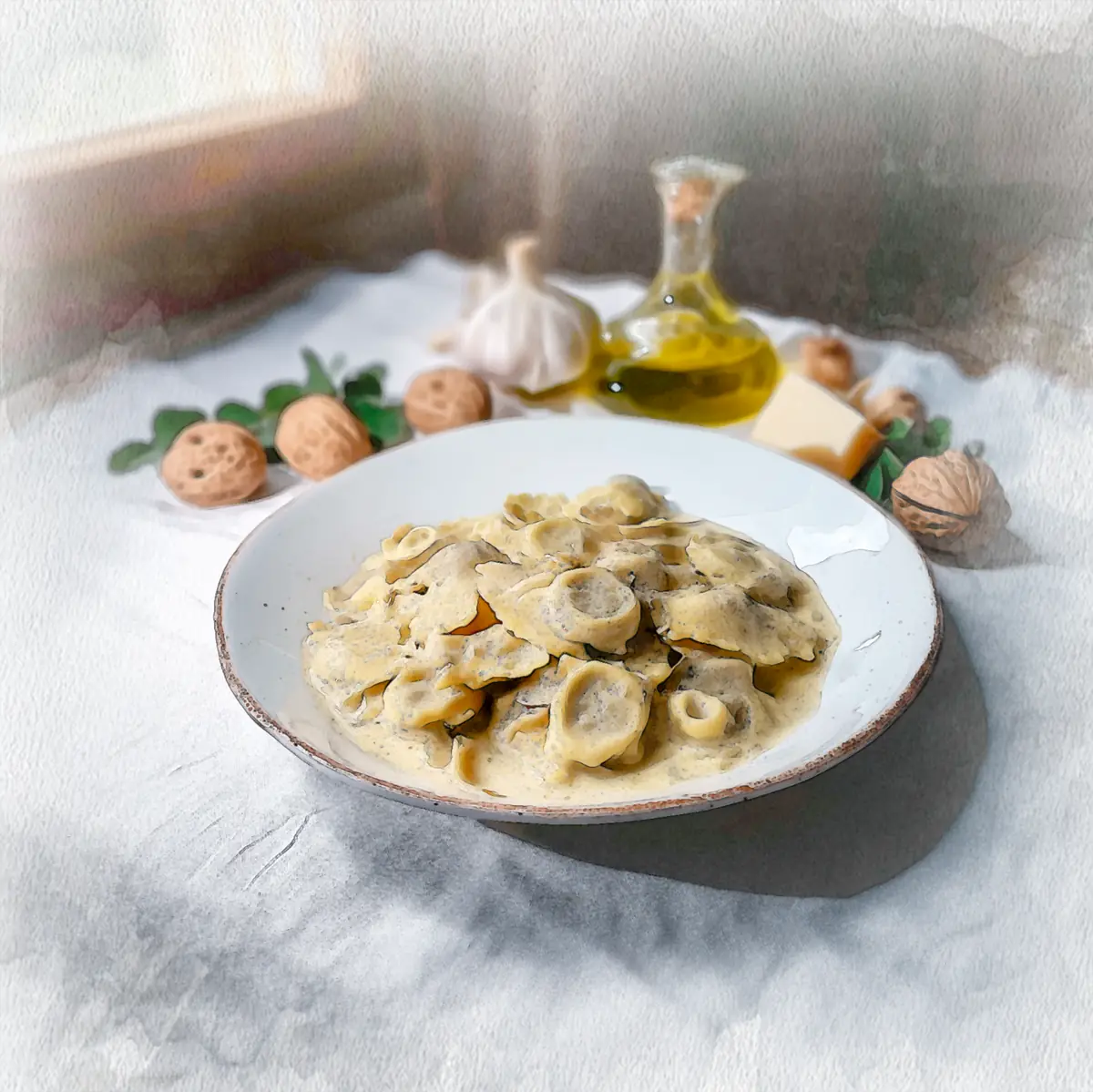
LIGURIAN PANSOTTI ENVELOPED IN A VELVETY WALNUT CREME
Walnuts, Eggs, Flour, Wild Meadow Herbs, Parmigiano Reggiano, Sweet Marjoram, Nutmeg.
A demanding pursuit
Liguria
A journey of ninety minutes
650 Kcal
LIGURIAN PANSOTTI ENVELOPED IN A VELVETY WALNUT CREME
Walnuts, Eggs, Flour, Wild Meadow Herbs, Parmigiano Reggiano, Sweet Marjoram, Nutmeg.
A demanding pursuit
Liguria
A journey of ninety minutes
650 Kcal
LIGURIAN PANSOTTI ENVELOPED IN A VELVETY WALNUT CREME
Walnuts, Eggs, Flour, Wild Meadow Herbs, Parmigiano Reggiano, Sweet Marjoram, Nutmeg.
A demanding pursuit
Liguria
A journey of ninety minutes
650 Kcal
GENESIS
Pansotti alla Genovese are defined by key, harmonious elements: a delicate pasta envelope, a uniquely lean, herbaceous filling characterized by preboggion (a wild bouquet of borage, wild chard, dandelion, sow thistle, common chicory, corn poppy, stinging nettle, bladder campion, picris, wild chicory, salad burnet, and bellflower), prescinseua (a fresh, soft curd cheese typical of the province of Genoa), and the traditional, velvety walnut sauce.
Their cultural significance lies in being a dish that embodies the ingenuity, frugality, and the visceral bond of Liguria with its rugged soil. The allure of pansoti endures, spanning from historic Lenten tables of abstinence to contemporary culinary reverence. They are far more than mere sustenance: they are vessels of history, tradition, and regional identity, offering an authentic taste of the Ligurian landscape. Pansotti alla Genovese, in their entirety—from the wild-harvested preboggion and local prescinseua to the distinctive walnut sauce, and even the debate surrounding the presence of egg in the dough—serve as a microcosm of Liguria’s gastronomic soul.
They reflect a historic reliance on local, often humble ingredients, a profound reverence for seasonal rhythms, a singular genius for creating sumptuous, meatless dishes, and a fierce sense of regional distinction. The use of preboggion speaks of a deep communion with the local flora and ancestral foraging traditions. The historic cheese, prescinseua, is a fiercely hyper-local treasure. The "di magro" (abstinence) nature of the filling mirrors historic Lenten practices and perhaps bygone economic realities. The specific marriage with walnut sauce, alongside the culinary "laws" forbidding pesto, demonstrates a highly defined local aesthetic.
Even the subtle variations in the dough or shape Bespeak a living, breathing tradition, adapted across the region's diverse communities. Collectively, these elements paint the portrait of an ingenious gastronomy, deeply rooted in its terroir and immensely proud of its unique heritage.
PORTIONS (FOR 4 PERSONS)
FOR THE PASTA
Flour 00
Water at room temperature
Dry white wine
Medium-sized eggs
Fine salt
500 g
150 g
30 g
2
1 pinch
FOR THE CREATION'S HEART
A medley of wild field greens, preboggion
Prescinseua curd
An egg of medium size
Parmigiano Reggiano DOP
Fresh marjoram
Nutmeg
Fine salt
800 g
180 g
1
50 g
cloves of delicate foliage
to taste
to taste
FOR THE NECTAR OF WALNUTS
Walnut kernels
Crumb of stale bread
Fresh whole milk
Garlic
Parmigiano Reggiano PDO
Fresh sweet marjoram
Extra virgin olive oil
Fine salt
200 g
100-150 g
150-200 ml
1 clove
75 g
fragrant leaves
80-100 ml
to taste
CURATION
The Crafting of Sacred Pasta:
Upon the traditional pastry board, fashion a well within the flour. Into its heart, release the eggs, adding the white wine, water, and a whisper of salt.
Gently begin drawing the flour inward with a fork, then knead with vigorous hands for a minimum of ten to fifteen minutes, until the dough transforms into a silken, supple, and unified sphere.
Envelop the dough in clingfilm (or a damp linen cloth) and grant it respite in the refrigerator for at least thirty minutes, though an hour is sublime. This repose allows the gluten to surrender, rendering the dough effortlessly pliable to the rolling pin.The Alchemical Filling:
Bathe the wild herbs with reverence. Simmer them briefly in a scant pool of salted boiling water (the borage and spinach will surrender swiftly, while the chard may require a prolonged moment). Drain them thoroughly, squeezing with utmost care to banish every trace of excess moisture.
Finely shred the herbs with a sharp blade.
In a generous vessel, unite the minced greenery, the native prescinseua (or sieved ricotta), the lightly beaten egg, the grated Parmigiano Reggiano, the whisper of chopped marjoram, a bountiful grating of nutmeg, and a pinch of salt.
Marry the ingredients with care until an immaculate harmony is achieved. Taste, adjust the salt if required, and set this verdant filling aside.The Walnut Sauce (The Noble Mortar Method):
Lull the breadcrumb to sleep in a pool of warm milk. Allow it to soften for about ten minutes, then press it dry with care.
Within the cool embrace of a marble mortar, crush the garlic clove (cleansed of its inner germ) with a scattering of coarse salt until it yields to a smooth cream.
Introduce the walnut kernels (should you seek a more delicate poetry on the palate, blanch them for five minutes and strip them of their skins). Crush them with spirited energy until they form a cohesive paste.
Incorporate the softened, squeezed breadcrumb, continuing the rhythmic embrace of the pestle.
Introduce the freshly grated Parmigiano Reggiano and the delicate leaves of marjoram.
Drizzle the extra virgin olive oil in a slow, silken thread, working continuously with the pestle until a sauce of luxurious creaminess with a pleasingly rustic texture emerges.
Season with salt. Should the elixir prove too dense, breathe life into it with a spoonful or two of the warm pasta cooking water or a touch of extra milk.The Modern Alternative (The Blender):
Steep the breadcrumb as decreed above.
Within the chamber of a blender, pulse the walnut kernels with the garlic.
Add the squeezed breadcrumb, Parmigiano, marjoram, olive oil, and a pinch of salt. Blend in short, rhythmic bursts to conjure a cream that is harmonious yet retains a whisper of its nutty texture. If required, add a splash of milk or cooking-water to achieve the desired viscosity.Shaping the Pansoti:
Retrieve the rested dough and roll it with a rolling pin or pasta machine until you obtain gossamer sheets (approximately 1-2 mm in thickness).
Upon these sheets, deposit small, elegant mounds of filling (roughly a generous teaspoon for each pansotto), leaving ample space between them.
With a fluted or straight pastry wheel, carve squares of dough measuring some 8-10 cm per side, ensuring the filling rests proudly in the center.
Breeze the edges of the squares with a touch of water. Fold each square diagonally into a triangle, pressing the borders firmly to seal the edges and expel any trapped air.
Lay the completed pansoti upon a tray lightly dusted with semolina, ensuring they do not touch.The Boiling and the Feast:
Bring a generous cauldron of water to a triumphant boil. Season with salt as it dances.
Submerge the pansoti, cooking them for three to five minutes, or until they rise to the surface like emerging pearls. Taste one to ensure the pasta has reached perfect al dente state.
Lift them from the water with utmost gentleness using a skimmer.
Transfer the pansoti into a warmed serving bowl or directly onto heated plates. Anoint them immediately with the walnut sauce, previously relaxed with a ladle of the pasta's cooking water to ensure it drapes the pasta in fluid, enveloping luxury.
Serve without delay, crowned with a dusting of Parmigiano Reggiano and adorned with a few fresh marjoram leaves, if your heart desires.
aspiration
Il Preboggion: Should this wild botanical bouquet elude your grasp, a harmonious blend of fresh borage, chard, and spinach shall serve as a worthy successor.
La Prescinseua: This curd, prized for its delicate acidity, is a singular jewel of the Ligurian dairy heritage. Should it remain beyond reach, one may substitute a pristine, well-drained cow's milk ricotta, gently whisked with a spoonful of natural yogurt to evoke its signature tang.
The Soul of the Sauce: A true, traditional walnut sauce shuns absolute smoothness, preserving instead a rustic, textured topography born of pestle-crushed kernels.
Preservation: These uncooked pansotti lend themselves beautifully to the frost. Arrange them upon a flour-dusted canvas, keeping each apart; once frozen, gather them into culinary pouches. They may be coaxed directly from the cold into the cauldron, requiring only a fleeting extension of their baptism in boiling water.


GENESIS
Pansotti alla Genovese are defined by key, harmonious elements: a delicate pasta envelope, a uniquely lean, herbaceous filling characterized by preboggion (a wild bouquet of borage, wild chard, dandelion, sow thistle, common chicory, corn poppy, stinging nettle, bladder campion, picris, wild chicory, salad burnet, and bellflower), prescinseua (a fresh, soft curd cheese typical of the province of Genoa), and the traditional, velvety walnut sauce.
Their cultural significance lies in being a dish that embodies the ingenuity, frugality, and the visceral bond of Liguria with its rugged soil. The allure of pansoti endures, spanning from historic Lenten tables of abstinence to contemporary culinary reverence. They are far more than mere sustenance: they are vessels of history, tradition, and regional identity, offering an authentic taste of the Ligurian landscape. Pansotti alla Genovese, in their entirety—from the wild-harvested preboggion and local prescinseua to the distinctive walnut sauce, and even the debate surrounding the presence of egg in the dough—serve as a microcosm of Liguria’s gastronomic soul.
They reflect a historic reliance on local, often humble ingredients, a profound reverence for seasonal rhythms, a singular genius for creating sumptuous, meatless dishes, and a fierce sense of regional distinction. The use of preboggion speaks of a deep communion with the local flora and ancestral foraging traditions. The historic cheese, prescinseua, is a fiercely hyper-local treasure. The "di magro" (abstinence) nature of the filling mirrors historic Lenten practices and perhaps bygone economic realities. The specific marriage with walnut sauce, alongside the culinary "laws" forbidding pesto, demonstrates a highly defined local aesthetic.
Even the subtle variations in the dough or shape Bespeak a living, breathing tradition, adapted across the region's diverse communities. Collectively, these elements paint the portrait of an ingenious gastronomy, deeply rooted in its terroir and immensely proud of its unique heritage.
PORTIONS (FOR 4 PERSONS)
FOR THE PASTA
Flour 00
Water at room temperature
Dry white wine
Medium-sized eggs
Fine salt
500 g
150 g
30 g
2
1 pinch
FOR THE CREATION'S HEART
A medley of wild field greens, preboggion
Prescinseua curd
An egg of medium size
Parmigiano Reggiano DOP
Fresh marjoram
Nutmeg
Fine salt
800 g
180 g
1
50 g
cloves of delicate foliage
to taste
to taste
FOR THE NECTAR OF WALNUTS
Walnut kernels
Crumb of stale bread
Fresh whole milk
Garlic
Parmigiano Reggiano PDO
Fresh sweet marjoram
Extra virgin olive oil
Fine salt
200 g
100-150 g
150-200 ml
1 clove
75 g
fragrant leaves
80-100 ml
to taste
CURATION
The Crafting of Sacred Pasta:
Upon the traditional pastry board, fashion a well within the flour. Into its heart, release the eggs, adding the white wine, water, and a whisper of salt.
Gently begin drawing the flour inward with a fork, then knead with vigorous hands for a minimum of ten to fifteen minutes, until the dough transforms into a silken, supple, and unified sphere.
Envelop the dough in clingfilm (or a damp linen cloth) and grant it respite in the refrigerator for at least thirty minutes, though an hour is sublime. This repose allows the gluten to surrender, rendering the dough effortlessly pliable to the rolling pin.The Alchemical Filling:
Bathe the wild herbs with reverence. Simmer them briefly in a scant pool of salted boiling water (the borage and spinach will surrender swiftly, while the chard may require a prolonged moment). Drain them thoroughly, squeezing with utmost care to banish every trace of excess moisture.
Finely shred the herbs with a sharp blade.
In a generous vessel, unite the minced greenery, the native prescinseua (or sieved ricotta), the lightly beaten egg, the grated Parmigiano Reggiano, the whisper of chopped marjoram, a bountiful grating of nutmeg, and a pinch of salt.
Marry the ingredients with care until an immaculate harmony is achieved. Taste, adjust the salt if required, and set this verdant filling aside.The Walnut Sauce (The Noble Mortar Method):
Lull the breadcrumb to sleep in a pool of warm milk. Allow it to soften for about ten minutes, then press it dry with care.
Within the cool embrace of a marble mortar, crush the garlic clove (cleansed of its inner germ) with a scattering of coarse salt until it yields to a smooth cream.
Introduce the walnut kernels (should you seek a more delicate poetry on the palate, blanch them for five minutes and strip them of their skins). Crush them with spirited energy until they form a cohesive paste.
Incorporate the softened, squeezed breadcrumb, continuing the rhythmic embrace of the pestle.
Introduce the freshly grated Parmigiano Reggiano and the delicate leaves of marjoram.
Drizzle the extra virgin olive oil in a slow, silken thread, working continuously with the pestle until a sauce of luxurious creaminess with a pleasingly rustic texture emerges.
Season with salt. Should the elixir prove too dense, breathe life into it with a spoonful or two of the warm pasta cooking water or a touch of extra milk.The Modern Alternative (The Blender):
Steep the breadcrumb as decreed above.
Within the chamber of a blender, pulse the walnut kernels with the garlic.
Add the squeezed breadcrumb, Parmigiano, marjoram, olive oil, and a pinch of salt. Blend in short, rhythmic bursts to conjure a cream that is harmonious yet retains a whisper of its nutty texture. If required, add a splash of milk or cooking-water to achieve the desired viscosity.Shaping the Pansoti:
Retrieve the rested dough and roll it with a rolling pin or pasta machine until you obtain gossamer sheets (approximately 1-2 mm in thickness).
Upon these sheets, deposit small, elegant mounds of filling (roughly a generous teaspoon for each pansotto), leaving ample space between them.
With a fluted or straight pastry wheel, carve squares of dough measuring some 8-10 cm per side, ensuring the filling rests proudly in the center.
Breeze the edges of the squares with a touch of water. Fold each square diagonally into a triangle, pressing the borders firmly to seal the edges and expel any trapped air.
Lay the completed pansoti upon a tray lightly dusted with semolina, ensuring they do not touch.The Boiling and the Feast:
Bring a generous cauldron of water to a triumphant boil. Season with salt as it dances.
Submerge the pansoti, cooking them for three to five minutes, or until they rise to the surface like emerging pearls. Taste one to ensure the pasta has reached perfect al dente state.
Lift them from the water with utmost gentleness using a skimmer.
Transfer the pansoti into a warmed serving bowl or directly onto heated plates. Anoint them immediately with the walnut sauce, previously relaxed with a ladle of the pasta's cooking water to ensure it drapes the pasta in fluid, enveloping luxury.
Serve without delay, crowned with a dusting of Parmigiano Reggiano and adorned with a few fresh marjoram leaves, if your heart desires.
aspiration
Il Preboggion: Should this wild botanical bouquet elude your grasp, a harmonious blend of fresh borage, chard, and spinach shall serve as a worthy successor.
La Prescinseua: This curd, prized for its delicate acidity, is a singular jewel of the Ligurian dairy heritage. Should it remain beyond reach, one may substitute a pristine, well-drained cow's milk ricotta, gently whisked with a spoonful of natural yogurt to evoke its signature tang.
The Soul of the Sauce: A true, traditional walnut sauce shuns absolute smoothness, preserving instead a rustic, textured topography born of pestle-crushed kernels.
Preservation: These uncooked pansotti lend themselves beautifully to the frost. Arrange them upon a flour-dusted canvas, keeping each apart; once frozen, gather them into culinary pouches. They may be coaxed directly from the cold into the cauldron, requiring only a fleeting extension of their baptism in boiling water.
latest culinary creations
GENESIS
Pansotti alla Genovese are defined by key, harmonious elements: a delicate pasta envelope, a uniquely lean, herbaceous filling characterized by preboggion (a wild bouquet of borage, wild chard, dandelion, sow thistle, common chicory, corn poppy, stinging nettle, bladder campion, picris, wild chicory, salad burnet, and bellflower), prescinseua (a fresh, soft curd cheese typical of the province of Genoa), and the traditional, velvety walnut sauce.
Their cultural significance lies in being a dish that embodies the ingenuity, frugality, and the visceral bond of Liguria with its rugged soil. The allure of pansoti endures, spanning from historic Lenten tables of abstinence to contemporary culinary reverence. They are far more than mere sustenance: they are vessels of history, tradition, and regional identity, offering an authentic taste of the Ligurian landscape. Pansotti alla Genovese, in their entirety—from the wild-harvested preboggion and local prescinseua to the distinctive walnut sauce, and even the debate surrounding the presence of egg in the dough—serve as a microcosm of Liguria’s gastronomic soul.
They reflect a historic reliance on local, often humble ingredients, a profound reverence for seasonal rhythms, a singular genius for creating sumptuous, meatless dishes, and a fierce sense of regional distinction. The use of preboggion speaks of a deep communion with the local flora and ancestral foraging traditions. The historic cheese, prescinseua, is a fiercely hyper-local treasure. The "di magro" (abstinence) nature of the filling mirrors historic Lenten practices and perhaps bygone economic realities. The specific marriage with walnut sauce, alongside the culinary "laws" forbidding pesto, demonstrates a highly defined local aesthetic.
Even the subtle variations in the dough or shape Bespeak a living, breathing tradition, adapted across the region's diverse communities. Collectively, these elements paint the portrait of an ingenious gastronomy, deeply rooted in its terroir and immensely proud of its unique heritage.
PORTIONS (FOR 4 PERSONS)
FOR THE PASTA
Flour 00
Water at room temperature
Dry white wine
Medium-sized eggs
Fine salt
500 g
150 g
30 g
2
1 pinch
FOR THE CREATION'S HEART
A medley of wild field greens, preboggion
Prescinseua curd
An egg of medium size
Parmigiano Reggiano DOP
Fresh marjoram
Nutmeg
Fine salt
800 g
180 g
1
50 g
cloves of delicate foliage
to taste
to taste
FOR THE NECTAR OF WALNUTS
Walnut kernels
Crumb of stale bread
Fresh whole milk
Garlic
Parmigiano Reggiano PDO
Fresh sweet marjoram
Extra virgin olive oil
Fine salt
200 g
100-150 g
150-200 ml
1 clove
75 g
fragrant leaves
80-100 ml
to taste
CURATION
The Crafting of Sacred Pasta:
Upon the traditional pastry board, fashion a well within the flour. Into its heart, release the eggs, adding the white wine, water, and a whisper of salt.
Gently begin drawing the flour inward with a fork, then knead with vigorous hands for a minimum of ten to fifteen minutes, until the dough transforms into a silken, supple, and unified sphere.
Envelop the dough in clingfilm (or a damp linen cloth) and grant it respite in the refrigerator for at least thirty minutes, though an hour is sublime. This repose allows the gluten to surrender, rendering the dough effortlessly pliable to the rolling pin.The Alchemical Filling:
Bathe the wild herbs with reverence. Simmer them briefly in a scant pool of salted boiling water (the borage and spinach will surrender swiftly, while the chard may require a prolonged moment). Drain them thoroughly, squeezing with utmost care to banish every trace of excess moisture.
Finely shred the herbs with a sharp blade.
In a generous vessel, unite the minced greenery, the native prescinseua (or sieved ricotta), the lightly beaten egg, the grated Parmigiano Reggiano, the whisper of chopped marjoram, a bountiful grating of nutmeg, and a pinch of salt.
Marry the ingredients with care until an immaculate harmony is achieved. Taste, adjust the salt if required, and set this verdant filling aside.The Walnut Sauce (The Noble Mortar Method):
Lull the breadcrumb to sleep in a pool of warm milk. Allow it to soften for about ten minutes, then press it dry with care.
Within the cool embrace of a marble mortar, crush the garlic clove (cleansed of its inner germ) with a scattering of coarse salt until it yields to a smooth cream.
Introduce the walnut kernels (should you seek a more delicate poetry on the palate, blanch them for five minutes and strip them of their skins). Crush them with spirited energy until they form a cohesive paste.
Incorporate the softened, squeezed breadcrumb, continuing the rhythmic embrace of the pestle.
Introduce the freshly grated Parmigiano Reggiano and the delicate leaves of marjoram.
Drizzle the extra virgin olive oil in a slow, silken thread, working continuously with the pestle until a sauce of luxurious creaminess with a pleasingly rustic texture emerges.
Season with salt. Should the elixir prove too dense, breathe life into it with a spoonful or two of the warm pasta cooking water or a touch of extra milk.The Modern Alternative (The Blender):
Steep the breadcrumb as decreed above.
Within the chamber of a blender, pulse the walnut kernels with the garlic.
Add the squeezed breadcrumb, Parmigiano, marjoram, olive oil, and a pinch of salt. Blend in short, rhythmic bursts to conjure a cream that is harmonious yet retains a whisper of its nutty texture. If required, add a splash of milk or cooking-water to achieve the desired viscosity.Shaping the Pansoti:
Retrieve the rested dough and roll it with a rolling pin or pasta machine until you obtain gossamer sheets (approximately 1-2 mm in thickness).
Upon these sheets, deposit small, elegant mounds of filling (roughly a generous teaspoon for each pansotto), leaving ample space between them.
With a fluted or straight pastry wheel, carve squares of dough measuring some 8-10 cm per side, ensuring the filling rests proudly in the center.
Breeze the edges of the squares with a touch of water. Fold each square diagonally into a triangle, pressing the borders firmly to seal the edges and expel any trapped air.
Lay the completed pansoti upon a tray lightly dusted with semolina, ensuring they do not touch.The Boiling and the Feast:
Bring a generous cauldron of water to a triumphant boil. Season with salt as it dances.
Submerge the pansoti, cooking them for three to five minutes, or until they rise to the surface like emerging pearls. Taste one to ensure the pasta has reached perfect al dente state.
Lift them from the water with utmost gentleness using a skimmer.
Transfer the pansoti into a warmed serving bowl or directly onto heated plates. Anoint them immediately with the walnut sauce, previously relaxed with a ladle of the pasta's cooking water to ensure it drapes the pasta in fluid, enveloping luxury.
Serve without delay, crowned with a dusting of Parmigiano Reggiano and adorned with a few fresh marjoram leaves, if your heart desires.
aspiration
Il Preboggion: Should this wild botanical bouquet elude your grasp, a harmonious blend of fresh borage, chard, and spinach shall serve as a worthy successor.
La Prescinseua: This curd, prized for its delicate acidity, is a singular jewel of the Ligurian dairy heritage. Should it remain beyond reach, one may substitute a pristine, well-drained cow's milk ricotta, gently whisked with a spoonful of natural yogurt to evoke its signature tang.
The Soul of the Sauce: A true, traditional walnut sauce shuns absolute smoothness, preserving instead a rustic, textured topography born of pestle-crushed kernels.
Preservation: These uncooked pansotti lend themselves beautifully to the frost. Arrange them upon a flour-dusted canvas, keeping each apart; once frozen, gather them into culinary pouches. They may be coaxed directly from the cold into the cauldron, requiring only a fleeting extension of their baptism in boiling water.