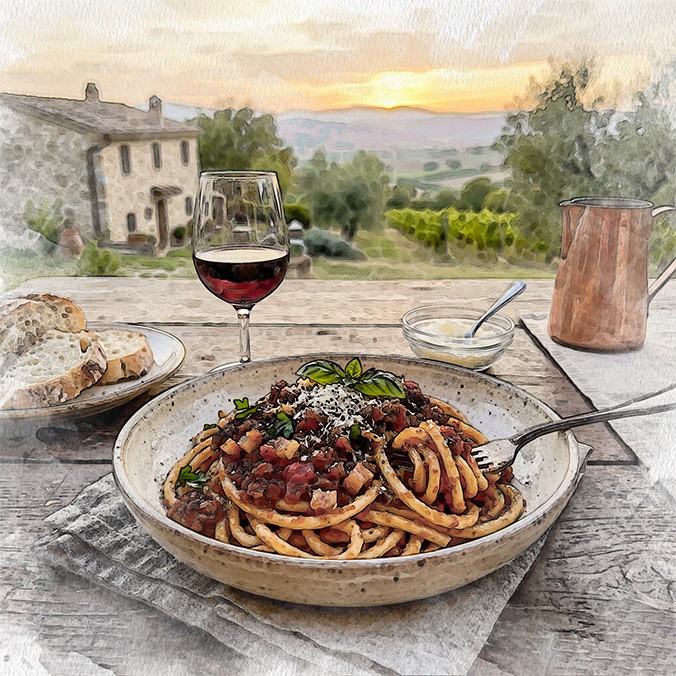
PASTA IN THE MILLER'S WIFE STYLE
Semolina of durum wheat, Flour 00, Finely minced beef, Finely minced pork, Cured pork jowl, Whole peeled tomatoes
Exceedingly Masterful
Abruzzo
130 minutes
710 Kcal
PASTA IN THE MILLER'S WIFE STYLE
Semolina of durum wheat, Flour 00, Finely minced beef, Finely minced pork, Cured pork jowl, Whole peeled tomatoes
Exceedingly Masterful
Abruzzo
130 minutes
710 Kcal
PASTA IN THE MILLER'S WIFE STYLE
Semolina of durum wheat, Flour 00, Finely minced beef, Finely minced pork, Cured pork jowl, Whole peeled tomatoes
Exceedingly Masterful
Abruzzo
130 minutes
710 Kcal
GENESIS
Pasta alla Mugnaia represents one of the most authentic and ancestral expressions of the Abruzzese gastronomic tradition, originating in particular from the valley of the Fino River, nestled between the provinces of Teramo and Pescara. The commune of Elice is revered as the primary guardian of this culinary art, celebrated annually with dedicated festivals that evoke its millenary history. The name derives directly from the millers (mugnai) who operated the numerous watermills along the river's course. The millers' wives conceived a pasta of supreme simplicity in its ingredientsu2014flour and wateru2014yet intricate in its manual execution, demanding no mechanical aid nor rolling pin.
The distinction of this dish lies in its very anatomy: the pasta is never cut, but exists as a single, endless cord spun entirely by hand. The technique requires shaping the dough into a ring, which is progressively lengthened and thinned through a rhythmic, rotating motion of the hands, yielding an irregular, textured strand. This rustic surface allows the condiment to cling perfectly to its form. Historically deemed a humble repast of the mill workers, it has embraced richer, more complex sauces over time. The traditional preparation features a ragu00f9 of mixed meats, often elevated by guanciale or pancetta and fiery chili pepper, mirroring the robust, soulful flavors of rural Abruzzo. Historical records dating to the medieval era already whisper of similar preparations within the mill lands, confirming that this manual spinning technique is an intangible heritage passed down through generations. Pasta alla Mugnaia has earned recognition as a Traditional Agri-Food Product (PAT) of the Abruzzo region, a testament to its cultural and historical prestige within the panorama of Italian gastronomy.
PORTIONS (FOR 4 PERSONS)
FOR THE FRESHLY KNEADED PASTA
Type 00 Flour
Durum wheat semolina
Tepid water
Salt
400 gr
100 gr
250 ml
1 pinch
FOR THE EMBELLISHMENT
Peeled plum tomatoes
Finely minced artisan beef
Finely minced heritage pork
Cured pork cheek (Guanciale)
Garlic clove
Dried chili pepper
Pecorino cheese of Abruzzo
Extra virgin olive oil
Fine sea salt
300 gr
150 gr
150 gr
100 gr
1 clove
1
50 gr
To taste
To taste
CURATION
For the fresh pasta:
Arrange the Soft Wheat Flour and Durum Wheat Semolina upon your wooden board, shaping them into a majestic well. Gradually pour in the tepid water, whispering a pinch of salt into its depths. Begin to knead with your hands from the center outward, incorporating the flour leaf by leaf, grain by grain. Work the dough for no less than ten minutes, until you fashion a smooth, supple, and harmonious mass. Shape it into a sphere, wrap it tenderly in a clean linen cloth, and let it rest at room temperature for some thirty minutes. Once its repose is complete, pierce a hole in the heart of the dough, forming a grand, rustic ring. Begin to stretch the dough with your hands, rotating and gradually thinning it, ensuring its sacred continuity remains unbroken. You must obtain a single, long, and beautifully irregular thread. Once this desired grandeur is achieved, lay the pasta upon a tray dusted generously with semolina.For the condiment:
Slice the guanciale into elegant, slender strips. In a spacious pan or a vessel of earthenware, warm a gentle swirl of Extra Virgin Olive Oil, adding the unpeeled clove of garlic and the dried chili pepper. When the garlic gilds to a golden hue, introduce the guanciale, letting it render until its fat transforms into a translucent veil. Add the minced beef and minced pork, releasing their grains gently with a fork. Let them brown over a lively flame until the meat changes its mantle. Pour in the peeled tomatoes, crushing them rusticly with a wooden spoon. Season with salt and allow to simmer upon a gentle ember for about forty minutes, enriching with a ladle of hot water should the sauce become too concentrated. Once the alchemy is complete, remove the garlic.For the finishing touch:
Bring a generous pot of salted water to a spirited boil. Immerse the pasta, taking care not to fracture its elegant lineage unnecessarily. Fresh mugnaia pasta cooks in but a few fleet moments, typically three to four depending on its thickness. Drain it directly into the cooperative warmth of the sauce, tossing the elements together for a minute to marry their flavors. Extinguish the flame and crown the creation with a generous handful of grated Abruzzo Pecorino.
aspiration
Employ tepid water for the dough, thereby imparting a sublime elasticity to the gluten network and facilitating the manual extension of the culinary thread.
For a depth of flavor more profound, you may introduce to the minced meat a subtle whisper of crumbled fresh sausage.
Should the dough prove recalcitrant to stretching, grant it a further period of repose; this rest is paramount to preserve its integrity and prevent its tearing during the sacred act of creation.


GENESIS
Pasta alla Mugnaia represents one of the most authentic and ancestral expressions of the Abruzzese gastronomic tradition, originating in particular from the valley of the Fino River, nestled between the provinces of Teramo and Pescara. The commune of Elice is revered as the primary guardian of this culinary art, celebrated annually with dedicated festivals that evoke its millenary history. The name derives directly from the millers (mugnai) who operated the numerous watermills along the river's course. The millers' wives conceived a pasta of supreme simplicity in its ingredientsu2014flour and wateru2014yet intricate in its manual execution, demanding no mechanical aid nor rolling pin.
The distinction of this dish lies in its very anatomy: the pasta is never cut, but exists as a single, endless cord spun entirely by hand. The technique requires shaping the dough into a ring, which is progressively lengthened and thinned through a rhythmic, rotating motion of the hands, yielding an irregular, textured strand. This rustic surface allows the condiment to cling perfectly to its form. Historically deemed a humble repast of the mill workers, it has embraced richer, more complex sauces over time. The traditional preparation features a ragu00f9 of mixed meats, often elevated by guanciale or pancetta and fiery chili pepper, mirroring the robust, soulful flavors of rural Abruzzo. Historical records dating to the medieval era already whisper of similar preparations within the mill lands, confirming that this manual spinning technique is an intangible heritage passed down through generations. Pasta alla Mugnaia has earned recognition as a Traditional Agri-Food Product (PAT) of the Abruzzo region, a testament to its cultural and historical prestige within the panorama of Italian gastronomy.
PORTIONS (FOR 4 PERSONS)
FOR THE FRESHLY KNEADED PASTA
Type 00 Flour
Durum wheat semolina
Tepid water
Salt
400 gr
100 gr
250 ml
1 pinch
FOR THE EMBELLISHMENT
Peeled plum tomatoes
Finely minced artisan beef
Finely minced heritage pork
Cured pork cheek (Guanciale)
Garlic clove
Dried chili pepper
Pecorino cheese of Abruzzo
Extra virgin olive oil
Fine sea salt
300 gr
150 gr
150 gr
100 gr
1 clove
1
50 gr
To taste
To taste
CURATION
For the fresh pasta:
Arrange the Soft Wheat Flour and Durum Wheat Semolina upon your wooden board, shaping them into a majestic well. Gradually pour in the tepid water, whispering a pinch of salt into its depths. Begin to knead with your hands from the center outward, incorporating the flour leaf by leaf, grain by grain. Work the dough for no less than ten minutes, until you fashion a smooth, supple, and harmonious mass. Shape it into a sphere, wrap it tenderly in a clean linen cloth, and let it rest at room temperature for some thirty minutes. Once its repose is complete, pierce a hole in the heart of the dough, forming a grand, rustic ring. Begin to stretch the dough with your hands, rotating and gradually thinning it, ensuring its sacred continuity remains unbroken. You must obtain a single, long, and beautifully irregular thread. Once this desired grandeur is achieved, lay the pasta upon a tray dusted generously with semolina.For the condiment:
Slice the guanciale into elegant, slender strips. In a spacious pan or a vessel of earthenware, warm a gentle swirl of Extra Virgin Olive Oil, adding the unpeeled clove of garlic and the dried chili pepper. When the garlic gilds to a golden hue, introduce the guanciale, letting it render until its fat transforms into a translucent veil. Add the minced beef and minced pork, releasing their grains gently with a fork. Let them brown over a lively flame until the meat changes its mantle. Pour in the peeled tomatoes, crushing them rusticly with a wooden spoon. Season with salt and allow to simmer upon a gentle ember for about forty minutes, enriching with a ladle of hot water should the sauce become too concentrated. Once the alchemy is complete, remove the garlic.For the finishing touch:
Bring a generous pot of salted water to a spirited boil. Immerse the pasta, taking care not to fracture its elegant lineage unnecessarily. Fresh mugnaia pasta cooks in but a few fleet moments, typically three to four depending on its thickness. Drain it directly into the cooperative warmth of the sauce, tossing the elements together for a minute to marry their flavors. Extinguish the flame and crown the creation with a generous handful of grated Abruzzo Pecorino.
aspiration
Employ tepid water for the dough, thereby imparting a sublime elasticity to the gluten network and facilitating the manual extension of the culinary thread.
For a depth of flavor more profound, you may introduce to the minced meat a subtle whisper of crumbled fresh sausage.
Should the dough prove recalcitrant to stretching, grant it a further period of repose; this rest is paramount to preserve its integrity and prevent its tearing during the sacred act of creation.
latest culinary creations
GENESIS
Pasta alla Mugnaia represents one of the most authentic and ancestral expressions of the Abruzzese gastronomic tradition, originating in particular from the valley of the Fino River, nestled between the provinces of Teramo and Pescara. The commune of Elice is revered as the primary guardian of this culinary art, celebrated annually with dedicated festivals that evoke its millenary history. The name derives directly from the millers (mugnai) who operated the numerous watermills along the river's course. The millers' wives conceived a pasta of supreme simplicity in its ingredientsu2014flour and wateru2014yet intricate in its manual execution, demanding no mechanical aid nor rolling pin.
The distinction of this dish lies in its very anatomy: the pasta is never cut, but exists as a single, endless cord spun entirely by hand. The technique requires shaping the dough into a ring, which is progressively lengthened and thinned through a rhythmic, rotating motion of the hands, yielding an irregular, textured strand. This rustic surface allows the condiment to cling perfectly to its form. Historically deemed a humble repast of the mill workers, it has embraced richer, more complex sauces over time. The traditional preparation features a ragu00f9 of mixed meats, often elevated by guanciale or pancetta and fiery chili pepper, mirroring the robust, soulful flavors of rural Abruzzo. Historical records dating to the medieval era already whisper of similar preparations within the mill lands, confirming that this manual spinning technique is an intangible heritage passed down through generations. Pasta alla Mugnaia has earned recognition as a Traditional Agri-Food Product (PAT) of the Abruzzo region, a testament to its cultural and historical prestige within the panorama of Italian gastronomy.
PORTIONS (FOR 4 PERSONS)
FOR THE FRESHLY KNEADED PASTA
Type 00 Flour
Durum wheat semolina
Tepid water
Salt
400 gr
100 gr
250 ml
1 pinch
FOR THE EMBELLISHMENT
Peeled plum tomatoes
Finely minced artisan beef
Finely minced heritage pork
Cured pork cheek (Guanciale)
Garlic clove
Dried chili pepper
Pecorino cheese of Abruzzo
Extra virgin olive oil
Fine sea salt
300 gr
150 gr
150 gr
100 gr
1 clove
1
50 gr
To taste
To taste
CURATION
For the fresh pasta:
Arrange the Soft Wheat Flour and Durum Wheat Semolina upon your wooden board, shaping them into a majestic well. Gradually pour in the tepid water, whispering a pinch of salt into its depths. Begin to knead with your hands from the center outward, incorporating the flour leaf by leaf, grain by grain. Work the dough for no less than ten minutes, until you fashion a smooth, supple, and harmonious mass. Shape it into a sphere, wrap it tenderly in a clean linen cloth, and let it rest at room temperature for some thirty minutes. Once its repose is complete, pierce a hole in the heart of the dough, forming a grand, rustic ring. Begin to stretch the dough with your hands, rotating and gradually thinning it, ensuring its sacred continuity remains unbroken. You must obtain a single, long, and beautifully irregular thread. Once this desired grandeur is achieved, lay the pasta upon a tray dusted generously with semolina.For the condiment:
Slice the guanciale into elegant, slender strips. In a spacious pan or a vessel of earthenware, warm a gentle swirl of Extra Virgin Olive Oil, adding the unpeeled clove of garlic and the dried chili pepper. When the garlic gilds to a golden hue, introduce the guanciale, letting it render until its fat transforms into a translucent veil. Add the minced beef and minced pork, releasing their grains gently with a fork. Let them brown over a lively flame until the meat changes its mantle. Pour in the peeled tomatoes, crushing them rusticly with a wooden spoon. Season with salt and allow to simmer upon a gentle ember for about forty minutes, enriching with a ladle of hot water should the sauce become too concentrated. Once the alchemy is complete, remove the garlic.For the finishing touch:
Bring a generous pot of salted water to a spirited boil. Immerse the pasta, taking care not to fracture its elegant lineage unnecessarily. Fresh mugnaia pasta cooks in but a few fleet moments, typically three to four depending on its thickness. Drain it directly into the cooperative warmth of the sauce, tossing the elements together for a minute to marry their flavors. Extinguish the flame and crown the creation with a generous handful of grated Abruzzo Pecorino.
aspiration
Employ tepid water for the dough, thereby imparting a sublime elasticity to the gluten network and facilitating the manual extension of the culinary thread.
For a depth of flavor more profound, you may introduce to the minced meat a subtle whisper of crumbled fresh sausage.
Should the dough prove recalcitrant to stretching, grant it a further period of repose; this rest is paramount to preserve its integrity and prevent its tearing during the sacred act of creation.