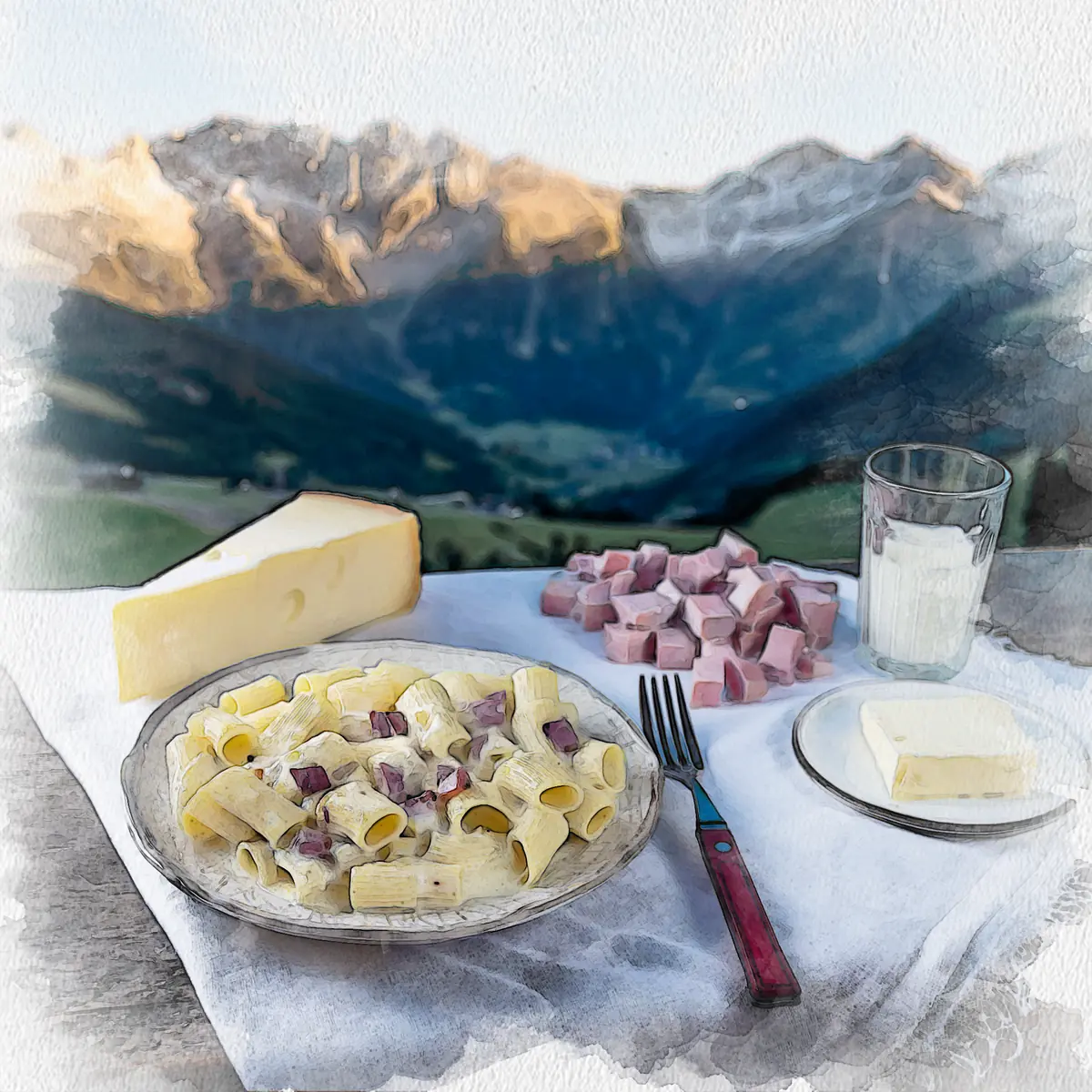
PASTA IN THE VALDOSTANA STYLE
Fontina DOP, artisanal cooked ham, and fresh cream.
Effortless
Val d'Aosta
A brief span of thirty minutes
680 Kcal
PASTA IN THE VALDOSTANA STYLE
Fontina DOP, artisanal cooked ham, and fresh cream.
Effortless
Val d'Aosta
A brief span of thirty minutes
680 Kcal
PASTA IN THE VALDOSTANA STYLE
Fontina DOP, artisanal cooked ham, and fresh cream.
Effortless
Val d'Aosta
A brief span of thirty minutes
680 Kcal
GENESIS
There exists no documented and recognized history of a traditional dish called "pasta alla Valdostana" possessing the same historical depth as other typical recipes of the Aosta Valley, such as Fonduta alla Valdostana or Polenta Concia.
While the gastronomy of Aosta boasts rich and savory creations that make generous use of local treasures like Fontina PDO, butter, cream, and cured meats, a specific pasta dish historically named "pasta alla Valdostana" does not emerge as a recipe of ancient tradition.
What is commonly prepared and celebrated today as "pasta alla Valdostana" is rather a modern culinary creation inspired by the characteristic flavors of the region. It is generally a dressing for pasta (often short shapes, such as penne or rigatoni) that elevates the signature ingredients of the Aosta Valley.
The elements that typically compose a modern "pasta alla Valdostana" include:
Fontina PDO, the supreme ingredient, a semi-hard, semi-cooked cheese crafted in the Aosta Valley, renowned for its sublime ability to melt beautifully.
Cooked ham, which imparts a savory depth and is often cut into delicate cubes or strips.
Butter, an essential pillar of Aostan cuisine, used to gently sauté and contribute to the dish's velvety creaminess.
Fresh cream, frequently added to render the dressing even more luxurious and enveloping.
Ultimately, the contemporary "pasta alla Valdostana" is a poetic homage to the artisanal products and tastes of the Aosta Valley, yet it does not trace its lineage to a consolidated historical tradition like other emblematic dishes of the territory. It stands as a testament to how regional flavors can inspire new culinary art over time.
PORTIONS (FOR 4 PERSONS)
THE RECIPE
Rigatoni
Fontina DOP
Cubed cooked ham
Fresh heavy cream
Butter
Salt
Freshly cracked black pepper
Nutmeg (optional)
320 g
200 g
100 g
200 ml
40 g
to taste
to taste
to taste
CURATION
For the dressing:
In a spacious pan, melt the butter over a gentle flame. Take care not to let it singe. Introduce the cooked ham, cut into cubes or ribbons, and let it brown lightly for a few moments, until it turns golden and releases its savory essence. Meanwhile, carve the Fontina PDO into small cubes or slender ribbons; this shall encourage the cheese to melt with grace. Pour the fresh cream into the pan with the ham. Warm it gently, yet do not let it come to a boil. Add the sliced Fontina to the cream and ham. Stir continuously with a wooden spoon or a hand whisk over the lowest heat, until the Fontina dissolves completely, weaving a smooth, harmonious cream. If necessary, you may raise the flame slightly, but remain vigilant lest the cheese cling to the bottom. Season with salt and freshly ground black pepper to suit your palate. Should you desire, add a generous grating of nutmeg for an extra touch of aromatic poetry. Keep the sauce warm off the heat while cooking the pasta.For the pasta:
Bring a generous pot of salted water to a rolling boil. Once the water sings with bubbles, immerse the pasta and cook it according to the package instructions, draining it while it still retains its firmness (al dente). Remember to reserve a ladle or two of the starchy cooking water before draining it completely.To unite the elements (Mantecare):
Drain the pasta al dente and transfer it directly into the pan with the Valdostana sauce. Awake the flame to medium heat and gently toss the pasta with the sauce for a minute or two, stirring delicately to harmonize all the ingredients. Should the sauce appear too dense, whisper a little of the reserved cooking water into the pan; the starch within will render the sauce even more velvety.
Serve the pasta alla Valdostana immediately, wondrously hot, perhaps graced with a final dusting of fresh black pepper to taste.
aspiration
Should you desire a flavor of even greater intensity, you may employ a delicate smoked ham in place of the traditional prosciutto cotto.
For those who harbor a passion for the treasures of the forest, sautéed champignon mushrooms may be gracefully introduced to the condiment alongside the ham.
To achieve a delicate, golden gratin, transfer the beautifully dressed pasta into a baking dish, dust with a whisper of freshly grated Parmigiano Reggiano, and let it brown gently in a warm oven for brief moments.


GENESIS
There exists no documented and recognized history of a traditional dish called "pasta alla Valdostana" possessing the same historical depth as other typical recipes of the Aosta Valley, such as Fonduta alla Valdostana or Polenta Concia.
While the gastronomy of Aosta boasts rich and savory creations that make generous use of local treasures like Fontina PDO, butter, cream, and cured meats, a specific pasta dish historically named "pasta alla Valdostana" does not emerge as a recipe of ancient tradition.
What is commonly prepared and celebrated today as "pasta alla Valdostana" is rather a modern culinary creation inspired by the characteristic flavors of the region. It is generally a dressing for pasta (often short shapes, such as penne or rigatoni) that elevates the signature ingredients of the Aosta Valley.
The elements that typically compose a modern "pasta alla Valdostana" include:
Fontina PDO, the supreme ingredient, a semi-hard, semi-cooked cheese crafted in the Aosta Valley, renowned for its sublime ability to melt beautifully.
Cooked ham, which imparts a savory depth and is often cut into delicate cubes or strips.
Butter, an essential pillar of Aostan cuisine, used to gently sauté and contribute to the dish's velvety creaminess.
Fresh cream, frequently added to render the dressing even more luxurious and enveloping.
Ultimately, the contemporary "pasta alla Valdostana" is a poetic homage to the artisanal products and tastes of the Aosta Valley, yet it does not trace its lineage to a consolidated historical tradition like other emblematic dishes of the territory. It stands as a testament to how regional flavors can inspire new culinary art over time.
PORTIONS (FOR 4 PERSONS)
THE RECIPE
Rigatoni
Fontina DOP
Cubed cooked ham
Fresh heavy cream
Butter
Salt
Freshly cracked black pepper
Nutmeg (optional)
320 g
200 g
100 g
200 ml
40 g
to taste
to taste
to taste
CURATION
For the dressing:
In a spacious pan, melt the butter over a gentle flame. Take care not to let it singe. Introduce the cooked ham, cut into cubes or ribbons, and let it brown lightly for a few moments, until it turns golden and releases its savory essence. Meanwhile, carve the Fontina PDO into small cubes or slender ribbons; this shall encourage the cheese to melt with grace. Pour the fresh cream into the pan with the ham. Warm it gently, yet do not let it come to a boil. Add the sliced Fontina to the cream and ham. Stir continuously with a wooden spoon or a hand whisk over the lowest heat, until the Fontina dissolves completely, weaving a smooth, harmonious cream. If necessary, you may raise the flame slightly, but remain vigilant lest the cheese cling to the bottom. Season with salt and freshly ground black pepper to suit your palate. Should you desire, add a generous grating of nutmeg for an extra touch of aromatic poetry. Keep the sauce warm off the heat while cooking the pasta.For the pasta:
Bring a generous pot of salted water to a rolling boil. Once the water sings with bubbles, immerse the pasta and cook it according to the package instructions, draining it while it still retains its firmness (al dente). Remember to reserve a ladle or two of the starchy cooking water before draining it completely.To unite the elements (Mantecare):
Drain the pasta al dente and transfer it directly into the pan with the Valdostana sauce. Awake the flame to medium heat and gently toss the pasta with the sauce for a minute or two, stirring delicately to harmonize all the ingredients. Should the sauce appear too dense, whisper a little of the reserved cooking water into the pan; the starch within will render the sauce even more velvety.
Serve the pasta alla Valdostana immediately, wondrously hot, perhaps graced with a final dusting of fresh black pepper to taste.
aspiration
Should you desire a flavor of even greater intensity, you may employ a delicate smoked ham in place of the traditional prosciutto cotto.
For those who harbor a passion for the treasures of the forest, sautéed champignon mushrooms may be gracefully introduced to the condiment alongside the ham.
To achieve a delicate, golden gratin, transfer the beautifully dressed pasta into a baking dish, dust with a whisper of freshly grated Parmigiano Reggiano, and let it brown gently in a warm oven for brief moments.
latest culinary creations
GENESIS
There exists no documented and recognized history of a traditional dish called "pasta alla Valdostana" possessing the same historical depth as other typical recipes of the Aosta Valley, such as Fonduta alla Valdostana or Polenta Concia.
While the gastronomy of Aosta boasts rich and savory creations that make generous use of local treasures like Fontina PDO, butter, cream, and cured meats, a specific pasta dish historically named "pasta alla Valdostana" does not emerge as a recipe of ancient tradition.
What is commonly prepared and celebrated today as "pasta alla Valdostana" is rather a modern culinary creation inspired by the characteristic flavors of the region. It is generally a dressing for pasta (often short shapes, such as penne or rigatoni) that elevates the signature ingredients of the Aosta Valley.
The elements that typically compose a modern "pasta alla Valdostana" include:
Fontina PDO, the supreme ingredient, a semi-hard, semi-cooked cheese crafted in the Aosta Valley, renowned for its sublime ability to melt beautifully.
Cooked ham, which imparts a savory depth and is often cut into delicate cubes or strips.
Butter, an essential pillar of Aostan cuisine, used to gently sauté and contribute to the dish's velvety creaminess.
Fresh cream, frequently added to render the dressing even more luxurious and enveloping.
Ultimately, the contemporary "pasta alla Valdostana" is a poetic homage to the artisanal products and tastes of the Aosta Valley, yet it does not trace its lineage to a consolidated historical tradition like other emblematic dishes of the territory. It stands as a testament to how regional flavors can inspire new culinary art over time.
PORTIONS (FOR 4 PERSONS)
THE RECIPE
Rigatoni
Fontina DOP
Cubed cooked ham
Fresh heavy cream
Butter
Salt
Freshly cracked black pepper
Nutmeg (optional)
320 g
200 g
100 g
200 ml
40 g
to taste
to taste
to taste
CURATION
For the dressing:
In a spacious pan, melt the butter over a gentle flame. Take care not to let it singe. Introduce the cooked ham, cut into cubes or ribbons, and let it brown lightly for a few moments, until it turns golden and releases its savory essence. Meanwhile, carve the Fontina PDO into small cubes or slender ribbons; this shall encourage the cheese to melt with grace. Pour the fresh cream into the pan with the ham. Warm it gently, yet do not let it come to a boil. Add the sliced Fontina to the cream and ham. Stir continuously with a wooden spoon or a hand whisk over the lowest heat, until the Fontina dissolves completely, weaving a smooth, harmonious cream. If necessary, you may raise the flame slightly, but remain vigilant lest the cheese cling to the bottom. Season with salt and freshly ground black pepper to suit your palate. Should you desire, add a generous grating of nutmeg for an extra touch of aromatic poetry. Keep the sauce warm off the heat while cooking the pasta.For the pasta:
Bring a generous pot of salted water to a rolling boil. Once the water sings with bubbles, immerse the pasta and cook it according to the package instructions, draining it while it still retains its firmness (al dente). Remember to reserve a ladle or two of the starchy cooking water before draining it completely.To unite the elements (Mantecare):
Drain the pasta al dente and transfer it directly into the pan with the Valdostana sauce. Awake the flame to medium heat and gently toss the pasta with the sauce for a minute or two, stirring delicately to harmonize all the ingredients. Should the sauce appear too dense, whisper a little of the reserved cooking water into the pan; the starch within will render the sauce even more velvety.
Serve the pasta alla Valdostana immediately, wondrously hot, perhaps graced with a final dusting of fresh black pepper to taste.
aspiration
Should you desire a flavor of even greater intensity, you may employ a delicate smoked ham in place of the traditional prosciutto cotto.
For those who harbor a passion for the treasures of the forest, sautéed champignon mushrooms may be gracefully introduced to the condiment alongside the ham.
To achieve a delicate, golden gratin, transfer the beautifully dressed pasta into a baking dish, dust with a whisper of freshly grated Parmigiano Reggiano, and let it brown gently in a warm oven for brief moments.