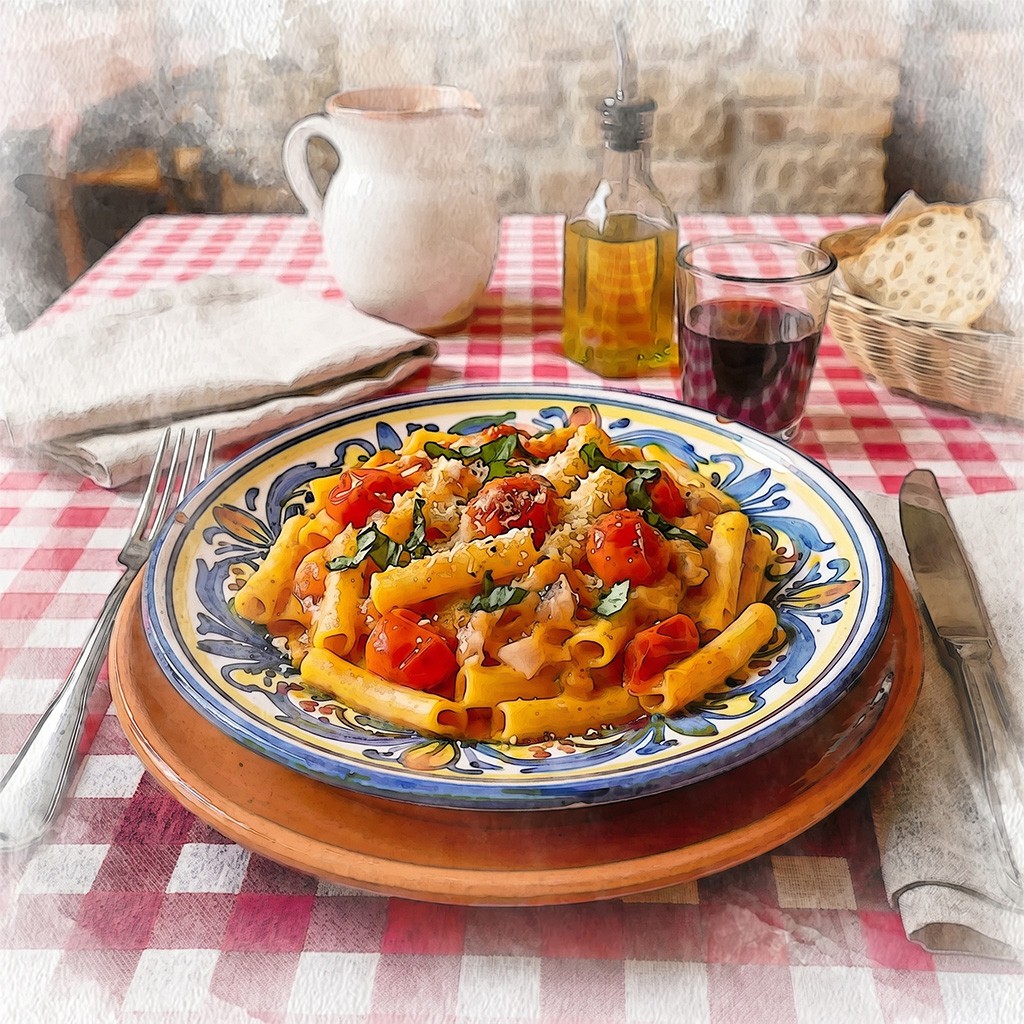
NEAPOLITAN PASTA WITH LARD: A CULINARY RITUAL
Broken Ziti pasta, Colonnata Lardo, Piennolo cherry tomatoes, and Pecorino Romano
Effortless
Campania
A forty-five minute journey
A nourishment of 680 Kcal
NEAPOLITAN PASTA WITH LARD: A CULINARY RITUAL
Broken Ziti pasta, Colonnata Lardo, Piennolo cherry tomatoes, and Pecorino Romano
Effortless
Campania
A forty-five minute journey
A nourishment of 680 Kcal
NEAPOLITAN PASTA WITH LARD: A CULINARY RITUAL
Broken Ziti pasta, Colonnata Lardo, Piennolo cherry tomatoes, and Pecorino Romano
Effortless
Campania
A forty-five minute journey
A nourishment of 680 Kcal
GENESIS
Pasta lardiata represents one of the lesser-known yet most authentic pillars of Neapolitan popular gastronomy. Its origins root themselves in the necessity of the less fortunate classes to substitute the costliest ingredients—such as the prized cuts of meat destined for ragù or genovese—with more humble and readily available animal fats. Lard, in particular, was the quintessential energy reserve for farming families and the laborers of Naples' vibrant working-class quarters.
The term lardiata derives directly from its sovereign ingredient, raw lard, which is transformed into a delicate cream through a fine mince executed with a knife—a technique known in the local dialect as "allacciare il lardo." Historically, this recipe was prepared primarily during the cold months, as the lipid component of the lard offered the necessary sustenance to endure the rigors of winter.
Though it may appear as a humble variation, the lardiata demands a remarkable culinary mastery in temperature control, ensuring the lard does not burn and forfeit its inherent sweetness and characteristic aroma. The addition of cherry tomatoes, preferably the piennolo of Mount Vesuvius, bestows upon the dish a bright, sweet-tart note that perfectly balances the rich savoriness of the fat and the grated cheese.
The choice of pasta shape traditionally falls upon mezzani or smooth penne, though broken ziti also adapt exquisitely, cradling the dense, enveloping sauce created by the emulsion of cooking water, liquefied lard, and grated cheeses. Despite its simple origins, the lardiata has been rediscoverd by modern gastronomic critics, who have ennobled its role within the Mediterranean diet as a sublime testament to the cuisine of resourcefulness and the harmonious balance of Campanian terroir. Today, it stands as a culinary ritual, celebrating the art of transforming a few humble elements into a dish of profound depth and intensity.
PORTIONS (FOR 4 PERSONS)
THE RECIPE
Broken Ziti
Lardo di Colonnata
Fresh Piennolo Cherry Tomatoes
Pecorino Romano
Parmigiano Reggiano
Copper Onion
Garlic
Fresh Chili Pepper
Extra Virgin Olive Oil
Salt
Fresh Basil
320 g
240 g
600 g
80 g
80 g
1
2
1
To taste
To taste
To taste
CURATION
For the seasoning:
Begin by taking the lardo and, upon a wooden board, reduce it to minute fragments with a finely sharpened knife. Continue to mince it with utmost patience until you achieve a near-creamy texture, reminiscent of a rich pomade. In a generous skillet, pour a thread of extra virgin olive oil and introduce the finely minced onion, the two whole cloves of garlic, and the chili pepper. Allow them to gently sweat over a most delicate flame to preserve the integrity of their aromas. Once the onion has rendered translucent, unite the beaten lardo, letting it dissolve slowly until it becomes clear, releasing its full, evocative fragrance. At this juncture, introduce the Piennolo cherry tomatoes, halved. Elevate the flame slightly and cook for approximately 15 minutes, gently pressing the tomatoes with a fork to coax forth their juices and the sun-drenched flavors of Vesuvius. Near the end of the cooking, remove the garlic and scatter a few leaves of fresh basil, torn lovingly by hand.For the pasta:
While the sauce simmers, bring a pot of abundant, salted water to a rolling boil. When the water reaches its zenith, snap the ziti by hand and plunge them into the depths. Drain them whilst still very al dente, taking care to reserve a ladle of the precious cooking water. Transfer the pasta directly into the pan embracing the seasoned sauce.For the mantecatura:
Toss the pasta over a lively flame for a single minute, introducing the set-aside cooking water if required, to fashion a luscious emulsion with the lardo and the profound flavors of the sauce. Extinguish the flame and scatter the grated Pecorino Romano and Parmigiano Reggiano. Stir with vigorous grace to bind the elements together, until each strand of pasta is perfectly veiled in a sublime, velvety gloss.
aspiration
Employ exclusively fresh Piennolo cherry tomatoes to achieve the perfect, vibrant acidity.
Ensure your lardo is of the finest provenance, preferably possessing a delicate vein of lean meat.
Always perform the mantecatura off the flame, lest the cheeses string or seize too abruptly.


GENESIS
Pasta lardiata represents one of the lesser-known yet most authentic pillars of Neapolitan popular gastronomy. Its origins root themselves in the necessity of the less fortunate classes to substitute the costliest ingredients—such as the prized cuts of meat destined for ragù or genovese—with more humble and readily available animal fats. Lard, in particular, was the quintessential energy reserve for farming families and the laborers of Naples' vibrant working-class quarters.
The term lardiata derives directly from its sovereign ingredient, raw lard, which is transformed into a delicate cream through a fine mince executed with a knife—a technique known in the local dialect as "allacciare il lardo." Historically, this recipe was prepared primarily during the cold months, as the lipid component of the lard offered the necessary sustenance to endure the rigors of winter.
Though it may appear as a humble variation, the lardiata demands a remarkable culinary mastery in temperature control, ensuring the lard does not burn and forfeit its inherent sweetness and characteristic aroma. The addition of cherry tomatoes, preferably the piennolo of Mount Vesuvius, bestows upon the dish a bright, sweet-tart note that perfectly balances the rich savoriness of the fat and the grated cheese.
The choice of pasta shape traditionally falls upon mezzani or smooth penne, though broken ziti also adapt exquisitely, cradling the dense, enveloping sauce created by the emulsion of cooking water, liquefied lard, and grated cheeses. Despite its simple origins, the lardiata has been rediscoverd by modern gastronomic critics, who have ennobled its role within the Mediterranean diet as a sublime testament to the cuisine of resourcefulness and the harmonious balance of Campanian terroir. Today, it stands as a culinary ritual, celebrating the art of transforming a few humble elements into a dish of profound depth and intensity.
PORTIONS (FOR 4 PERSONS)
THE RECIPE
Broken Ziti
Lardo di Colonnata
Fresh Piennolo Cherry Tomatoes
Pecorino Romano
Parmigiano Reggiano
Copper Onion
Garlic
Fresh Chili Pepper
Extra Virgin Olive Oil
Salt
Fresh Basil
320 g
240 g
600 g
80 g
80 g
1
2
1
To taste
To taste
To taste
CURATION
For the seasoning:
Begin by taking the lardo and, upon a wooden board, reduce it to minute fragments with a finely sharpened knife. Continue to mince it with utmost patience until you achieve a near-creamy texture, reminiscent of a rich pomade. In a generous skillet, pour a thread of extra virgin olive oil and introduce the finely minced onion, the two whole cloves of garlic, and the chili pepper. Allow them to gently sweat over a most delicate flame to preserve the integrity of their aromas. Once the onion has rendered translucent, unite the beaten lardo, letting it dissolve slowly until it becomes clear, releasing its full, evocative fragrance. At this juncture, introduce the Piennolo cherry tomatoes, halved. Elevate the flame slightly and cook for approximately 15 minutes, gently pressing the tomatoes with a fork to coax forth their juices and the sun-drenched flavors of Vesuvius. Near the end of the cooking, remove the garlic and scatter a few leaves of fresh basil, torn lovingly by hand.For the pasta:
While the sauce simmers, bring a pot of abundant, salted water to a rolling boil. When the water reaches its zenith, snap the ziti by hand and plunge them into the depths. Drain them whilst still very al dente, taking care to reserve a ladle of the precious cooking water. Transfer the pasta directly into the pan embracing the seasoned sauce.For the mantecatura:
Toss the pasta over a lively flame for a single minute, introducing the set-aside cooking water if required, to fashion a luscious emulsion with the lardo and the profound flavors of the sauce. Extinguish the flame and scatter the grated Pecorino Romano and Parmigiano Reggiano. Stir with vigorous grace to bind the elements together, until each strand of pasta is perfectly veiled in a sublime, velvety gloss.
aspiration
Employ exclusively fresh Piennolo cherry tomatoes to achieve the perfect, vibrant acidity.
Ensure your lardo is of the finest provenance, preferably possessing a delicate vein of lean meat.
Always perform the mantecatura off the flame, lest the cheeses string or seize too abruptly.
latest culinary creations
GENESIS
Pasta lardiata represents one of the lesser-known yet most authentic pillars of Neapolitan popular gastronomy. Its origins root themselves in the necessity of the less fortunate classes to substitute the costliest ingredients—such as the prized cuts of meat destined for ragù or genovese—with more humble and readily available animal fats. Lard, in particular, was the quintessential energy reserve for farming families and the laborers of Naples' vibrant working-class quarters.
The term lardiata derives directly from its sovereign ingredient, raw lard, which is transformed into a delicate cream through a fine mince executed with a knife—a technique known in the local dialect as "allacciare il lardo." Historically, this recipe was prepared primarily during the cold months, as the lipid component of the lard offered the necessary sustenance to endure the rigors of winter.
Though it may appear as a humble variation, the lardiata demands a remarkable culinary mastery in temperature control, ensuring the lard does not burn and forfeit its inherent sweetness and characteristic aroma. The addition of cherry tomatoes, preferably the piennolo of Mount Vesuvius, bestows upon the dish a bright, sweet-tart note that perfectly balances the rich savoriness of the fat and the grated cheese.
The choice of pasta shape traditionally falls upon mezzani or smooth penne, though broken ziti also adapt exquisitely, cradling the dense, enveloping sauce created by the emulsion of cooking water, liquefied lard, and grated cheeses. Despite its simple origins, the lardiata has been rediscoverd by modern gastronomic critics, who have ennobled its role within the Mediterranean diet as a sublime testament to the cuisine of resourcefulness and the harmonious balance of Campanian terroir. Today, it stands as a culinary ritual, celebrating the art of transforming a few humble elements into a dish of profound depth and intensity.
PORTIONS (FOR 4 PERSONS)
THE RECIPE
Broken Ziti
Lardo di Colonnata
Fresh Piennolo Cherry Tomatoes
Pecorino Romano
Parmigiano Reggiano
Copper Onion
Garlic
Fresh Chili Pepper
Extra Virgin Olive Oil
Salt
Fresh Basil
320 g
240 g
600 g
80 g
80 g
1
2
1
To taste
To taste
To taste
CURATION
For the seasoning:
Begin by taking the lardo and, upon a wooden board, reduce it to minute fragments with a finely sharpened knife. Continue to mince it with utmost patience until you achieve a near-creamy texture, reminiscent of a rich pomade. In a generous skillet, pour a thread of extra virgin olive oil and introduce the finely minced onion, the two whole cloves of garlic, and the chili pepper. Allow them to gently sweat over a most delicate flame to preserve the integrity of their aromas. Once the onion has rendered translucent, unite the beaten lardo, letting it dissolve slowly until it becomes clear, releasing its full, evocative fragrance. At this juncture, introduce the Piennolo cherry tomatoes, halved. Elevate the flame slightly and cook for approximately 15 minutes, gently pressing the tomatoes with a fork to coax forth their juices and the sun-drenched flavors of Vesuvius. Near the end of the cooking, remove the garlic and scatter a few leaves of fresh basil, torn lovingly by hand.For the pasta:
While the sauce simmers, bring a pot of abundant, salted water to a rolling boil. When the water reaches its zenith, snap the ziti by hand and plunge them into the depths. Drain them whilst still very al dente, taking care to reserve a ladle of the precious cooking water. Transfer the pasta directly into the pan embracing the seasoned sauce.For the mantecatura:
Toss the pasta over a lively flame for a single minute, introducing the set-aside cooking water if required, to fashion a luscious emulsion with the lardo and the profound flavors of the sauce. Extinguish the flame and scatter the grated Pecorino Romano and Parmigiano Reggiano. Stir with vigorous grace to bind the elements together, until each strand of pasta is perfectly veiled in a sublime, velvety gloss.
aspiration
Employ exclusively fresh Piennolo cherry tomatoes to achieve the perfect, vibrant acidity.
Ensure your lardo is of the finest provenance, preferably possessing a delicate vein of lean meat.
Always perform the mantecatura off the flame, lest the cheeses string or seize too abruptly.