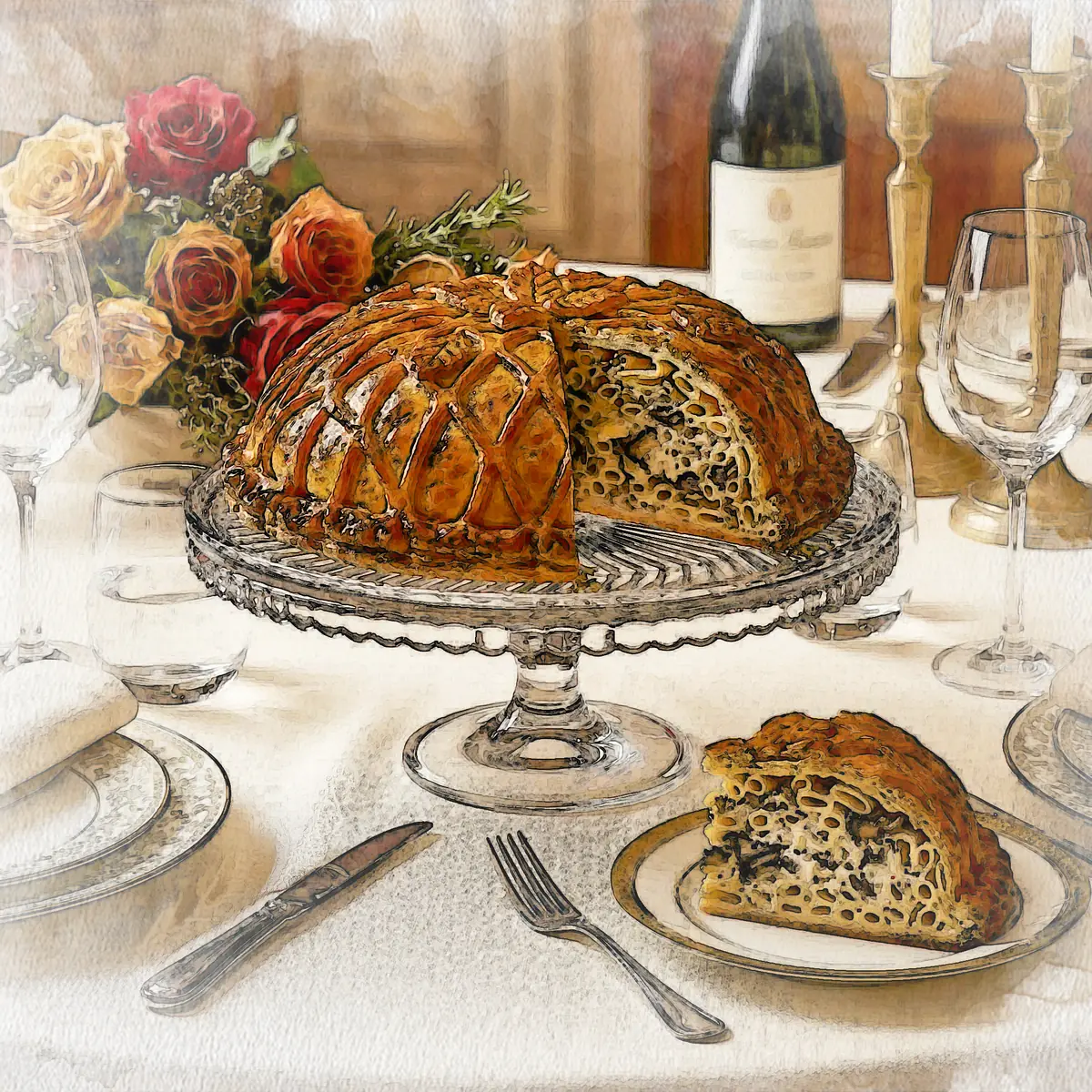
FERRARESE PASTICCIO
Maccheroncini, noble beef, choice pork, sun-dried forest mushrooms, exquisite truffle, aged Parmigiano Reggiano, artisanal flour, churned butter, and pure milk
Exceedingly Masterful
Emilia-Romagna
Three hours of culinary contemplation
850 Kcal
FERRARESE PASTICCIO
Maccheroncini, noble beef, choice pork, sun-dried forest mushrooms, exquisite truffle, aged Parmigiano Reggiano, artisanal flour, churned butter, and pure milk
Exceedingly Masterful
Emilia-Romagna
Three hours of culinary contemplation
850 Kcal
FERRARESE PASTICCIO
Maccheroncini, noble beef, choice pork, sun-dried forest mushrooms, exquisite truffle, aged Parmigiano Reggiano, artisanal flour, churned butter, and pure milk
Exceedingly Masterful
Emilia-Romagna
Three hours of culinary contemplation
850 Kcal
GENESIS
The Pasticcio alla ferrarese stands as one of the loftiest expressions of Renaissance courtly cuisine, profoundly intertwined with the history of the House of Este, who ruled Ferrara for centuries. This creation distinguishes itself through the refined counterpoint between the sweet embrace of its outer crust and the savory depth of its fillingu2014a hallmark characteristic of sixteenth-century aristocratic banquets, wherein sugar was revered as a precious spice and a symbol of social prestige. The earliest traces of such culinary masterpieces are found within the recipe books of Cristoforo di Messisbugo, scalco to the Estense court, who documented sumptuous compositions of pasta enclosed in golden crusts of shortcrust pastry.
The aesthetic elegance of the dish remains paramount: traditionally, it is baked within specialized tinned copper vessels known as "pasticciere," which bestow upon it its signature dome-like majesty. Over the centuries, the recipe has gracefully evolved, anchoring itself in the contemporary rendition that calls for maccheroncini enveloped in a rich, white ragu00f9, velvet bu00e9chamel, dried forest mushrooms, and, in its most opulent iterations, shaved black truffle.
Unlike the savory pies of other Italian regions, that of Ferrara rigorously preserves the sacred union of sweet pastry and savory core. Historically, it was savored during the revelries of Carnival or on the occasion of solemn feasts, representing the Sunday centerpiece for noble houses and, in later times, for the city's refined bourgeoisie. Its creation demands extraordinary technical mastery, particularly in tempering the delicate pastry and in the slow, meditative simmering of the ragu00f9, which must remain untouched by tomato to honor the original purity of its colors and flavors. To this day, the Pasticcio alla ferrarese is safeguarded as a traditional agro-alimentary treasure, standing as a pillar of Ferrara's gastronomic soul, proudly offered in the historic taverns of the city's ancient heart.
PORTIONS (FOR 4 PERSONS)
FOR THE PASTA
Maccheroncini
320 g
FOR THE EMBELLISHMENT
Minced beef sirloin
Minced heritage pork shoulder
Velvety chicken livers
Sun-dried forest mushrooms
Treasured black truffle (optional)
Regal Parmigiano Reggiano
Churched butter
Sweet garden carrot
Crisp stalk of celery
Golden summer onion
Dry, crisp white wine
Extra virgin olive oil
Fine sea salt
Freshly cracked pepper
300 g
150 g
50 g
30 g
1
100 g
50 g
1
1
1
1 glass
To taste
To taste
To taste
FOR THE PASTRY CRUST
Flour 00
Butter
Sugar
Egg yolks
Grated zest
Salt
500 g
250 g
200 g
4
1/2 lemon
To taste
FOR THE VELVET BECHAMEL
Whole milk
Butter
Flour 00
Nutmeg
Salt
500 ml
50 g
50 g
To taste
To taste
CURATION
For the pastry crust:
Arrange the flour in a well upon a wooden pastry board; within its heart, place the chilled butter in small pieces, the sugar, the golden egg yolks, the fragrant lemon zest, and a pinch of salt. Work these ingredients swiftly with your hands until they unite into a smooth, cohesive dough. Envelop this sweet pastry in cling film and let it rest in the cool depths of the refrigerator for at least one hour before bringing it to the oven.For the ragù:
Begin by steeping the dried mushrooms in lukewarm water for approximately 20 minutes, awakening their forest aromas. Prepare the aromatic base, finely mincing the onion, carrot, and celery. In a copper casserole, warm a thread of extra virgin olive oil and a pat of butter, then gently sweat the vegetables over a low flame. Introduce the minced beef and pork, searing them beautifully until they color. Deglaze the pan with white wine, letting the alcohol evaporate into the air. Add the squeezed and finely chopped mushrooms, the chicken livers cut into delicate pieces, and let the sauce simmer patiently for about an hour and a half, ladling in hot water or broth as needed. As the cooking nears its end, season with salt and pepper. If using truffle, shave it finely and stir it into the ragù once away from the fire.For the béchamel:
In a small saucepan, gently melt the butter over a low flame. Whisk in the flour all at once, stirring smoothly to create a golden roux. Stream in the warm milk slowly, whisking with vigor to prevent any lumps from forming. Cook until the sauce thickens into a velvety cream, then season with salt and a grating of nutmeg.For the pasta and composition:
Boil the maccheroncini in abundant salted water, draining them halfway through their cooking time, as they will finish their transformation in the oven. In a generous bowl, dress the pasta with the rich ragù, the velvety béchamel, and a bountiful dusting of Parmigiano Reggiano. Mix gently so that all elements marry harmoniously. Retrieve your sweet pastry from the refrigerator and divide it into two portions, one slightly larger than the other. Roll out the larger portion with a rolling pin and line a buttered dome-shaped mold. Fill this pastry cradle with the dressed pasta. Roll out the second portion of pastry to form a lid, sealing the edges with care. If any pastry remains, adorn the surface with delicate braids or ornamental details.For the baking:
Preheat your oven to 180°C and bake the pasticcio for approximately 45 minutes, or until the pastry assumes a rich, golden hue. Once fully baked, remove it from the oven and let it rest for at least 15 minutes before gently unmolding it onto a serving platter and presenting it to the table.
aspiration
Should you desire a more aromatic cadence, a subtle whisper of cinnamon may be coaxed into the pastry dough.
Ensure the ragù has been simmered to a rich, concentrated essence, devoid of excess moisture, lest it compromise the crisp, pristine integrity of the pastry base.
To achieve a sublime, golden luster, you may gently brush the crown of the pastry with a wash of beaten egg yolk and a single spoonful of milk before committing it to the oven's embrace.


GENESIS
The Pasticcio alla ferrarese stands as one of the loftiest expressions of Renaissance courtly cuisine, profoundly intertwined with the history of the House of Este, who ruled Ferrara for centuries. This creation distinguishes itself through the refined counterpoint between the sweet embrace of its outer crust and the savory depth of its fillingu2014a hallmark characteristic of sixteenth-century aristocratic banquets, wherein sugar was revered as a precious spice and a symbol of social prestige. The earliest traces of such culinary masterpieces are found within the recipe books of Cristoforo di Messisbugo, scalco to the Estense court, who documented sumptuous compositions of pasta enclosed in golden crusts of shortcrust pastry.
The aesthetic elegance of the dish remains paramount: traditionally, it is baked within specialized tinned copper vessels known as "pasticciere," which bestow upon it its signature dome-like majesty. Over the centuries, the recipe has gracefully evolved, anchoring itself in the contemporary rendition that calls for maccheroncini enveloped in a rich, white ragu00f9, velvet bu00e9chamel, dried forest mushrooms, and, in its most opulent iterations, shaved black truffle.
Unlike the savory pies of other Italian regions, that of Ferrara rigorously preserves the sacred union of sweet pastry and savory core. Historically, it was savored during the revelries of Carnival or on the occasion of solemn feasts, representing the Sunday centerpiece for noble houses and, in later times, for the city's refined bourgeoisie. Its creation demands extraordinary technical mastery, particularly in tempering the delicate pastry and in the slow, meditative simmering of the ragu00f9, which must remain untouched by tomato to honor the original purity of its colors and flavors. To this day, the Pasticcio alla ferrarese is safeguarded as a traditional agro-alimentary treasure, standing as a pillar of Ferrara's gastronomic soul, proudly offered in the historic taverns of the city's ancient heart.
PORTIONS (FOR 4 PERSONS)
FOR THE PASTA
Maccheroncini
320 g
FOR THE EMBELLISHMENT
Minced beef sirloin
Minced heritage pork shoulder
Velvety chicken livers
Sun-dried forest mushrooms
Treasured black truffle (optional)
Regal Parmigiano Reggiano
Churched butter
Sweet garden carrot
Crisp stalk of celery
Golden summer onion
Dry, crisp white wine
Extra virgin olive oil
Fine sea salt
Freshly cracked pepper
300 g
150 g
50 g
30 g
1
100 g
50 g
1
1
1
1 glass
To taste
To taste
To taste
FOR THE PASTRY CRUST
Flour 00
Butter
Sugar
Egg yolks
Grated zest
Salt
500 g
250 g
200 g
4
1/2 lemon
To taste
FOR THE VELVET BECHAMEL
Whole milk
Butter
Flour 00
Nutmeg
Salt
500 ml
50 g
50 g
To taste
To taste
CURATION
For the pastry crust:
Arrange the flour in a well upon a wooden pastry board; within its heart, place the chilled butter in small pieces, the sugar, the golden egg yolks, the fragrant lemon zest, and a pinch of salt. Work these ingredients swiftly with your hands until they unite into a smooth, cohesive dough. Envelop this sweet pastry in cling film and let it rest in the cool depths of the refrigerator for at least one hour before bringing it to the oven.For the ragù:
Begin by steeping the dried mushrooms in lukewarm water for approximately 20 minutes, awakening their forest aromas. Prepare the aromatic base, finely mincing the onion, carrot, and celery. In a copper casserole, warm a thread of extra virgin olive oil and a pat of butter, then gently sweat the vegetables over a low flame. Introduce the minced beef and pork, searing them beautifully until they color. Deglaze the pan with white wine, letting the alcohol evaporate into the air. Add the squeezed and finely chopped mushrooms, the chicken livers cut into delicate pieces, and let the sauce simmer patiently for about an hour and a half, ladling in hot water or broth as needed. As the cooking nears its end, season with salt and pepper. If using truffle, shave it finely and stir it into the ragù once away from the fire.For the béchamel:
In a small saucepan, gently melt the butter over a low flame. Whisk in the flour all at once, stirring smoothly to create a golden roux. Stream in the warm milk slowly, whisking with vigor to prevent any lumps from forming. Cook until the sauce thickens into a velvety cream, then season with salt and a grating of nutmeg.For the pasta and composition:
Boil the maccheroncini in abundant salted water, draining them halfway through their cooking time, as they will finish their transformation in the oven. In a generous bowl, dress the pasta with the rich ragù, the velvety béchamel, and a bountiful dusting of Parmigiano Reggiano. Mix gently so that all elements marry harmoniously. Retrieve your sweet pastry from the refrigerator and divide it into two portions, one slightly larger than the other. Roll out the larger portion with a rolling pin and line a buttered dome-shaped mold. Fill this pastry cradle with the dressed pasta. Roll out the second portion of pastry to form a lid, sealing the edges with care. If any pastry remains, adorn the surface with delicate braids or ornamental details.For the baking:
Preheat your oven to 180°C and bake the pasticcio for approximately 45 minutes, or until the pastry assumes a rich, golden hue. Once fully baked, remove it from the oven and let it rest for at least 15 minutes before gently unmolding it onto a serving platter and presenting it to the table.
aspiration
Should you desire a more aromatic cadence, a subtle whisper of cinnamon may be coaxed into the pastry dough.
Ensure the ragù has been simmered to a rich, concentrated essence, devoid of excess moisture, lest it compromise the crisp, pristine integrity of the pastry base.
To achieve a sublime, golden luster, you may gently brush the crown of the pastry with a wash of beaten egg yolk and a single spoonful of milk before committing it to the oven's embrace.
latest culinary creations
GENESIS
The Pasticcio alla ferrarese stands as one of the loftiest expressions of Renaissance courtly cuisine, profoundly intertwined with the history of the House of Este, who ruled Ferrara for centuries. This creation distinguishes itself through the refined counterpoint between the sweet embrace of its outer crust and the savory depth of its fillingu2014a hallmark characteristic of sixteenth-century aristocratic banquets, wherein sugar was revered as a precious spice and a symbol of social prestige. The earliest traces of such culinary masterpieces are found within the recipe books of Cristoforo di Messisbugo, scalco to the Estense court, who documented sumptuous compositions of pasta enclosed in golden crusts of shortcrust pastry.
The aesthetic elegance of the dish remains paramount: traditionally, it is baked within specialized tinned copper vessels known as "pasticciere," which bestow upon it its signature dome-like majesty. Over the centuries, the recipe has gracefully evolved, anchoring itself in the contemporary rendition that calls for maccheroncini enveloped in a rich, white ragu00f9, velvet bu00e9chamel, dried forest mushrooms, and, in its most opulent iterations, shaved black truffle.
Unlike the savory pies of other Italian regions, that of Ferrara rigorously preserves the sacred union of sweet pastry and savory core. Historically, it was savored during the revelries of Carnival or on the occasion of solemn feasts, representing the Sunday centerpiece for noble houses and, in later times, for the city's refined bourgeoisie. Its creation demands extraordinary technical mastery, particularly in tempering the delicate pastry and in the slow, meditative simmering of the ragu00f9, which must remain untouched by tomato to honor the original purity of its colors and flavors. To this day, the Pasticcio alla ferrarese is safeguarded as a traditional agro-alimentary treasure, standing as a pillar of Ferrara's gastronomic soul, proudly offered in the historic taverns of the city's ancient heart.
PORTIONS (FOR 4 PERSONS)
FOR THE PASTA
Maccheroncini
320 g
FOR THE EMBELLISHMENT
Minced beef sirloin
Minced heritage pork shoulder
Velvety chicken livers
Sun-dried forest mushrooms
Treasured black truffle (optional)
Regal Parmigiano Reggiano
Churched butter
Sweet garden carrot
Crisp stalk of celery
Golden summer onion
Dry, crisp white wine
Extra virgin olive oil
Fine sea salt
Freshly cracked pepper
300 g
150 g
50 g
30 g
1
100 g
50 g
1
1
1
1 glass
To taste
To taste
To taste
FOR THE PASTRY CRUST
Flour 00
Butter
Sugar
Egg yolks
Grated zest
Salt
500 g
250 g
200 g
4
1/2 lemon
To taste
FOR THE VELVET BECHAMEL
Whole milk
Butter
Flour 00
Nutmeg
Salt
500 ml
50 g
50 g
To taste
To taste
CURATION
For the pastry crust:
Arrange the flour in a well upon a wooden pastry board; within its heart, place the chilled butter in small pieces, the sugar, the golden egg yolks, the fragrant lemon zest, and a pinch of salt. Work these ingredients swiftly with your hands until they unite into a smooth, cohesive dough. Envelop this sweet pastry in cling film and let it rest in the cool depths of the refrigerator for at least one hour before bringing it to the oven.For the ragù:
Begin by steeping the dried mushrooms in lukewarm water for approximately 20 minutes, awakening their forest aromas. Prepare the aromatic base, finely mincing the onion, carrot, and celery. In a copper casserole, warm a thread of extra virgin olive oil and a pat of butter, then gently sweat the vegetables over a low flame. Introduce the minced beef and pork, searing them beautifully until they color. Deglaze the pan with white wine, letting the alcohol evaporate into the air. Add the squeezed and finely chopped mushrooms, the chicken livers cut into delicate pieces, and let the sauce simmer patiently for about an hour and a half, ladling in hot water or broth as needed. As the cooking nears its end, season with salt and pepper. If using truffle, shave it finely and stir it into the ragù once away from the fire.For the béchamel:
In a small saucepan, gently melt the butter over a low flame. Whisk in the flour all at once, stirring smoothly to create a golden roux. Stream in the warm milk slowly, whisking with vigor to prevent any lumps from forming. Cook until the sauce thickens into a velvety cream, then season with salt and a grating of nutmeg.For the pasta and composition:
Boil the maccheroncini in abundant salted water, draining them halfway through their cooking time, as they will finish their transformation in the oven. In a generous bowl, dress the pasta with the rich ragù, the velvety béchamel, and a bountiful dusting of Parmigiano Reggiano. Mix gently so that all elements marry harmoniously. Retrieve your sweet pastry from the refrigerator and divide it into two portions, one slightly larger than the other. Roll out the larger portion with a rolling pin and line a buttered dome-shaped mold. Fill this pastry cradle with the dressed pasta. Roll out the second portion of pastry to form a lid, sealing the edges with care. If any pastry remains, adorn the surface with delicate braids or ornamental details.For the baking:
Preheat your oven to 180°C and bake the pasticcio for approximately 45 minutes, or until the pastry assumes a rich, golden hue. Once fully baked, remove it from the oven and let it rest for at least 15 minutes before gently unmolding it onto a serving platter and presenting it to the table.
aspiration
Should you desire a more aromatic cadence, a subtle whisper of cinnamon may be coaxed into the pastry dough.
Ensure the ragù has been simmered to a rich, concentrated essence, devoid of excess moisture, lest it compromise the crisp, pristine integrity of the pastry base.
To achieve a sublime, golden luster, you may gently brush the crown of the pastry with a wash of beaten egg yolk and a single spoonful of milk before committing it to the oven's embrace.