genesis
Before becoming a Milanese boutique in the elegant quarter of Corso Vercelli, even before establishing itself as a counter of fresh pasta, cappelletti, sfoglie, and ragù, Pastificio Irma is a story scented with roots. An adventure that germinates far from Milan, in the inland of Calabria, in the province of Crotone, where Giovanni Andreoli was born in 1989 and raised within a domestic economy composed of countryside, livestock, olive trees, preserves, and necessary, ritual gestures.
His grandparents, Filomena and Salvatore, lived on a true farmholding: piglets, hens, ducks, geese, goats, sheep, fruit trees, and some three hundred olive specimens. Not an idyll reconstructed in hindsight for readers hungry for picturesque, pastoral tales, but a concrete form of life: the vegetable garden, the tomato set aside for the dark depths of winter, meat reared solely for the family, oil, immense labor, and self-reliance.
Pasta, in that Southern geography, is not so much the domain of the egg and the filling, as that of semolina and tepid water: fusilli al ferretto, cavatelli, strascinati—shapes hollowed and rolled with commendable patience. And then, Grandmother Filomena's Sunday ragù, with ribs, sausage, and pork rind: that "lesser meat" belonging not to noble cuts, but to the ancient wisdom of our ancestresses and the secrets of slow, profound cooking.
Milan arrived early, with the migration of his parents in 1990. Giovanni grew up and studied here, recognizing Milan as his own city, "Milan col coeur in man": demanding yet generous, capable of returning promise to those who resolve to labor. Yet, after his studies in economics and management, he understood his path could not be severed from that primordial world: he wished to dedicate himself to food, to authenticity, to something that germinates slowly from one's own hands.
His first decisive encounter was with Giuseppe Zen, founder of the renowned Macelleria Popolare, at the Municipal Market of the Darsena. Giovanni entered almost by chance, bearing a curriculum, drawn by a popular yet rigorous philosophy of raw ingredients. There he encountered meats, cheeses, honest recipes, and above all, his first challenge: a raviolo of fresh goat ricotta and marjoram, simple and pristine, which forced him to measure himself against what he did not yet know how to do. From that moment, fresh pasta became a study, an exercise, a quiet obsession: he purchased books, experimented at home, kneaded, erred, and began anew.
Then came a small workshop in Rozzano, amid the agricultural landscape of the Parco Sud: a wooden table inside a farmhouse shared with a painter and a young man who repaired bicycles. There, amidst flours, eggs, and silent trials, Giovanni began to define himself: not a cook, nor an entrepreneur in an abstract sense, but a pasta maker. An artisan of fresh pasta and traditional gastronomy.
In 2019, he entered Pastificio Irma. The boutique, founded in 1959, preserves a Milanese heritage of handmade fresh pasta and traditional gastronomy, bound to the figure of Signora Irma and later to Nicoletta, her daughter, who long safeguarded its name, its sign, and its daily memory. Giovanni arrived first as an assistant, then as a partner in July of that same year, in time becoming its sole proprietor between 2020 and 2021.
alchemy
Here they dwell in the perseverance of the gesture, where the machine assists, yet does not decree. The mixer and the sheeter accompany the labor; they do not supplant it. Giovanni states it with pristine clarity: “ten percent machine, ninety percent artisan.” For even as the golden sheet of pasta glides through the rollers, it is the hand and the wealth of experience that perceive its humidity, its texture, its shrinkage, and its perfect, ephemeral thickness.
It is a subtle manual artistry, woven from silent adjustments and invisible touches. Indeed, the pasta is never identical to its predecessor: it shifts with the weather, with the breath of the air, with the flour, and with the choice of filling.
The heart of the workshop beats around several iconic creations. The first is the Cappelletto Irma, heir to the historic house recipe: a meat filling crafted from a slow-braised stracotto and a rich roast, adorned with Parmigiano, nutmeg, and refinements that Giovanni has honed over time, perfecting the raw ingredients and proportions without ever betraying the ancestral foundation. Alongside it, the Tortello with ricotta, lemon, and saffron—born at the dawning of Giovanni's new adventure in the bottega—is perhaps the very point where Milan most eloquently enters the pasta. There is also the Lasagna al ragù, constructed entirely in-house: vibrant green spinach pasta, a delicate bechamel from a classic roux, a slow-simmered ragù, rich broth, tender meats, and the luxury of patience.
Yet, the workshop also breathes in harmony with the seasons. Certain tortelli arrive and vanish according to the rhythm of the garden and the market: artichokes and pumpkin between autumn and spring, asparagus in the verdant months, roasted eggplant in the summer, carrying an almost Mediterranean whisper of babaganoush. And then, the Tortello alla Nerano, Giovanni's poetic homage to his companion, a native of the splendid Amalfi Coast.
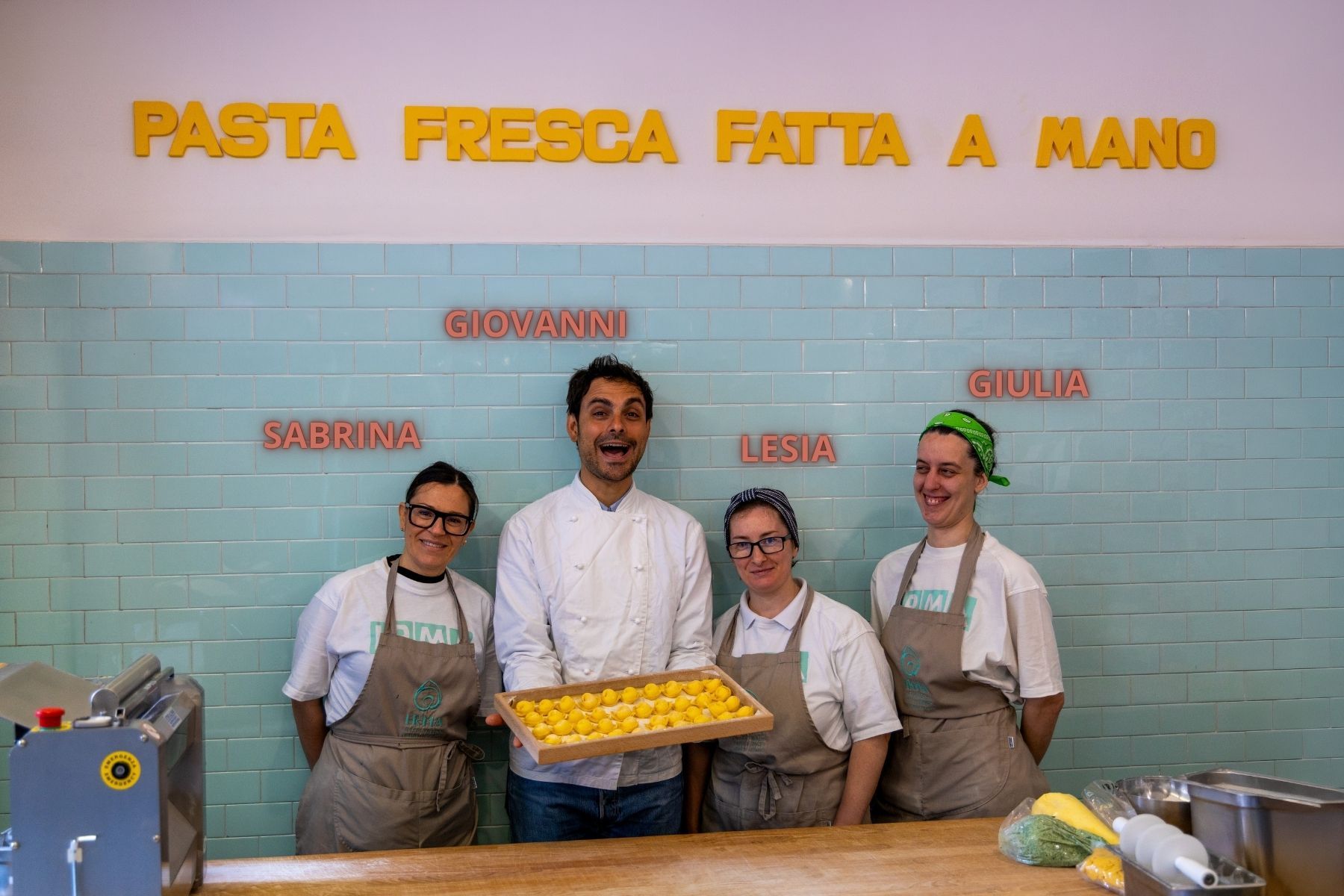
Upon request, other shapes may also come to life: sea bass tortelli kissed with thyme and lemon zest, plin, bespoke doughs, and variations conceived for those who seek a tailored sensory experience. All of this is realized through the passionate collaboration of an entirely female team: the hands of Lesia and Giulia in the laboratory, and the welcoming smile of Sabrina greeting patrons at the threshold.
provenance
final heritages


genesis
Before becoming a Milanese boutique in the elegant quarter of Corso Vercelli, even before establishing itself as a counter of fresh pasta, cappelletti, sfoglie, and ragù, Pastificio Irma is a story scented with roots. An adventure that germinates far from Milan, in the inland of Calabria, in the province of Crotone, where Giovanni Andreoli was born in 1989 and raised within a domestic economy composed of countryside, livestock, olive trees, preserves, and necessary, ritual gestures.
His grandparents, Filomena and Salvatore, lived on a true farmholding: piglets, hens, ducks, geese, goats, sheep, fruit trees, and some three hundred olive specimens. Not an idyll reconstructed in hindsight for readers hungry for picturesque, pastoral tales, but a concrete form of life: the vegetable garden, the tomato set aside for the dark depths of winter, meat reared solely for the family, oil, immense labor, and self-reliance.
Pasta, in that Southern geography, is not so much the domain of the egg and the filling, as that of semolina and tepid water: fusilli al ferretto, cavatelli, strascinati—shapes hollowed and rolled with commendable patience. And then, Grandmother Filomena's Sunday ragù, with ribs, sausage, and pork rind: that "lesser meat" belonging not to noble cuts, but to the ancient wisdom of our ancestresses and the secrets of slow, profound cooking.
Milan arrived early, with the migration of his parents in 1990. Giovanni grew up and studied here, recognizing Milan as his own city, "Milan col coeur in man": demanding yet generous, capable of returning promise to those who resolve to labor. Yet, after his studies in economics and management, he understood his path could not be severed from that primordial world: he wished to dedicate himself to food, to authenticity, to something that germinates slowly from one's own hands.
His first decisive encounter was with Giuseppe Zen, founder of the renowned Macelleria Popolare, at the Municipal Market of the Darsena. Giovanni entered almost by chance, bearing a curriculum, drawn by a popular yet rigorous philosophy of raw ingredients. There he encountered meats, cheeses, honest recipes, and above all, his first challenge: a raviolo of fresh goat ricotta and marjoram, simple and pristine, which forced him to measure himself against what he did not yet know how to do. From that moment, fresh pasta became a study, an exercise, a quiet obsession: he purchased books, experimented at home, kneaded, erred, and began anew.
Then came a small workshop in Rozzano, amid the agricultural landscape of the Parco Sud: a wooden table inside a farmhouse shared with a painter and a young man who repaired bicycles. There, amidst flours, eggs, and silent trials, Giovanni began to define himself: not a cook, nor an entrepreneur in an abstract sense, but a pasta maker. An artisan of fresh pasta and traditional gastronomy.
In 2019, he entered Pastificio Irma. The boutique, founded in 1959, preserves a Milanese heritage of handmade fresh pasta and traditional gastronomy, bound to the figure of Signora Irma and later to Nicoletta, her daughter, who long safeguarded its name, its sign, and its daily memory. Giovanni arrived first as an assistant, then as a partner in July of that same year, in time becoming its sole proprietor between 2020 and 2021.
alchemy
Here they dwell in the perseverance of the gesture, where the machine assists, yet does not decree. The mixer and the sheeter accompany the labor; they do not supplant it. Giovanni states it with pristine clarity: “ten percent machine, ninety percent artisan.” For even as the golden sheet of pasta glides through the rollers, it is the hand and the wealth of experience that perceive its humidity, its texture, its shrinkage, and its perfect, ephemeral thickness.
It is a subtle manual artistry, woven from silent adjustments and invisible touches. Indeed, the pasta is never identical to its predecessor: it shifts with the weather, with the breath of the air, with the flour, and with the choice of filling.
The heart of the workshop beats around several iconic creations. The first is the Cappelletto Irma, heir to the historic house recipe: a meat filling crafted from a slow-braised stracotto and a rich roast, adorned with Parmigiano, nutmeg, and refinements that Giovanni has honed over time, perfecting the raw ingredients and proportions without ever betraying the ancestral foundation. Alongside it, the Tortello with ricotta, lemon, and saffron—born at the dawning of Giovanni's new adventure in the bottega—is perhaps the very point where Milan most eloquently enters the pasta. There is also the Lasagna al ragù, constructed entirely in-house: vibrant green spinach pasta, a delicate bechamel from a classic roux, a slow-simmered ragù, rich broth, tender meats, and the luxury of patience.
Yet, the workshop also breathes in harmony with the seasons. Certain tortelli arrive and vanish according to the rhythm of the garden and the market: artichokes and pumpkin between autumn and spring, asparagus in the verdant months, roasted eggplant in the summer, carrying an almost Mediterranean whisper of babaganoush. And then, the Tortello alla Nerano, Giovanni's poetic homage to his companion, a native of the splendid Amalfi Coast.
Upon request, other shapes may also come to life: sea bass tortelli kissed with thyme and lemon zest, plin, bespoke doughs, and variations conceived for those who seek a tailored sensory experience. All of this is realized through the passionate collaboration of an entirely female team: the hands of Lesia and Giulia in the laboratory, and the welcoming smile of Sabrina greeting patrons at the threshold.
provenance
final heritages
genesis
Before becoming a Milanese boutique in the elegant quarter of Corso Vercelli, even before establishing itself as a counter of fresh pasta, cappelletti, sfoglie, and ragù, Pastificio Irma is a story scented with roots. An adventure that germinates far from Milan, in the inland of Calabria, in the province of Crotone, where Giovanni Andreoli was born in 1989 and raised within a domestic economy composed of countryside, livestock, olive trees, preserves, and necessary, ritual gestures.
His grandparents, Filomena and Salvatore, lived on a true farmholding: piglets, hens, ducks, geese, goats, sheep, fruit trees, and some three hundred olive specimens. Not an idyll reconstructed in hindsight for readers hungry for picturesque, pastoral tales, but a concrete form of life: the vegetable garden, the tomato set aside for the dark depths of winter, meat reared solely for the family, oil, immense labor, and self-reliance.
Pasta, in that Southern geography, is not so much the domain of the egg and the filling, as that of semolina and tepid water: fusilli al ferretto, cavatelli, strascinati—shapes hollowed and rolled with commendable patience. And then, Grandmother Filomena's Sunday ragù, with ribs, sausage, and pork rind: that "lesser meat" belonging not to noble cuts, but to the ancient wisdom of our ancestresses and the secrets of slow, profound cooking.
Milan arrived early, with the migration of his parents in 1990. Giovanni grew up and studied here, recognizing Milan as his own city, "Milan col coeur in man": demanding yet generous, capable of returning promise to those who resolve to labor. Yet, after his studies in economics and management, he understood his path could not be severed from that primordial world: he wished to dedicate himself to food, to authenticity, to something that germinates slowly from one's own hands.
His first decisive encounter was with Giuseppe Zen, founder of the renowned Macelleria Popolare, at the Municipal Market of the Darsena. Giovanni entered almost by chance, bearing a curriculum, drawn by a popular yet rigorous philosophy of raw ingredients. There he encountered meats, cheeses, honest recipes, and above all, his first challenge: a raviolo of fresh goat ricotta and marjoram, simple and pristine, which forced him to measure himself against what he did not yet know how to do. From that moment, fresh pasta became a study, an exercise, a quiet obsession: he purchased books, experimented at home, kneaded, erred, and began anew.
Then came a small workshop in Rozzano, amid the agricultural landscape of the Parco Sud: a wooden table inside a farmhouse shared with a painter and a young man who repaired bicycles. There, amidst flours, eggs, and silent trials, Giovanni began to define himself: not a cook, nor an entrepreneur in an abstract sense, but a pasta maker. An artisan of fresh pasta and traditional gastronomy.
In 2019, he entered Pastificio Irma. The boutique, founded in 1959, preserves a Milanese heritage of handmade fresh pasta and traditional gastronomy, bound to the figure of Signora Irma and later to Nicoletta, her daughter, who long safeguarded its name, its sign, and its daily memory. Giovanni arrived first as an assistant, then as a partner in July of that same year, in time becoming its sole proprietor between 2020 and 2021.
alchemy
Here they dwell in the perseverance of the gesture, where the machine assists, yet does not decree. The mixer and the sheeter accompany the labor; they do not supplant it. Giovanni states it with pristine clarity: “ten percent machine, ninety percent artisan.” For even as the golden sheet of pasta glides through the rollers, it is the hand and the wealth of experience that perceive its humidity, its texture, its shrinkage, and its perfect, ephemeral thickness.
It is a subtle manual artistry, woven from silent adjustments and invisible touches. Indeed, the pasta is never identical to its predecessor: it shifts with the weather, with the breath of the air, with the flour, and with the choice of filling.
The heart of the workshop beats around several iconic creations. The first is the Cappelletto Irma, heir to the historic house recipe: a meat filling crafted from a slow-braised stracotto and a rich roast, adorned with Parmigiano, nutmeg, and refinements that Giovanni has honed over time, perfecting the raw ingredients and proportions without ever betraying the ancestral foundation. Alongside it, the Tortello with ricotta, lemon, and saffron—born at the dawning of Giovanni's new adventure in the bottega—is perhaps the very point where Milan most eloquently enters the pasta. There is also the Lasagna al ragù, constructed entirely in-house: vibrant green spinach pasta, a delicate bechamel from a classic roux, a slow-simmered ragù, rich broth, tender meats, and the luxury of patience.
Yet, the workshop also breathes in harmony with the seasons. Certain tortelli arrive and vanish according to the rhythm of the garden and the market: artichokes and pumpkin between autumn and spring, asparagus in the verdant months, roasted eggplant in the summer, carrying an almost Mediterranean whisper of babaganoush. And then, the Tortello alla Nerano, Giovanni's poetic homage to his companion, a native of the splendid Amalfi Coast.
Upon request, other shapes may also come to life: sea bass tortelli kissed with thyme and lemon zest, plin, bespoke doughs, and variations conceived for those who seek a tailored sensory experience. All of this is realized through the passionate collaboration of an entirely female team: the hands of Lesia and Giulia in the laboratory, and the welcoming smile of Sabrina greeting patrons at the threshold.