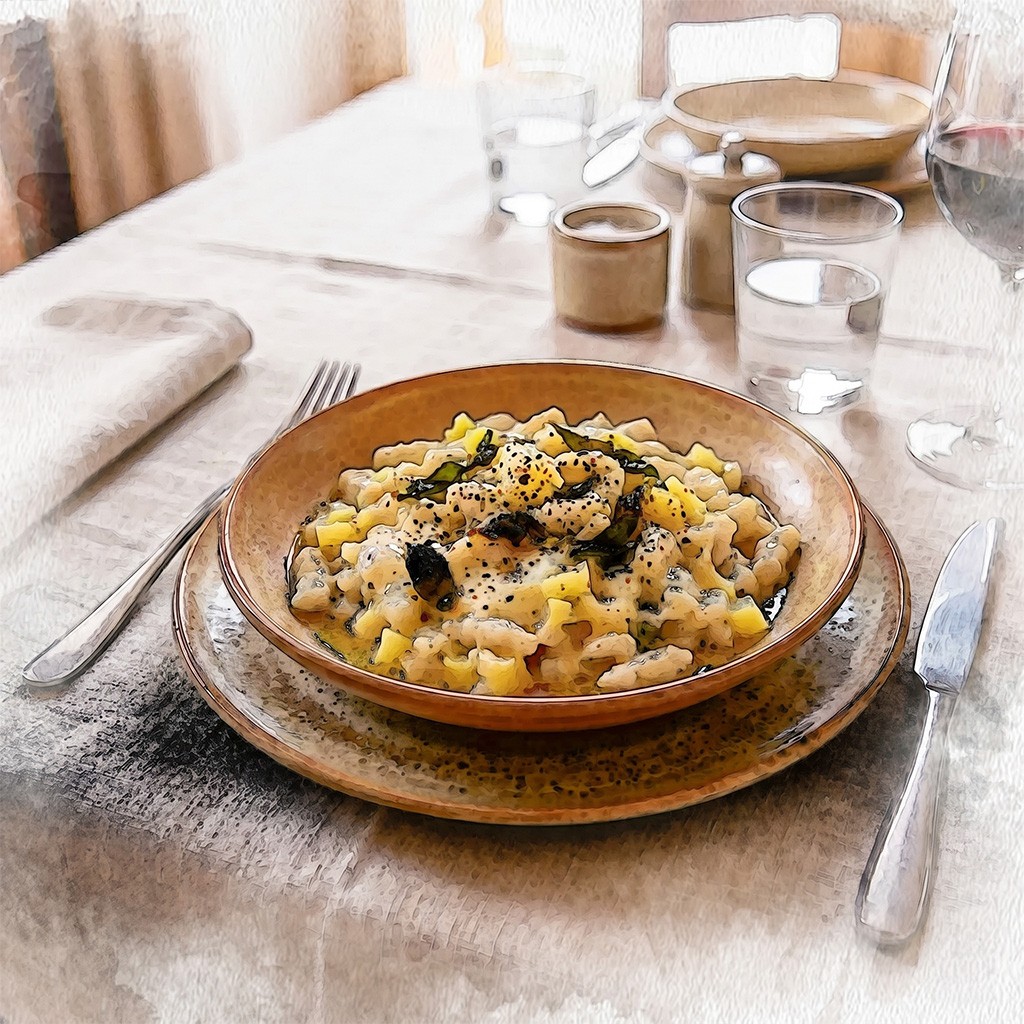
White Pizzoccheri
Soft wheat flour 00, stale crusts of bread, milk, earthen potatoes, young Casera cheese, sweet butter, and fresh sage
Moderate
Lombardy
An hour's passage
590 Kcal
White Pizzoccheri
Soft wheat flour 00, stale crusts of bread, milk, earthen potatoes, young Casera cheese, sweet butter, and fresh sage
Moderate
Lombardy
An hour's passage
590 Kcal
White Pizzoccheri
Soft wheat flour 00, stale crusts of bread, milk, earthen potatoes, young Casera cheese, sweet butter, and fresh sage
Moderate
Lombardy
An hour's passage
590 Kcal
GENESIS
The white pizzoccheri represent one of the most deeply rooted gastronomic masterworks of Valchiavenna and the province of Sondrio, distinguishing themselves elegantly from the more famous Valtellina counterpart in both composition and form. While the latter are crafted from buckwheat flour and fashioned as ribbons of pasta, the Chiavenna version emerges as a delicate, pale gnocchettou2014the fruit of an ingenious culinary art of recovery that traces its ancestry to the valleyu2019s rustic past. Indeed, the foundation of the dough is stale bread bathed in milk, a precious resource for peasant families to whom waste was an unthinkable indulgence.
Historical manuscripts and local lore whisper that this preparing of Sustenance was born within the "crotti" u2014 the natural caverns birthed from rockfalls, swept by the "sorel", a mountain breeze of constant temperature that nurtures the maturation of noble cheeses and cured meats. Valchiavenna, positioned as a vital passageway for commerce winding toward the alpine passes of Spluga and Maloja, refined over epochs a robust culinary heritage, capable of elevating humble, raw ingredients into dishes of profound caloric grandeur, essential to endure the fierce mountain winters and the grueling labors of the earth.
The ancestral recipe has been tenderly guarded by the local communities, distinguished by the lavish embrace of alpine butter and indigenous cheeses which, when melted together, compose a velvet, enveloping cream. The poetic contrast between the yielding softness of the bread gnocchetti and the earthy substance of potatoes, harmonized by the aromatic whisper of sage and garlic gently simmered in butter, renders this dish a sacred emblem of territorial identity. The moniker "pizzoccheri" likely descends from the root "pit" or "piz," evoking the small piece or "pinch" used to shape the pastau2014a manual gesture of artisanship still reverently practiced today in the homes and taverns of the valley.
PORTIONS (FOR 4 PERSONS)
FOR THE FRESHLY KNEADED PASTA
Stale white bread
Whole milk
Flour 00
Salt
400 g
200 ml
200 g
To taste
FOR THE ACCOMPANIMENT
Yellow-fleshed potatoes
Casera cheese
Parmigiano Reggiano
Butter
Garlic
Sage
Black pepper
250 g
200 g
100 g
150 g
3 cloves
6 leaves
To taste
CURATION
For the fresh pasta:
Begin by cutting the stale bread into small cubes and placing it in a spacious bowl. Pour the gently warmed milk over it, allowing it to rest for approximately 30 minutes, until the bread is completely softened. Once this time has elapsed, squeeze the bread thoroughly with your hands to discard any excess liquid, and pass it through a sieve or mash it with a fork to obtain a harmonious, smooth mixture. Integrate the flour and a pinch of salt. Knead the dough with your hands until it transforms into a firm, workable mass. Let the dough rest, covered, for 15 minutes.For the condiment:
Peel the potatoes and cut them into cubes of about 2 centimeters. Shave the Casera cheese into delicate flakes or small cubes, and finely grate the Parmigiano Reggiano. In a small, separate saucepan, melt the butter over a gentle flame alongside the lightly crushed garlic cloves and fresh sage leaves, allowing the butter to sizzle softly until it drapes itself in a hazely hue and the aromas meld into a sublime symphony.For the cooking and assembly:
Bring a generous pot of salted water to a rolling boil. First, submerge the finely cubed potatoes. After they have parboiled for about 5 minutes, begin crafting the pizzoccheri: take small portions of the dough and, guided by a teaspoon, shape them into rustic, irregular gnocchetti, dropping them directly into the boiling water. As the pizzoccheri rise gracefully to the surface (requiring a mere 2 to 3 minutes), lift them out with a skimmer together with the potatoes.
In a warmed serving bowl, construct layers, alternating the partition of pizzoccheri and potatoes with the Casera and Parmigiano Reggiano. Continue until these elements are exhausted. Finally, crown the dish by pouring the sizzling, aromatic melted butter over it, ensuring the garlic is cast aside. Fold gently to entice the cheeses into a velvety melt, and serve immediately with a generous grind of black pepper.
aspiration
For an optimal texture, employ a loaf of the "michetta" variety, or a white bread boasting a dense and compact crumb.
Ensure the butter is poured whilst piping hot upon the cheese; this pivotal gesture is essential to conjure the dish's signature, velvety creaminess.
Should you desire a more profound and aromatic essence, the Casera cheese may be gracefully substituted with a young Bitto.


GENESIS
The white pizzoccheri represent one of the most deeply rooted gastronomic masterworks of Valchiavenna and the province of Sondrio, distinguishing themselves elegantly from the more famous Valtellina counterpart in both composition and form. While the latter are crafted from buckwheat flour and fashioned as ribbons of pasta, the Chiavenna version emerges as a delicate, pale gnocchettou2014the fruit of an ingenious culinary art of recovery that traces its ancestry to the valleyu2019s rustic past. Indeed, the foundation of the dough is stale bread bathed in milk, a precious resource for peasant families to whom waste was an unthinkable indulgence.
Historical manuscripts and local lore whisper that this preparing of Sustenance was born within the "crotti" u2014 the natural caverns birthed from rockfalls, swept by the "sorel", a mountain breeze of constant temperature that nurtures the maturation of noble cheeses and cured meats. Valchiavenna, positioned as a vital passageway for commerce winding toward the alpine passes of Spluga and Maloja, refined over epochs a robust culinary heritage, capable of elevating humble, raw ingredients into dishes of profound caloric grandeur, essential to endure the fierce mountain winters and the grueling labors of the earth.
The ancestral recipe has been tenderly guarded by the local communities, distinguished by the lavish embrace of alpine butter and indigenous cheeses which, when melted together, compose a velvet, enveloping cream. The poetic contrast between the yielding softness of the bread gnocchetti and the earthy substance of potatoes, harmonized by the aromatic whisper of sage and garlic gently simmered in butter, renders this dish a sacred emblem of territorial identity. The moniker "pizzoccheri" likely descends from the root "pit" or "piz," evoking the small piece or "pinch" used to shape the pastau2014a manual gesture of artisanship still reverently practiced today in the homes and taverns of the valley.
PORTIONS (FOR 4 PERSONS)
FOR THE FRESHLY KNEADED PASTA
Stale white bread
Whole milk
Flour 00
Salt
400 g
200 ml
200 g
To taste
FOR THE ACCOMPANIMENT
Yellow-fleshed potatoes
Casera cheese
Parmigiano Reggiano
Butter
Garlic
Sage
Black pepper
250 g
200 g
100 g
150 g
3 cloves
6 leaves
To taste
CURATION
For the fresh pasta:
Begin by cutting the stale bread into small cubes and placing it in a spacious bowl. Pour the gently warmed milk over it, allowing it to rest for approximately 30 minutes, until the bread is completely softened. Once this time has elapsed, squeeze the bread thoroughly with your hands to discard any excess liquid, and pass it through a sieve or mash it with a fork to obtain a harmonious, smooth mixture. Integrate the flour and a pinch of salt. Knead the dough with your hands until it transforms into a firm, workable mass. Let the dough rest, covered, for 15 minutes.For the condiment:
Peel the potatoes and cut them into cubes of about 2 centimeters. Shave the Casera cheese into delicate flakes or small cubes, and finely grate the Parmigiano Reggiano. In a small, separate saucepan, melt the butter over a gentle flame alongside the lightly crushed garlic cloves and fresh sage leaves, allowing the butter to sizzle softly until it drapes itself in a hazely hue and the aromas meld into a sublime symphony.For the cooking and assembly:
Bring a generous pot of salted water to a rolling boil. First, submerge the finely cubed potatoes. After they have parboiled for about 5 minutes, begin crafting the pizzoccheri: take small portions of the dough and, guided by a teaspoon, shape them into rustic, irregular gnocchetti, dropping them directly into the boiling water. As the pizzoccheri rise gracefully to the surface (requiring a mere 2 to 3 minutes), lift them out with a skimmer together with the potatoes.
In a warmed serving bowl, construct layers, alternating the partition of pizzoccheri and potatoes with the Casera and Parmigiano Reggiano. Continue until these elements are exhausted. Finally, crown the dish by pouring the sizzling, aromatic melted butter over it, ensuring the garlic is cast aside. Fold gently to entice the cheeses into a velvety melt, and serve immediately with a generous grind of black pepper.
aspiration
For an optimal texture, employ a loaf of the "michetta" variety, or a white bread boasting a dense and compact crumb.
Ensure the butter is poured whilst piping hot upon the cheese; this pivotal gesture is essential to conjure the dish's signature, velvety creaminess.
Should you desire a more profound and aromatic essence, the Casera cheese may be gracefully substituted with a young Bitto.
latest culinary creations
GENESIS
The white pizzoccheri represent one of the most deeply rooted gastronomic masterworks of Valchiavenna and the province of Sondrio, distinguishing themselves elegantly from the more famous Valtellina counterpart in both composition and form. While the latter are crafted from buckwheat flour and fashioned as ribbons of pasta, the Chiavenna version emerges as a delicate, pale gnocchettou2014the fruit of an ingenious culinary art of recovery that traces its ancestry to the valleyu2019s rustic past. Indeed, the foundation of the dough is stale bread bathed in milk, a precious resource for peasant families to whom waste was an unthinkable indulgence.
Historical manuscripts and local lore whisper that this preparing of Sustenance was born within the "crotti" u2014 the natural caverns birthed from rockfalls, swept by the "sorel", a mountain breeze of constant temperature that nurtures the maturation of noble cheeses and cured meats. Valchiavenna, positioned as a vital passageway for commerce winding toward the alpine passes of Spluga and Maloja, refined over epochs a robust culinary heritage, capable of elevating humble, raw ingredients into dishes of profound caloric grandeur, essential to endure the fierce mountain winters and the grueling labors of the earth.
The ancestral recipe has been tenderly guarded by the local communities, distinguished by the lavish embrace of alpine butter and indigenous cheeses which, when melted together, compose a velvet, enveloping cream. The poetic contrast between the yielding softness of the bread gnocchetti and the earthy substance of potatoes, harmonized by the aromatic whisper of sage and garlic gently simmered in butter, renders this dish a sacred emblem of territorial identity. The moniker "pizzoccheri" likely descends from the root "pit" or "piz," evoking the small piece or "pinch" used to shape the pastau2014a manual gesture of artisanship still reverently practiced today in the homes and taverns of the valley.
PORTIONS (FOR 4 PERSONS)
FOR THE FRESHLY KNEADED PASTA
Stale white bread
Whole milk
Flour 00
Salt
400 g
200 ml
200 g
To taste
FOR THE ACCOMPANIMENT
Yellow-fleshed potatoes
Casera cheese
Parmigiano Reggiano
Butter
Garlic
Sage
Black pepper
250 g
200 g
100 g
150 g
3 cloves
6 leaves
To taste
CURATION
For the fresh pasta:
Begin by cutting the stale bread into small cubes and placing it in a spacious bowl. Pour the gently warmed milk over it, allowing it to rest for approximately 30 minutes, until the bread is completely softened. Once this time has elapsed, squeeze the bread thoroughly with your hands to discard any excess liquid, and pass it through a sieve or mash it with a fork to obtain a harmonious, smooth mixture. Integrate the flour and a pinch of salt. Knead the dough with your hands until it transforms into a firm, workable mass. Let the dough rest, covered, for 15 minutes.For the condiment:
Peel the potatoes and cut them into cubes of about 2 centimeters. Shave the Casera cheese into delicate flakes or small cubes, and finely grate the Parmigiano Reggiano. In a small, separate saucepan, melt the butter over a gentle flame alongside the lightly crushed garlic cloves and fresh sage leaves, allowing the butter to sizzle softly until it drapes itself in a hazely hue and the aromas meld into a sublime symphony.For the cooking and assembly:
Bring a generous pot of salted water to a rolling boil. First, submerge the finely cubed potatoes. After they have parboiled for about 5 minutes, begin crafting the pizzoccheri: take small portions of the dough and, guided by a teaspoon, shape them into rustic, irregular gnocchetti, dropping them directly into the boiling water. As the pizzoccheri rise gracefully to the surface (requiring a mere 2 to 3 minutes), lift them out with a skimmer together with the potatoes.
In a warmed serving bowl, construct layers, alternating the partition of pizzoccheri and potatoes with the Casera and Parmigiano Reggiano. Continue until these elements are exhausted. Finally, crown the dish by pouring the sizzling, aromatic melted butter over it, ensuring the garlic is cast aside. Fold gently to entice the cheeses into a velvety melt, and serve immediately with a generous grind of black pepper.
aspiration
For an optimal texture, employ a loaf of the "michetta" variety, or a white bread boasting a dense and compact crumb.
Ensure the butter is poured whilst piping hot upon the cheese; this pivotal gesture is essential to conjure the dish's signature, velvety creaminess.
Should you desire a more profound and aromatic essence, the Casera cheese may be gracefully substituted with a young Bitto.