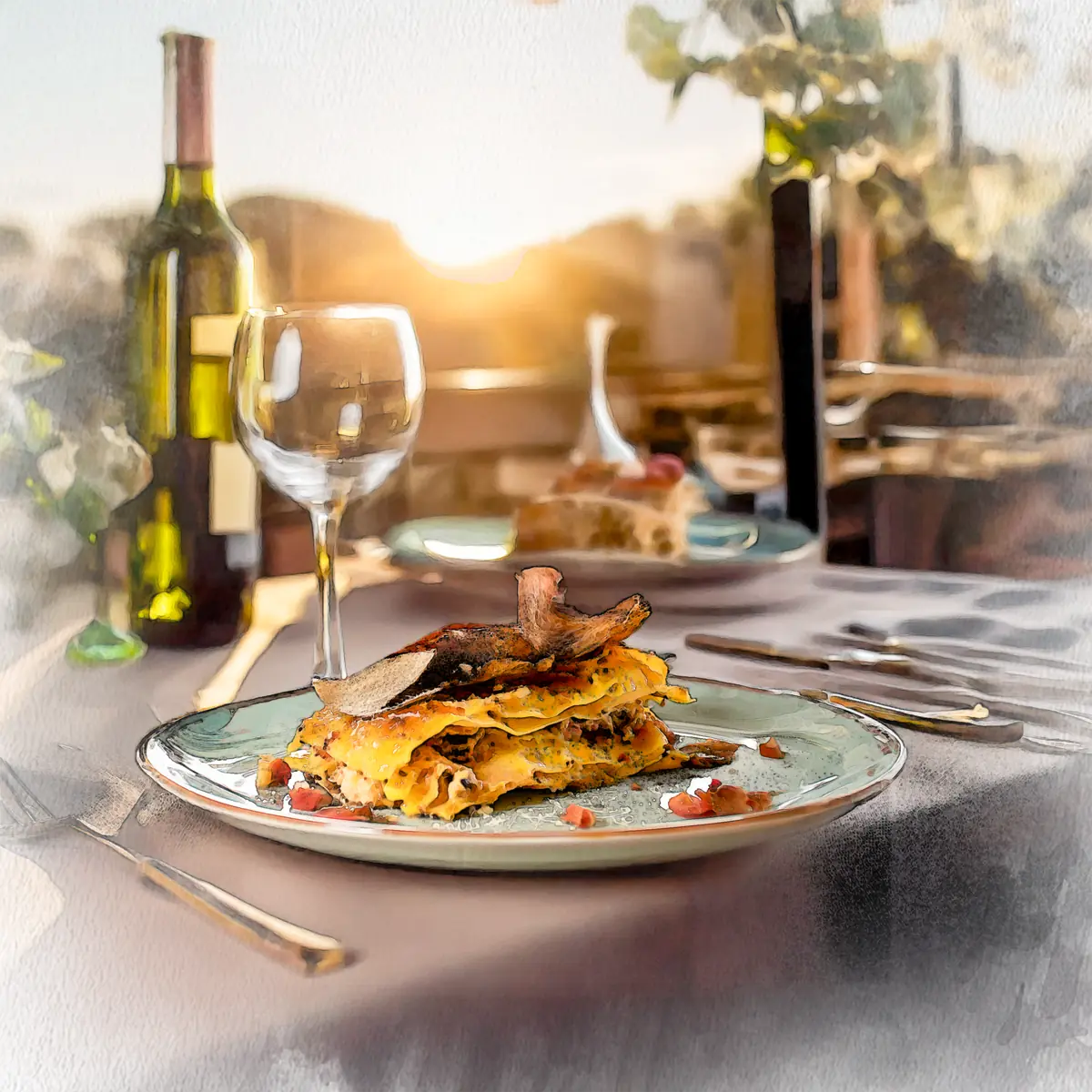
PRINCISGRAS
Sweetbread of veal, prosciutto crudo, black truffle, and cream
A demanding pursuit
The Marches
110 minutes
920 Kcal
PRINCISGRAS
Sweetbread of veal, prosciutto crudo, black truffle, and cream
A demanding pursuit
The Marches
110 minutes
920 Kcal
PRINCISGRAS
Sweetbread of veal, prosciutto crudo, black truffle, and cream
A demanding pursuit
The Marches
110 minutes
920 Kcal
GENESIS
The Princisgras is no peasant fare, but a veritable archaeological relic of the gastronomy of the Ancien Régime in the Marche region. Its genesis is documented with precision and authority: it is a creation of Antonio Nebbia, a professional chef in the service of the noble houses of Macerata, who included it in his celebrated 1786 treatise, Il Cuoco Maceratese. This dish, in its original guise, stands as an eloquent testament to the French culinary influence of the era, distinguished by a rich and complex sauce, cream-based and devoid of tomato, an ingredient that would only attain widespread adoption in the succeeding century.
The "written acknowledgement" is here preserved in its most irrefutable form: a primary historical document detailing its preparation. The analysis of this original recipe permits a true archaeological reconstruction. The pasta is a simple sheet of flour and egg. It is the sauce that defines the aristocratic character of the dish: an elaborate composition that commences with the blanching of veal sweetbreads, progresses with a soffritto of prosciutto and onion, and is enriched by the addition of the sweetbreads themselves, fresh cream (
a leaf and a half of milk tempered with flour in the original recipe) and, finally, shavings of truffle.
The assembly unfolds within a pie dish, layer upon layer, departing from the rectangular form of the modern lasagna, often crowned with a cross decoration of cured pork cheek upon the surface.
The extinction of Princisgras is a direct consequence of culinary evolution and socio-economic shifts. The original dish is a white preparation, sumptuous, founded upon noble offal (the sweetbreads), cream, and truffles. Its very name is likely an Italianization of the surname of the Austrian General Alfred von Windisch-Grätz, binding the dish to a precise historical epoch. Over the course of the 19th and 20th centuries, Italian cuisine underwent a profound metamorphosis, turning decisively toward the embrace of the tomato. The modern
Vincisgrassi, today protected as a Traditional Speciality Guaranteed (TSG), is the direct heir to this evolution: its heart is a rich ragù of mixed meats based on tomatoes. This transition reflects the decline of French culinary hegemony, the rise of a more "Italian" national cuisine, the greater availability and accessibility of the tomato compared to truffles and sweetbreads, and a general shift in palate. Thus, the
Princisgras did not merely vanish; it was transcended and transformed into its descendant. Its extinction is a case of evolution, wherein the original species is no longer found, yet its DNA survives in its progeny.
It is the historical "white" version, the noble ancestor of the modern Vincisgrassi with tomato.
PORTIONS (FOR 4 PERSONS)
FOR THE PASTA
Flour 00
Whole eggs
300 gr
3
FOR THE EMBELLISHMENT
Veal sweetbreads
Artisanal cured prosciutto
Fresh black truffle
Fresh liquid cream
Whole milk
Butter
Flour
Onion
Parmigiano Reggiano
Nutmeg
Sea salt
Freshly cracked pepper
200 g
150 g
100 g
250 ml
250 ml
50 g
40 g
1/2
To taste
To taste
To taste
To taste
CURATION
For the fresh pasta:
Knead the flour with the eggs until you obtain a smooth and supple dough. Allow it to rest for 30 minutes, then roll out a sheet of modest thickness and cut it into elegant squares or rectangles.For the condiment:
First, prepare the sweetbreads: blanch them in lightly salted water for about 5 minutes to purify them. Drain, plunge them into cold water, and gently remove the outer membrane and any firm parts. Cut them into delicate pieces.
In a saucepan, melt a portion of the butter, adding the minced onion and the diced prosciutto. Allow them to sweat gently. In another vessel, prepare a dense, velvet-like béchamel: warm the milk with a pinch of salt and a grating of nutmeg. Separately, melt 30 grams of butter, whisk in the flour to create a blond roux, and then slowly pour in the warm milk, whisking constantly to ensure no lumps form. Simmer for about 10 minutes until the sauce thickens into a rich cream.
Unite the sauté of prosciutto and onion with the béchamel. Introduce the pieces of sweetbreads and the black truffle, shaved into delicate coins. Allow the flavors to marry over low heat for a few moments, then fold in the fresh cream, stirring thoroughly. Adjust with salt and pepper. The sauce must emerge opulent and velvety.For the assembly and baking:
Gently boil the sheets of pasta in abundant salted water for a couple of minutes, drain, and pass them swiftly through cold water to arrest the cooking. Dry them reverently upon a clean cloth.
Butter a baking dish and spread an initial layer of the rich sauce. Lay down a sheet of pasta, cover with a generous ladle of sauce, and a lavish dusting of Parmigiano Reggiano. Continue to alternate these layers until all ingredients are spent, crowning the creation with a final layer of sauce, dollops of butter, and Parmigiano.
Bake in a preheated static oven at 180°C for approximately 20-25 minutes, or until the surface has blossomed into a golden, crisped crust. Allow it to rest for a few moments of contemplation before serving.
aspiration
For a touch of philological reverence, utilize a round tart tin as decreed by Nebbia's original recipe.
The provenance of the ingredients is paramount: seek out the freshest sweetbreads and a black truffle of supreme quality to honor the aristocratic character of this dish.
In times past, the surface was often adorned with a cross of guanciale before baking, a traditional embellishment you may wish to explore.
Allowing the creation to rest for a few moments upon leaving the oven is essential, granting the layers and flavors time to harmonize and settle.


GENESIS
The Princisgras is no peasant fare, but a veritable archaeological relic of the gastronomy of the Ancien Régime in the Marche region. Its genesis is documented with precision and authority: it is a creation of Antonio Nebbia, a professional chef in the service of the noble houses of Macerata, who included it in his celebrated 1786 treatise, Il Cuoco Maceratese. This dish, in its original guise, stands as an eloquent testament to the French culinary influence of the era, distinguished by a rich and complex sauce, cream-based and devoid of tomato, an ingredient that would only attain widespread adoption in the succeeding century.
The "written acknowledgement" is here preserved in its most irrefutable form: a primary historical document detailing its preparation. The analysis of this original recipe permits a true archaeological reconstruction. The pasta is a simple sheet of flour and egg. It is the sauce that defines the aristocratic character of the dish: an elaborate composition that commences with the blanching of veal sweetbreads, progresses with a soffritto of prosciutto and onion, and is enriched by the addition of the sweetbreads themselves, fresh cream (
a leaf and a half of milk tempered with flour in the original recipe) and, finally, shavings of truffle.
The assembly unfolds within a pie dish, layer upon layer, departing from the rectangular form of the modern lasagna, often crowned with a cross decoration of cured pork cheek upon the surface.
The extinction of Princisgras is a direct consequence of culinary evolution and socio-economic shifts. The original dish is a white preparation, sumptuous, founded upon noble offal (the sweetbreads), cream, and truffles. Its very name is likely an Italianization of the surname of the Austrian General Alfred von Windisch-Grätz, binding the dish to a precise historical epoch. Over the course of the 19th and 20th centuries, Italian cuisine underwent a profound metamorphosis, turning decisively toward the embrace of the tomato. The modern
Vincisgrassi, today protected as a Traditional Speciality Guaranteed (TSG), is the direct heir to this evolution: its heart is a rich ragù of mixed meats based on tomatoes. This transition reflects the decline of French culinary hegemony, the rise of a more "Italian" national cuisine, the greater availability and accessibility of the tomato compared to truffles and sweetbreads, and a general shift in palate. Thus, the
Princisgras did not merely vanish; it was transcended and transformed into its descendant. Its extinction is a case of evolution, wherein the original species is no longer found, yet its DNA survives in its progeny.
It is the historical "white" version, the noble ancestor of the modern Vincisgrassi with tomato.
PORTIONS (FOR 4 PERSONS)
FOR THE PASTA
Flour 00
Whole eggs
300 gr
3
FOR THE EMBELLISHMENT
Veal sweetbreads
Artisanal cured prosciutto
Fresh black truffle
Fresh liquid cream
Whole milk
Butter
Flour
Onion
Parmigiano Reggiano
Nutmeg
Sea salt
Freshly cracked pepper
200 g
150 g
100 g
250 ml
250 ml
50 g
40 g
1/2
To taste
To taste
To taste
To taste
CURATION
For the fresh pasta:
Knead the flour with the eggs until you obtain a smooth and supple dough. Allow it to rest for 30 minutes, then roll out a sheet of modest thickness and cut it into elegant squares or rectangles.For the condiment:
First, prepare the sweetbreads: blanch them in lightly salted water for about 5 minutes to purify them. Drain, plunge them into cold water, and gently remove the outer membrane and any firm parts. Cut them into delicate pieces.
In a saucepan, melt a portion of the butter, adding the minced onion and the diced prosciutto. Allow them to sweat gently. In another vessel, prepare a dense, velvet-like béchamel: warm the milk with a pinch of salt and a grating of nutmeg. Separately, melt 30 grams of butter, whisk in the flour to create a blond roux, and then slowly pour in the warm milk, whisking constantly to ensure no lumps form. Simmer for about 10 minutes until the sauce thickens into a rich cream.
Unite the sauté of prosciutto and onion with the béchamel. Introduce the pieces of sweetbreads and the black truffle, shaved into delicate coins. Allow the flavors to marry over low heat for a few moments, then fold in the fresh cream, stirring thoroughly. Adjust with salt and pepper. The sauce must emerge opulent and velvety.For the assembly and baking:
Gently boil the sheets of pasta in abundant salted water for a couple of minutes, drain, and pass them swiftly through cold water to arrest the cooking. Dry them reverently upon a clean cloth.
Butter a baking dish and spread an initial layer of the rich sauce. Lay down a sheet of pasta, cover with a generous ladle of sauce, and a lavish dusting of Parmigiano Reggiano. Continue to alternate these layers until all ingredients are spent, crowning the creation with a final layer of sauce, dollops of butter, and Parmigiano.
Bake in a preheated static oven at 180°C for approximately 20-25 minutes, or until the surface has blossomed into a golden, crisped crust. Allow it to rest for a few moments of contemplation before serving.
aspiration
For a touch of philological reverence, utilize a round tart tin as decreed by Nebbia's original recipe.
The provenance of the ingredients is paramount: seek out the freshest sweetbreads and a black truffle of supreme quality to honor the aristocratic character of this dish.
In times past, the surface was often adorned with a cross of guanciale before baking, a traditional embellishment you may wish to explore.
Allowing the creation to rest for a few moments upon leaving the oven is essential, granting the layers and flavors time to harmonize and settle.
latest culinary creations
GENESIS
The Princisgras is no peasant fare, but a veritable archaeological relic of the gastronomy of the Ancien Régime in the Marche region. Its genesis is documented with precision and authority: it is a creation of Antonio Nebbia, a professional chef in the service of the noble houses of Macerata, who included it in his celebrated 1786 treatise, Il Cuoco Maceratese. This dish, in its original guise, stands as an eloquent testament to the French culinary influence of the era, distinguished by a rich and complex sauce, cream-based and devoid of tomato, an ingredient that would only attain widespread adoption in the succeeding century.
The "written acknowledgement" is here preserved in its most irrefutable form: a primary historical document detailing its preparation. The analysis of this original recipe permits a true archaeological reconstruction. The pasta is a simple sheet of flour and egg. It is the sauce that defines the aristocratic character of the dish: an elaborate composition that commences with the blanching of veal sweetbreads, progresses with a soffritto of prosciutto and onion, and is enriched by the addition of the sweetbreads themselves, fresh cream (
a leaf and a half of milk tempered with flour in the original recipe) and, finally, shavings of truffle.
The assembly unfolds within a pie dish, layer upon layer, departing from the rectangular form of the modern lasagna, often crowned with a cross decoration of cured pork cheek upon the surface.
The extinction of Princisgras is a direct consequence of culinary evolution and socio-economic shifts. The original dish is a white preparation, sumptuous, founded upon noble offal (the sweetbreads), cream, and truffles. Its very name is likely an Italianization of the surname of the Austrian General Alfred von Windisch-Grätz, binding the dish to a precise historical epoch. Over the course of the 19th and 20th centuries, Italian cuisine underwent a profound metamorphosis, turning decisively toward the embrace of the tomato. The modern
Vincisgrassi, today protected as a Traditional Speciality Guaranteed (TSG), is the direct heir to this evolution: its heart is a rich ragù of mixed meats based on tomatoes. This transition reflects the decline of French culinary hegemony, the rise of a more "Italian" national cuisine, the greater availability and accessibility of the tomato compared to truffles and sweetbreads, and a general shift in palate. Thus, the
Princisgras did not merely vanish; it was transcended and transformed into its descendant. Its extinction is a case of evolution, wherein the original species is no longer found, yet its DNA survives in its progeny.
It is the historical "white" version, the noble ancestor of the modern Vincisgrassi with tomato.
PORTIONS (FOR 4 PERSONS)
FOR THE PASTA
Flour 00
Whole eggs
300 gr
3
FOR THE EMBELLISHMENT
Veal sweetbreads
Artisanal cured prosciutto
Fresh black truffle
Fresh liquid cream
Whole milk
Butter
Flour
Onion
Parmigiano Reggiano
Nutmeg
Sea salt
Freshly cracked pepper
200 g
150 g
100 g
250 ml
250 ml
50 g
40 g
1/2
To taste
To taste
To taste
To taste
CURATION
For the fresh pasta:
Knead the flour with the eggs until you obtain a smooth and supple dough. Allow it to rest for 30 minutes, then roll out a sheet of modest thickness and cut it into elegant squares or rectangles.For the condiment:
First, prepare the sweetbreads: blanch them in lightly salted water for about 5 minutes to purify them. Drain, plunge them into cold water, and gently remove the outer membrane and any firm parts. Cut them into delicate pieces.
In a saucepan, melt a portion of the butter, adding the minced onion and the diced prosciutto. Allow them to sweat gently. In another vessel, prepare a dense, velvet-like béchamel: warm the milk with a pinch of salt and a grating of nutmeg. Separately, melt 30 grams of butter, whisk in the flour to create a blond roux, and then slowly pour in the warm milk, whisking constantly to ensure no lumps form. Simmer for about 10 minutes until the sauce thickens into a rich cream.
Unite the sauté of prosciutto and onion with the béchamel. Introduce the pieces of sweetbreads and the black truffle, shaved into delicate coins. Allow the flavors to marry over low heat for a few moments, then fold in the fresh cream, stirring thoroughly. Adjust with salt and pepper. The sauce must emerge opulent and velvety.For the assembly and baking:
Gently boil the sheets of pasta in abundant salted water for a couple of minutes, drain, and pass them swiftly through cold water to arrest the cooking. Dry them reverently upon a clean cloth.
Butter a baking dish and spread an initial layer of the rich sauce. Lay down a sheet of pasta, cover with a generous ladle of sauce, and a lavish dusting of Parmigiano Reggiano. Continue to alternate these layers until all ingredients are spent, crowning the creation with a final layer of sauce, dollops of butter, and Parmigiano.
Bake in a preheated static oven at 180°C for approximately 20-25 minutes, or until the surface has blossomed into a golden, crisped crust. Allow it to rest for a few moments of contemplation before serving.
aspiration
For a touch of philological reverence, utilize a round tart tin as decreed by Nebbia's original recipe.
The provenance of the ingredients is paramount: seek out the freshest sweetbreads and a black truffle of supreme quality to honor the aristocratic character of this dish.
In times past, the surface was often adorned with a cross of guanciale before baking, a traditional embellishment you may wish to explore.
Allowing the creation to rest for a few moments upon leaving the oven is essential, granting the layers and flavors time to harmonize and settle.