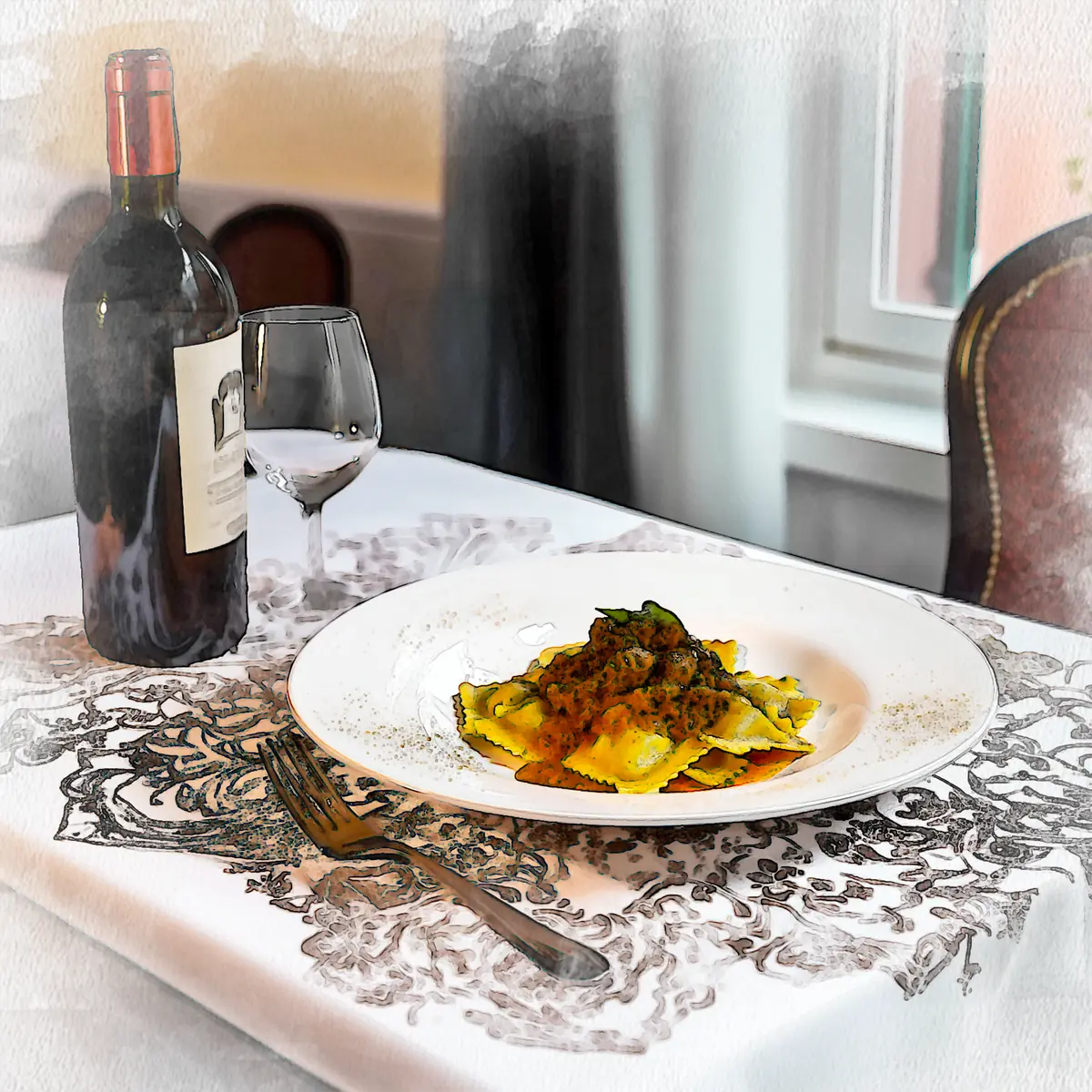
PAGANINI'S RAVIOLI
Beef, Veal, Veal brain, Luganega sausage, Borage, Parmigiano Reggiano, Dried porcini mushrooms, Tomato conserve.
A demanding pursuit
Liguria
120 minutes
650 Kcal
PAGANINI'S RAVIOLI
Beef, Veal, Veal brain, Luganega sausage, Borage, Parmigiano Reggiano, Dried porcini mushrooms, Tomato conserve.
A demanding pursuit
Liguria
120 minutes
650 Kcal
PAGANINI'S RAVIOLI
Beef, Veal, Veal brain, Luganega sausage, Borage, Parmigiano Reggiano, Dried porcini mushrooms, Tomato conserve.
A demanding pursuit
Liguria
120 minutes
650 Kcal
GENESIS
Ravioli alla Paganini represent a sublime chapter of Ligurian culinary history, indissolubly bound to the figure of Niccolò Paganini, the legendary nineteenth-century Genoese violin virtuoso. Beyond his musical transcendence, Paganini was celebrated for his profound devotion to gastronomy, most notably the cherished dishes of his native soil. It is sung that the maestro, despite the sirens of international renown and arduous voyages, never once failed to carry the flavors of his homeland in his heart. In a letter dated 1838, addressed to his companion Luigi Germi, the composer confessed that his mouth watered at the mere memory of the exquisite ravioli savored at his table. The following year, while in Nice and grievously ill, Paganini nevertheless desired to commit to paper, with trembling hand, the recipe for the "genuine filling of Genoese ravioli"—a manuscript treasured to this day within the Library of Congress in Washington.
Herewith is the recipe, transcribed from Paganini's own manuscript:
"For a pound and a half (approx. 320g) of flour, two pounds of good lean beef, to fashion the jus.
Into the pan one places butter, then a small amount of finely minced onion, to sweat gently.
The beef is added, allowing it to take on a delicate color.
And to obtain a rich, consistent jus, a few pinches of flour are taken and slowly dusted into the pan, that it may brown.
Then, tomato paste is dissolved in water, and this essence is poured over the flour in the pan, stirring to meld it further, and lastly, well-chopped and crushed dried porcini mushrooms are introduced, and thus the jus is achieved.
Now we come to the dough, to roll out the sheets without the use of eggs.
A pinch of salt within the dough will bestow the desired elasticity.
Now we come to the filling.
In the same pan, and in that very jus, one cooks half a pound of lean veal, then removes, minces, and grinds it thoroughly.
A calf's brain is simmered in water, then skinned of its membrane, minced, and ground separately in the manner of the meat.
A handful of borage, known in Nice as 'bora', is boiled, wrung dry, and ground as above.
Three eggs are taken, which suffice for a pound and a half of flour.
These are beaten, and all aforementioned ingredients are folded in and ground once more with the eggs, adding a touch of Parmigiano cheese.
Thus, the filling is complete.
One may employ capon instead of veal, or sweetbreads in place of brain, to achieve a more delicate filling.
Should the filling remain too firm, a ladle of jus is added.
The dough for the ravioli should be left somewhat supple.
It is rested for one hour beneath a plate, to facilitate the rolling of gossamer-thin sheets."
This recipe stands as a testament to an opulent and deeply flavorful cuisine, characteristic of the era, which celebrated the harmony of mixed meats, delicate offal, and wild flora such as borage—a signature of the Ligurian landscape. Then, as now, these ravioli were regarded as a festive creation, a sacred symbol of conviviality and abundance. Their preparation, complex and demanding of time, mirrored the profound devotion bestowed upon the culinary arts and the deliberate pace of their creation. Paganini's recipe, with its lavish tapestry of ingredients and meticulous detail, offers an authentic window into nineteenth-century Genoese gastronomy—a true ode to profound, enveloping flavors. These celestial ravioli were traditionally crowned with "tuccu," a slow-simmered meat sauce of exceptional depth, which elevated their savor to the sublime.
PORTIONS (FOR 4 PERSONS)
FOR THE PASTA
Soft wheat flour, type "00"
Fresh medium eggs
A pinch of salt
450 gr
4
to taste
FOR THE CREATION'S HEART
Lean beef
Lean veal
Veal brains
(or veal sweetbreads)
Luganega sausage
Fresh borage
Medium farm eggs
Parmigiano Reggiano
300 g
150 g
1
80 g
80 g
2
80 g
FOR THE EMBELLISHMENT
Lean beef for the ragù
Butter
Small onion
Tomato paste
Dried porcini mushrooms
Salt
Black pepper
400 g
30 g
1
20 g
10 g
to taste
to taste
CURATION
For the fresh pasta:
First, prepare the hand-crafted pasta. Upon a wooden board, shape the flour into a well, creating a hollow chamber at its heart. Crack the whole eggs into this crown of flour and add a mere whisper of salt. Begin to marry the ingredients with a fork, gradually drawing the flour from the perimeter toward the center. As the dough gathers strength, continue to knead with your hands for some 10 to 15 minutes, until it surrenders into a smooth, elastic, and harmonious texture. Envelop this precious dough in plastic wrap and allow it to rest at room temperature for at least 30 minutes.For the meat sauce (tuccu):
Melt the butter in a spacious vessel over a medium flame, letting it liquefy. Introduce the finely minced onion, allowing it to gently sweat and soften until it turns translucent and takes on a delicate golden hue. Add the lean beef, cut into generous portions, searing the meat on all sides to seal in its juices and impart a rich, caramelized color. To bestow a deeper structure upon the sauce, you may dust a few pinches of flour over the meat, letting it toast lightly. Incorporate the concentrated tomato paste, previously dissolved in a splash of warm water, stirring with care. Add the dried porcini mushrooms, which have been lovingly rehydrated in lukewarm water and finely chopped. Cover the ingredients with hot water, coax to a boil, and then reduce the flame to a gentle simmer. Allow the sauce to slowly evolve over 2 to 3 hours, or even longer, stirring occasionally and adding hot water as required, until it thickens into a rich, deeply savory elixir. At the journey's end, season with salt and pepper to taste.For the ravioli filling:
In the same vessel as your rich sauce, draw a portion of the liquid to braise the lean veal, cut into pieces, allowing it to absorb the deep, savory aromas. Once tender, lift the veal and mince it finely with a knife, or pass it through a meat grinder. Cook the veal brains in boiling water for approximately 10 to 15 minutes. Drain, remove the delicate outer membrane, and mince finely. Strip the casing from the Luganega sausage and mince its seasoned meat. Blanch the wild borage in boiling salted water for a few fleeting minutes, drain thoroughly, squeeze to banish all excess moisture, and chop finely. In a generous bowl, unite the minced veal, the delicate filling of brain, the savory sausage, the vibrant borage, the two eggs, and the grated Parmigiano Reggiano. Knead these ingredients together until they form a perfectly harmonious and compact filling. Should the mixture feel too firm, you may soften its texture with a ladle of the previously prepared meat sauce.For the assembly of the ravioli:
Take the rested dough and portion it into small spheres. Roll out each portion with a pasta machine or a traditional rolling pin, until you obtain exquisitely thin sheets (about 1 mm in thickness). Place delicate mounds of filling along one half of the pasta sheet, spacing them with poetic symmetry. Fold the remaining half of the sheet over the filling, pressing carefully around each mound to expel the air and seal the dough. Using a fluted pastry wheel, cut the ravioli into their classic shape, typically square or crescent moons. Arrange the finished ravioli upon a lightly floured tray and let them rest for about an hour, draped under a clean linen cloth, allowing the pasta to dry slightly.For the boiling and the presentation:
Bring a generous pot of abundantly salted water to a spirited boil. Gently manifest the ravioli into the boiling water, cooking them for just a few minutes, until they float triumphantly to the surface and the pasta is cooked, yet retains its noble 'al dente' structural integrity. Lift them tenderly with a skimmer and arrange them directly onto the serving plates. Dress the ravioli generously with the warm, velvety meat sauce (tuccu) and a lavish snowfall of freshly grated Parmigiano Reggiano. Serve immediately, as a celebration of culinary heritage.
aspiration
Should you desire a filling of even greater delicacy, you may substitute the veal brain with prized veal sweetbreads or the tender flesh of poached capon, finely minced.
To elevate the depth of the sauce, you may introduce a splash of dry red wine during the cooking, allowing it to reduce entirely and impart its soul before bathing the pan in water.


GENESIS
Ravioli alla Paganini represent a sublime chapter of Ligurian culinary history, indissolubly bound to the figure of Niccolò Paganini, the legendary nineteenth-century Genoese violin virtuoso. Beyond his musical transcendence, Paganini was celebrated for his profound devotion to gastronomy, most notably the cherished dishes of his native soil. It is sung that the maestro, despite the sirens of international renown and arduous voyages, never once failed to carry the flavors of his homeland in his heart. In a letter dated 1838, addressed to his companion Luigi Germi, the composer confessed that his mouth watered at the mere memory of the exquisite ravioli savored at his table. The following year, while in Nice and grievously ill, Paganini nevertheless desired to commit to paper, with trembling hand, the recipe for the "genuine filling of Genoese ravioli"—a manuscript treasured to this day within the Library of Congress in Washington.
Herewith is the recipe, transcribed from Paganini's own manuscript:
"For a pound and a half (approx. 320g) of flour, two pounds of good lean beef, to fashion the jus.
Into the pan one places butter, then a small amount of finely minced onion, to sweat gently.
The beef is added, allowing it to take on a delicate color.
And to obtain a rich, consistent jus, a few pinches of flour are taken and slowly dusted into the pan, that it may brown.
Then, tomato paste is dissolved in water, and this essence is poured over the flour in the pan, stirring to meld it further, and lastly, well-chopped and crushed dried porcini mushrooms are introduced, and thus the jus is achieved.
Now we come to the dough, to roll out the sheets without the use of eggs.
A pinch of salt within the dough will bestow the desired elasticity.
Now we come to the filling.
In the same pan, and in that very jus, one cooks half a pound of lean veal, then removes, minces, and grinds it thoroughly.
A calf's brain is simmered in water, then skinned of its membrane, minced, and ground separately in the manner of the meat.
A handful of borage, known in Nice as 'bora', is boiled, wrung dry, and ground as above.
Three eggs are taken, which suffice for a pound and a half of flour.
These are beaten, and all aforementioned ingredients are folded in and ground once more with the eggs, adding a touch of Parmigiano cheese.
Thus, the filling is complete.
One may employ capon instead of veal, or sweetbreads in place of brain, to achieve a more delicate filling.
Should the filling remain too firm, a ladle of jus is added.
The dough for the ravioli should be left somewhat supple.
It is rested for one hour beneath a plate, to facilitate the rolling of gossamer-thin sheets."
This recipe stands as a testament to an opulent and deeply flavorful cuisine, characteristic of the era, which celebrated the harmony of mixed meats, delicate offal, and wild flora such as borage—a signature of the Ligurian landscape. Then, as now, these ravioli were regarded as a festive creation, a sacred symbol of conviviality and abundance. Their preparation, complex and demanding of time, mirrored the profound devotion bestowed upon the culinary arts and the deliberate pace of their creation. Paganini's recipe, with its lavish tapestry of ingredients and meticulous detail, offers an authentic window into nineteenth-century Genoese gastronomy—a true ode to profound, enveloping flavors. These celestial ravioli were traditionally crowned with "tuccu," a slow-simmered meat sauce of exceptional depth, which elevated their savor to the sublime.
PORTIONS (FOR 4 PERSONS)
FOR THE PASTA
Soft wheat flour, type "00"
Fresh medium eggs
A pinch of salt
450 gr
4
to taste
FOR THE CREATION'S HEART
Lean beef
Lean veal
Veal brains
(or veal sweetbreads)
Luganega sausage
Fresh borage
Medium farm eggs
Parmigiano Reggiano
300 g
150 g
1
80 g
80 g
2
80 g
FOR THE EMBELLISHMENT
Lean beef for the ragù
Butter
Small onion
Tomato paste
Dried porcini mushrooms
Salt
Black pepper
400 g
30 g
1
20 g
10 g
to taste
to taste
CURATION
For the fresh pasta:
First, prepare the hand-crafted pasta. Upon a wooden board, shape the flour into a well, creating a hollow chamber at its heart. Crack the whole eggs into this crown of flour and add a mere whisper of salt. Begin to marry the ingredients with a fork, gradually drawing the flour from the perimeter toward the center. As the dough gathers strength, continue to knead with your hands for some 10 to 15 minutes, until it surrenders into a smooth, elastic, and harmonious texture. Envelop this precious dough in plastic wrap and allow it to rest at room temperature for at least 30 minutes.For the meat sauce (tuccu):
Melt the butter in a spacious vessel over a medium flame, letting it liquefy. Introduce the finely minced onion, allowing it to gently sweat and soften until it turns translucent and takes on a delicate golden hue. Add the lean beef, cut into generous portions, searing the meat on all sides to seal in its juices and impart a rich, caramelized color. To bestow a deeper structure upon the sauce, you may dust a few pinches of flour over the meat, letting it toast lightly. Incorporate the concentrated tomato paste, previously dissolved in a splash of warm water, stirring with care. Add the dried porcini mushrooms, which have been lovingly rehydrated in lukewarm water and finely chopped. Cover the ingredients with hot water, coax to a boil, and then reduce the flame to a gentle simmer. Allow the sauce to slowly evolve over 2 to 3 hours, or even longer, stirring occasionally and adding hot water as required, until it thickens into a rich, deeply savory elixir. At the journey's end, season with salt and pepper to taste.For the ravioli filling:
In the same vessel as your rich sauce, draw a portion of the liquid to braise the lean veal, cut into pieces, allowing it to absorb the deep, savory aromas. Once tender, lift the veal and mince it finely with a knife, or pass it through a meat grinder. Cook the veal brains in boiling water for approximately 10 to 15 minutes. Drain, remove the delicate outer membrane, and mince finely. Strip the casing from the Luganega sausage and mince its seasoned meat. Blanch the wild borage in boiling salted water for a few fleeting minutes, drain thoroughly, squeeze to banish all excess moisture, and chop finely. In a generous bowl, unite the minced veal, the delicate filling of brain, the savory sausage, the vibrant borage, the two eggs, and the grated Parmigiano Reggiano. Knead these ingredients together until they form a perfectly harmonious and compact filling. Should the mixture feel too firm, you may soften its texture with a ladle of the previously prepared meat sauce.For the assembly of the ravioli:
Take the rested dough and portion it into small spheres. Roll out each portion with a pasta machine or a traditional rolling pin, until you obtain exquisitely thin sheets (about 1 mm in thickness). Place delicate mounds of filling along one half of the pasta sheet, spacing them with poetic symmetry. Fold the remaining half of the sheet over the filling, pressing carefully around each mound to expel the air and seal the dough. Using a fluted pastry wheel, cut the ravioli into their classic shape, typically square or crescent moons. Arrange the finished ravioli upon a lightly floured tray and let them rest for about an hour, draped under a clean linen cloth, allowing the pasta to dry slightly.For the boiling and the presentation:
Bring a generous pot of abundantly salted water to a spirited boil. Gently manifest the ravioli into the boiling water, cooking them for just a few minutes, until they float triumphantly to the surface and the pasta is cooked, yet retains its noble 'al dente' structural integrity. Lift them tenderly with a skimmer and arrange them directly onto the serving plates. Dress the ravioli generously with the warm, velvety meat sauce (tuccu) and a lavish snowfall of freshly grated Parmigiano Reggiano. Serve immediately, as a celebration of culinary heritage.
aspiration
Should you desire a filling of even greater delicacy, you may substitute the veal brain with prized veal sweetbreads or the tender flesh of poached capon, finely minced.
To elevate the depth of the sauce, you may introduce a splash of dry red wine during the cooking, allowing it to reduce entirely and impart its soul before bathing the pan in water.
latest culinary creations
GENESIS
Ravioli alla Paganini represent a sublime chapter of Ligurian culinary history, indissolubly bound to the figure of Niccolò Paganini, the legendary nineteenth-century Genoese violin virtuoso. Beyond his musical transcendence, Paganini was celebrated for his profound devotion to gastronomy, most notably the cherished dishes of his native soil. It is sung that the maestro, despite the sirens of international renown and arduous voyages, never once failed to carry the flavors of his homeland in his heart. In a letter dated 1838, addressed to his companion Luigi Germi, the composer confessed that his mouth watered at the mere memory of the exquisite ravioli savored at his table. The following year, while in Nice and grievously ill, Paganini nevertheless desired to commit to paper, with trembling hand, the recipe for the "genuine filling of Genoese ravioli"—a manuscript treasured to this day within the Library of Congress in Washington.
Herewith is the recipe, transcribed from Paganini's own manuscript:
"For a pound and a half (approx. 320g) of flour, two pounds of good lean beef, to fashion the jus.
Into the pan one places butter, then a small amount of finely minced onion, to sweat gently.
The beef is added, allowing it to take on a delicate color.
And to obtain a rich, consistent jus, a few pinches of flour are taken and slowly dusted into the pan, that it may brown.
Then, tomato paste is dissolved in water, and this essence is poured over the flour in the pan, stirring to meld it further, and lastly, well-chopped and crushed dried porcini mushrooms are introduced, and thus the jus is achieved.
Now we come to the dough, to roll out the sheets without the use of eggs.
A pinch of salt within the dough will bestow the desired elasticity.
Now we come to the filling.
In the same pan, and in that very jus, one cooks half a pound of lean veal, then removes, minces, and grinds it thoroughly.
A calf's brain is simmered in water, then skinned of its membrane, minced, and ground separately in the manner of the meat.
A handful of borage, known in Nice as 'bora', is boiled, wrung dry, and ground as above.
Three eggs are taken, which suffice for a pound and a half of flour.
These are beaten, and all aforementioned ingredients are folded in and ground once more with the eggs, adding a touch of Parmigiano cheese.
Thus, the filling is complete.
One may employ capon instead of veal, or sweetbreads in place of brain, to achieve a more delicate filling.
Should the filling remain too firm, a ladle of jus is added.
The dough for the ravioli should be left somewhat supple.
It is rested for one hour beneath a plate, to facilitate the rolling of gossamer-thin sheets."
This recipe stands as a testament to an opulent and deeply flavorful cuisine, characteristic of the era, which celebrated the harmony of mixed meats, delicate offal, and wild flora such as borage—a signature of the Ligurian landscape. Then, as now, these ravioli were regarded as a festive creation, a sacred symbol of conviviality and abundance. Their preparation, complex and demanding of time, mirrored the profound devotion bestowed upon the culinary arts and the deliberate pace of their creation. Paganini's recipe, with its lavish tapestry of ingredients and meticulous detail, offers an authentic window into nineteenth-century Genoese gastronomy—a true ode to profound, enveloping flavors. These celestial ravioli were traditionally crowned with "tuccu," a slow-simmered meat sauce of exceptional depth, which elevated their savor to the sublime.
PORTIONS (FOR 4 PERSONS)
FOR THE PASTA
Soft wheat flour, type "00"
Fresh medium eggs
A pinch of salt
450 gr
4
to taste
FOR THE CREATION'S HEART
Lean beef
Lean veal
Veal brains
(or veal sweetbreads)
Luganega sausage
Fresh borage
Medium farm eggs
Parmigiano Reggiano
300 g
150 g
1
80 g
80 g
2
80 g
FOR THE EMBELLISHMENT
Lean beef for the ragù
Butter
Small onion
Tomato paste
Dried porcini mushrooms
Salt
Black pepper
400 g
30 g
1
20 g
10 g
to taste
to taste
CURATION
For the fresh pasta:
First, prepare the hand-crafted pasta. Upon a wooden board, shape the flour into a well, creating a hollow chamber at its heart. Crack the whole eggs into this crown of flour and add a mere whisper of salt. Begin to marry the ingredients with a fork, gradually drawing the flour from the perimeter toward the center. As the dough gathers strength, continue to knead with your hands for some 10 to 15 minutes, until it surrenders into a smooth, elastic, and harmonious texture. Envelop this precious dough in plastic wrap and allow it to rest at room temperature for at least 30 minutes.For the meat sauce (tuccu):
Melt the butter in a spacious vessel over a medium flame, letting it liquefy. Introduce the finely minced onion, allowing it to gently sweat and soften until it turns translucent and takes on a delicate golden hue. Add the lean beef, cut into generous portions, searing the meat on all sides to seal in its juices and impart a rich, caramelized color. To bestow a deeper structure upon the sauce, you may dust a few pinches of flour over the meat, letting it toast lightly. Incorporate the concentrated tomato paste, previously dissolved in a splash of warm water, stirring with care. Add the dried porcini mushrooms, which have been lovingly rehydrated in lukewarm water and finely chopped. Cover the ingredients with hot water, coax to a boil, and then reduce the flame to a gentle simmer. Allow the sauce to slowly evolve over 2 to 3 hours, or even longer, stirring occasionally and adding hot water as required, until it thickens into a rich, deeply savory elixir. At the journey's end, season with salt and pepper to taste.For the ravioli filling:
In the same vessel as your rich sauce, draw a portion of the liquid to braise the lean veal, cut into pieces, allowing it to absorb the deep, savory aromas. Once tender, lift the veal and mince it finely with a knife, or pass it through a meat grinder. Cook the veal brains in boiling water for approximately 10 to 15 minutes. Drain, remove the delicate outer membrane, and mince finely. Strip the casing from the Luganega sausage and mince its seasoned meat. Blanch the wild borage in boiling salted water for a few fleeting minutes, drain thoroughly, squeeze to banish all excess moisture, and chop finely. In a generous bowl, unite the minced veal, the delicate filling of brain, the savory sausage, the vibrant borage, the two eggs, and the grated Parmigiano Reggiano. Knead these ingredients together until they form a perfectly harmonious and compact filling. Should the mixture feel too firm, you may soften its texture with a ladle of the previously prepared meat sauce.For the assembly of the ravioli:
Take the rested dough and portion it into small spheres. Roll out each portion with a pasta machine or a traditional rolling pin, until you obtain exquisitely thin sheets (about 1 mm in thickness). Place delicate mounds of filling along one half of the pasta sheet, spacing them with poetic symmetry. Fold the remaining half of the sheet over the filling, pressing carefully around each mound to expel the air and seal the dough. Using a fluted pastry wheel, cut the ravioli into their classic shape, typically square or crescent moons. Arrange the finished ravioli upon a lightly floured tray and let them rest for about an hour, draped under a clean linen cloth, allowing the pasta to dry slightly.For the boiling and the presentation:
Bring a generous pot of abundantly salted water to a spirited boil. Gently manifest the ravioli into the boiling water, cooking them for just a few minutes, until they float triumphantly to the surface and the pasta is cooked, yet retains its noble 'al dente' structural integrity. Lift them tenderly with a skimmer and arrange them directly onto the serving plates. Dress the ravioli generously with the warm, velvety meat sauce (tuccu) and a lavish snowfall of freshly grated Parmigiano Reggiano. Serve immediately, as a celebration of culinary heritage.
aspiration
Should you desire a filling of even greater delicacy, you may substitute the veal brain with prized veal sweetbreads or the tender flesh of poached capon, finely minced.
To elevate the depth of the sauce, you may introduce a splash of dry red wine during the cooking, allowing it to reduce entirely and impart its soul before bathing the pan in water.