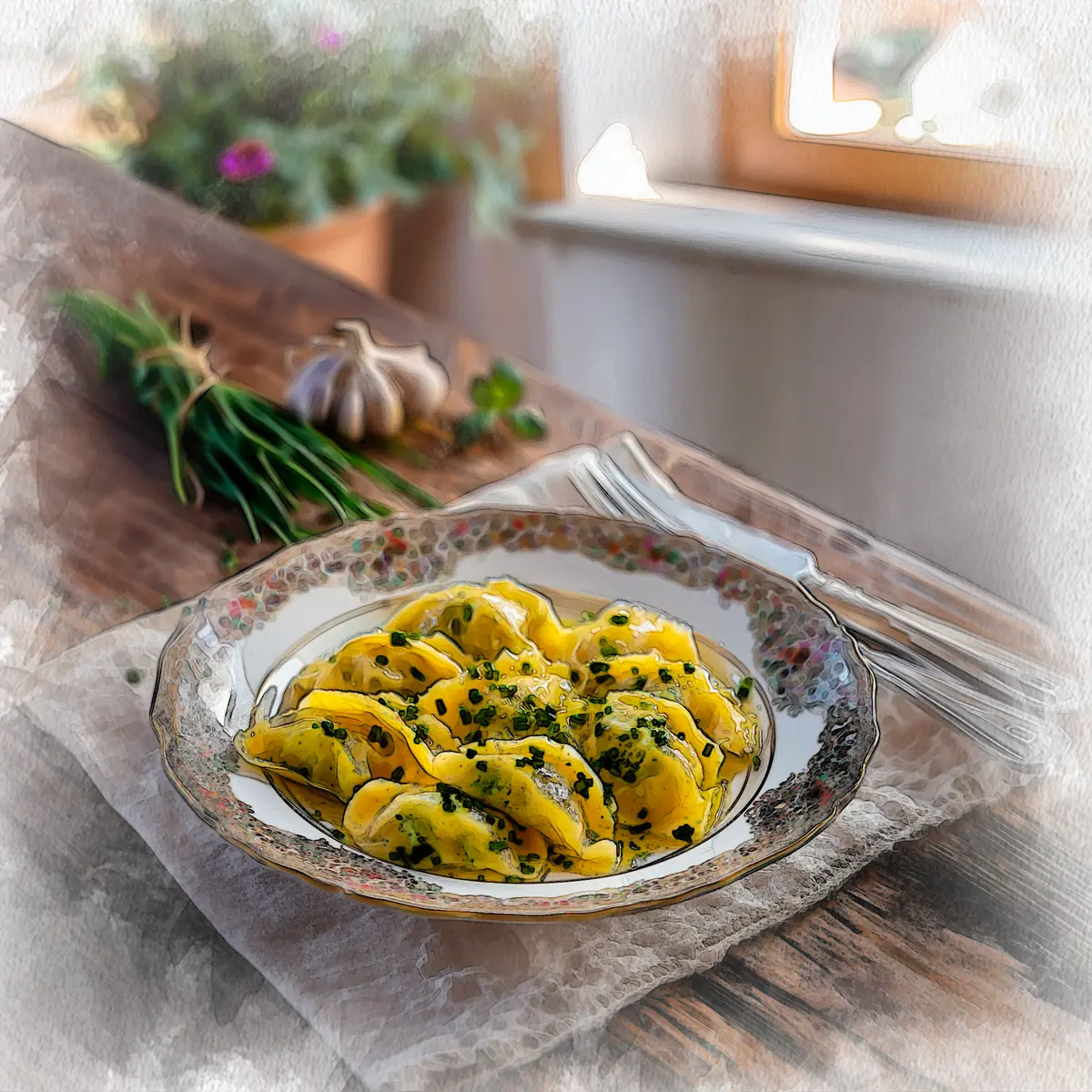
Schlutzkrapfen
Rye flour, Wheat flour, Egg, Spinach, Ricotta, Parmigiano Reggiano, Chives, Butter
Moderate
Trentino-Alto Adige
An hour's passage
680 Kcal
Schlutzkrapfen
Rye flour, Wheat flour, Egg, Spinach, Ricotta, Parmigiano Reggiano, Chives, Butter
Moderate
Trentino-Alto Adige
An hour's passage
680 Kcal
Schlutzkrapfen
Rye flour, Wheat flour, Egg, Spinach, Ricotta, Parmigiano Reggiano, Chives, Butter
Moderate
Trentino-Alto Adige
An hour's passage
680 Kcal
GENESIS
The Schlutzkrapfen, also celebrated as "Tyrolean half-moons," are an iconic masterwork of the traditional culinary heritage of Trentino-Alto Adige, particularly cherished in the Puster Valley.
Their history is deeply rooted in the rural culture of these valley-dwellers, where the imperative to craft substantial, nourishing fare from simple, local ingredients gave birth to this exquisite filled pasta.
The name "Schlutzkrapfen" derives from the German verb "schluzen," meaning "to slide," evoking their smooth, seductive texture that glides gracefully across the palate. In certain regions of the Ladin valleys, they are known by diverse names, such as "cancì," "crafuncins," "cajincì," "casonzì," or "casunziei," bearing witness to the opulence and vibrant tapestry of Alpine culinary lore.
While the most renowned and beloved rendition features a delicate filling of spinach and ricotta, the versatile nature of Schlutzkrapfen has inspired a myriad of variations—incorporating potatoes, beetroot, forest mushrooms, or even wild nettles—each deeply tied to the seasons and the cycle of the earth. This dish, though simple in its essence, stands as a true monument to conviviality and ancestral warmth, passed down through generations and prepared to this day with devout passion in the homes and taverns of Alto Adige.
PORTIONS (FOR 4 PERSONS)
FOR THE PASTA
Rye flour
Wheat flour 00
Egg
Lukewarm water
Extra virgin olive oil
Salt
150 g
100 g
1
50-60 ml
1 tablespoon
to taste
FOR THE CREATION'S HEART
Fresh spinach
Fresh cow's milk ricotta
Onion
Garlic
Butter
Parmigiano Reggiano
Fresh chives
Nutmeg
Black pepper
Salt
300 g
100 g
50 g
1/2 clove
1 tablespoon
1 tablespoon
1 tablespoon
to taste
to taste
to taste
FOR THE EMBELLISHMENT
Butter
Parmigiano Reggiano
Fresh chives
50 g
to taste
to taste
CURATION
For the filling:
Begin by preparing the sacred heart of the pasta. Thoroughly wash the fresh spinach and gently wilt them in a vessel of lightly salted water for a mere few minutes, until tender. Drain them meticulously, pressing with care to coax out any lingering water, and mince them finely.
Meanwhile, in a skillet, allow a spoonful of butter to melt, letting the finely minced onion soften into translucent sweetness alongside the half clove of garlic. Once the onion is tender and glistening, unite it with the minced spinach, allowing them to harmonize over low heat for a few moments. Remove from the warmth and allow to cool completely.
In a spacious bowl, marry the cow's milk ricotta with the sautéed spinach, the freshly grated Parmigiano Reggiano, and the finely snipped chives. Grate a delicate whisper of nutmeg, and season with salt and freshly cracked black pepper. Mingle all elements until they dissolve into a smooth, cohesive ensemble.For the fresh pasta:
Upon a wooden pastry board or in a wide bowl, unite the two flours with the salt. Form a sacred well in the center and break the egg. Add the extra virgin olive oil and begin to knead, gradually incorporating the tepid water, drop by drop. Knead the dough with vigorous devotion for about 10-15 minutes, until it surrenders into a smooth, elastic, and flawless sphere. Should the dough prove too resistant, entice it with another drop of water; if too adhesive, dust with a whisper of flour. Drape a clean cloth or film over the dough and let it rest in peaceful repose at room temperature for at least 30 minutes. This allows the gluten to relax, rendering the dough supple and ready to be spun fine.For the shaping of the Schlutzkrapfen:
Once the period of repose has concluded, reclaim the dough and roll it thin with a rolling pin or the traditional pasta machine, shaping a delicate sheet about 1-2 mm in thickness. Using a circular pastry cutter (approximately 6-8 cm in diameter) or a glass, carve out perfect discs.
Place a small crown of filling in the center of each disc. Moisten the edges of the half-moon lightly with water, then fold the disc over, forming a pristine crescent. Press the edges firmly with your fingertips to seal them, ensuring the precious filling does not escape during the trial of cooking. You may also trace the tines of a fork along the border to create a decorative edge and guarantee a perfect enclosure. As you shape each creation, arrange the Schlutzkrapfen on a lightly floured tray to prevent them from adhering to one another.For the boiling and the finish:
Bring a bountiful pot of salted water to a spirited boil. Gently plunge the Schlutzkrapfen into the water, cooking them for approximately 3-4 minutes from the moment they gracefully rise to the surface.
In the meantime, melt the butter in a pan over low heat until it transforms into a golden hue and begins to breathe the warm aroma of toasted hazelnuts. Guard it closely so it does not burn.
Retrieve the Schlutzkrapfen with a skimmer and arrange them directly onto individual plates. Dress them immediately with the warm, melted butter and a generous snowfall of grated Parmigiano Reggiano. Complete the presentation with a vibrant scatter of freshly snipped chives before offering them to the table.
aspiration
For a more intense nuance of flavor, you may grace the filling with a whisper of wild marjoram or freshly gathered parsley, finely minced.
For a more opulent rendition, you may gently brown a small portion of cured speck, cut into delicate cubes, within the molten butter before dressing the Schlutzkrapfen.
The Schlutzkrapfen may be crafted in advance and preserved through the frost. Arrange them upon a tray, thoughtfully spaced, and once the cold has claimed them, transfer them into artisanal storage bags. Cook them, then, directly from their frozen slumber in boiling water.


GENESIS
The Schlutzkrapfen, also celebrated as "Tyrolean half-moons," are an iconic masterwork of the traditional culinary heritage of Trentino-Alto Adige, particularly cherished in the Puster Valley.
Their history is deeply rooted in the rural culture of these valley-dwellers, where the imperative to craft substantial, nourishing fare from simple, local ingredients gave birth to this exquisite filled pasta.
The name "Schlutzkrapfen" derives from the German verb "schluzen," meaning "to slide," evoking their smooth, seductive texture that glides gracefully across the palate. In certain regions of the Ladin valleys, they are known by diverse names, such as "cancì," "crafuncins," "cajincì," "casonzì," or "casunziei," bearing witness to the opulence and vibrant tapestry of Alpine culinary lore.
While the most renowned and beloved rendition features a delicate filling of spinach and ricotta, the versatile nature of Schlutzkrapfen has inspired a myriad of variations—incorporating potatoes, beetroot, forest mushrooms, or even wild nettles—each deeply tied to the seasons and the cycle of the earth. This dish, though simple in its essence, stands as a true monument to conviviality and ancestral warmth, passed down through generations and prepared to this day with devout passion in the homes and taverns of Alto Adige.
PORTIONS (FOR 4 PERSONS)
FOR THE PASTA
Rye flour
Wheat flour 00
Egg
Lukewarm water
Extra virgin olive oil
Salt
150 g
100 g
1
50-60 ml
1 tablespoon
to taste
FOR THE CREATION'S HEART
Fresh spinach
Fresh cow's milk ricotta
Onion
Garlic
Butter
Parmigiano Reggiano
Fresh chives
Nutmeg
Black pepper
Salt
300 g
100 g
50 g
1/2 clove
1 tablespoon
1 tablespoon
1 tablespoon
to taste
to taste
to taste
FOR THE EMBELLISHMENT
Butter
Parmigiano Reggiano
Fresh chives
50 g
to taste
to taste
CURATION
For the filling:
Begin by preparing the sacred heart of the pasta. Thoroughly wash the fresh spinach and gently wilt them in a vessel of lightly salted water for a mere few minutes, until tender. Drain them meticulously, pressing with care to coax out any lingering water, and mince them finely.
Meanwhile, in a skillet, allow a spoonful of butter to melt, letting the finely minced onion soften into translucent sweetness alongside the half clove of garlic. Once the onion is tender and glistening, unite it with the minced spinach, allowing them to harmonize over low heat for a few moments. Remove from the warmth and allow to cool completely.
In a spacious bowl, marry the cow's milk ricotta with the sautéed spinach, the freshly grated Parmigiano Reggiano, and the finely snipped chives. Grate a delicate whisper of nutmeg, and season with salt and freshly cracked black pepper. Mingle all elements until they dissolve into a smooth, cohesive ensemble.For the fresh pasta:
Upon a wooden pastry board or in a wide bowl, unite the two flours with the salt. Form a sacred well in the center and break the egg. Add the extra virgin olive oil and begin to knead, gradually incorporating the tepid water, drop by drop. Knead the dough with vigorous devotion for about 10-15 minutes, until it surrenders into a smooth, elastic, and flawless sphere. Should the dough prove too resistant, entice it with another drop of water; if too adhesive, dust with a whisper of flour. Drape a clean cloth or film over the dough and let it rest in peaceful repose at room temperature for at least 30 minutes. This allows the gluten to relax, rendering the dough supple and ready to be spun fine.For the shaping of the Schlutzkrapfen:
Once the period of repose has concluded, reclaim the dough and roll it thin with a rolling pin or the traditional pasta machine, shaping a delicate sheet about 1-2 mm in thickness. Using a circular pastry cutter (approximately 6-8 cm in diameter) or a glass, carve out perfect discs.
Place a small crown of filling in the center of each disc. Moisten the edges of the half-moon lightly with water, then fold the disc over, forming a pristine crescent. Press the edges firmly with your fingertips to seal them, ensuring the precious filling does not escape during the trial of cooking. You may also trace the tines of a fork along the border to create a decorative edge and guarantee a perfect enclosure. As you shape each creation, arrange the Schlutzkrapfen on a lightly floured tray to prevent them from adhering to one another.For the boiling and the finish:
Bring a bountiful pot of salted water to a spirited boil. Gently plunge the Schlutzkrapfen into the water, cooking them for approximately 3-4 minutes from the moment they gracefully rise to the surface.
In the meantime, melt the butter in a pan over low heat until it transforms into a golden hue and begins to breathe the warm aroma of toasted hazelnuts. Guard it closely so it does not burn.
Retrieve the Schlutzkrapfen with a skimmer and arrange them directly onto individual plates. Dress them immediately with the warm, melted butter and a generous snowfall of grated Parmigiano Reggiano. Complete the presentation with a vibrant scatter of freshly snipped chives before offering them to the table.
aspiration
For a more intense nuance of flavor, you may grace the filling with a whisper of wild marjoram or freshly gathered parsley, finely minced.
For a more opulent rendition, you may gently brown a small portion of cured speck, cut into delicate cubes, within the molten butter before dressing the Schlutzkrapfen.
The Schlutzkrapfen may be crafted in advance and preserved through the frost. Arrange them upon a tray, thoughtfully spaced, and once the cold has claimed them, transfer them into artisanal storage bags. Cook them, then, directly from their frozen slumber in boiling water.
latest culinary creations
GENESIS
The Schlutzkrapfen, also celebrated as "Tyrolean half-moons," are an iconic masterwork of the traditional culinary heritage of Trentino-Alto Adige, particularly cherished in the Puster Valley.
Their history is deeply rooted in the rural culture of these valley-dwellers, where the imperative to craft substantial, nourishing fare from simple, local ingredients gave birth to this exquisite filled pasta.
The name "Schlutzkrapfen" derives from the German verb "schluzen," meaning "to slide," evoking their smooth, seductive texture that glides gracefully across the palate. In certain regions of the Ladin valleys, they are known by diverse names, such as "cancì," "crafuncins," "cajincì," "casonzì," or "casunziei," bearing witness to the opulence and vibrant tapestry of Alpine culinary lore.
While the most renowned and beloved rendition features a delicate filling of spinach and ricotta, the versatile nature of Schlutzkrapfen has inspired a myriad of variations—incorporating potatoes, beetroot, forest mushrooms, or even wild nettles—each deeply tied to the seasons and the cycle of the earth. This dish, though simple in its essence, stands as a true monument to conviviality and ancestral warmth, passed down through generations and prepared to this day with devout passion in the homes and taverns of Alto Adige.
PORTIONS (FOR 4 PERSONS)
FOR THE PASTA
Rye flour
Wheat flour 00
Egg
Lukewarm water
Extra virgin olive oil
Salt
150 g
100 g
1
50-60 ml
1 tablespoon
to taste
FOR THE CREATION'S HEART
Fresh spinach
Fresh cow's milk ricotta
Onion
Garlic
Butter
Parmigiano Reggiano
Fresh chives
Nutmeg
Black pepper
Salt
300 g
100 g
50 g
1/2 clove
1 tablespoon
1 tablespoon
1 tablespoon
to taste
to taste
to taste
FOR THE EMBELLISHMENT
Butter
Parmigiano Reggiano
Fresh chives
50 g
to taste
to taste
CURATION
For the filling:
Begin by preparing the sacred heart of the pasta. Thoroughly wash the fresh spinach and gently wilt them in a vessel of lightly salted water for a mere few minutes, until tender. Drain them meticulously, pressing with care to coax out any lingering water, and mince them finely.
Meanwhile, in a skillet, allow a spoonful of butter to melt, letting the finely minced onion soften into translucent sweetness alongside the half clove of garlic. Once the onion is tender and glistening, unite it with the minced spinach, allowing them to harmonize over low heat for a few moments. Remove from the warmth and allow to cool completely.
In a spacious bowl, marry the cow's milk ricotta with the sautéed spinach, the freshly grated Parmigiano Reggiano, and the finely snipped chives. Grate a delicate whisper of nutmeg, and season with salt and freshly cracked black pepper. Mingle all elements until they dissolve into a smooth, cohesive ensemble.For the fresh pasta:
Upon a wooden pastry board or in a wide bowl, unite the two flours with the salt. Form a sacred well in the center and break the egg. Add the extra virgin olive oil and begin to knead, gradually incorporating the tepid water, drop by drop. Knead the dough with vigorous devotion for about 10-15 minutes, until it surrenders into a smooth, elastic, and flawless sphere. Should the dough prove too resistant, entice it with another drop of water; if too adhesive, dust with a whisper of flour. Drape a clean cloth or film over the dough and let it rest in peaceful repose at room temperature for at least 30 minutes. This allows the gluten to relax, rendering the dough supple and ready to be spun fine.For the shaping of the Schlutzkrapfen:
Once the period of repose has concluded, reclaim the dough and roll it thin with a rolling pin or the traditional pasta machine, shaping a delicate sheet about 1-2 mm in thickness. Using a circular pastry cutter (approximately 6-8 cm in diameter) or a glass, carve out perfect discs.
Place a small crown of filling in the center of each disc. Moisten the edges of the half-moon lightly with water, then fold the disc over, forming a pristine crescent. Press the edges firmly with your fingertips to seal them, ensuring the precious filling does not escape during the trial of cooking. You may also trace the tines of a fork along the border to create a decorative edge and guarantee a perfect enclosure. As you shape each creation, arrange the Schlutzkrapfen on a lightly floured tray to prevent them from adhering to one another.For the boiling and the finish:
Bring a bountiful pot of salted water to a spirited boil. Gently plunge the Schlutzkrapfen into the water, cooking them for approximately 3-4 minutes from the moment they gracefully rise to the surface.
In the meantime, melt the butter in a pan over low heat until it transforms into a golden hue and begins to breathe the warm aroma of toasted hazelnuts. Guard it closely so it does not burn.
Retrieve the Schlutzkrapfen with a skimmer and arrange them directly onto individual plates. Dress them immediately with the warm, melted butter and a generous snowfall of grated Parmigiano Reggiano. Complete the presentation with a vibrant scatter of freshly snipped chives before offering them to the table.
aspiration
For a more intense nuance of flavor, you may grace the filling with a whisper of wild marjoram or freshly gathered parsley, finely minced.
For a more opulent rendition, you may gently brown a small portion of cured speck, cut into delicate cubes, within the molten butter before dressing the Schlutzkrapfen.
The Schlutzkrapfen may be crafted in advance and preserved through the frost. Arrange them upon a tray, thoughtfully spaced, and once the cold has claimed them, transfer them into artisanal storage bags. Cook them, then, directly from their frozen slumber in boiling water.