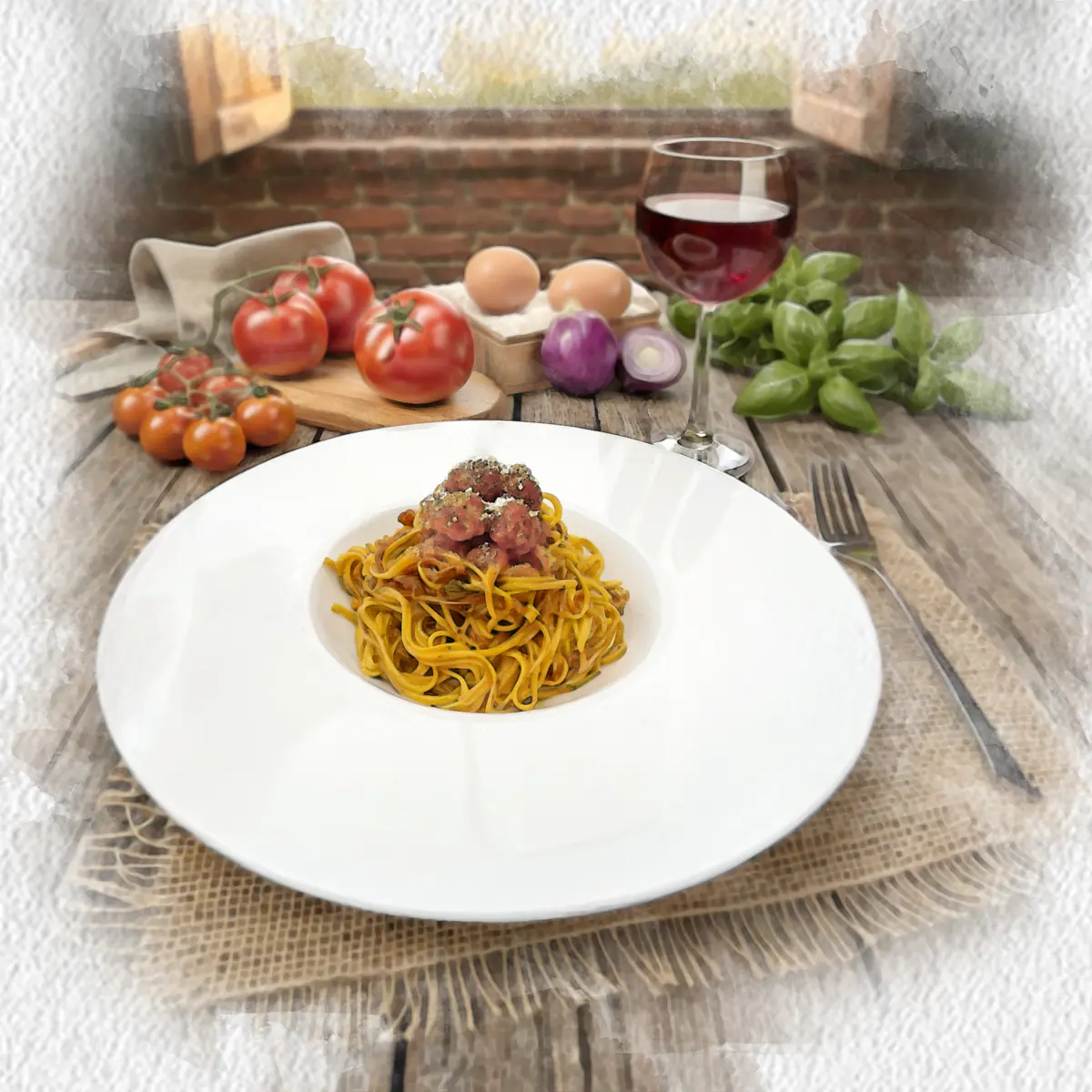
Chitarra Spaghetti with Artisanal Pallottine meatballs
Flour, Eggs, Beef, Pork, Parmigiano, Tomato.
Moderate
Abruzzo
75 minutes
750 Calories
Chitarra Spaghetti with Artisanal Pallottine meatballs
Flour, Eggs, Beef, Pork, Parmigiano, Tomato.
Moderate
Abruzzo
75 minutes
750 Calories
Chitarra Spaghetti with Artisanal Pallottine meatballs
Flour, Eggs, Beef, Pork, Parmigiano, Tomato.
Moderate
Abruzzo
75 minutes
750 Calories
GENESIS
Spaghetti alla Chitarra with Pallottine represent an undying classic of the Abruzzese culinary tradition, encapsulating the entire history and pure authenticity of the land. Indeed, they owe their name to the instrument of the selfsame title used to fashion them: a wooden frame strung with metallic chords, upon which the sheet of egg pasta is pressed, thereby yielding square-cut spaghetti of a characteristic porosity, destined to cradle and hold fast the sauce.
The pallottineu2014diminutive meat balls (often of a blended selection) or, in the rustic and ubiquitous variation, composed of stale bread, eggs, and cheese ("pallotte cacio e ova")u2014are themselves a crowning element of Abruzzese gastronomy. Born from the noble necessity of exalting available ingredients, they have blossomed into a symbol of conviviality and festive feasts, particularly in the lands of Teramo.
The marriage of spaghetti alla chitarra with a sauce enriched by these savory pallottine is a gastronomic union deeply rooted in tradition, the voice of a cuisine that is humble yet rich in flavor and history. This sumptuous dish perfectly embodies the very soul of Abruzzese domestic culinary art.
PORTIONS (FOR 4 PERSONS)
FOR THE PASTA
Flour 00
Medium eggs
Salt
300 g
3
a pinch
FOR THE FILLING "THE PALLOTTINE"
Minced meat (beef and pork)
Stale bread softened in milk
Grated Parmigiano
A small egg
Garlic
Chopped parsley
Salt
Black pepper
200 g
50 g
30 g
1
1
to taste
to taste
to taste
FOR THE EMBELLISHMENT
Strained tomato passata
Cubed cured pork belly
Small onion
Small carrot
Stalk of celery
Red wine
Extra virgin olive oil
Salt
Black pepper
Grated Pecorino cheese
Fresh basil
700 g
50 g
1
1
1
1/2 glass
to taste
to taste
to taste
to taste
a few leaves
CURATION
Fashion the Fresh Pasta:
Upon a wooden pastry board, arrange the flour in a sacred well. Into the center, release the eggs and introduce a whisper of salt. With a fork, whisk them gently, gradually marrying the flour from the inner edge.
Knead the dough until it achieves a state of smooth and supple grace. Envelop it in transparent film and allow it to rest in quiet repose for at least thirty minutes.
Roll the dough using a rolling pin or a pasta machine to obtain a sheet of the desired thickness (approximately 1-2 mm).
Drape this veil of dough over the "chitarra" and, with the rolling pin, press gently so the dough yields to the wires, giving birth to the classic spaghetti alla chitarra. Dust the pasta with a breath of semolina flour, preserving its delicate separation.Sculpt the Pallottine:
In a vessel, harmonize the minced meat with the bread, softened and squeezed dry, the grated Parmigiano, the egg, minced garlic, finely chopped parsley, salt, and pepper.
Incorporate these ingredients in perfect unison.
Shape them into small spheres, veritable culinary pearls, about 2-3 cm in diameter.Compose the Condiment:
In a generous pan, warm a thread of extra virgin olive oil and sear the cubed pancetta until it yields a satisfying crispness. Retrieve it from the vessel and set it aside.
Within the same oil, introduce the minced onion, letting it sweat over a gentle flame until translucent.
Add the finely chopped carrot and celery, allowing them to soften for a few moments in quiet harmony.
Introduce the pallottine, searing them on all sides until they are draped in a beautiful golden hue.
Bless the pan with red wine, allowing the spirited alcohol to evaporate into the air.
Pour in the tomato passata, adding a pinch of salt and a grind of black pepper. Stir gently, lower the flame, cover, and let the sauce simmer in slow contemplation for at least 45 minutes, stirring with the utmost care to preserve the integrity of the delicate spheres. Should the sauce dry too much, enrich it with a splash of warm water.Boil the Pasta:
In the meantime, bring a pot of abundant, salted water to a spirited boil, cooking the spaghetti alla chitarra until it achieves the perfect al dente state. Drain the pasta, reserving a small measure of its cooking water.
Transfer the spaghetti to the pan to join the rich sauce and the pallottine, adding the crispy pancetta and a few leaves of fresh, aromatic basil. Toss gracefully, introducing, should the dish require it, a splash of the pasta's cooking water to achieve a velvety, luxurious emulsion.
Present the spaghetti alla chitarra piping hot, artfully distributing the small culinary spheres upon the plates and finishing with a generous dusting of grated Pecorino.
aspiration
Should you desire a more profound depth of flavor within the pallottine, a subtle whisper of nutmeg may be incorporated into the dough.
One may also choose to bake the pallottine: once gently browned in the pan, transfer them into a baking vessel enveloped in their sauce, and consign to the oven at 180°C for some 20 to 25 minutes.


GENESIS
Spaghetti alla Chitarra with Pallottine represent an undying classic of the Abruzzese culinary tradition, encapsulating the entire history and pure authenticity of the land. Indeed, they owe their name to the instrument of the selfsame title used to fashion them: a wooden frame strung with metallic chords, upon which the sheet of egg pasta is pressed, thereby yielding square-cut spaghetti of a characteristic porosity, destined to cradle and hold fast the sauce.
The pallottineu2014diminutive meat balls (often of a blended selection) or, in the rustic and ubiquitous variation, composed of stale bread, eggs, and cheese ("pallotte cacio e ova")u2014are themselves a crowning element of Abruzzese gastronomy. Born from the noble necessity of exalting available ingredients, they have blossomed into a symbol of conviviality and festive feasts, particularly in the lands of Teramo.
The marriage of spaghetti alla chitarra with a sauce enriched by these savory pallottine is a gastronomic union deeply rooted in tradition, the voice of a cuisine that is humble yet rich in flavor and history. This sumptuous dish perfectly embodies the very soul of Abruzzese domestic culinary art.
PORTIONS (FOR 4 PERSONS)
FOR THE PASTA
Flour 00
Medium eggs
Salt
300 g
3
a pinch
FOR THE FILLING "THE PALLOTTINE"
Minced meat (beef and pork)
Stale bread softened in milk
Grated Parmigiano
A small egg
Garlic
Chopped parsley
Salt
Black pepper
200 g
50 g
30 g
1
1
to taste
to taste
to taste
FOR THE EMBELLISHMENT
Strained tomato passata
Cubed cured pork belly
Small onion
Small carrot
Stalk of celery
Red wine
Extra virgin olive oil
Salt
Black pepper
Grated Pecorino cheese
Fresh basil
700 g
50 g
1
1
1
1/2 glass
to taste
to taste
to taste
to taste
a few leaves
CURATION
Fashion the Fresh Pasta:
Upon a wooden pastry board, arrange the flour in a sacred well. Into the center, release the eggs and introduce a whisper of salt. With a fork, whisk them gently, gradually marrying the flour from the inner edge.
Knead the dough until it achieves a state of smooth and supple grace. Envelop it in transparent film and allow it to rest in quiet repose for at least thirty minutes.
Roll the dough using a rolling pin or a pasta machine to obtain a sheet of the desired thickness (approximately 1-2 mm).
Drape this veil of dough over the "chitarra" and, with the rolling pin, press gently so the dough yields to the wires, giving birth to the classic spaghetti alla chitarra. Dust the pasta with a breath of semolina flour, preserving its delicate separation.Sculpt the Pallottine:
In a vessel, harmonize the minced meat with the bread, softened and squeezed dry, the grated Parmigiano, the egg, minced garlic, finely chopped parsley, salt, and pepper.
Incorporate these ingredients in perfect unison.
Shape them into small spheres, veritable culinary pearls, about 2-3 cm in diameter.Compose the Condiment:
In a generous pan, warm a thread of extra virgin olive oil and sear the cubed pancetta until it yields a satisfying crispness. Retrieve it from the vessel and set it aside.
Within the same oil, introduce the minced onion, letting it sweat over a gentle flame until translucent.
Add the finely chopped carrot and celery, allowing them to soften for a few moments in quiet harmony.
Introduce the pallottine, searing them on all sides until they are draped in a beautiful golden hue.
Bless the pan with red wine, allowing the spirited alcohol to evaporate into the air.
Pour in the tomato passata, adding a pinch of salt and a grind of black pepper. Stir gently, lower the flame, cover, and let the sauce simmer in slow contemplation for at least 45 minutes, stirring with the utmost care to preserve the integrity of the delicate spheres. Should the sauce dry too much, enrich it with a splash of warm water.Boil the Pasta:
In the meantime, bring a pot of abundant, salted water to a spirited boil, cooking the spaghetti alla chitarra until it achieves the perfect al dente state. Drain the pasta, reserving a small measure of its cooking water.
Transfer the spaghetti to the pan to join the rich sauce and the pallottine, adding the crispy pancetta and a few leaves of fresh, aromatic basil. Toss gracefully, introducing, should the dish require it, a splash of the pasta's cooking water to achieve a velvety, luxurious emulsion.
Present the spaghetti alla chitarra piping hot, artfully distributing the small culinary spheres upon the plates and finishing with a generous dusting of grated Pecorino.
aspiration
Should you desire a more profound depth of flavor within the pallottine, a subtle whisper of nutmeg may be incorporated into the dough.
One may also choose to bake the pallottine: once gently browned in the pan, transfer them into a baking vessel enveloped in their sauce, and consign to the oven at 180°C for some 20 to 25 minutes.
latest culinary creations
GENESIS
Spaghetti alla Chitarra with Pallottine represent an undying classic of the Abruzzese culinary tradition, encapsulating the entire history and pure authenticity of the land. Indeed, they owe their name to the instrument of the selfsame title used to fashion them: a wooden frame strung with metallic chords, upon which the sheet of egg pasta is pressed, thereby yielding square-cut spaghetti of a characteristic porosity, destined to cradle and hold fast the sauce.
The pallottineu2014diminutive meat balls (often of a blended selection) or, in the rustic and ubiquitous variation, composed of stale bread, eggs, and cheese ("pallotte cacio e ova")u2014are themselves a crowning element of Abruzzese gastronomy. Born from the noble necessity of exalting available ingredients, they have blossomed into a symbol of conviviality and festive feasts, particularly in the lands of Teramo.
The marriage of spaghetti alla chitarra with a sauce enriched by these savory pallottine is a gastronomic union deeply rooted in tradition, the voice of a cuisine that is humble yet rich in flavor and history. This sumptuous dish perfectly embodies the very soul of Abruzzese domestic culinary art.
PORTIONS (FOR 4 PERSONS)
FOR THE PASTA
Flour 00
Medium eggs
Salt
300 g
3
a pinch
FOR THE FILLING "THE PALLOTTINE"
Minced meat (beef and pork)
Stale bread softened in milk
Grated Parmigiano
A small egg
Garlic
Chopped parsley
Salt
Black pepper
200 g
50 g
30 g
1
1
to taste
to taste
to taste
FOR THE EMBELLISHMENT
Strained tomato passata
Cubed cured pork belly
Small onion
Small carrot
Stalk of celery
Red wine
Extra virgin olive oil
Salt
Black pepper
Grated Pecorino cheese
Fresh basil
700 g
50 g
1
1
1
1/2 glass
to taste
to taste
to taste
to taste
a few leaves
CURATION
Fashion the Fresh Pasta:
Upon a wooden pastry board, arrange the flour in a sacred well. Into the center, release the eggs and introduce a whisper of salt. With a fork, whisk them gently, gradually marrying the flour from the inner edge.
Knead the dough until it achieves a state of smooth and supple grace. Envelop it in transparent film and allow it to rest in quiet repose for at least thirty minutes.
Roll the dough using a rolling pin or a pasta machine to obtain a sheet of the desired thickness (approximately 1-2 mm).
Drape this veil of dough over the "chitarra" and, with the rolling pin, press gently so the dough yields to the wires, giving birth to the classic spaghetti alla chitarra. Dust the pasta with a breath of semolina flour, preserving its delicate separation.Sculpt the Pallottine:
In a vessel, harmonize the minced meat with the bread, softened and squeezed dry, the grated Parmigiano, the egg, minced garlic, finely chopped parsley, salt, and pepper.
Incorporate these ingredients in perfect unison.
Shape them into small spheres, veritable culinary pearls, about 2-3 cm in diameter.Compose the Condiment:
In a generous pan, warm a thread of extra virgin olive oil and sear the cubed pancetta until it yields a satisfying crispness. Retrieve it from the vessel and set it aside.
Within the same oil, introduce the minced onion, letting it sweat over a gentle flame until translucent.
Add the finely chopped carrot and celery, allowing them to soften for a few moments in quiet harmony.
Introduce the pallottine, searing them on all sides until they are draped in a beautiful golden hue.
Bless the pan with red wine, allowing the spirited alcohol to evaporate into the air.
Pour in the tomato passata, adding a pinch of salt and a grind of black pepper. Stir gently, lower the flame, cover, and let the sauce simmer in slow contemplation for at least 45 minutes, stirring with the utmost care to preserve the integrity of the delicate spheres. Should the sauce dry too much, enrich it with a splash of warm water.Boil the Pasta:
In the meantime, bring a pot of abundant, salted water to a spirited boil, cooking the spaghetti alla chitarra until it achieves the perfect al dente state. Drain the pasta, reserving a small measure of its cooking water.
Transfer the spaghetti to the pan to join the rich sauce and the pallottine, adding the crispy pancetta and a few leaves of fresh, aromatic basil. Toss gracefully, introducing, should the dish require it, a splash of the pasta's cooking water to achieve a velvety, luxurious emulsion.
Present the spaghetti alla chitarra piping hot, artfully distributing the small culinary spheres upon the plates and finishing with a generous dusting of grated Pecorino.
aspiration
Should you desire a more profound depth of flavor within the pallottine, a subtle whisper of nutmeg may be incorporated into the dough.
One may also choose to bake the pallottine: once gently browned in the pan, transfer them into a baking vessel enveloped in their sauce, and consign to the oven at 180°C for some 20 to 25 minutes.