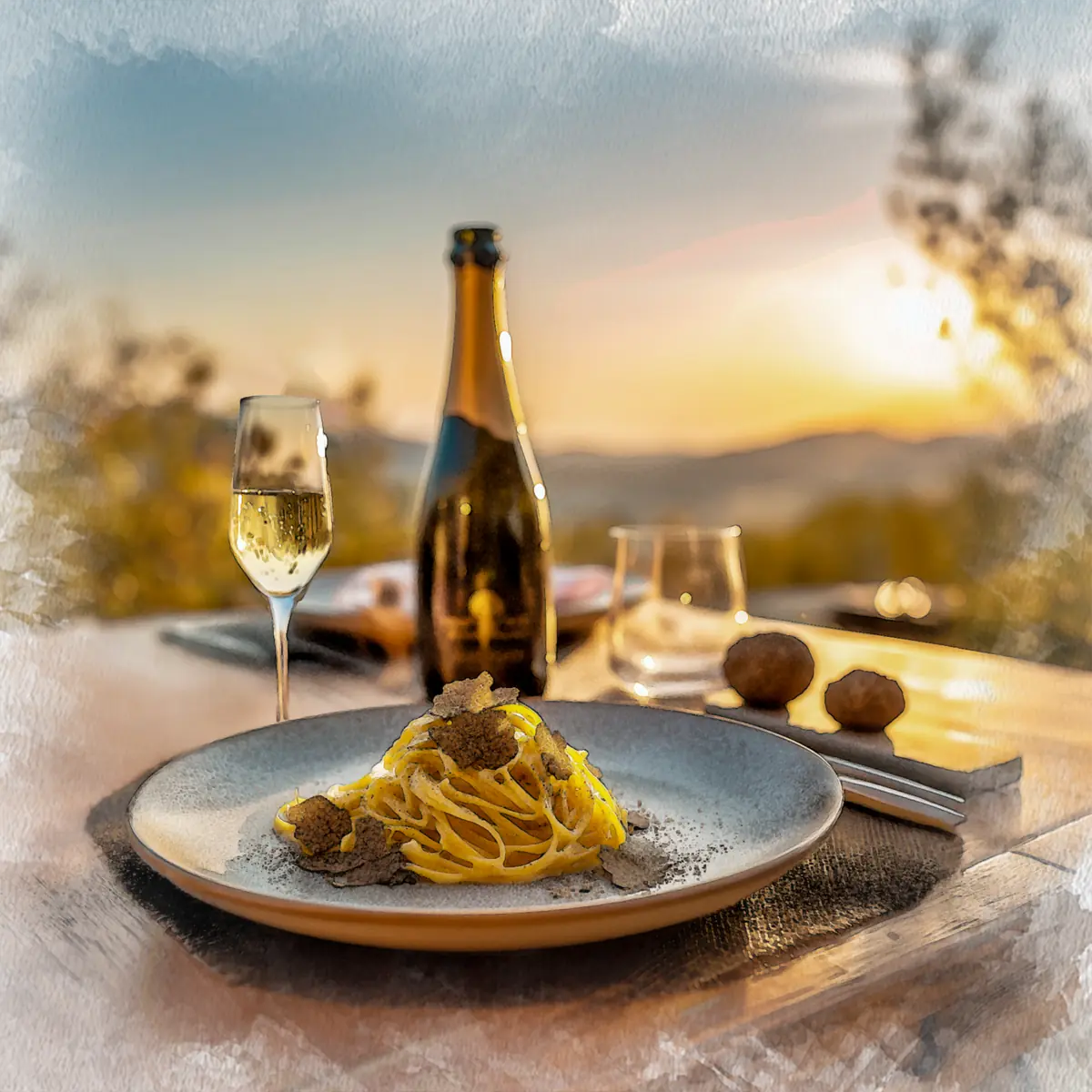
TAJARIN ENRICHED WITH THE ESSENCE OF TRUFFLE
Flour 00, Yolks of egg, Butter, White or black Truffle, Parmigiano Reggiano.
Effortless
Piedmont
50 minutes
580 kcal
TAJARIN ENRICHED WITH THE ESSENCE OF TRUFFLE
Flour 00, Yolks of egg, Butter, White or black Truffle, Parmigiano Reggiano.
Effortless
Piedmont
50 minutes
580 kcal
TAJARIN ENRICHED WITH THE ESSENCE OF TRUFFLE
Flour 00, Yolks of egg, Butter, White or black Truffle, Parmigiano Reggiano.
Effortless
Piedmont
50 minutes
580 kcal
GENESIS
Tajarin with truffle represents one of the most iconic and sublime creations of Piedmontese gastronomy, a true testament to a terroir blessed with culinary marvels. Their history is intimately bound to the agrarian heritage of the Langhe, where egg pasta, fashioned by hand with consummate mastery, reigned as a foundational sustenance. The tajarin, in particular, distinguish themselves by their almost impalpable thinness—the fruit of a dough lavishly enriched with egg yolks, which bestows upon the pasta a vibrant golden hue and a velvety texture. Historically, they were prepared exclusively for solemn occasions, Sundays, and feast days, owing to the opulence of the ingredients and the painstaking manual labor required.
The marriage with truffle—be it the revered white truffle of Alba or the more ubiquitous black truffle—ascends this dish to a realm of celestial refinement. The truffle, heralded by many as the "diamond of the earth," possesses a millenary history rooted in ancient Rome and Greece, where it was revered as the food of the gods. In Piedmont, the quest for the truffle evolved into a veritable art, refined through the ages, employing trained hounds rather than swine to seek out these precious subterranean treasures.
During the seventeenth century, the consumption of truffles in Piedmont attained great prominence, likely of a desire to emulate the culinary customs of the French nobility, who already esteemed them highly. King Victor Emmanuel II was renowned as a passionate devotee of tajarin, which he frequently savored adorned with truffle. The elegant simplicity of the dressing—melted butter, Parmigiano, and a generous shaving of fresh truffle—exalts to the highest degree the unmistakable flavor and perfume of this legendary ingredient.
PORTIONS (FOR 4 PERSONS)
FOR THE PASTA
Flour 00
Yolks (approximately 8-9 yolks)
Salt
350 g
150 g
to taste
FOR THE EMBELLISHMENT
Butter of finest quality
Parmigiano Reggiano
White or black truffle
Salt
Black pepper
80 g
50 g
5-7 g
to taste
to taste
CURATION
For the fresh pasta:
Arrange the 00 flour in a fountain shape on a clean wooden kneading board. Create a wide well at the centre and pour in the egg yolks. Add a pinch of salt. Begin to knead gently with a fork, gradually incorporating the flour from the edges toward the centre, until the yolks have embraced all the flour. At this point, proceed by hand, kneading for at least 15 to 20 minutes with energetic, rhythmic motions until you achieve a smooth, supple, and homogeneous dough. It should feel quite firm. Shroud the dough in cling film and allow it to rest at room temperature for at least 30 minutes.
Once the period of repose has elapsed, return to the dough and, with the aid of a rolling pin or a pasta machine, roll out an exceedingly thin sheet, almost translucent, bearing in mind that this sheer finesse is the defining signature of tajarin. When the sheet of pasta is ready, dust it lightly with flour and roll it upon itself without squeezing too tightly. With a sharp knife, slice the roll into gossamer ribbons, approximately 1-2 mm in width. Gently unravel the resulting tajarin and arrange them on a lightly floured tray, shaping them into delicate nests to prevent them from clinging to one another. Let them dry for a brief few minutes.For the condiment:
While the pasta water rises to a boil, prepare the seasoning. In a spacious pan over medium-low heat, gently melt the butter in small pieces; it must dissolve slowly without burning, so that it may acquire a light golden hue and an intense aroma. If employing black truffle, you may infuse a whisper-thin shaving into the melting butter to deepen its fragrance. If you are using the precious white truffle, do not introduce it to the hot butter, as excessive heat would dissipate its volatile essence. Reserve a small ladle of the pasta cooking water.
Boil the tajarin in abundant salted water for 1-2 minutes; given their sheer delicacy, they will cook exceedingly fast. Drain them directly into the pan with the melted butter, using tongs or a skimmer. Shower with the grated Parmigiano Reggiano and a droplet of the cooking water, tossing gently to emulsify all elements into a velvety cream that envelops the pasta. Extinguish the flame.
Immediately arrange the tajarin, shaping a nest on each plate. Shave an abundance of fresh truffle in thin petals directly over the pasta using a truffle slicer. Should you desire, complete the masterpiece with a dusting of freshly cracked black pepper.
aspiration
To elevate the sublime essence of the truffle to its zenith, depart from any excess of heat. The white truffle, most singularly, must ever be shaved raw, bestowed upon the dish only at the final moment of its creation.
To impart a more velvety opulence, you may introduce a spoonful of fresh cream into the melted butter before uniting it with the pasta.


GENESIS
Tajarin with truffle represents one of the most iconic and sublime creations of Piedmontese gastronomy, a true testament to a terroir blessed with culinary marvels. Their history is intimately bound to the agrarian heritage of the Langhe, where egg pasta, fashioned by hand with consummate mastery, reigned as a foundational sustenance. The tajarin, in particular, distinguish themselves by their almost impalpable thinness—the fruit of a dough lavishly enriched with egg yolks, which bestows upon the pasta a vibrant golden hue and a velvety texture. Historically, they were prepared exclusively for solemn occasions, Sundays, and feast days, owing to the opulence of the ingredients and the painstaking manual labor required.
The marriage with truffle—be it the revered white truffle of Alba or the more ubiquitous black truffle—ascends this dish to a realm of celestial refinement. The truffle, heralded by many as the "diamond of the earth," possesses a millenary history rooted in ancient Rome and Greece, where it was revered as the food of the gods. In Piedmont, the quest for the truffle evolved into a veritable art, refined through the ages, employing trained hounds rather than swine to seek out these precious subterranean treasures.
During the seventeenth century, the consumption of truffles in Piedmont attained great prominence, likely of a desire to emulate the culinary customs of the French nobility, who already esteemed them highly. King Victor Emmanuel II was renowned as a passionate devotee of tajarin, which he frequently savored adorned with truffle. The elegant simplicity of the dressing—melted butter, Parmigiano, and a generous shaving of fresh truffle—exalts to the highest degree the unmistakable flavor and perfume of this legendary ingredient.
PORTIONS (FOR 4 PERSONS)
FOR THE PASTA
Flour 00
Yolks (approximately 8-9 yolks)
Salt
350 g
150 g
to taste
FOR THE EMBELLISHMENT
Butter of finest quality
Parmigiano Reggiano
White or black truffle
Salt
Black pepper
80 g
50 g
5-7 g
to taste
to taste
CURATION
For the fresh pasta:
Arrange the 00 flour in a fountain shape on a clean wooden kneading board. Create a wide well at the centre and pour in the egg yolks. Add a pinch of salt. Begin to knead gently with a fork, gradually incorporating the flour from the edges toward the centre, until the yolks have embraced all the flour. At this point, proceed by hand, kneading for at least 15 to 20 minutes with energetic, rhythmic motions until you achieve a smooth, supple, and homogeneous dough. It should feel quite firm. Shroud the dough in cling film and allow it to rest at room temperature for at least 30 minutes.
Once the period of repose has elapsed, return to the dough and, with the aid of a rolling pin or a pasta machine, roll out an exceedingly thin sheet, almost translucent, bearing in mind that this sheer finesse is the defining signature of tajarin. When the sheet of pasta is ready, dust it lightly with flour and roll it upon itself without squeezing too tightly. With a sharp knife, slice the roll into gossamer ribbons, approximately 1-2 mm in width. Gently unravel the resulting tajarin and arrange them on a lightly floured tray, shaping them into delicate nests to prevent them from clinging to one another. Let them dry for a brief few minutes.For the condiment:
While the pasta water rises to a boil, prepare the seasoning. In a spacious pan over medium-low heat, gently melt the butter in small pieces; it must dissolve slowly without burning, so that it may acquire a light golden hue and an intense aroma. If employing black truffle, you may infuse a whisper-thin shaving into the melting butter to deepen its fragrance. If you are using the precious white truffle, do not introduce it to the hot butter, as excessive heat would dissipate its volatile essence. Reserve a small ladle of the pasta cooking water.
Boil the tajarin in abundant salted water for 1-2 minutes; given their sheer delicacy, they will cook exceedingly fast. Drain them directly into the pan with the melted butter, using tongs or a skimmer. Shower with the grated Parmigiano Reggiano and a droplet of the cooking water, tossing gently to emulsify all elements into a velvety cream that envelops the pasta. Extinguish the flame.
Immediately arrange the tajarin, shaping a nest on each plate. Shave an abundance of fresh truffle in thin petals directly over the pasta using a truffle slicer. Should you desire, complete the masterpiece with a dusting of freshly cracked black pepper.
aspiration
To elevate the sublime essence of the truffle to its zenith, depart from any excess of heat. The white truffle, most singularly, must ever be shaved raw, bestowed upon the dish only at the final moment of its creation.
To impart a more velvety opulence, you may introduce a spoonful of fresh cream into the melted butter before uniting it with the pasta.
latest culinary creations
GENESIS
Tajarin with truffle represents one of the most iconic and sublime creations of Piedmontese gastronomy, a true testament to a terroir blessed with culinary marvels. Their history is intimately bound to the agrarian heritage of the Langhe, where egg pasta, fashioned by hand with consummate mastery, reigned as a foundational sustenance. The tajarin, in particular, distinguish themselves by their almost impalpable thinness—the fruit of a dough lavishly enriched with egg yolks, which bestows upon the pasta a vibrant golden hue and a velvety texture. Historically, they were prepared exclusively for solemn occasions, Sundays, and feast days, owing to the opulence of the ingredients and the painstaking manual labor required.
The marriage with truffle—be it the revered white truffle of Alba or the more ubiquitous black truffle—ascends this dish to a realm of celestial refinement. The truffle, heralded by many as the "diamond of the earth," possesses a millenary history rooted in ancient Rome and Greece, where it was revered as the food of the gods. In Piedmont, the quest for the truffle evolved into a veritable art, refined through the ages, employing trained hounds rather than swine to seek out these precious subterranean treasures.
During the seventeenth century, the consumption of truffles in Piedmont attained great prominence, likely of a desire to emulate the culinary customs of the French nobility, who already esteemed them highly. King Victor Emmanuel II was renowned as a passionate devotee of tajarin, which he frequently savored adorned with truffle. The elegant simplicity of the dressing—melted butter, Parmigiano, and a generous shaving of fresh truffle—exalts to the highest degree the unmistakable flavor and perfume of this legendary ingredient.
PORTIONS (FOR 4 PERSONS)
FOR THE PASTA
Flour 00
Yolks (approximately 8-9 yolks)
Salt
350 g
150 g
to taste
FOR THE EMBELLISHMENT
Butter of finest quality
Parmigiano Reggiano
White or black truffle
Salt
Black pepper
80 g
50 g
5-7 g
to taste
to taste
CURATION
For the fresh pasta:
Arrange the 00 flour in a fountain shape on a clean wooden kneading board. Create a wide well at the centre and pour in the egg yolks. Add a pinch of salt. Begin to knead gently with a fork, gradually incorporating the flour from the edges toward the centre, until the yolks have embraced all the flour. At this point, proceed by hand, kneading for at least 15 to 20 minutes with energetic, rhythmic motions until you achieve a smooth, supple, and homogeneous dough. It should feel quite firm. Shroud the dough in cling film and allow it to rest at room temperature for at least 30 minutes.
Once the period of repose has elapsed, return to the dough and, with the aid of a rolling pin or a pasta machine, roll out an exceedingly thin sheet, almost translucent, bearing in mind that this sheer finesse is the defining signature of tajarin. When the sheet of pasta is ready, dust it lightly with flour and roll it upon itself without squeezing too tightly. With a sharp knife, slice the roll into gossamer ribbons, approximately 1-2 mm in width. Gently unravel the resulting tajarin and arrange them on a lightly floured tray, shaping them into delicate nests to prevent them from clinging to one another. Let them dry for a brief few minutes.For the condiment:
While the pasta water rises to a boil, prepare the seasoning. In a spacious pan over medium-low heat, gently melt the butter in small pieces; it must dissolve slowly without burning, so that it may acquire a light golden hue and an intense aroma. If employing black truffle, you may infuse a whisper-thin shaving into the melting butter to deepen its fragrance. If you are using the precious white truffle, do not introduce it to the hot butter, as excessive heat would dissipate its volatile essence. Reserve a small ladle of the pasta cooking water.
Boil the tajarin in abundant salted water for 1-2 minutes; given their sheer delicacy, they will cook exceedingly fast. Drain them directly into the pan with the melted butter, using tongs or a skimmer. Shower with the grated Parmigiano Reggiano and a droplet of the cooking water, tossing gently to emulsify all elements into a velvety cream that envelops the pasta. Extinguish the flame.
Immediately arrange the tajarin, shaping a nest on each plate. Shave an abundance of fresh truffle in thin petals directly over the pasta using a truffle slicer. Should you desire, complete the masterpiece with a dusting of freshly cracked black pepper.
aspiration
To elevate the sublime essence of the truffle to its zenith, depart from any excess of heat. The white truffle, most singularly, must ever be shaved raw, bestowed upon the dish only at the final moment of its creation.
To impart a more velvety opulence, you may introduce a spoonful of fresh cream into the melted butter before uniting it with the pasta.