THOMAS JEFFERSON AND THE ART OF PASTA
when taste crossed the Atlantic
Mar 16, 2026
THOMAS JEFFERSON AND THE ART OF PASTA
when taste crossed the Atlantic
Mar 16, 2026
THOMAS JEFFERSON AND THE ART OF PASTA
when taste crossed the Atlantic
Mar 16, 2026
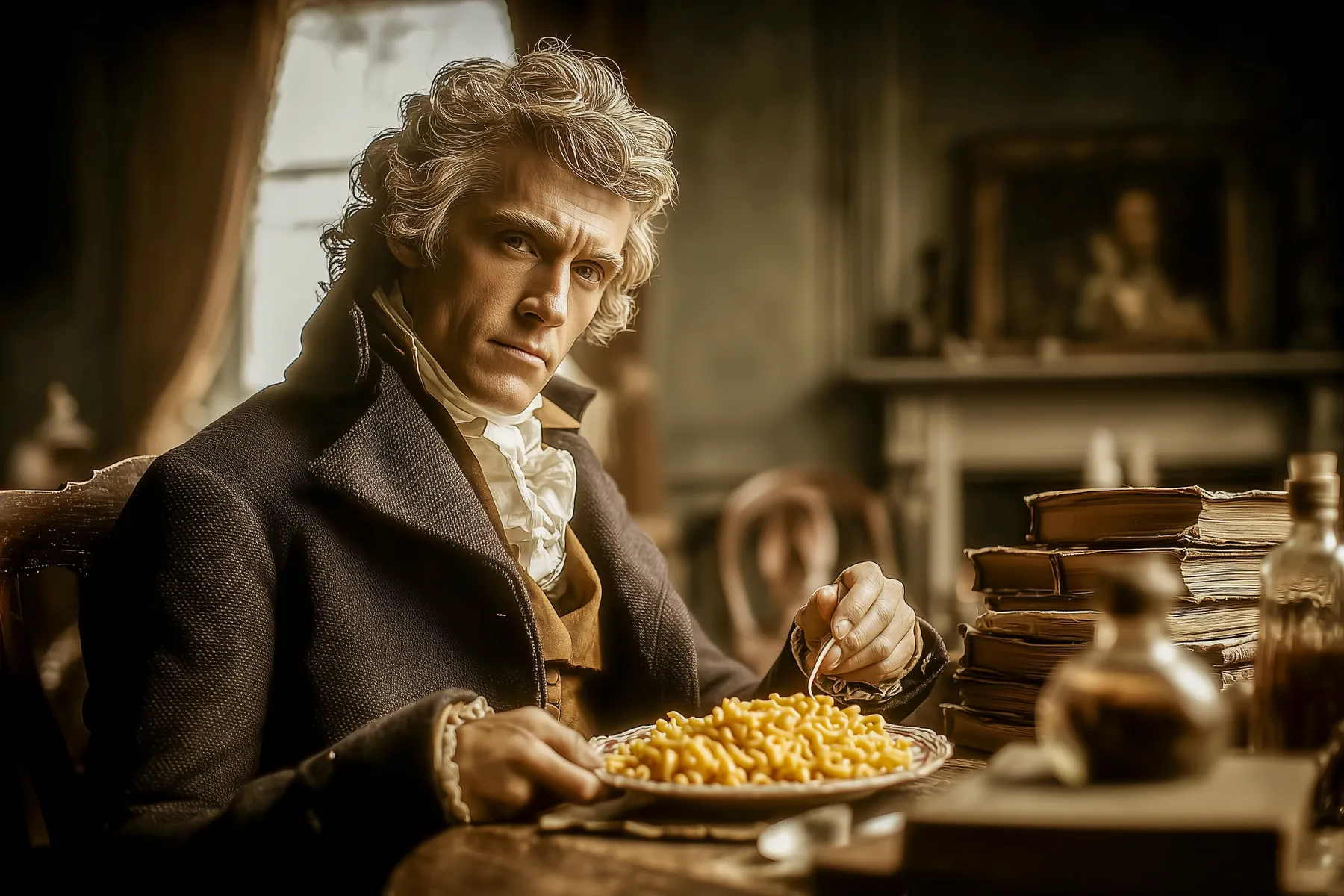
There are men who found nations, and sensitive spirits who, almost without intending to, educate the palate of a continent. Thomas Jefferson belongs to both of these species. Father of the Declaration of Independence, third President of the United States, diplomat, agronomist, bibliophile, architect of his own existence; but also a curious traveler, a meticulous observer of the everyday, a collector of the refined forms of civil living. Among these, the table. And upon the table, in an era when America was still seeking its own gastronomic lexicon, there appeared this: pasta.
Around Jefferson and macaroni, a small national mythology has been constructed. It has been said that he "brought" them to America, that he introduced their use, even that he invented macaroni and cheese. The truth, as is often the case, is far more compelling and nuanced. Pasta was not unknown to Great Britain or to the American colonies of the eighteenth century, and dishes of pasta with cheese already circulated in Europe before his return. Jefferson, therefore, was not the first apostle of the macaroni; he was something more modern: the one who intuited its symbolic, cultural, and almost social value, integrating it into an ideal of domestic refinement and of the civilization of taste.
The decisive moment crystallized during his European years. Serving as United States Minister to France between 1785 and 1789, Jefferson fell in love with continental cuisines; but it was especially during his journey of 1787, between the south of France and northern Italy, that his gaze became almost technical. He did not merely nourish himself: he observed, he noted, he drew. Indeed, in his papers appears a sketch of a machine for macaroni with instructions on the processing of dough, a precious testament to a curiosity that was not mere gluttony, but rather a desire to understand the inner workings of things, to translate pleasure into procedure, wonder into mechanical ingenuity.
In February 1789, at his request, William Short, Jefferson's private secretary and protégé, procured for him in Naples a “mould for making maccaroni,” that is, a mold or press destined for the production of pasta. The object, in all probability, later reached the United States and appeared in connection with the goods shipped in 1793 to Monticello, Jefferson's Virginian estate near Charlottesville. This is a detail of greater significance than it might seem: not because Jefferson wished to industrialize his domestic kitchen, but because it reveals his desire to transfer a material heritage from Europe to the New World. Pasta, for him, was not merely sustenance: it was a gentle technology, a grammar of transformation. Semolina, water, pressure, time: few elements, yet already sufficient to narrate an idea of order and culture.
Rendering this 'transmigration of taste' possible was also James Hemings, the highly skilled, enslaved chef whom Jefferson took with him to France and had trained in the French culinary arts. It is likely that through this very training, certain pasta preparations—including those dressed or gratinéed with cheese—found a more stable path to the elite American tables. Yet here too, it is wise to step back from folklore: neither Jefferson nor Hemings invented macaroni and cheese. Rather, they contributed to offering them a new stage, a new prestige, a new capacity to enchant guests; indeed, their appearance on the menus of the White House was perceived as a singular novelty.
And perhaps this is the very point that truly concerns us today. Jefferson's significance lies not in his "discovery" of pasta, but in his recognition and social elevate of it. He saw in it something that transcended nourishment: an exportable form of civility, a disciplined pleasure, a bridge between disparate landscapes and ways of life.


There are men who found nations, and sensitive spirits who, almost without intending to, educate the palate of a continent. Thomas Jefferson belongs to both of these species. Father of the Declaration of Independence, third President of the United States, diplomat, agronomist, bibliophile, architect of his own existence; but also a curious traveler, a meticulous observer of the everyday, a collector of the refined forms of civil living. Among these, the table. And upon the table, in an era when America was still seeking its own gastronomic lexicon, there appeared this: pasta.
Around Jefferson and macaroni, a small national mythology has been constructed. It has been said that he "brought" them to America, that he introduced their use, even that he invented macaroni and cheese. The truth, as is often the case, is far more compelling and nuanced. Pasta was not unknown to Great Britain or to the American colonies of the eighteenth century, and dishes of pasta with cheese already circulated in Europe before his return. Jefferson, therefore, was not the first apostle of the macaroni; he was something more modern: the one who intuited its symbolic, cultural, and almost social value, integrating it into an ideal of domestic refinement and of the civilization of taste.
The decisive moment crystallized during his European years. Serving as United States Minister to France between 1785 and 1789, Jefferson fell in love with continental cuisines; but it was especially during his journey of 1787, between the south of France and northern Italy, that his gaze became almost technical. He did not merely nourish himself: he observed, he noted, he drew. Indeed, in his papers appears a sketch of a machine for macaroni with instructions on the processing of dough, a precious testament to a curiosity that was not mere gluttony, but rather a desire to understand the inner workings of things, to translate pleasure into procedure, wonder into mechanical ingenuity.
In February 1789, at his request, William Short, Jefferson's private secretary and protégé, procured for him in Naples a “mould for making maccaroni,” that is, a mold or press destined for the production of pasta. The object, in all probability, later reached the United States and appeared in connection with the goods shipped in 1793 to Monticello, Jefferson's Virginian estate near Charlottesville. This is a detail of greater significance than it might seem: not because Jefferson wished to industrialize his domestic kitchen, but because it reveals his desire to transfer a material heritage from Europe to the New World. Pasta, for him, was not merely sustenance: it was a gentle technology, a grammar of transformation. Semolina, water, pressure, time: few elements, yet already sufficient to narrate an idea of order and culture.
Rendering this 'transmigration of taste' possible was also James Hemings, the highly skilled, enslaved chef whom Jefferson took with him to France and had trained in the French culinary arts. It is likely that through this very training, certain pasta preparations—including those dressed or gratinéed with cheese—found a more stable path to the elite American tables. Yet here too, it is wise to step back from folklore: neither Jefferson nor Hemings invented macaroni and cheese. Rather, they contributed to offering them a new stage, a new prestige, a new capacity to enchant guests; indeed, their appearance on the menus of the White House was perceived as a singular novelty.
And perhaps this is the very point that truly concerns us today. Jefferson's significance lies not in his "discovery" of pasta, but in his recognition and social elevate of it. He saw in it something that transcended nourishment: an exportable form of civility, a disciplined pleasure, a bridge between disparate landscapes and ways of life.
There are men who found nations, and sensitive spirits who, almost without intending to, educate the palate of a continent. Thomas Jefferson belongs to both of these species. Father of the Declaration of Independence, third President of the United States, diplomat, agronomist, bibliophile, architect of his own existence; but also a curious traveler, a meticulous observer of the everyday, a collector of the refined forms of civil living. Among these, the table. And upon the table, in an era when America was still seeking its own gastronomic lexicon, there appeared this: pasta.
Around Jefferson and macaroni, a small national mythology has been constructed. It has been said that he "brought" them to America, that he introduced their use, even that he invented macaroni and cheese. The truth, as is often the case, is far more compelling and nuanced. Pasta was not unknown to Great Britain or to the American colonies of the eighteenth century, and dishes of pasta with cheese already circulated in Europe before his return. Jefferson, therefore, was not the first apostle of the macaroni; he was something more modern: the one who intuited its symbolic, cultural, and almost social value, integrating it into an ideal of domestic refinement and of the civilization of taste.
The decisive moment crystallized during his European years. Serving as United States Minister to France between 1785 and 1789, Jefferson fell in love with continental cuisines; but it was especially during his journey of 1787, between the south of France and northern Italy, that his gaze became almost technical. He did not merely nourish himself: he observed, he noted, he drew. Indeed, in his papers appears a sketch of a machine for macaroni with instructions on the processing of dough, a precious testament to a curiosity that was not mere gluttony, but rather a desire to understand the inner workings of things, to translate pleasure into procedure, wonder into mechanical ingenuity.
In February 1789, at his request, William Short, Jefferson's private secretary and protégé, procured for him in Naples a “mould for making maccaroni,” that is, a mold or press destined for the production of pasta. The object, in all probability, later reached the United States and appeared in connection with the goods shipped in 1793 to Monticello, Jefferson's Virginian estate near Charlottesville. This is a detail of greater significance than it might seem: not because Jefferson wished to industrialize his domestic kitchen, but because it reveals his desire to transfer a material heritage from Europe to the New World. Pasta, for him, was not merely sustenance: it was a gentle technology, a grammar of transformation. Semolina, water, pressure, time: few elements, yet already sufficient to narrate an idea of order and culture.
Rendering this 'transmigration of taste' possible was also James Hemings, the highly skilled, enslaved chef whom Jefferson took with him to France and had trained in the French culinary arts. It is likely that through this very training, certain pasta preparations—including those dressed or gratinéed with cheese—found a more stable path to the elite American tables. Yet here too, it is wise to step back from folklore: neither Jefferson nor Hemings invented macaroni and cheese. Rather, they contributed to offering them a new stage, a new prestige, a new capacity to enchant guests; indeed, their appearance on the menus of the White House was perceived as a singular novelty.
And perhaps this is the very point that truly concerns us today. Jefferson's significance lies not in his "discovery" of pasta, but in his recognition and social elevate of it. He saw in it something that transcended nourishment: an exportable form of civility, a disciplined pleasure, a bridge between disparate landscapes and ways of life.