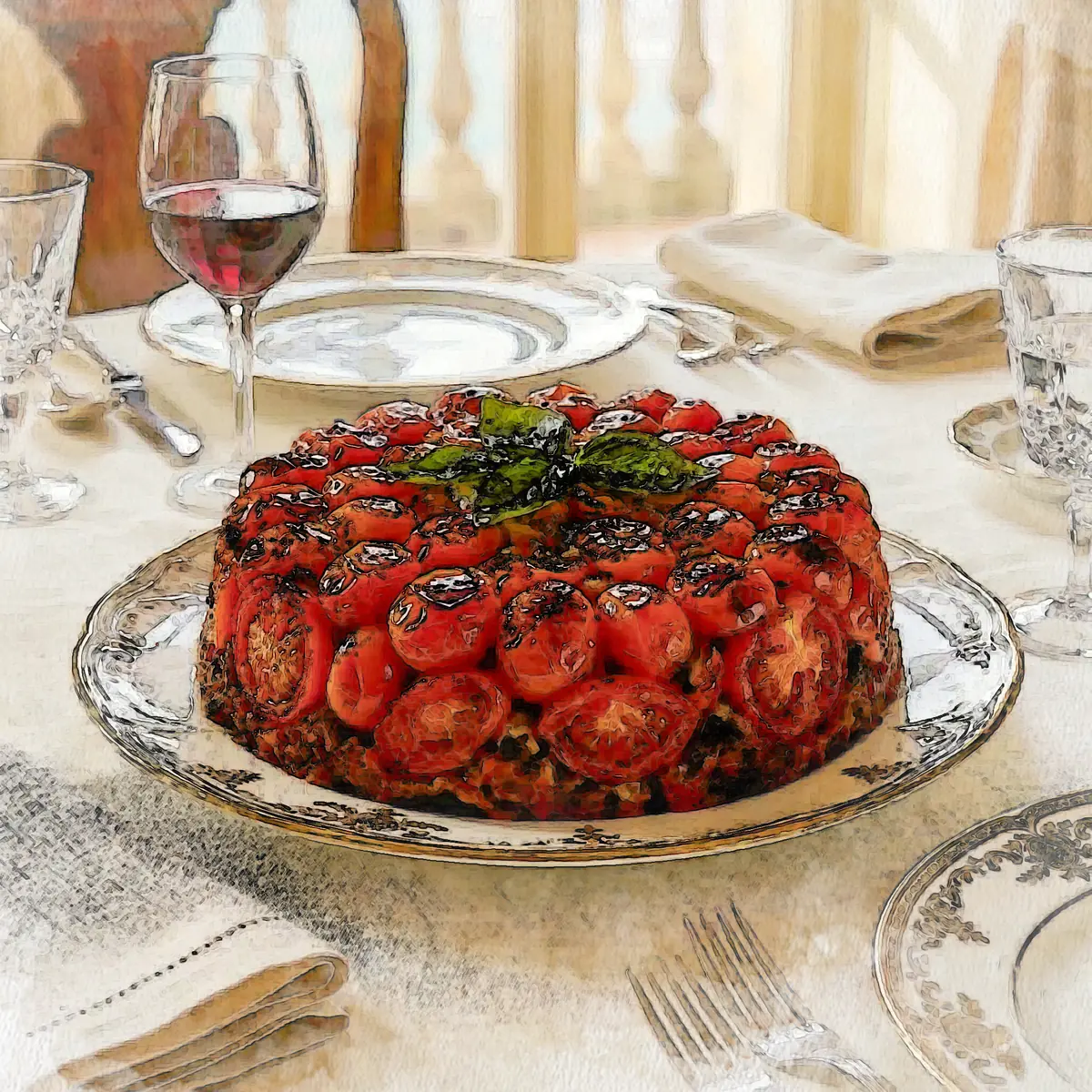
The Cardinal's Timballo
Maccheroni, tomatoes, buffalo mozzarella, aubergines, hard-boiled eggs, and Parmigiano Reggiano
A demanding pursuit
Campania
640 Kilocalories
640 Kilocalories
The Cardinal's Timballo
Maccheroni, tomatoes, buffalo mozzarella, aubergines, hard-boiled eggs, and Parmigiano Reggiano
A demanding pursuit
Campania
640 Kilocalories
640 Kilocalories
The Cardinal's Timballo
Maccheroni, tomatoes, buffalo mozzarella, aubergines, hard-boiled eggs, and Parmigiano Reggiano
A demanding pursuit
Campania
640 Kilocalories
640 Kilocalories
GENESIS
The history of the Cardinal's Timballo represents one of the most fascinating chapters in the gastronomy of the Kingdom of the Two Sicilies. Its origin is entwined with the figure of Francis II of Bourbon, the twilight sovereign to reign over Naples before the Unification of Italy. Legend whispers that, on the occasion of a gala banquet in honor of an eminent prince of the Church, the monarch implored his court chefs, the celebrated monzu00f9, to conjure a dish capable of astonishing the illustrious guest through its sheer elegance and symbolism. The monzu00f9, profoundly influenced by French culinary technique yet viscerally bound to the bounties of the Neapolitan terroir, resolved to transcend the classical concept of the timballo.
Until that epoch, timballi were customarily encased in heavy caskets of shortcrust or puff pastry, legacies of medieval traditions and Renaissance opulence. The brilliant intuition for this specific occasion was to banish the flour crust altogether, replacing it with an entirely botanical envelopment composed of fresh tomatoes. This choice was not merely aesthetic, designed to evoke the brilliant scarlet of the cardinal's robe, but also functional, rendering a dish of greater levity and fragrance, capable of exalting the freshness of summer's harvest.
In its vegetarian incarnation, the dish preserves its architectural majesty untouched to this day. The heart of the timballo is fashioned from Gragnano macaroni, bound by a concentrated tomato reduction and enriched with ingredients that mirror the opulence of Mediterranean gastronomy: buffalo mozzarella, fried aubergines, and hard-boiled eggs. The preparation demands an exquisite dexterity in handling the tomatoes, which must be gently hollowed and arranged within the mold to form a vessel both robust and seamless. This recipe stands as testament to the transition toward a more refined and modern culinary art, wherein the treasure of the kitchen garden becomes the supreme protagonist, ennobled by a presentation worthy of a royal table.
PORTIONS (FOR 4 PERSONS)
THE RECIPE
Maccheroni
Ripe vine tomatoes
Aubergines
Buffalo mozzarella
Parmigiano Reggiano
Hard-boiled eggs
Garlic
Fresh basil
Breadcrumbs
Extra virgin olive oil
Salt
Black pepper
400 gr
1.5 kg
2
250 gr
100 gr
2
1 clove
1 sprig
50 gr
to taste
to taste
to taste
CURATION
For the aubergines:
Gently wash the aubergines and carve them into small cuboids. Place them within a colander, dusted with a touch of salt, and allow them to rest for some 30 minutes to release their bitter juices. Once this vigil has passed, rinse them, dry them with utmost care, and submerge them in a generous bath of extra virgin olive oil until they achieve a glorious golden hue; then, let them drain upon absorbent paper.For the tomato vessel:
Tenderly wash the vine-ripened tomatoes, then halve them horizontally. With the aid of a small spoon, hollow each half, freeing them of seeds and their inner waters, taking care not to wound the outer flesh. Reserve this extracted nectar and pulp to compose the sauce. Lightly salt the interior of these crimson chalices and set them inverted upon a wire rack to rest for a few moments.For the seasoning:
In a spacious pan, warm a thread of extra virgin olive oil alongside a whole clove of garlic. Introduce the coarsely chopped tomato pulp, saved from the hollowing process, and allow it to simmer vigorously over an active flame for 15 minutes, perfumed with fresh basil. Season with salt and pepper. Once the sauce has reduced to a rich, concentrated essence, discard the garlic and set aside. Slice the buffalo mozzarella into small cubes and leave it to drain. Coarsely chop the hard-boiled eggs.For the pasta:
Immerse the macaroni into boiling salted water, and drain them while they still retain a firm bite (al dente). Cast the pasta into the pan with the rich tomato sauce, then fold in the golden aubergines, the drained buffalo mozzarella, the hard-boiled eggs, and the grated Parmigiano Reggiano. Stir with devotion, ensuring all elements and flavours are harmoniously entwined.For the assembly:
Anoint a timbal mould thoroughly with extra virgin olive oil, then dust its walls with a delicate veil of breadcrumbs. Arrange the hollowed tomato halves within the mould, placing them closely side-by-side to tapestry the base and sides, thereby fashioning a true edible vessel. Fill this ruby-red crown with the dressed pasta, pressing gently to compact the ensemble. Crown the crest with the remaining breadcrumbs and a final thread of extra virgin olive oil.For the baking:
Consign the timbal to a preheated static oven at 180°C for approximately 30 minutes. Once baked, extract the mould from the heat and allow it to rest in quiet contemplation for 10 minutes. Place a serving platter atop the mould and invert it with a swift, confident gesture. Serve the timbal whole, celebrating the magnificent tomato shell that encases the pasta treasure within.
aspiration
For a flawless structure, select tomatoes uniform in size, sharing the same silhouette.
You may introduce cubes of smoked provola instead of mozzarella, should you desire a more pronounced, vibrant character.
Serve the dish gently warmed; a moment of repose coaxes the timballo to find its elegant form, allowing the symphony of flavors to meld in perfect harmony.


GENESIS
The history of the Cardinal's Timballo represents one of the most fascinating chapters in the gastronomy of the Kingdom of the Two Sicilies. Its origin is entwined with the figure of Francis II of Bourbon, the twilight sovereign to reign over Naples before the Unification of Italy. Legend whispers that, on the occasion of a gala banquet in honor of an eminent prince of the Church, the monarch implored his court chefs, the celebrated monzu00f9, to conjure a dish capable of astonishing the illustrious guest through its sheer elegance and symbolism. The monzu00f9, profoundly influenced by French culinary technique yet viscerally bound to the bounties of the Neapolitan terroir, resolved to transcend the classical concept of the timballo.
Until that epoch, timballi were customarily encased in heavy caskets of shortcrust or puff pastry, legacies of medieval traditions and Renaissance opulence. The brilliant intuition for this specific occasion was to banish the flour crust altogether, replacing it with an entirely botanical envelopment composed of fresh tomatoes. This choice was not merely aesthetic, designed to evoke the brilliant scarlet of the cardinal's robe, but also functional, rendering a dish of greater levity and fragrance, capable of exalting the freshness of summer's harvest.
In its vegetarian incarnation, the dish preserves its architectural majesty untouched to this day. The heart of the timballo is fashioned from Gragnano macaroni, bound by a concentrated tomato reduction and enriched with ingredients that mirror the opulence of Mediterranean gastronomy: buffalo mozzarella, fried aubergines, and hard-boiled eggs. The preparation demands an exquisite dexterity in handling the tomatoes, which must be gently hollowed and arranged within the mold to form a vessel both robust and seamless. This recipe stands as testament to the transition toward a more refined and modern culinary art, wherein the treasure of the kitchen garden becomes the supreme protagonist, ennobled by a presentation worthy of a royal table.
PORTIONS (FOR 4 PERSONS)
THE RECIPE
Maccheroni
Ripe vine tomatoes
Aubergines
Buffalo mozzarella
Parmigiano Reggiano
Hard-boiled eggs
Garlic
Fresh basil
Breadcrumbs
Extra virgin olive oil
Salt
Black pepper
400 gr
1.5 kg
2
250 gr
100 gr
2
1 clove
1 sprig
50 gr
to taste
to taste
to taste
CURATION
For the aubergines:
Gently wash the aubergines and carve them into small cuboids. Place them within a colander, dusted with a touch of salt, and allow them to rest for some 30 minutes to release their bitter juices. Once this vigil has passed, rinse them, dry them with utmost care, and submerge them in a generous bath of extra virgin olive oil until they achieve a glorious golden hue; then, let them drain upon absorbent paper.For the tomato vessel:
Tenderly wash the vine-ripened tomatoes, then halve them horizontally. With the aid of a small spoon, hollow each half, freeing them of seeds and their inner waters, taking care not to wound the outer flesh. Reserve this extracted nectar and pulp to compose the sauce. Lightly salt the interior of these crimson chalices and set them inverted upon a wire rack to rest for a few moments.For the seasoning:
In a spacious pan, warm a thread of extra virgin olive oil alongside a whole clove of garlic. Introduce the coarsely chopped tomato pulp, saved from the hollowing process, and allow it to simmer vigorously over an active flame for 15 minutes, perfumed with fresh basil. Season with salt and pepper. Once the sauce has reduced to a rich, concentrated essence, discard the garlic and set aside. Slice the buffalo mozzarella into small cubes and leave it to drain. Coarsely chop the hard-boiled eggs.For the pasta:
Immerse the macaroni into boiling salted water, and drain them while they still retain a firm bite (al dente). Cast the pasta into the pan with the rich tomato sauce, then fold in the golden aubergines, the drained buffalo mozzarella, the hard-boiled eggs, and the grated Parmigiano Reggiano. Stir with devotion, ensuring all elements and flavours are harmoniously entwined.For the assembly:
Anoint a timbal mould thoroughly with extra virgin olive oil, then dust its walls with a delicate veil of breadcrumbs. Arrange the hollowed tomato halves within the mould, placing them closely side-by-side to tapestry the base and sides, thereby fashioning a true edible vessel. Fill this ruby-red crown with the dressed pasta, pressing gently to compact the ensemble. Crown the crest with the remaining breadcrumbs and a final thread of extra virgin olive oil.For the baking:
Consign the timbal to a preheated static oven at 180°C for approximately 30 minutes. Once baked, extract the mould from the heat and allow it to rest in quiet contemplation for 10 minutes. Place a serving platter atop the mould and invert it with a swift, confident gesture. Serve the timbal whole, celebrating the magnificent tomato shell that encases the pasta treasure within.
aspiration
For a flawless structure, select tomatoes uniform in size, sharing the same silhouette.
You may introduce cubes of smoked provola instead of mozzarella, should you desire a more pronounced, vibrant character.
Serve the dish gently warmed; a moment of repose coaxes the timballo to find its elegant form, allowing the symphony of flavors to meld in perfect harmony.
latest culinary creations
GENESIS
The history of the Cardinal's Timballo represents one of the most fascinating chapters in the gastronomy of the Kingdom of the Two Sicilies. Its origin is entwined with the figure of Francis II of Bourbon, the twilight sovereign to reign over Naples before the Unification of Italy. Legend whispers that, on the occasion of a gala banquet in honor of an eminent prince of the Church, the monarch implored his court chefs, the celebrated monzu00f9, to conjure a dish capable of astonishing the illustrious guest through its sheer elegance and symbolism. The monzu00f9, profoundly influenced by French culinary technique yet viscerally bound to the bounties of the Neapolitan terroir, resolved to transcend the classical concept of the timballo.
Until that epoch, timballi were customarily encased in heavy caskets of shortcrust or puff pastry, legacies of medieval traditions and Renaissance opulence. The brilliant intuition for this specific occasion was to banish the flour crust altogether, replacing it with an entirely botanical envelopment composed of fresh tomatoes. This choice was not merely aesthetic, designed to evoke the brilliant scarlet of the cardinal's robe, but also functional, rendering a dish of greater levity and fragrance, capable of exalting the freshness of summer's harvest.
In its vegetarian incarnation, the dish preserves its architectural majesty untouched to this day. The heart of the timballo is fashioned from Gragnano macaroni, bound by a concentrated tomato reduction and enriched with ingredients that mirror the opulence of Mediterranean gastronomy: buffalo mozzarella, fried aubergines, and hard-boiled eggs. The preparation demands an exquisite dexterity in handling the tomatoes, which must be gently hollowed and arranged within the mold to form a vessel both robust and seamless. This recipe stands as testament to the transition toward a more refined and modern culinary art, wherein the treasure of the kitchen garden becomes the supreme protagonist, ennobled by a presentation worthy of a royal table.
PORTIONS (FOR 4 PERSONS)
THE RECIPE
Maccheroni
Ripe vine tomatoes
Aubergines
Buffalo mozzarella
Parmigiano Reggiano
Hard-boiled eggs
Garlic
Fresh basil
Breadcrumbs
Extra virgin olive oil
Salt
Black pepper
400 gr
1.5 kg
2
250 gr
100 gr
2
1 clove
1 sprig
50 gr
to taste
to taste
to taste
CURATION
For the aubergines:
Gently wash the aubergines and carve them into small cuboids. Place them within a colander, dusted with a touch of salt, and allow them to rest for some 30 minutes to release their bitter juices. Once this vigil has passed, rinse them, dry them with utmost care, and submerge them in a generous bath of extra virgin olive oil until they achieve a glorious golden hue; then, let them drain upon absorbent paper.For the tomato vessel:
Tenderly wash the vine-ripened tomatoes, then halve them horizontally. With the aid of a small spoon, hollow each half, freeing them of seeds and their inner waters, taking care not to wound the outer flesh. Reserve this extracted nectar and pulp to compose the sauce. Lightly salt the interior of these crimson chalices and set them inverted upon a wire rack to rest for a few moments.For the seasoning:
In a spacious pan, warm a thread of extra virgin olive oil alongside a whole clove of garlic. Introduce the coarsely chopped tomato pulp, saved from the hollowing process, and allow it to simmer vigorously over an active flame for 15 minutes, perfumed with fresh basil. Season with salt and pepper. Once the sauce has reduced to a rich, concentrated essence, discard the garlic and set aside. Slice the buffalo mozzarella into small cubes and leave it to drain. Coarsely chop the hard-boiled eggs.For the pasta:
Immerse the macaroni into boiling salted water, and drain them while they still retain a firm bite (al dente). Cast the pasta into the pan with the rich tomato sauce, then fold in the golden aubergines, the drained buffalo mozzarella, the hard-boiled eggs, and the grated Parmigiano Reggiano. Stir with devotion, ensuring all elements and flavours are harmoniously entwined.For the assembly:
Anoint a timbal mould thoroughly with extra virgin olive oil, then dust its walls with a delicate veil of breadcrumbs. Arrange the hollowed tomato halves within the mould, placing them closely side-by-side to tapestry the base and sides, thereby fashioning a true edible vessel. Fill this ruby-red crown with the dressed pasta, pressing gently to compact the ensemble. Crown the crest with the remaining breadcrumbs and a final thread of extra virgin olive oil.For the baking:
Consign the timbal to a preheated static oven at 180°C for approximately 30 minutes. Once baked, extract the mould from the heat and allow it to rest in quiet contemplation for 10 minutes. Place a serving platter atop the mould and invert it with a swift, confident gesture. Serve the timbal whole, celebrating the magnificent tomato shell that encases the pasta treasure within.
aspiration
For a flawless structure, select tomatoes uniform in size, sharing the same silhouette.
You may introduce cubes of smoked provola instead of mozzarella, should you desire a more pronounced, vibrant character.
Serve the dish gently warmed; a moment of repose coaxes the timballo to find its elegant form, allowing the symphony of flavors to meld in perfect harmony.